
I
Pointing is a nonverbal gesture. Often, the index finger is used. Like an archer aiming an arrow at a target, the index finger aims at something. This gesture is meant to direct another person’s attention, to move their gaze so that they focus on the object indicated by the finger.
It is also possible to point with words: “this,” “there,” “here,” “now,” “you,” and “I” are all terms that point. “I,” “here,” and “now” are especially interesting, as they are indexical terms that refer to the person, place, and time of their use. If someone asks, “Who wants another dessert?” I can say “I,” and thereby point to myself, whatever that might mean. And if someone asks, “Where did my dessert go?” I might say “here” and point to my belly.
Texts in which one often finds the “I” are novels written in the first-person perspective, such as Günter Grass’s The Tin Drum, told by its hero Oskar Matzerath; autobiographies, like Goethe’s Poetry and Truth; confessions, such as those by Augustine or Rousseau; and diaries, like those of Ludwig Wittgenstein and Simone Weil. The boundaries between these genres are fluid. Autobiographies and confessions are written, like novels, for readers other than the writer and may contain some or many fictional elements. Most diaries are not fiction and are not intended for the public. Confessions are originally probably a legal genre. The term conscientia refers, according to Cicero, to an inner forum, that is the highest authority in judging about virtues and vices and stands above publicity.[1] We can relate conscientia in this context also to what is now called “guilty conscience”. A prosecutor might read out his accusations, and the defendant turns pale—he shows conscientia. After that, he might confess, show penitence, and thereby change the judge’s mind so that he is seen not just as a villain but as someone capable of shame and regret. Thus, a confession is directed against a possible accuser and judge. From the legal realm, this idea moved perhaps into religion (or was it the other way round?), where God is thought of as an almighty judge.
These complications are not unimportant to our topic, since the self is sometimes described as an inner tribunal. The accusing and praising voices of our parents may be internalized and continue “within us,” producing an inner polylogue. The metaphorical inner theater and the drama of accusation, confession, praise, and regret played out on its stage can be seen as what we call “the self”, if we follow philosophers like David Hume and George Herbert Mead.
II
Diaries are private chronological records of the diarist’s daily activities, thoughts, feelings, and reflections—perhaps also of regrets, accusations, and confessions made to oneself—a written manifestation of the play that goes on in the inner theater, perhaps constantly and sometimes observed by the author.
Writing for a public audience about oneself means projecting an image of oneself onto others, trying to get them to accept a certain narrative. This could mean that one is not perfectly honest. Neither the image one has of oneself nor the one projected to the public may be true. But projecting an image different from the one you have of yourself means you are not being truthful. Truth and truthfulness are two different things, as Bernard Williams has shown, following Nietzsche (Bernard Williams, Truth and Truthfulness. An Essay in Genealogy, Princeton 2002). We might not be able to reach truth, but we can try to be truthful.
It seems that we expect writers of private diaries to be truthful, or even that a diary is an instrument for truthfulness. That truthfulness is not realized in public writing does not have to be a cause for moral criticism. One does not necessarily want the public to know everything about oneself and may have good reasons for that. Perhaps one wants to protect other people who might still be alive when the diaries are published. But if one writes a diary just for oneself, it is different. We seem to expect that people want to be truthful to themselves, whatever that might mean. We might even expect that private truthfulness has a therapeutic effect for the diary writer: She might become able to face facts she could not face before she opened her diary and tried to write them down. But if you look more closely, writing a diary only for oneself seems a very strange endeavor. Who exactly is one writing to? And why should one write to oneself? Anne Frank wrote “Dear diary” at the start of each entry in her book, as if addressing another person.
III
Writing a private diary seems to be a reflexive act. This is easier said than understood, because all reflexive acts are epistemically risky. Reflexivity is connected to the dangers of paradox and infinity. Think about the liar paradox: “All Cretans are liars,” says the Cretan. Or about Russell’s paradox: the barber who shaves all those who do not shave themselves. Both paradoxes result from reflexivity. Russell’s attempt to avoid them by a theory of types is as unsatisfactory as Wittgenstein’s remark to Turing that these paradoxes are just silly games. Wittgenstein underestimated reflexivity and rarely tackled its pitfalls, although his distinction between saying and pointing might be more helpful in dealing with them than Russell’s approach. Russell tried to argue the paradoxes of reflexivity away by distinguishing different levels of saying: object and meta-levels. Wittgenstein tried to ignore them.
What kind of reflexivity occurs when you write a diary? You or your self are not objects that can be studied like a stone, a vase, or a dead rabbit. Nor are you moving to a meta-level by considering what it means to study yourself. Supposedly, you are really studying yourself—or more exactly, what happened to you. You are listening to and watching the inner theater that is performed, and you write down your observations of these performances. So, are you really writing to or about yourself when you write a diary?
When you write your experiences down, it seems that you must have already known these experiences before writing them. If you did not already knew them in the way you know them when you write them down, then you are not writing about or to yourself. If writing your experiences down changes you, then they are not your experiences anymore after you have written them, but the experiences of your past self—if there is such a thing as a past self (which I doubt)? Whoever writes a diary probably has the experience of meeting the person they once were when reading entries from some time ago.
To know your own experiences, especially to know them verbally so that you can write them down, means to interpret them through the words you choose to fix them on paper. If an interpreted experience is something other than the not-yet-interpreted experience, and if you are, as a mental being, your stream of experiences, memories, thoughts, wishes, and so on, then you change yourself by interpreting your experiences. Writing a diary would then be a transformative practice.
Human minds are constantly transformed anyway—by new ideas, by memories popping up and disappearing. But they could also be transformed by reflexive acts like willfully remembering, meditating, or writing a diary, which might be a mixture of both activities: remembering and interpretative meditation. This activity of self-transformation is paradoxical because it is unclear who is doing it and who is being transformed. Who is watching your memories? Who is interpreting them? Is the past self transforming itself into a future self, or is a present self transforming a past self into a future self?
On the one hand, this process seems banal, like washing yourself. On the other hand, it is not banal, since washing yourself brings your body back to an old state—the state of cleanliness before you became dirty. Interpreting your experiences does not return you to any original state but brings about a new understanding of yourself and thus a new self or a new state in the fleeting mental process we call our self.
These observations may seem abstract, but they are very relevant for Simone Weil’s diaries, to which I will turn now, because one important topic of her diaries is the self or the soul, or the Ego, as she writes, and the necessity of its disappearance. Isn’t it strange, that somebody who wants the self or the Ego to disappear writes a diary?
IV
Simone Weil wrote diaries that were not intended for publication. Precisely for this reason, they are especially valuable—not only because they are considered truthful. Weil is a very original philosopher because she closely relates all of her thinking to her life experiences, which are described in her diaries. Contemporary academic philosophy of many different schools, analytical, phenomenological, but also of critical theory, often suffers from a lack of lived experience.
Unlike experimental sciences, philosophy is not conducted in a laboratory where new experiences are produced. Most academic philosophers shy away from connecting their thinking to their lives, as their lives are often bureaucratic, spent reading and writing in university offices. This was not the case with Simone Weil. She worked as a political activist, a school teacher, a factory worker, a member of the resistance, who wanted to fight and serve as a nurse, a religious enthusiast, who observed her ecstatic religious experiences, and she suffered severely from migraines, making this and all her other sufferings an object of philosophical reflection. Often, in her letters and diaries, she like to quote Aschylos: “to pathei mathos” – “knowledge comes through suffering” (Cf. Robert Zaretsky, The Subversive Simone Weil. A Life in Five Ideas, Chicago 2021, 7).
Her life-experiences and their interpretation in her diaries are very relvant in two ways: politically and in their relation to religion, because Weil expierences a conflict between her political and her mystical religious experiences. In both Eastern and Western philosophical and non-philosophical literature, one can find many reports and reflections on mystical experiences and transformations. Two important more recent sources in the West are William James’s Varieties of Religious Experience from 1902 and Robert Musil’s The Man Without Qualities from 1930. Texts about mystical transformations written for the public are not unproblematic. The realm of religious development is not immune to the all-too-human drive for fame and superiority. In competitive societies, people want to excel and be recognized as special or “higher” than others. Just as there is intellectual careerism, where people are more interested in themselves and their position in an intellectual hierarchy than in the truth, so there is also spiritual careerism. Texts about ecstatic religious experiences written for publication are therefore always under suspicion. Since Weil did not write for a public audience, her texts are immune from this suspicion.
V
In some of her diaries, such as her factory diary from 1934–35 (published in 1951), Weil uses “I” quite frequently. This does not seem different from her letters. In her famous Cahiers, however, she rarely uses “I.” She writes about the “I” or “the Ego”, but rarely about herself. Yet the Cahiers are not entirely different from her other unpublished writings; in fact, they seem to interpret her personal experiences on a more abstract level, so that we can see levels of reflexivity between her more personal notes and the Cahiers. Perhaps these levels of reflexivity are connected to levels of paradoxes, since Weil interprets her personal experiences againt a philosophical and mystical background, which suggests, that the I, the Ego should disappear.
In the following I want firstly to consider her experiences as a factory worker, the political views connected with them, and secondly her mystical theology and philosophy as manifested in the Cahiers. I want to relate these two diaries because they point in different directions regarding the self, which seem to contradict each other.
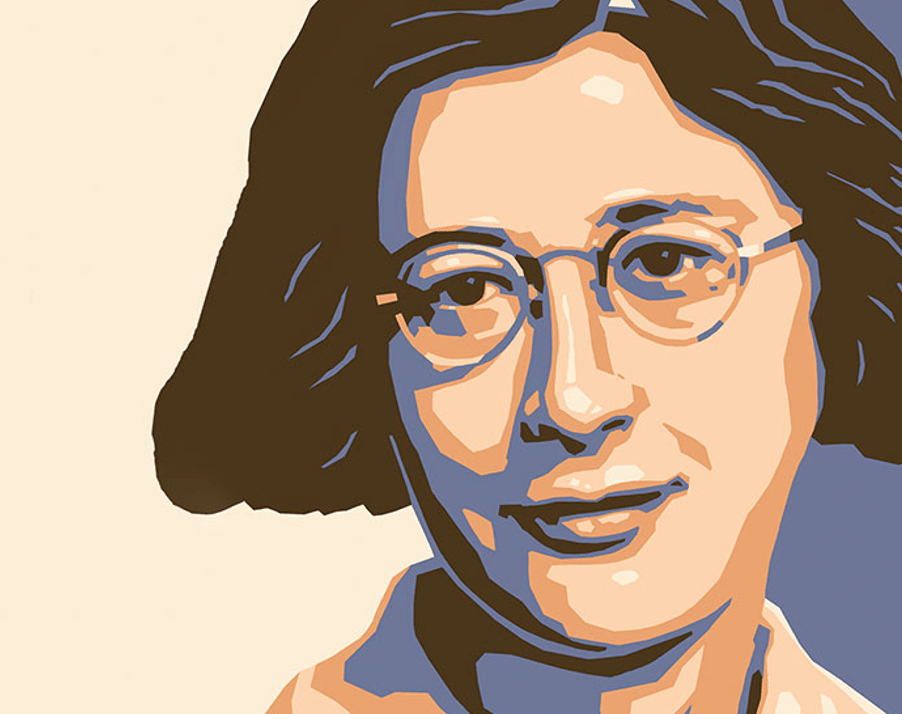
The factory diary points to the degradation of the worker’s self—the anxiety and slavery workers endure, unable to control their own time, suffering exhaustion that deprives them of the chance to reflect on their situation and articulate their problems independently of party jargon. Weil accuses those who claim to be active on behalf of workers of not making an effort to share their experiences:
“…when I think that the great Bolshevik leaders proposed to create a free working class and that doubtless none of them—certainly not Trotsky, and I don’t think Lenin either—had ever set foot inside a factory, so that they hadn’t the faintest idea of the real conditions which make servitude or freedom for the workers—well, politics appears to me a sinister farce.”
(Weil, Seventy Letters, Oxford 1965, p. 15)
The way Weil writes about her factory experience points to a threatened self, one humiliated and unfree under the conditions of assembly-line work in a large factory. I believe these interpretations are correct in a sense, but they do not go far enough, because Weil as a mystic, did not believe in the reality of the self. I believe that, because of this background, she did not believe in a political solution for the dire situation of factory workers. She writes about this possibility, and especially about Marxism, as follows:
“Humanity has always placed in God its hopes of quenching its thirst for justice. Once God no longer inhabited men’s souls, that hope had either to be discarded or to be placed in matter. Man cannot bear to be alone in willing the good. He needs an all-powerful ally. If this ally is not spirit, it will be matter. It is simply a case of two different expressions of the same fundamental thought. But the second expression is defective. It is a badly constructed religion. There is, therefore, nothing surprising in the fact that Marxism has always possessed a religious character. It has a great many things in common with the forms of religious life bitterly attacked by Marx … as the opium of the people. But it is a religion devoid of mystique…”
(Weil, Oppression and Liberty, London 2001, 154)
A revolution will not help workers in her eyes, because in a revlutionary fight they will be used by the powerfull just as much as in the factory. Opression does not stop by revolutions, she believes:
„The word ‘revolution’ is a word for which you kill, for which you die, for which you send the laboring masses to their death, but which does not possess any content.“ (Oppression and Liberty, 35)
VI
Her mysticism, which is at its core a Christian one—though she also studied and commented on Vedanta and Zen mysticism—is characterized by practices that attempt to dissolve the illusion of a substantial self as the center of suffering. Its ultimate goal is to end the identification of oneself with one’s own body. The central claim in this context is that:
“The whole universe should become my body.”
“Tout l’univers devrait devenir mon corps.”
(Œuvres complètes VI. Cahiers, Paris, 1994, 345)
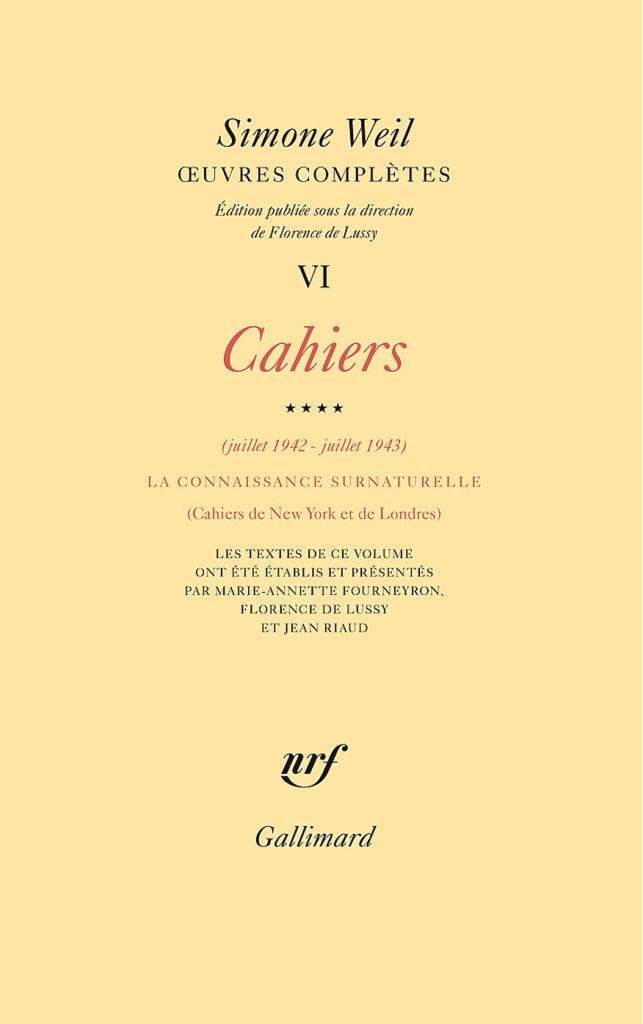
The attempt of the mystical practices is to go beyond the borders of one’s own body by the observation of severe suffering as a means to free subjectivity, or the soul, from its limitations. Working with your body in this way is described by Weil as using the body as a lever:
“The body is a lever for salvation.” (Œuvres complètes VI, 234)
“The body is a lever with which the soul acts upon the soul. Through the discipline imposed on the body, the wandering energy of the soul exhausts itself. … finally it is exhausted and lies down. … the wandering part of the soul, when the body is pinned down … it stirs … finally it exhausts itself and disappears.”(Œuvres complètes VI, 264)
If this work is successful, the personal “I” disappears, perception becomes impersonal, and perceptions are no longer disturbed by the survival interests of the very body with which the self was identified. Everything becomes beautiful; all threats relative to the evaluations of the body disappear:
“I have to disappear, so that the things which I see become perfectly beautiful, because they are not things anymore. The whole universe should become my body.” (Œuvres complètes VI, 345)
“God created me as a non-being that appears to be … The I is nothing. But I have no right to know that.” (Œuvres complètes VI, 124.)
“Our disappearing I has to become a hole, through which God and creation can look at each other.” (Œuvres complètes VI, 316)
Even hopelessness can be a lever for the mystic, Weil thought it takes one away from wanting, from being directed onto the future, so that we can see the beauty of what is present.
VII
Factory workers are not engaged in mystical practices during their work. Their self is not sacrificed for an insight into God or the absolute. Theoretically, they could take their work as a mystical practice, but in reality, their self is suppressed and damaged for profit. Their bdoies and minds have become means to serve machines. (One could also say of academics that their minds have become means, in some cases, to serve careers.) Workers do not seek to transcend the limits of their bodies in order to experience ecstatic religious states, but they may be forced to work beyond their bodily limits due to the demands of the assembly line.
The same could be said of a migraine sufferer like Weil. Such a person could, in theory, use her pains as a means of transcending her body. However, if she has no religious interests, she will just take morphine. Simone Weil, who suffered a migraine attack during a Catholic service, in fact used her pain at this event, as she reports, in the same way as a Buddhist monk uses his pains during long meditation. She tried to see her body ‘from the outside’. However, no doctor would advise a migraine patient to do so. And no political activist would advise a suffering worker to do this.
The same could be said of the strict timetables and isolation in prisons and Christian or Buddhist monasteries. In both cases, people in these institutions may be deprived of the freedom to manage their time or communicate as they wish. However, in a monastery, where people voluntarily follow a strict routine, this means something different to a prison. A person’s social and physical identity can be broken by work or torture in order to dominate them. This can happen in prison, in a military training camp or in a factory. Alternatively, a person may try to break her own social and physcial identity because she considers this identity an illusion that is bad. The social and physical identity is considered by mystics as a kind of prison or a machine that forces constant evaluations of everything and everyone, leading to fear, hatred and arrogance and ultimately suffering, but not to joy and beauty.
Thus, the different practices that break the social and physical self are tools for different aims, like the knife of a mugger is different from that of a surgeon. The mugger tries to threaten you with his weapon; the surgeon tries to heal you. However, both might attack your body.
Scientific research from both neuroscience and social science suggests that the self is a construct, an invention tightly connected to bodily functions and expierences that are mainly related to self-preservation. However, there seems to be no individual self beyond these processes that wants to preserve itself. As far as we know, our mental history is not centred around a spiritual substance. This seems to be a Cartesian myth. In this sense, modern scientific insights and mystical experiences of selflessness converge. This does not mean that suffering caused in personal relationships, working conditions or correctional facilities is justified in any way. One could argue that suffering should be avoided unless it is used by organisms in a reflective way as a means to an end.
However, here a paradox arises: What is this reflexivity that tries to transcend the body and break social identity? Can this reflexivity be thought about in a way that is different to the approaches of Descartes and Kant, who believed in a free-thinking substance (Descartes) or an individual autonomous person who can initiate chains of causality from nothing (Kant)? Simone Weil demonstrates this reflexivity in her diaries when she reflects on her suffering, points to her body states in the factory and in her migraine attacks and interprets these states as a means of overcoming the limitations imposed on her by certain social and historical conditions. Her diaries demonstrate that such reflexivity is possible. However, they do not explain what this reflexivity is, if it is not a capacity of the socially constructed Ego, of a particzular person. Perhaps Weil thinks it is not possible to say what this reflexivity is, since our talk is always objectifying. When she says, “The I is nothing. But I have no right to know that’, one could perhaps add the following statement: ‘Reflexivity is not a thing, does not belong to a thing or individual, but it is not nothing, perhaps its everything. But as finite beings, we have no way of knowing that.’ But perhaps we can experience this reflexivity.
[1] Cicero, Tusculan Disputations II, 64. Translation King, Cambridge/Mass, 1927, 218 / 219.

 Handling Ideas