Cognitive offloading: Let’s not miss the tipping point

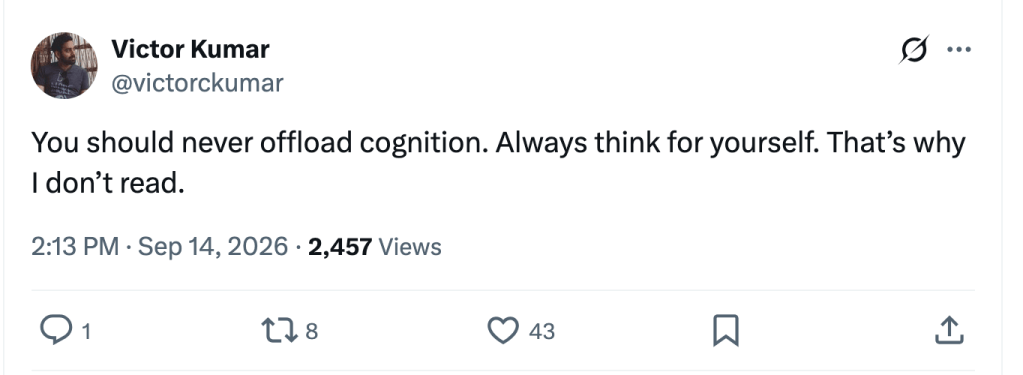
Yesterday, I came across the following tweet:

Admittedly, I was slightly fuming at first, but then I realised that Victor Kumar makes a really neat point. Tying reading and cognitive offloading together in this way, he brings out (and debunks, at least implicitly) two misconceptions at once: (1) Cognitive offloading is often unduly restricted to the use of AI devices and then simply contrasted with analog skills like reading or writing. (2) At least in philosophy, reading is often unduly restricted to the passive intake of someone else’s thought and then simply contrasted with thinking for oneself. Schopenhauer famously put this as follows: “When we read, someone else is thinking for us: we merely repeat his mental process …” (More on this here.)

Neat as this point may be, there is a worry about deskilling I’d like to address in the following. People often debunk arguments about deskilling through AI use in similar ways by pointing out that we seem to have handled cognitive offloading through various means quite well in the past, suggesting that AI, and especially LLMs, might just turn out to be the next form of refined tool use, allowing us to offload torturous tasks to the LLM, while using the freed time and capacity for higher cognitive endeavours.

What this kind of argument seems to miss is a tipping point at which cognitive offloading, despite our best intentions, might well turn into deskilling. Compare cooking: Of course, there was a time during which we learned to prepare food in such a way that we prevented poisoning ourselves in the process. Gradually becoming shared knowledge, this skill became widespread and implemented thanks to a lot of offloading and division of labour. Certainly, this process can be seen as a great improvement. But now we’ve reached a level of offloading in food production where we increasingly allow for outright self-harm by stuffing ourselves with fast food and make do with industrial cruelty to non-human animals, resulting in harm and diseases on an evergrowing scale.

Returning to AI use, then, we shouldn’t miss the tipping point at which cognitive offloading might turn into all kinds of self-harm.

Why much academic writing isn’t thinking. A response to Lavinia Marin

Especially since the arrival of LLMs, there are quite a few pieces that claim “writing is thinking” or portray writing as thinking in a certain way (even Nature featured a piece on it). The idea is that you don’t just jot down what you thought out beforehand. Rather, the writing and rewriting process often produces thoughts that have not been anticipated by the writer. This is crucial in processes of learning, knowledge-production, artistic endeavours, or therapeutic ambitions. Although I don’t seem to have put it quite that way, I am myself a vocal advocate of that claim. In what follows, I don’t want to revoke my earlier claims. But still: I want to convince you that it’s even worthwhile to entertain the idea that much writing isn’t thinking in this sense, and that that might just be fine.

My idea goes back to recent exchanges with my colleagues Lavinia Marin and Timm Lampert. Lavinia pointed out to me that writing papers in the so-called hard and even some social sciences has no epistemic function. Papers get written to communicate work set-ups and results at conferences, to publish and to get funding. Today, Lavinia detailed this and a number of further points in an intriguing blog post (which I advise you to read as a whole). About writing in these sciences, she says the following: “Writing is just this process where you sit down and add up words. The hardest part is sitting down. … The way many academics treat writing today is that writing is not supposed to produce any new knowledge, insights or thinking. Writing is the wrapping of your results. This is at least for large parts of science, so alpha sciences, beta sciences, all that empirical stuff. “Apply ass to chair”, as Austin K Leon likes to say.” Timm took up this idea and suggested that much applied work based on logic, mathematics, and indeed programming with the aid of LLMs might fit this account.

This is of course somewhat anectdotal, but if this picture isn’t entirely off the mark, it does reveal some insights, not least in explaining why the academic responses to Large Language Models are such a mixed bag. The philosopher in me immediately wants to raise his voice and declare how much gets lost in this view on writing. Yet the historian in me cautions me to wait and listen. What does this mean? Here is a hunch: It doesn’t mean that people in the sciences don’t care about thinking. It just might mean that the real (epistemic) action is elsewhere. Not that long ago I stumbled across some intriguing work by Dana Jalobeanu on enacting experiments and recipes, inspiring me to rethink assumptions about early modern texts. As Dana points out in a paper on Della Porta and Bacon, experiments and recipes are records of what has been tried out in a laboratory or kitchen. The actual epistemic work is not in crafting the written text (which might sometimes just be a list of items and acts), but in all the work that precedes the writing and the work or reenactment inspired in the recipient who might try and replicate the promised results, with all the twisting and turning and trying and failing and trying again slightly differently. Once you see this, it becomes clear that the status and expectations from writing in certain sciences are vastly different from the status of writing in the humanities. In the former, much writing seems a much more social and epistemic action oriented endeavour where texts are just intermediearies and starting points for the actual work. In fact, once you see this, it becomes clear that even philosophical classics like the Descartes’ Meditations or Locke’s Essay heavily rely on the collaboration of the readers.

As I see it, this is quite a positive view of non-epistemic writing. And if writing works really like that in a number of domains, then there do seem to be good reasons to outsource such tedious exercises to LLMs. Recognising this rather strong difference between writing in the humanities and a number of sciences is really helpful to understand the different reactions to the advent of a lot of AI developments. Even if many colleagues in the humanities are not entirely skeptical about the merits of LLMs, they are worried about outsourcing too much and giving way to pernicious deskilling. Rightly so, because writing in the humanities really is different.

However, the process of introducing non-epistemic writing practices into the humanities has not begun with LLMs. It began much earlier. As most of us know all too well, there is the endless repetition of talk of the “crisis of humanties” – to which many administrators (it’s always the administrators!) responded, at least since the New Public Management developments in the 80s, by introducing success measures from the sciences into the humanities. Before we knew it, we began to write papers instead of books, grant applications, performance reviews, explained the value of potential applications of our work to various stakeholders and the average taxpayer. While there is nothing wrong with accountability per se, many complained – rightly I think – that the humanities’ competition with the hard and many social sciences is a game we can’t win. As I see it, this development lead to forms of formulaic writing in the humanities that tip the balance in favour of the (in some respects non-epistemic) paper model which I think is pernicious for many endeavours in our field (and should be countered by the reintroduction of the genre of commentary, as I argued earlier). So I think that many worries about recent technological developments are not inspired by LLMs per se, but by the way in which they accelerate an aleady problematic development in the humanities.

What’s more, the message that writing as such can be shortened and largely outsourced is not lost on students who are often already too busy. I am old enough to have grown up in a world where I learned writing by hand and the first thing I typed on a computer was my MA thesis, the authoritative book-like page on the screen making me feel at once proud and like an impostor whose scribblings were seemingly unduly dignified by the miraculous word-processor. But I keep wondering what it’s like for people who have never made this transition and are born into a world where pens and paper are part of a posh hobby like collecting vinyl records perhaps.

I’m not sure how big of a difference this makes. But what I’m reminded of is that we all (still) write, even if we happen to write non-epistemically and outsource like hell, in an environment in which those who are happy enough to have learned the art of reading and writing at school. This social environment with all its implicit forms of collective knowledge matters greatly. For the forms of writing we (used to?) learn – all the different genres of reports, discussions, commentaries, tables, proofs, translations, essays etc., all that jazz – is epistemic writing in that it trained us to think and imagine. Being trained this way, we can also enjoy the luxury of writing non-epistemically now and then, for instance when the action of thinking is happening elsewhere.

Most of all, we shouldn’t forget that meandering and serendipitous research processes inside and outside of the actual writing are a deeply human thing. Seen this way, there is no point in outsourcing, because writing and thinking – just like many other beautiful things that take time and practice to learn – are not there for the purpose of piling up huge quantities of ever more texts or lines in an academic CV. They have, as the saying goes, intrinsic value. As Lavinia highlights in her blog post, it doesn’t just happen in academic contexts but – now perhaps most of all – in our (popular) culture more widely understood:

“Much of the knowledge propagated in the popular culture is exactly from nerds and fans who have no profit mindset, but simply enjoy the sheer act of research. (I am inspired here by Celine Nguyen’s amazing essay). Research is a wonderful experience, just as painting, singing, staging a drama in your backyard, singing in a garage band, sculpting or knitting. It’s a particular form of leading a creative life, which I think we were all meant to lead. Any artistic practice is highly enjoyable in itself and helps us endure this life on earth. And we just need to recognise that reading and writing are such practices that make us more human and happier to be alive. And hence, the benefit, if you must use these economic terms, is simply experiential. Writing by hand, reading slowly are acts of sheer experiential enchantment. Ways of living our intellectual lives. If we insist on becoming more efficient about these practices, we will be refusing to future generations the access to these practices; we may be cutting them off from very human experiences that we shouldn’t hoard for ourselves.”

Lesekompetenz als schwindende Situiertheit? (Video)

Hier findet sich das Video meines gleichnamigen Vortrags vom 25. Juni 2026 im Rahmen des Hagener forum philosophicum sowie als Keynote des Workshops Phänomenologie der Situation & Situierte Lektüren:

Abstract: Lesekompetenz als schwindende Situiertheit?

(Here is an English version of the talk.)

Ausgangspunkt ist die These, dass Lesekompetenz nicht lediglich eine Kulturtechnik, sondern eine historisch kontingente Form der Situiertheit ist, die bestimmte Praktiken des Denkens, Verstehens und Imaginierens überhaupt erst ermöglicht. Ausgehend von einem sozial-pragmatischen Verständnis des Lesens wird argumentiert, dass die Bedeutung von Texten nicht im Text selbst oder im lesenden Individuum liegt, sondern in den sozialen Interaktionen zwischen Leser*innen. Lesekompetenz erscheint dabei als historisch erworbene Voraussetzung für den distanzierten Umgang mit Schrift.

Anhand der Entwicklung von der mittelalterlichen Buchkultur zur scholastischen Universität wird gezeigt, wie sich Texte zu epistemischen Instrumenten abstrahieren konnten. Erst die zunehmende Beherrschung schriftsprachlicher Strukturen ermöglichte eine Loslösung des Textes von seinem materiellen Träger sowie neue Formen systematischen und reflexiven Denkens.

In einem zweiten Schritt werden Auswirkungen digitaler Medien auf diese Form der Lesekompetenz untersucht. Während die Buchkultur durch Distanz, Abstraktion und eine relative Entkopplung von unmittelbaren Handlungskontexten gekennzeichnet ist, binden soziale Medien schriftliche Kommunikation erneut eng an affektive Relevanzmarker, soziale Bewertungen und unmittelbare Anschlusshandlungen. Online-Kommunikation folgt damit zunehmend der Pragmatik gesprochener Sprache („fingered speech“).

Der Vortrag schließt mit der Überlegung, dass die für Buch- und Wissenskultur zentrale Fähigkeit epistemischer Distanznahme keine selbstverständliche anthropologische Konstante, sondern eine historisch fragile Errungenschaft ist. Sollte sich die soziale Funktion schriftlicher Texte grundlegend verändern, könnte auch die daran gebundene Form der Lesekompetenz und damit eine wesentliche Bedingung wissenschaftlicher und imaginativer Praxis allmählich verloren gehen.

Stupid readers? The significance of cooperation in online communication

My daughter Hannah began to indulge in irony probably around the age of six or seven. Depending on the context, she could be quite frustrated or even fearful when she didn’t get it. When she finally would get it, it was often with great relief. Now, at the age of nine, she still sometimes asks, “you meant that ironically, didn’t you?” What’s so upsetting about it? Part of it is that, when she doesn’t get it, the world or I am being unpredictable to her. If she does get it, we’re in sync again. Being “in sync” doesn’t just mean that we share a harmonious mood; it means that we established a cooperative sign use. I produce the sign “I’m actually a famous rock star disguised as your father”; she interprets the sign. But if she doesn’t immediately get the non-literal sense in which the sign can be used, it can be confusing, at least for a moment. The example is light-hearted, but I’m sure you can imagine grimmer versions that are disruptive to the point of triggering feelings of existential threat. – Now, did you notice how I just placed the (cognitive) responsibility on my daughter?

I said, “she didn’t get it”. Instead, I could have said, “I didn’t produce the right kind of sign.” But this move is so common that it’s hard to notice. We assume that “irony” and other figures of speech are well established conventions. Assuming that there are stable linguistic conventions and assuming that speakers and writers used them aptly, we tend to place the burden on the listener or reader, rarely on the producer. This is particularly obvious in online communication. Writing blog posts, for instance, I often wonder why people don’t read what I wrote but rather seem to single out a side issue and run with it. Of course, I’m joking now, readers of my blog are the most competent ones. But what’s going on here anyway?

The ableism involved in charges against (online) readers doesn’t help, but it’s not the issue I want to tackle now. Nor is the point to place the burden on the writer instead. The point is that linguistic conventions don’t just exist ready to use. When I say that someone “didn’t get it” or someone “didn’t express it clearly”, I’m supposing that it is a stable convention that I can hit or miss just like I can sing in or out of tune. But isn’t that the case? Well, it is and it isn’t. Linguistic conventions, I assume with a little help of Ruth Millikan, are stabilized for a reason. They serve certain purposes for the producers and the consumers of signs. (Consumers and producers should not be seen as humans or whole organisms but as cooperative systems, but that’s by the by now.) It’s the purpose or function that keeps the convention alive. If the proximate purpose of a remark is social alignment through irony, then it’s not enough for both parties to “hit” or “get” the convention of irony as such. Rather, the purposes of social alignment have to be connected to the use of irony for both parties, too. Why? Because the purpose of social alignment is what stabilises the convention. “Getting” the convention cannot be separated from participating in the function that that keeps the convention in existence. It’s not enough then to share knowledge of linguistic conventions; we (or our cognitive systems) have to participate in a certain set of common purposes. Such participation has to be established.

Why is that so difficult in online contexts? For Hannah and me, the purposes of social alignment can be established through various ways and sign uses. If one communicative attempt fails, there are thousands of other attempts that make up for it. Generally, in familiar local contexts, conventions are commonly established in relation to joint purposes that, in turn, will stabilize even most idiosyncratic conventions or codes. We form a community, both in the sense of linguistic conventions and the purposes that stabilize the conventions. Given then that we’d interpret and produce certain linguistic items in keeping with joint purposes, we might call this community an interpretive community. By contrast, in online contexts, we often have random or very reduced encounters. Here, it’s not a given whether we share in common purposes. An ironic remark might aim at social alignment, but it might also aim at detachment. While we might recognize familiar linguistic conventions, we cannot be sure that they are used in keeping with the same functions. Someone might write an ironic remark, but for the readers randomly hitting on that remark online the irony might not be related to social alignment. In such situations, we’re at odds. But we’re at odds without noticing it, because what’s in front of us, the written ironic text, doesn’t reveal the mismatch of purposes. (There are many purposes, even purposes driving our own actions, that we are not aware of.) Neither the writers nor the readers are stupid. But they’re out of sync. They do not form an interpretive community.

In fact, online contexts are not only often populated by people out of sync. The playful recontextualization of conventions and memes lends itself not just to jokes and shitposting. It also undermines and destabilizes the cooperation required for forming interpretive communities. If the reassurance available to us in offline local contexts is entirely missing, we are often kept in limbo, yielding frustrated attempts of cooperation in sign use.   

Vulnerability and lacking literacy in (academic) online communication

Many people who interact on so-called social media express confusion about the behaviour of their interlocutors. Besides the on-going friendly chatter, there is a number of “polarizing” issues in the context of which a single “like” or a couple of lines might spiral out of control. While there are certain names – like Rowling or Kimmel – whose mere mention might be taken as tantamount to “taking a side” and hence be causing outrage, there is a vast number of smaller occurences or patterns that might be less charged but equally perplexing. I’m thinking of unexpected outbursts or insults or even more low-key issues such as inappropriate forms of address. What’s going wrong in such situations? While there are many helpful explanations of specific forms of communicative failures, I’m still thinking there might be a fairly general problem related to the way we engage as readers (and writers) in such situations. As I see it, we commonly underestimate the differences between spoken and written language. Let me explain.

Online communication consists neither solely in spoken nor solely in written language. Rather, it yields a hybrid sometimes called fingered speech. This hybrid is at once attention-grabbing, like most spoken language directed at a definite interlocutor or audience, and randomly targeting whoever cares to pay attention, like much written language (messages to specific people aside). In a spoken exhange, the speaker commonly starts the conversation by making the topic relevant to the hearer. (Deidre Wilson and Dan Sperber have worked this out in detail.) I might, for instance, tell you that it’s raining. But I wouldn’t do it just so. Normally, I would do that only if I knew that you’re intending to go out or that it’s relevant to you in some other way. Not so in written texts. A treatise or a news report on a subject matter is of course targeting an interested audience, but normally it isn’t targeting anyone in particular. By contrast, much online communication has traits of both: the written form in an open forum comes with the authority of relative permanence, visibility, references, perhaps comments, and targets no one in particular; yet, many features of online posts, like the (seeming) spontaneiety, speed, informal tone, specific references etc. make it seem much more context-dependent and even personal. Seemingly, there is “someone like you”, i.e. someone scrolling on their device and adding to “the conversation”.

For those (like me) socialized with written and spoken language as distinctive forms, this creates a paradox: If you’re scrolling, the items you see are signalling relevance (as in spoken conversation) but they are usually not directed at you personally (as in many kinds of written text or adverts). Being socialized with news outlets and advertising, this is familiar to most of us, but online communication adds an extra layer because many social media posts have properties that are typical of highly context-dependent and personal communication. This paradox runs deeper than might meet the eye. On the one hand, it seems to be the context-dependence and personal features that draw us in. On the other hand, the written online text comes with special affordances such as likes or favs and comments that signal status, the relation to certain in-groups or out-groups (Alex Davies calls this bystander information.) and hence might be welcoming or alienating, independently of what is said in a particular post. This paradox also has a political dimension: On the one hand, the illusion of fairly personal communication seems to create a safe space in which you can safely lurk or reach out. On the other hand, this “safe space” allows us to be monitored by stakeholders in often undesirable ways. Despite these facts, the interactions take place in the (seeming) privacy of our own homes or phones, where communication seems targeted, intentional and personal.

If this is correct, much of our confusion resides in the vastly different expectations that we associate with written versus spoken language. Depending on the further development of the related technologies, many of the confusions in online communication might pass sooner or later, but for the time being, the hybrid of fingered speech confronts at least some of us with a lacking literacy. Approching such speech with the sensibilities of diligent academic readers, we will forever bemoan the inconsistency and impertinence of our interlocutors who fail to live up to the pertinent expectations. Approaching such speech with the in-group sensibilities of attentive listeners, we will forever bemoan the stiffness and ignorance (not to speak of moral failures) of out-group posters. Online communication is not one or the other and hence not either written or spoken language. Accordingly, we will be vulnerable to incoherent expectations as long as we keep mistaking the kind of language we’re confronted with for something else.

How to start working systematically. From exploring to writing

Today was the final session of my three-day course on medieval philosophy. As so often when I’m about to send my students home after difficult work on texts, I worry that they end up being mainly confused and at a loss when it comes to writing their papers. So today my doubts got the better of me and I talked them through a brief sheet I had prepared on the fly. The main idea was to hand out questions or tasks that they can use to work through the material in order to get from a mainly explorative phase to actually start a systematic writing process. After talking them through the sheet, I asked them to come up with a response to each item and sketch a paper or thesis based on it. After 20 minutes preparation time, we discussed three sets of replies. The point was not to give exhaustive responses, but to mark starting points. My hope was that the process could be facilitated by indicating (in brackets) what they actually had to do. The results left me stunned. Below, I’ll just leave you with the notes on the sheet.

Getting started

Throughout the course, I asked students to come up with what I call structured questions targeting a difficult paragraph or phrase in the text. So the starting point for the exercise is to look for a difficult passage and write down a structured question about it. Going from there, students had to pick a passage and work on the following items.

Preliminary questions (mostly settled during the course)

  1. What type of text is it?
  2. What genre is it?
  3. What about the text’s transmission / kind of edition / translation?
  4. What kind of speech act is it? Who is the author? Who is the intended / targeted audience?

Operationalizing the question about the text:

  1. Terminology: Identify problematic words or phrases. Try to clarify them. Are they technical terms or everyday expressions? (Here, you should do searches in encyclopedias and such like.)
  2. Content: What would be the case if the claim were true? What would be the case if the claim were not true? If the opposite were true? (Here, you should mainly think through the claims and counterfactuals. Use your imagination.)
  3. Establishing a thematic point of reference / creating conceptual tension: How is the content of the passage related to the theme of the text (as a whole or of a specific section)? Does this relationship help to clarify or illuminate something, or does it make something problematic or unclear?
  4. Context: What points of contact are there to other texts? Both terminological or content-related. (Browse through neighbouring passages, other texts, histories.)
  5. Methodological aspects: Ask yourself honestly: What assumptions am I making? Which of my assumptions facilitate understanding? Which of my assumptions make the content of the text appear difficult, absurd, or false? – Which of my assumptions are directly supported by the text? – Which are not? – Qualify the way in which these assumptions are supported / not supported by the text. (Here, you try to evaluate your responses to the former items, i.e. the relation between your assumptions and the material, and figure out what kind of methodological demands they make on your arguments.)

Questions for your planned work:

  1. Which of these points are addressed in secondary literature? (Checking this helps you figuring out for which items you’ll have to argue yourself. Most issues can be settled by referencing literature. Try to have your work focusing mainly on one of the above items.)
  2. Which points are not sufficiently covered? (research gap)
  3. In which respects would you like to diverge from or expand upon the literature? (your own contribution)

Misguided expectations in reading: texts as arguments

Imagine a tulip! Now let me tell you that every tulip is a flower. – What is the difference between these two previous sentences? Among the many differences, the first invites you, diligent reader, to do something, whereas the second does not. Arguably, the first sentence is somehow incomplete without your cooperation. You have to do some imagining and it is not set in stone that what you do is entirely predictable to me, the author of that imperative clause. For one thing, I can’t anticipate the colour of your imagined tulip. Although I’m almost certain that you imagined a coloured tulip, not a colourless one. In what follows, I’d like to suggest that certain (philosophical) texts demand our cooperation. But they do this not just in the sense that our reading might be less boring if we actively think along. Rather, our thoughts and experiences are part of the argument or project. I think this suggestion matters greatly in that this cooperative feature of texts is often ignored, especially in early modern texts. Hence, the way early modern arguments work is often misunderstood.    

As some you know, I’ve just co-organised a workshop on reading as a social practice.* While my head is brimming with thoughts of my interlocutors that I have yet to work through, I’ll try to wind down by following up on an issue that had occupied my mind since I began pondering on my Socializing Minds and was brought to light again especially when listening to a brilliant talk by Dana Jalobeanu on “Interactive Reading of Francis Bacon’s Novum Organum” (you can find the abstract here). According to her, Bacon’s

Novum Organum was actively read in a distinctive, collaborative manner that requires careful reconstruction. Focusing on the early Royal Society, I show that some of the virtuosi pooled their intellectual resources to decipher and interpret Bacon’s text. Their reading practices were not solitary acts of comprehension, but collective efforts to engage with, extend, and enact Bacon’s larger project. Rather than treating the Novum Organum as a self-contained treatise, these readers approached it as a repertoire of experiments (“instances”) and methodological exemplars, and as a “to-be-completed” fragment of the broader, unfinished Instauratio Magna. They became active collaborators, interpreting, testing, and “relieving” (Beale, 1666) parts of Bacon’s work, subsuming the results into their own projects.”

In the discussion of the paper, we considered whether the prompting of such interactive reading might have been a more common strategy. I vividly remembered Locke stating that he makes his argument for the origin of ideas dependent on the readers’ cooperation:

“I suppose what I have said in the foregoing Book will be much more easily admitted, when I have shown whence the understanding may get all the ideas it has; and by what ways and degrees they may come into the mind;—for which I shall appeal to every one’s own observation and experience.” (Locke, Essay II, I, 1)

This appeal is not a mere trope. The argument relies on the readers’ experience. Likewise, Descartes’ Meditations are not a solitary exercise. Apart from the fact that Descartes was adamant that they be published with the Objections and Replies, he insists from the beginning that the reader meditate with him. (See this post and podcast for Andrea Sangiacomo’s take on meditation and the Meditations.)

As Catarina Dutilh Novaes has shown in her The Dialogical Roots of Deduction, logical and mathematical thinking have often been designed as dialogical activities in ancient and medieval contexts. While she paints an intriguing picture of this practice, she repeats the assumption that early modern authors pushed it to the fringes in favour of a mentalistic and individualistic understanding of reasoning (see this paper for a bit more discussion). As I see it, the prompts of collaborative reading show that this picture needs correction.**

At the workshop I asked Dana what she thinks might make us so ignorant of this collaborative strategy in early modern texts. Her reply was that readings inspired by 19th-century assumptions about philosophy being a systematic endeavour might have contributed strongly to this. Indeed, if you think that a text gives you a system, you will assume that it was designed with the aspiration of providing a systematic whole. Something that does not rely on the (contingent and only partly predictable) cooperation of the reader. In this systematic tradition, it’s the text that provides the argument, and the job of the reader is to read the argument off the text. If this assumption is correct, philosophical texts that come with the ambition of presenting a whole and perhaps closed system will involve fewer or no prompts to the readers (I haven’t checked for this properly, but it’s something that suggests itself).

Of course, this doesn’t mean that the 19th century leaves us with a final shift to systems or at least to texts that merely count on the readers’ silent comprehension. If you think of texts appealing to future readers, as for instance in Nietzsche or in attempts at ameliorative conceptual engineering, you recognize something like a trend of collaborative reading, named “philosophic prophecy” by Eric Schliesser. According to him, philosophic prophecy is involved in the business of coining concepts that “disclose the near or distant past and create a shared horizon for our philosophical future.” In this spirit, we might think of such texts as prompting collaborative concepts, arguments or entire collaborative projects. Accordingly, it might make sense to distinguish, inter alia, between texts that prompt active reading as opposed to texts that merely demand passive reading (at least for the fulfillment of the invoked argumentative purposes).

Why don’t we recognize this when we’re met with it, then? Does the common paper model, favouring the defence of claims, make us blind to these reading strategies? Be that as it may, perhaps the advancement of prompts for LLMs will raise awareness of this feature again.

______

* I’m enormously grateful to everyone at this fabulous workshop. Special thanks to Dana Jalobeanu and Valentina Sperotto for discussing this mode of early modern reading.

** Catarina Dutilh Novaes makes the following clarification (on facebook): “Just to clarify, my claim about the mentalistic conceptions of reasoning in the early modern period pertain primarily to logic, and how they talked about logic. It doesn’t mean that in their practices of reasoning, i.e. when engaging in philosophical inquiry, these authors were not themselves using dialogical, social strategies.”

Our project on Reading as a Social Practice has its own website:

On behalf of Irmtraud Hnilica and myself, I’m very happy to announce that our project on Reading as a Social Practice now has its own website. Since the project is intended to be ongoing for years and years to come, we’ll keep feeding the place with all sorts of news and findings. Additionally, we’re also hosting a facebook group on the topic. So please pay a visit and spread the word.

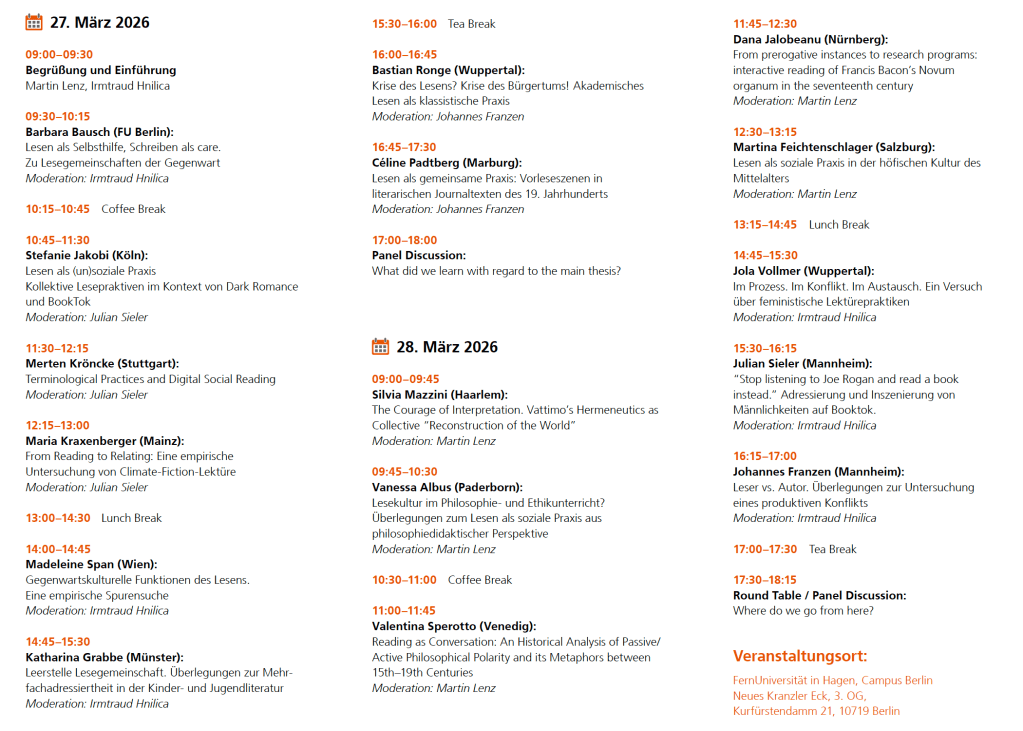
Workshop: Reading as a Social Practice

Following the CfP in October 2025, I’m thrilled to announce the programme of the interdisciplinary workshop on Reading as a Social Practice, organized by Irmtraud Hnilica and myself. We are excited about the range of perspectives brought together in this event. Further information can be found below, and we would be happy to answer any questions.

According to a widely held consensus, we are currently experiencing a reading crisis. This workshop aims to take a step back from the rhetoric of decline and instead ask how reading itself can be conceptualized and examined from different disciplinary perspectives – particularly in philosophy and literary studies. As an initial approach, we propose that reading is shaped not only by the texts themselves or by individual readers, but significantly by the interactions among readers. The workshop brings together researchers who discuss reading as a social practice from historical, theoretical, and contemporary perspectives. In doing so, it opens a space for interdisciplinary exchange and lays the foundation for future collaborations and a shared network.