Why much academic writing isn’t thinking. A response to Lavinia Marin

Especially since the arrival of LLMs, there are quite a few pieces that claim “writing is thinking” or portray writing as thinking in a certain way (even Nature featured a piece on it). The idea is that you don’t just jot down what you thought out beforehand. Rather, the writing and rewriting process often produces thoughts that have not been anticipated by the writer. This is crucial in processes of learning, knowledge-production, artistic endeavours, or therapeutic ambitions. Although I don’t seem to have put it quite that way, I am myself a vocal advocate of that claim. In what follows, I don’t want to revoke my earlier claims. But still: I want to convince you that it’s even worthwhile to entertain the idea that much writing isn’t thinking in this sense, and that that might just be fine.

My idea goes back to recent exchanges with my colleagues Lavinia Marin and Timm Lampert. Lavinia pointed out to me that writing papers in the so-called hard and even some social sciences has no epistemic function. Papers get written to communicate work set-ups and results at conferences, to publish and to get funding. Today, Lavinia detailed this and a number of further points in an intriguing blog post (which I advise you to read as a whole). About writing in these sciences, she says the following: “Writing is just this process where you sit down and add up words. The hardest part is sitting down. … The way many academics treat writing today is that writing is not supposed to produce any new knowledge, insights or thinking. Writing is the wrapping of your results. This is at least for large parts of science, so alpha sciences, beta sciences, all that empirical stuff. “Apply ass to chair”, as Austin K Leon likes to say.” Timm took up this idea and suggested that much applied work based on logic, mathematics, and indeed programming with the aid of LLMs might fit this account.

This is of course somewhat anectdotal, but if this picture isn’t entirely off the mark, it does reveal some insights, not least in explaining why the academic responses to Large Language Models are such a mixed bag. The philosopher in me immediately wants to raise his voice and declare how much gets lost in this view on writing. Yet the historian in me cautions me to wait and listen. What does this mean? Here is a hunch: It doesn’t mean that people in the sciences don’t care about thinking. It just might mean that the real (epistemic) action is elsewhere. Not that long ago I stumbled across some intriguing work by Dana Jalobeanu on enacting experiments and recipes, inspiring me to rethink assumptions about early modern texts. As Dana points out in a paper on Della Porta and Bacon, experiments and recipes are records of what has been tried out in a laboratory or kitchen. The actual epistemic work is not in crafting the written text (which might sometimes just be a list of items and acts), but in all the work that precedes the writing and the work or reenactment inspired in the recipient who might try and replicate the promised results, with all the twisting and turning and trying and failing and trying again slightly differently. Once you see this, it becomes clear that the status and expectations from writing in certain sciences are vastly different from the status of writing in the humanities. In the former, much writing seems a much more social and epistemic action oriented endeavour where texts are just intermediearies and starting points for the actual work. In fact, once you see this, it becomes clear that even philosophical classics like the Descartes’ Meditations or Locke’s Essay heavily rely on the collaboration of the readers.

As I see it, this is quite a positive view of non-epistemic writing. And if writing works really like that in a number of domains, then there do seem to be good reasons to outsource such tedious exercises to LLMs. Recognising this rather strong difference between writing in the humanities and a number of sciences is really helpful to understand the different reactions to the advent of a lot of AI developments. Even if many colleagues in the humanities are not entirely skeptical about the merits of LLMs, they are worried about outsourcing too much and giving way to pernicious deskilling. Rightly so, because writing in the humanities really is different.

However, the process of introducing non-epistemic writing practices into the humanities has not begun with LLMs. It began much earlier. As most of us know all too well, there is the endless repetition of talk of the “crisis of humanties” – to which many administrators (it’s always the administrators!) responded, at least since the New Public Management developments in the 80s, by introducing success measures from the sciences into the humanities. Before we knew it, we began to write papers instead of books, grant applications, performance reviews, explained the value of potential applications of our work to various stakeholders and the average taxpayer. While there is nothing wrong with accountability per se, many complained – rightly I think – that the humanities’ competition with the hard and many social sciences is a game we can’t win. As I see it, this development lead to forms of formulaic writing in the humanities that tip the balance in favour of the (in some respects non-epistemic) paper model which I think is pernicious for many endeavours in our field (and should be countered by the reintroduction of the genre of commentary, as I argued earlier). So I think that many worries about recent technological developments are not inspired by LLMs per se, but by the way in which they accelerate an aleady problematic development in the humanities.

What’s more, the message that writing as such can be shortened and largely outsourced is not lost on students who are often already too busy. I am old enough to have grown up in a world where I learned writing by hand and the first thing I typed on a computer was my MA thesis, the authoritative book-like page on the screen making me feel at once proud and like an impostor whose scribblings were seemingly unduly dignified by the miraculous word-processor. But I keep wondering what it’s like for people who have never made this transition and are born into a world where pens and paper are part of a posh hobby like collecting vinyl records perhaps.

I’m not sure how big of a difference this makes. But what I’m reminded of is that we all (still) write, even if we happen to write non-epistemically and outsource like hell, in an environment in which those who are happy enough to have learned the art of reading and writing at school. This social environment with all its implicit forms of collective knowledge matters greatly. For the forms of writing we (used to?) learn – all the different genres of reports, discussions, commentaries, tables, proofs, translations, essays etc., all that jazz – is epistemic writing in that it trained us to think and imagine. Being trained this way, we can also enjoy the luxury of writing non-epistemically now and then, for instance when the action of thinking is happening elsewhere.

Most of all, we shouldn’t forget that meandering and serendipitous research processes inside and outside of the actual writing are a deeply human thing. Seen this way, there is no point in outsourcing, because writing and thinking – just like many other beautiful things that take time and practice to learn – are not there for the purpose of piling up huge quantities of ever more texts or lines in an academic CV. They have, as the saying goes, intrinsic value. As Lavinia highlights in her blog post, it doesn’t just happen in academic contexts but – now perhaps most of all – in our (popular) culture more widely understood:

“Much of the knowledge propagated in the popular culture is exactly from nerds and fans who have no profit mindset, but simply enjoy the sheer act of research. (I am inspired here by Celine Nguyen’s amazing essay). Research is a wonderful experience, just as painting, singing, staging a drama in your backyard, singing in a garage band, sculpting or knitting. It’s a particular form of leading a creative life, which I think we were all meant to lead. Any artistic practice is highly enjoyable in itself and helps us endure this life on earth. And we just need to recognise that reading and writing are such practices that make us more human and happier to be alive. And hence, the benefit, if you must use these economic terms, is simply experiential. Writing by hand, reading slowly are acts of sheer experiential enchantment. Ways of living our intellectual lives. If we insist on becoming more efficient about these practices, we will be refusing to future generations the access to these practices; we may be cutting them off from very human experiences that we shouldn’t hoard for ourselves.”

Stupid readers? The significance of cooperation in online communication

My daughter Hannah began to indulge in irony probably around the age of six or seven. Depending on the context, she could be quite frustrated or even fearful when she didn’t get it. When she finally would get it, it was often with great relief. Now, at the age of nine, she still sometimes asks, “you meant that ironically, didn’t you?” What’s so upsetting about it? Part of it is that, when she doesn’t get it, the world or I am being unpredictable to her. If she does get it, we’re in sync again. Being “in sync” doesn’t just mean that we share a harmonious mood; it means that we established a cooperative sign use. I produce the sign “I’m actually a famous rock star disguised as your father”; she interprets the sign. But if she doesn’t immediately get the non-literal sense in which the sign can be used, it can be confusing, at least for a moment. The example is light-hearted, but I’m sure you can imagine grimmer versions that are disruptive to the point of triggering feelings of existential threat. – Now, did you notice how I just placed the (cognitive) responsibility on my daughter?

I said, “she didn’t get it”. Instead, I could have said, “I didn’t produce the right kind of sign.” But this move is so common that it’s hard to notice. We assume that “irony” and other figures of speech are well established conventions. Assuming that there are stable linguistic conventions and assuming that speakers and writers used them aptly, we tend to place the burden on the listener or reader, rarely on the producer. This is particularly obvious in online communication. Writing blog posts, for instance, I often wonder why people don’t read what I wrote but rather seem to single out a side issue and run with it. Of course, I’m joking now, readers of my blog are the most competent ones. But what’s going on here anyway?

The ableism involved in charges against (online) readers doesn’t help, but it’s not the issue I want to tackle now. Nor is the point to place the burden on the writer instead. The point is that linguistic conventions don’t just exist ready to use. When I say that someone “didn’t get it” or someone “didn’t express it clearly”, I’m supposing that it is a stable convention that I can hit or miss just like I can sing in or out of tune. But isn’t that the case? Well, it is and it isn’t. Linguistic conventions, I assume with a little help of Ruth Millikan, are stabilized for a reason. They serve certain purposes for the producers and the consumers of signs. (Consumers and producers should not be seen as humans or whole organisms but as cooperative systems, but that’s by the by now.) It’s the purpose or function that keeps the convention alive. If the proximate purpose of a remark is social alignment through irony, then it’s not enough for both parties to “hit” or “get” the convention of irony as such. Rather, the purposes of social alignment have to be connected to the use of irony for both parties, too. Why? Because the purpose of social alignment is what stabilises the convention. “Getting” the convention cannot be separated from participating in the function that that keeps the convention in existence. It’s not enough then to share knowledge of linguistic conventions; we (or our cognitive systems) have to participate in a certain set of common purposes. Such participation has to be established.

Why is that so difficult in online contexts? For Hannah and me, the purposes of social alignment can be established through various ways and sign uses. If one communicative attempt fails, there are thousands of other attempts that make up for it. Generally, in familiar local contexts, conventions are commonly established in relation to joint purposes that, in turn, will stabilize even most idiosyncratic conventions or codes. We form a community, both in the sense of linguistic conventions and the purposes that stabilize the conventions. Given then that we’d interpret and produce certain linguistic items in keeping with joint purposes, we might call this community an interpretive community. By contrast, in online contexts, we often have random or very reduced encounters. Here, it’s not a given whether we share in common purposes. An ironic remark might aim at social alignment, but it might also aim at detachment. While we might recognize familiar linguistic conventions, we cannot be sure that they are used in keeping with the same functions. Someone might write an ironic remark, but for the readers randomly hitting on that remark online the irony might not be related to social alignment. In such situations, we’re at odds. But we’re at odds without noticing it, because what’s in front of us, the written ironic text, doesn’t reveal the mismatch of purposes. (There are many purposes, even purposes driving our own actions, that we are not aware of.) Neither the writers nor the readers are stupid. But they’re out of sync. They do not form an interpretive community.

In fact, online contexts are not only often populated by people out of sync. The playful recontextualization of conventions and memes lends itself not just to jokes and shitposting. It also undermines and destabilizes the cooperation required for forming interpretive communities. If the reassurance available to us in offline local contexts is entirely missing, we are often kept in limbo, yielding frustrated attempts of cooperation in sign use.   

Vulnerability and lacking literacy in (academic) online communication

Many people who interact on so-called social media express confusion about the behaviour of their interlocutors. Besides the on-going friendly chatter, there is a number of “polarizing” issues in the context of which a single “like” or a couple of lines might spiral out of control. While there are certain names – like Rowling or Kimmel – whose mere mention might be taken as tantamount to “taking a side” and hence be causing outrage, there is a vast number of smaller occurences or patterns that might be less charged but equally perplexing. I’m thinking of unexpected outbursts or insults or even more low-key issues such as inappropriate forms of address. What’s going wrong in such situations? While there are many helpful explanations of specific forms of communicative failures, I’m still thinking there might be a fairly general problem related to the way we engage as readers (and writers) in such situations. As I see it, we commonly underestimate the differences between spoken and written language. Let me explain.

Online communication consists neither solely in spoken nor solely in written language. Rather, it yields a hybrid sometimes called fingered speech. This hybrid is at once attention-grabbing, like most spoken language directed at a definite interlocutor or audience, and randomly targeting whoever cares to pay attention, like much written language (messages to specific people aside). In a spoken exhange, the speaker commonly starts the conversation by making the topic relevant to the hearer. (Deidre Wilson and Dan Sperber have worked this out in detail.) I might, for instance, tell you that it’s raining. But I wouldn’t do it just so. Normally, I would do that only if I knew that you’re intending to go out or that it’s relevant to you in some other way. Not so in written texts. A treatise or a news report on a subject matter is of course targeting an interested audience, but normally it isn’t targeting anyone in particular. By contrast, much online communication has traits of both: the written form in an open forum comes with the authority of relative permanence, visibility, references, perhaps comments, and targets no one in particular; yet, many features of online posts, like the (seeming) spontaneiety, speed, informal tone, specific references etc. make it seem much more context-dependent and even personal. Seemingly, there is “someone like you”, i.e. someone scrolling on their device and adding to “the conversation”.

For those (like me) socialized with written and spoken language as distinctive forms, this creates a paradox: If you’re scrolling, the items you see are signalling relevance (as in spoken conversation) but they are usually not directed at you personally (as in many kinds of written text or adverts). Being socialized with news outlets and advertising, this is familiar to most of us, but online communication adds an extra layer because many social media posts have properties that are typical of highly context-dependent and personal communication. This paradox runs deeper than might meet the eye. On the one hand, it seems to be the context-dependence and personal features that draw us in. On the other hand, the written online text comes with special affordances such as likes or favs and comments that signal status, the relation to certain in-groups or out-groups (Alex Davies calls this bystander information.) and hence might be welcoming or alienating, independently of what is said in a particular post. This paradox also has a political dimension: On the one hand, the illusion of fairly personal communication seems to create a safe space in which you can safely lurk or reach out. On the other hand, this “safe space” allows us to be monitored by stakeholders in often undesirable ways. Despite these facts, the interactions take place in the (seeming) privacy of our own homes or phones, where communication seems targeted, intentional and personal.

If this is correct, much of our confusion resides in the vastly different expectations that we associate with written versus spoken language. Depending on the further development of the related technologies, many of the confusions in online communication might pass sooner or later, but for the time being, the hybrid of fingered speech confronts at least some of us with a lacking literacy. Approching such speech with the sensibilities of diligent academic readers, we will forever bemoan the inconsistency and impertinence of our interlocutors who fail to live up to the pertinent expectations. Approaching such speech with the in-group sensibilities of attentive listeners, we will forever bemoan the stiffness and ignorance (not to speak of moral failures) of out-group posters. Online communication is not one or the other and hence not either written or spoken language. Accordingly, we will be vulnerable to incoherent expectations as long as we keep mistaking the kind of language we’re confronted with for something else.

How to start working systematically. From exploring to writing

Today was the final session of my three-day course on medieval philosophy. As so often when I’m about to send my students home after difficult work on texts, I worry that they end up being mainly confused and at a loss when it comes to writing their papers. So today my doubts got the better of me and I talked them through a brief sheet I had prepared on the fly. The main idea was to hand out questions or tasks that they can use to work through the material in order to get from a mainly explorative phase to actually start a systematic writing process. After talking them through the sheet, I asked them to come up with a response to each item and sketch a paper or thesis based on it. After 20 minutes preparation time, we discussed three sets of replies. The point was not to give exhaustive responses, but to mark starting points. My hope was that the process could be facilitated by indicating (in brackets) what they actually had to do. The results left me stunned. Below, I’ll just leave you with the notes on the sheet.

Getting started

Throughout the course, I asked students to come up with what I call structured questions targeting a difficult paragraph or phrase in the text. So the starting point for the exercise is to look for a difficult passage and write down a structured question about it. Going from there, students had to pick a passage and work on the following items.

Preliminary questions (mostly settled during the course)

  1. What type of text is it?
  2. What genre is it?
  3. What about the text’s transmission / kind of edition / translation?
  4. What kind of speech act is it? Who is the author? Who is the intended / targeted audience?

Operationalizing the question about the text:

  1. Terminology: Identify problematic words or phrases. Try to clarify them. Are they technical terms or everyday expressions? (Here, you should do searches in encyclopedias and such like.)
  2. Content: What would be the case if the claim were true? What would be the case if the claim were not true? If the opposite were true? (Here, you should mainly think through the claims and counterfactuals. Use your imagination.)
  3. Establishing a thematic point of reference / creating conceptual tension: How is the content of the passage related to the theme of the text (as a whole or of a specific section)? Does this relationship help to clarify or illuminate something, or does it make something problematic or unclear?
  4. Context: What points of contact are there to other texts? Both terminological or content-related. (Browse through neighbouring passages, other texts, histories.)
  5. Methodological aspects: Ask yourself honestly: What assumptions am I making? Which of my assumptions facilitate understanding? Which of my assumptions make the content of the text appear difficult, absurd, or false? – Which of my assumptions are directly supported by the text? – Which are not? – Qualify the way in which these assumptions are supported / not supported by the text. (Here, you try to evaluate your responses to the former items, i.e. the relation between your assumptions and the material, and figure out what kind of methodological demands they make on your arguments.)

Questions for your planned work:

  1. Which of these points are addressed in secondary literature? (Checking this helps you figuring out for which items you’ll have to argue yourself. Most issues can be settled by referencing literature. Try to have your work focusing mainly on one of the above items.)
  2. Which points are not sufficiently covered? (research gap)
  3. In which respects would you like to diverge from or expand upon the literature? (your own contribution)

The incorrigibility of ChatGPT and the end of teaching

Suppose you witness an accident and have to report it to the police. “Well, the red car drove with high speed towards me and then took a sharp left turn”, you exclaim. You try hard to find the right words to capture the precise sequence of events and people you’ve noticed. Being a bit fussy by nature, you keep correcting yourself. “To begin with, it seemed as if the driver wanted to run me over.”, is the formulation you eventually settle on. – Now imagine you try to refine your impressions using ChatGPT. Obviously, there is always room for improving on style and grammar. But can you expect ChatGPT (or any LLMs or AI) to improve on the accuracy of your factual statements? No. But what does it mean if it is used to that end anyway?

Given the way ChatGPT works, it has no experience of the world in any sense. Rather, it generates sentences by predicting the most likely sequence of words based on the input it receives and the vast amount of text it was trained on. Thus, it cannot improve on the content of any statements relying on experience. While this is no surprise, the repercussions it has for teaching contexts deserve careful attention because such contexts thrive on the correction of statements. Especially now that people not only use this device to hide their plagiarisms, but also to “decide” all sorts of questions. I’ve been wondering repeatedly what precisely it is that goes wrong in teaching contexts with the use of AI and now I begin to think that it comes down to a loss of corrigibility, a loss of understanding what corrigibility even means. Put in a nutshell, seeing that this device improves the form of (written) texts in amazing dimensions, it makes us blind to the fact that it impoverishes our relation to empirical content. In what follows, I’d like to explore this loss with regard to teaching philosophy.  

What is corrigibility? Corrigibilty means that a statement or text can be corrected. If I state that it’s raining you can correct me by pointing out that it’s in fact not raining. We offer and receive corrections all the time. We improve the way of phrasing something we’ve seen by finding more adequate phrases. We can differentiate between grammatical and stylistical corrections as corrections of form as opposed to content, but often the two are difficult to keep apart. The phrase “it’s raining” is formally correct when used among English language speakers, but what makes it correct for these users is how it’s applied to a shared experience of the world (in which it happens to rain). If I ask you to refine your phrasing, suggesting for instance that it’s really pouring and not just raining, I can mean at once to pay attention to your experience and the conventional way of expressing such an experience in the English language. When you think about your experience and modes of expression, you’ll likely involve linguistic sources (your language conventions, literature, the sociolect your audience is supposedly expecting etc.) as well as non-linguistic sources (whatever you can gather from other sense-modalities). Most importantly, you’ll involve relations of applying linguistic resources to non-linguistic experiences. In other words, we relate linguistic conventions to (non-linguistic) facts. ChatGPT, by contrast, doesn’t do that. Having no relation to the world, it is confined to linguistic resources; it has no other sense modalities and it has no way of relating linguistic to non-linguistic facts. In other words, while it can improve on formulations, it cannot be corrected. Put in Wittgensteinian terms, whatever seems correct to ChatGPT is correct – and that means that there is no sense of distinguishing between correct and incorrect. (There is an intriguing piece about learning this the hard way.) Thus, we shouldn’t even say that it’s “hallucinating” when it’s “making things up”. There is no meaningful distinction for this device between hallucinating and getting things right in the first place.

Now I doubt that I’m spreading any news here. So why is this worth saying? Because both the language of ChatGPT and of the merchants of this technology constantly suggests that this device is learning, being corrected and improved. Yes, it’s being improved at what it does already, but it’s not improved in any other sense. This lingo tricks many of us into thinking that the improvement is of the kind that we are familiar with. Just like AI is now increasingly taken to be a meaningful, sexy or caring interlocutor, it tricks many of us into assuming that it could “learn” by being “corrected”. But learning, for humans, always involves a relation to the world. The great confusion about ChatGPT, then, is that it would be improved in any way that we would try to improve our own way of expressing ourselves.

How does this affect teaching (philosophy)? There are many pieces about the decline of the humanities in the face of ChatGPT and related devices. Given how this technology diffuses our sense of authorship and our reading culture, I’m inclined to think that our whole way of cherishing text production and reading will go out of fashion and become a nerdy niche. Just like long electric guitar solos or keyboard solos, which seemingly were ubiquitous in the 70s and 80s, are now a thing for a few nerds on youtube. So as I see it, the problem is not that students are faking texts; the problem is that most texts are considered irrelevant. Along with the skills and features that go into their production. Being able to write good texts is already irrelevant in world where so-called leaders get by without even glancing at their briefings. But let’s stick to the current story. My hunch is that the loss of corrigibility ingrained in ChatGPT is the outcome of a larger trend that was clearly recognised in Harry Frankfurt’s On Bullshit as early as 1986: Once you realise that you can convince without sticking to techniques of truth-evaluation, you can disregard truth altogether. After all, the question is not in what way ChatGPT is incorrigible. We can figure that out quickly. The question is why are we letting ourselves be corrected by a device that is incorrigible.

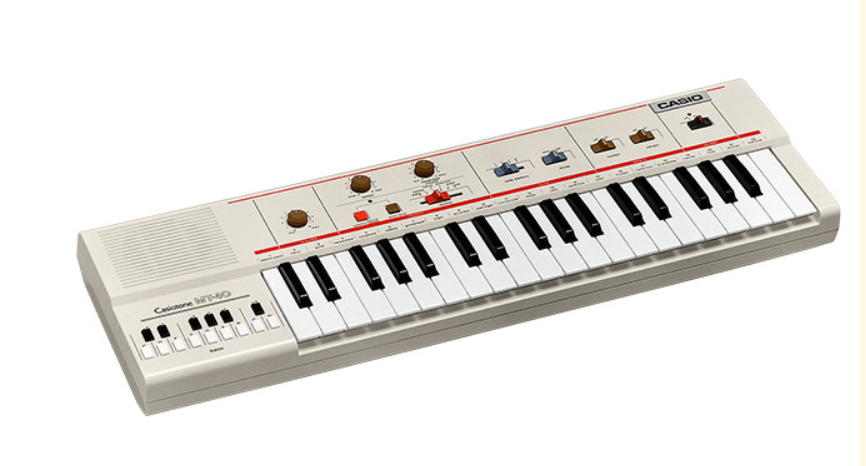
But that’s a question for nerds. Mastering long written texts, let alone writing them, then, doesn’t seem to hold much of a promise for anything now. This is not just because students have incentives to fake their work; it’s because there are hardly any incentives to produce such work in the first place. Why do you need to learn to play the piano if you have keyboards with automatic accompaniment? Of course, you might get sick of their sounds quickly. But who cares if that’s all that’s on offer?

So again: the problem is not cheating; it’s irrelevance. Writing this, I feel like a fossil decrying the loss of its natural habitat. And that’s probably what it is: An old man whining that no one recognises the beauties hidden in the art he cherishes. So what? So what indeed?

So what’s left for teachers? If you don’t worry too much about plagiarized texts, you might adjust your energy towards getting people to think, not by by analysing texts, but by coming up with good prompts for ChatGPT or by enhancing your techniques of video editing. In other words, while certain products (such as well-written essays) will simply be done by ChatGPT in the future, you can support students in improving “their” work by focussing on helping them to use this and the AI devices to come as a good tool. The remaining question is, though, what this tool is good for, once we admit that writing texts is irrelevant?

What does it say? The supposed objectivity of written texts

“… interpretation is the source of texts, facts, authors, and intentions.”

Stanley Fish, Is There a Text in This Class?

Do you remember when you first committed some of your own thoughts to paper? Perhaps you kept a diary, perhaps you wrote poems or lyrics or crafted a letter to a friend. Perhaps you had worked on the aesthetics of your handwriting. Anyway, there it was. Something that you had written could now be read and, of course, misread in a distant place during your absence. This striking distance became even more evident to me when I had seen my words, not in my clumsy handwriting, but in the typeface of a word-processor. Imagining that someone would read my words not as my personal scribblings but as a text in an authoritative typeface, made me at once proud but also seemed to diminish my personal impact on the text. In any case, the absence or possible absence of the author from something written, I suppose, is what turns texts into something objective. As I see it, texts become objective when they can be read independently of the writer, of what the writer says and thinks. If this is correct, it seems that written texts are fundamentally different from spoken texts or thoughts. In turn, this makes me wonder whether it’s written texts alone that afford the interpretive openness allowing for different readings or interpretations as we know them in the humanities of our time. In what follows, I would like pursue some perhaps naïve musings on this issue.

Thinking versus speaking versus thought?

If you observe what you say in contrast to how you write, you’ll probably notice a stark difference between spoken versus written language. While academics sometimes seem to try and imitate the grammatical standards of their written language in their speech, we quickly notice that the grammatical rules, word choices and other aspects are vastly different. Pondering on this issue quickly brought me back to the ancient and medieval doctrine of “three kinds of language”, according to which thought is expressed through spoken language and spoken language is signified by written language. But once you notice how different already speaking and writing really are, it’s difficult to give much credit to said doctrine. The very idea that writing is a set of signs of what is spoken strikes me as a very impoverished understanding of the difference. This makes me wonder when written language was first considered as a set of signs independently from spoken language. Following Stephan Meier-Oeser’s work, my hunch is that William of Ockham and Pierre D’Ailly in their logical treatises are among the first to deem written signs as independent from spoken language. (Sadly, it’s not entirely clear why they hold this in contrast to many of their fellow thinkers.) Now, once you think of written language as independent from speech it seems that you acknowledge something that could be the objectivity of the written text. Of course, long before the written text is acknowledged as an independent signifier, there have been sacred texts like the Bible that were considered objective in some sense. But experiencing our very own writings as independent from our speaking must do something to the way we think about texts and their interpretability more generally, or so I think.

The written text as an objective ‘thing’

The way we encounter written texts or books (be it on paper or screens) seems to present them as distal objects, independent from how we interact about or with them. Like the table in front of you, the book on your desk or in your pdf isn’t altered when you look away. This experience is certainly at least in part responsible for the common assumption that texts and their meanings are stable items independently of us. Likewise, our experience of reading is commonly thought of as grasping something external to us or our interactions. But why? While I myself have begun to think that reading is in many ways a matter primarily dependent on interactions between readers, I equally wonder how written texts, non-sacred texts in particular, have earned the status of independent carriers of meaning that can be hit or missed. Our current reading practices inside and outside of academia seem to corroborate this assumption. – (What does it say? This is a question that silences classes but equally fosters the pretence that texts are stable unchanging sources of meaning that provide all the necessary constraints for possible interpretations. Yet, not knowing whether we’re reading a recipe or a a poem, we are probably unable to tell the genres apart without context. “Context” – this harmless little term obscuring all the greatly important factors allowing for recognition, and constantly underestimated as a “side issue” when it comes to competing readings!) But what does it take for a written text to be actually seen as independent in such ways?

The advent of ChatGPT

Investigating the question of the objectivity of texts will take some time. But currently it seems that this objectivity becomes undone in quite unexpected manners: the advent of chatGPT does not only call into question the production of texts through proper authorship. Rather, it also calls into question the independence of written language as a system of signs, thriving on a supposed text-world relation having been taken for granted for a very long time. Reading a piece of text, we can no longer presume that it was produced by a person having a relation to the world, to themselves and to other people making it a rational item, interpretable by rational beings, or simply readers.

How did we get here?

Stop grading student essays and start reading them instead. The ethics of reading (2)

A question for scholars. – How can we spend a lifetime on a chapter in Aristotle and think we’re done with a student essay in two hours? Both can be equally enigmatic.

Writing this little joke back in 2018, ChatGPT was still unheard of in my part of the world. My point was that our teaching practice results in our unlearning to read and encourages mindless writing and reading. Back then, people responded by emphasising that, contrary to texts of “proper” philosophers, student work is being produced and read to be judged with regard to specific skills, so it doesn’t merit further attention. With the advent of ChatGPT, the judging part of this kind of exercise went down the drain. But even back then, the thought that sparked the worry behind my joke was that we have students produce texts that no one wants to read and, basically, that we train forms of writing that no one wants to read. After all, we now know that it’s not only student papers that often get no more than a quick glace, but equally work of peers. As I see it, then, ChatGPT did not alter this situation but just made our practice of mindless reading and writing more visible. At least, we talk about it now.

If this contains at least a grain of truth, then we knew very well before the advent of ChatGPT that our exercises weren’t very promising. Why? Of course, writing is a great thing and should be practised, but grading writing is another matter altogether. Either our responses would have to be very formulaic or they would have to be so time consuming that no one could serve larger classes. So the problem is not that students now have better ways of cheating. The problem is that we don’t and didn’t act well as readers of our student work. No matter whether we act like cops to catch cheaters or just keep rushing through masses of work: we’re acting as a bad role model for good reading and writing. If we rush through student papers, we demonstrate that we only care about grading. Students learn that they should mainly care about grades, too. It’s no surprise, then, that what gets perfected is not the writing but the techniques of cheating.

But this doesn’t mean that students don’t want to write or learn writing. Rather, they probably don’t want to write for readers who spend two to five seconds on a paragraph that took two days to compose. Perhaps what we (should) really feel, now that ChatGPT makes it almost impossible to distinguish real from hallucinated work, is relief – relief that student essays can’t be graded as they used to be. It should encourage us, not to abolish this kind of exercise, but take it more seriously and stop grading it in the way we used to. While we can focus our common grading practices on other kinds of exercises, we could encourage student essays designed as longer projects for those who really want to go through the effort.

Wie schreibt man ein Exposé für eine philosophische Arbeit?

Schreiben ist schwer. Schreiben über das, was man zu schreiben beabsichtigt, ist meist noch schwerer, weil man nicht weiß, was man herausfinden wird. Dennoch ist gerade bei der Absprache einer Arbeit das Exposé eines der wichtigesten Bestandteile. Denn hierüber kann man am besten absehen, wo Schwierigkeiten entstehen, ob die Planung realistisch ist und eine interessante Arbeit verspricht. Idealerweise werden Lehrende gerade hier eingreifen, wenn sich Probleme abzeichnen, und Korrekturen am Gesamtprojekt vorschlagen. Deshalb sollte man für das Exposé und dessen Überarbeitungen (Plural!) einen Großteil der verfügbaren Zeit und Mühe einplanen. Ja, natürlich wird sich vieles erst beim Schreiben der Arbeit ergeben, aber ob die Arbeit überhaupt Hand und Fuß haben wird, zeigt sich bereits beim Exposé. Woraus also sollte es bestehen?

Ein gutes Exposé ist nichts anderes als eine vorläufige Einleitung, die im Groben aus der Formulierung eines Problems und eines Lösungsvorschlags besteht. Bevor wir uns die einzelnen Teile bzw. Unterteile ansehen, noch ein paar strategische Bemerkungen.

Grundsätzliches. – Die Arbeit an einer Arbeit und auch am Exposé zu einer Arbeit besteht aus zwei sehr unterschiedlichen Phasen: der Exploration, in der Sie ein Thema erkunden, und der Darstellung, in der Sie Ihre Gedanken zum Thema einer Leserschaft präsentieren. Die oft zufällig-assoziative Ordnung der Exploration ist von der didaktisch geleiteten Darstellung grundverschieden. Im Exposé und in der Arbeit geht es um die Darstellung, nicht um die Erschließung des Themas. Als Leserschaft stellen Sie sich am besten interessierte Erstsemester vor. Gehen Sie nicht davon aus, dass sich Ihre Leser:innen auskennen. Bedenken Sie bitte auch, dass Sie nicht all das, was Sie in der Exploration interessiert oder hilft, für die Darstellung benötigen. Deshalb ist es für die Fragestellung oder These, die Ihre Darstellung leitet, wichtig, dass Sie möglichst klar und eng eingegrenzt ist. Überhaupt ist die Fragestellung oder These, die Sie in Ihrer Arbeit entwickeln, das allerwichtigste. Laut einer trefflichen Beobachtung meiner Kollegin Charlotte Baumann legen viele Studierende Ihre Arbeiten wie Übersichtsartikel bei Wikipedia an. Das ist keine gute Idee. Fokussieren Sie sich stattdessen auf eine (und nicht mehr als eine!) These, für die Sie in Ihrer Arbeit argumentieren. Wie finden Sie aber eine These? Das ist nicht so leicht. Am besten entscheiden Sie sich im Laufe Ihrer Exploration einfach für eine bestimmte These, die Ihnen plausibel erscheint, und versuchen, diese mit eigenen Argumenten und Belegen zu untermauern. Was soll so eine These dabei eigentlich leisten? Nun, sie ist der L.ösungsvorschlag für ein Problem. Zunächst also müssen Sie ein Problem aufdecken? Wie machen Sie das? Nun, Sie nehmen sich eine konkrete Passage aus einem Primärtext oder aus einem Sekundärtext vor und schauen nach einer Reibung oder Schwierigkeit, die der Erklärung bedarf. Solche Reibungen können Sie selbst erzeugen, indem Sie sich über die Konsequenzen des Gesagten Gedanken machen. Mit der Reibung und der These haben Sie das besagte Problem und einen Lösungsvorschlag. Und damit kann es losgehen.

Ihr Exposé besteht neben dem Titel oder Arbeitstitel idealerweise aus folgenden Teilen. Das sind:

(a) das allgemeine Thema bzw. die problematische Textpassage;

(b) ein Problem, das in den wissenschaftlichen Debatten des Themas oder der Passage auftritt (oft im Einklang mit der Diskussion in der Literatur);

(c) die Motivation des Problems bzw. eine Erklärung, warum das Problem relevant ist oder welche ungelösten Schwierigkeiten es offenlässt;

(d) eine These zur Herangehensweise an das Problem;

(e) die Forschungsfrage, d. h. die Frage nach einem entscheidenden Aspekt, der untersucht werden muss, damit sich die These als wahr oder als plausibel erweist;

(f) der methodische Ansatz, der die Art der zur Beantwortung dieser Frage erforderlichen Belege oder Argumente rechtfertigt;

(g) die Gliederungsschritte (und Einschränkungen), die zur Begründung der Argumentation berücksichtigt werden müssen.

Wie Sie sehen, kann man eine Menge unterschiedliche Dinge bereits im Exposé ansprechen. Dabei geht es nicht darum, schon alle Punkte genau untersucht zu haben. Vielmehr müssen Sie sich einfach trauen, diese Punkte mal ins Blaue zu formulieren und dann ­– im Austausch mit anderen (z.B. der Lehrenden) – nachzujustieren, bis sich ein gangbarer Weg abzeichnet. In jedem Fall werden Sie so endlich aus der bloßen Explorationsphase rauskommen und zur Darstellung übergehen können. Wenn das Exposé abgestimmt ist, kann es dann mit der eigentlichen Arbeit weitergehen, für die ich den Hagener Leitfaden empfehlen möchte.

On autosociobiography and Tracey Thorn as a philosopher

Where do I begin? I’m getting into a new genre, fairly new at least for me: autosociobigraphy. While the term seems to have been coined by Annie Ernaux (see here for a volume on the genre), this kind of autobiography is perhaps not entirely new: As I understand it, it is an autobiography that does not merely give an account of one’s own life, but also presents it as a sociological or political analysis.* So this genre doesn’t just add a bit of reflection. Rather, it seems to be designed as an approach to (social) reality through a first-person narrative. Of course, sociology is not the only discipline in which this kind of approach is a clear enrichment. But although we also see autobiographies of philosophers and receive them as philosophical works, the potential of this genre leaves much space to be explored.** So, how about an autophilobiography? After all, a decidedly personal approach opens up the possibility to give pride of place to experience – a concept much cherished but also often banned for a supposed lack of universality. A fairly recent attempt at an autobiographical approach to philosophy I can recommend is Michael Hampe’s What for? A philosophy of purposelessness (Wozu? Eine Philosophie der Zwecklosigkeit). Reading this made me think that this is what I, among other things, want: If you are a more regular reader, you’ll know that I attempt to use a decidedly personal perspective now and then to make a point (a perhaps obvious piece is the one on the phenomenology of writing). Yet, once we allow that the autobiographical approach doesn’t have to be implemented in an entire book, we can see that there are a lot of reflections that are worthwhile bits of philosophy in this sense. Let me give just one example:

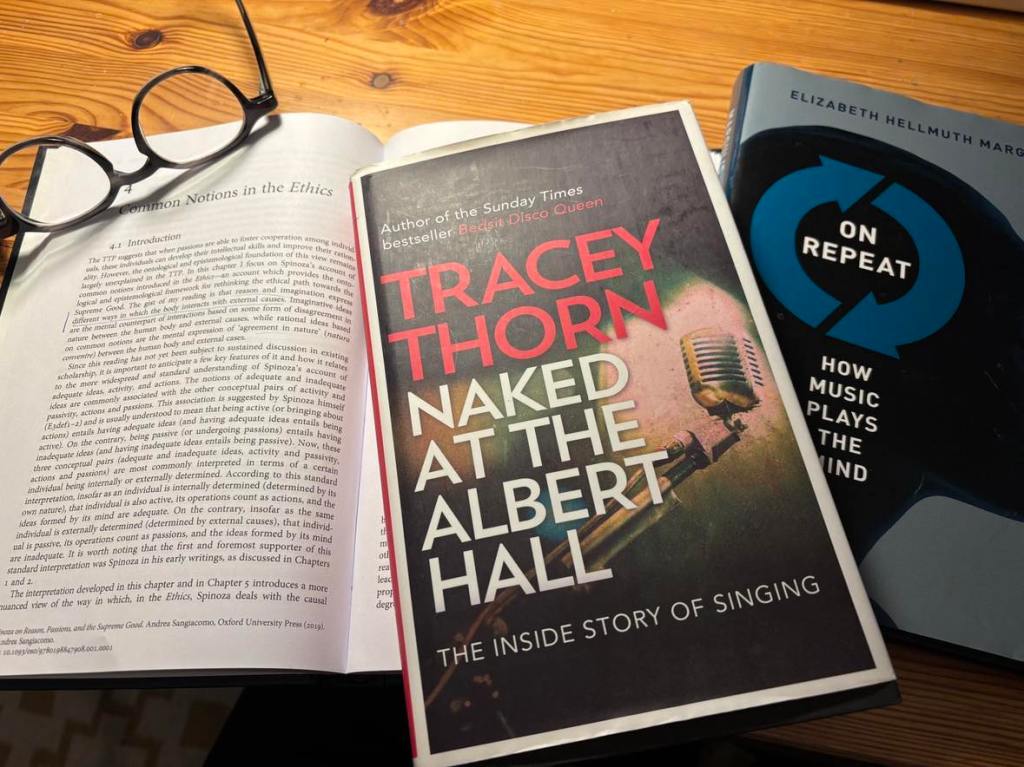
Being interested in the history of music in the 20th century in particular, I swallowed Tracey Thorn’s Bedsit Disco Queen where she describes the music scene of her early years before Everything But The Girl was formed in Hull, England. This as well as her more recent Another Planet can certainly count as autosociobiographies. While Thorn is a great singer and writer, I was equally taken by her reflections on singing in her essay collection Naked at the Albert Hall. Reading her account of singing inspired me to reconsider Spinoza’s philosophy of mind and particularly his account of philosophical therapy (I just finished a paper draft involving Thorn and Spinoza).  I think that Thorn, while describing her way into singing, is really expressing a kind of reflection that Spinoza would deem an approach to philosophical therapy in the sense of re-ordering ideas about what matters. Let me just quote from her first essay in Naked at the Albert Hall:

“When did you know you could sing? people ask me. How did you even start? Where does your voice come from, is it from inside your head or inside your body? … I’ve written before that it was a disappointment to me when I realised I wouldn’t be Patti Smith, but that was a little way off in the future when I first heard her in 1979. … My first reaction to Patti Smith was one of possibility. I wanted to be her because a) on the cover of the record she looked like a boy, and I felt that I pretty much looked like a boy, and she made looking like a boy a beautiful thing; and b) the first time I tried to sing along with those opening lines on Horses, I realised in fact that I could sound like her. … Low, dark boyish, it existed in a space that seemed familiar, and contained the echoes of the sound I was tentatively exploring in the privacy of my bedroom. Joining in with her I found that we did indeed occupy the same ground, and without knowing how or why I had an immediate sense of my voice ‘fitting’. Imagining this to be a conceptual ‘fit’, I of course believed that I sounded a bit like Patti Smith because we were alike, it was a metaphysical connection being made. And in doing so I fell into the first and most basic misconception about vocal influence – the idea that it transcends the physical. Now I believe that the reason she implanted herself into my imagination as my first vocal influence was the simple accident of vocal range … My perfect, ideal range. Still the place I most like to sing. … Almost the entire Horses album is pitched perfectly for me … Joining in with Patti on these songs was a joyous experience, utterly secret … The basic physical coincidence of our vocal ranges connected us not just ideologically, but physiologically. … The lungs propel air, which passes through the vocal chords, making them vibrate and producing the sound we use for either speaking or singing. But unlike any other instrument, these components are your own actual body parts, and the sound you make is both defined and limited by your anatomy. As an instrumentalist you might practice and adapt your technique in order to follow the style and sound of players you like … But as a singer there is only so much you can ever do to adapt the sound of your voice to emulate singers. We label as inspirational those whose sound lives somewhere close to our own …” (Thorn 2015, 3-6)

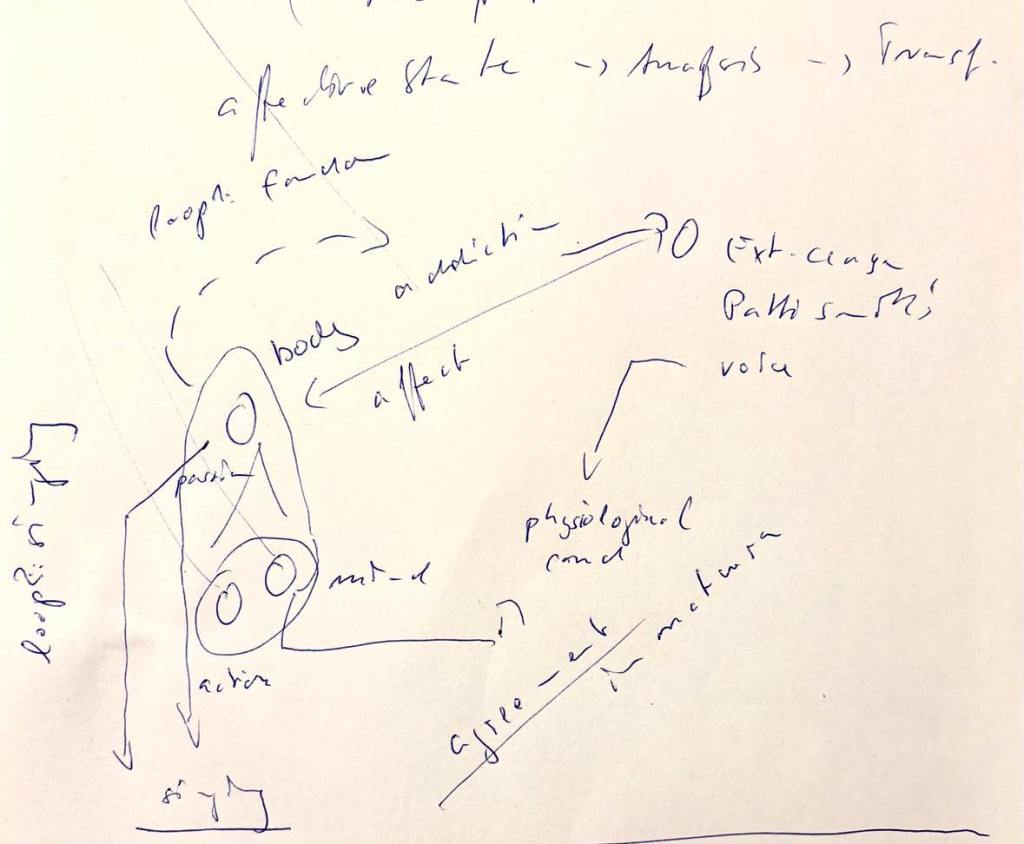
There is a lot in these observations. A couple of years ago, I took her observations as an anchor to think about active forms of listening to music. But now I think this goes deeper and exemplifies how we re-evaluate experiences and thus change (narratives about) ourselves. Apart from the aspiration and attraction depicted, it is clear that the author, Thorn, takes her body to be in agreement with that of Patti Smith, at least as far as the conditions for singing are concerned, and that that agreement is physiological. At the same time, the author realises that this agreement is easily confused with one of personality. But what she is describing is a common concept of her physiologically determined vocal range in agreement with that of Patti Smith. In Spinoza’s terms, Thorn, getting this more distinct concept of her physiological likenesses with Patti Smith, is revealing an agreement in nature. Arguably, while the initial exposure to Smith’s voice in 1979 is a confused attraction, the account Thorn gives in 2015 is a therapeutic disentanglement of the initially confused concept, distinguishing the external or distal cause, Smith’s voice, from the internal or proximate cause, her own voice, and the resonance between them, i.e. the agreement.

(An early attempt at scribbling down Tracey Thorn’s account as it relates to Spinoza’s Ethics)

____

* Dirk Koppelberg kindly corrected me on FB and offered the following charactrisation: “As I read Annie Ernaux, she does not “also” present a sociological or political analysis of her life but delivers an aesthetically arranged and composed description of it that illuminates certain sociological and political determinants of her life. This kind of writing seems to me an aesthetically challenging alternative to a sociological and political analysis in the strict sense.”

** The autosociobiographical approach will also figure in a project on reading as a social practice that I’m currently planning together with Irmtraud Hnilica. Stay tuned for updates on this project soonish.

A rough but workable guide to plan an essay

I keep noticing that one of the greatest worries of students is finding a workable research question for their essays – one that allows them to structure their work and keeps them in line with what they intend to promise. I’ve written on this before at length on this blog (here, a Groningen student reviews three of my posts), but I think I managed to break down the issue even more. – I’ve just finished an exciting three-day seminar on “Spinoza’s Ethics. An introduction to doing philosophy systematically for beginners.” The idea was to bring out the systematicity of the Ethics to such a degree that students could continue working with the text independently without loosing grip of the general framework. On the last day, I wanted to turn the tables and have my roughly fourty students work, not primarily through the text, but through potential essays on this book. Hence, I divided them into six groups and gave them pertinent tasks. In a feedback round, most students and I agreed that this was a surprising success. Therefore, I simply want to share the set-up of the tasks:

At the beginning, I asked the students to:

  • find some friction (in the text),
  • provide concrete evidence for this friction by providing at least two passages or sentences from the text,
  • provide a motivation of why the friction arises,
  • provide at least one possible answer as to how to state the friction and how to amend it.

By asking for a friction, I could rule out explorative works that have no natural boundaries and can keep students on the preparatory reading path forwever. By asking for concrete passages of text, students will have a constant fall-back place when themes would have them meander into the wilderness of the space of reasons. By asking for friction in the text, I also wanted to make sure that the friction arises from an immanent reading, rather than from an external criticism (e.g. of the sort: I don’t like this kind of philosophy, so here is why I prefer something else – which doesn’t really engage with the material). This approach mostly yields ambiguous uses / understandings of particular terms. Not everyone is interested in that kind of focus, but the promise is that this provides a workable way in and out, while one still has time to draw in all the pertinent aspects related to working through the friction.

Eventually, the student groups came up with six workable research questions. The evidence and motivations made for a pertinent structure, the possible answer for a fairly clear hypothesis. In the discussion of these approaches, we then tried to establish what the chapters / sections should look like: i.e. how they should implement the friction, motivation, and the answers. (In fact, this idea for planning essays is derived from my account of questions.)

Especially for beginners, it’s also important to counter the feeling that they don’t yet know enough to come up with a proper question. I addressed this worry by making clear that any philosophical thesis can (and indeed will be) countered at some point. So one shouldn’t waste their time by trying to immunise their work against criticism. Whatever you’ll say can be criticised. So you might as well get started immediately.

Of course, this is not waterproof. But my sense was that students now had an idea about how to move from reading to planning their writing – and that’s all I want.

***

Many thanks again to my great students in this course!