

Category: Reading as a Social Practice
Cognitive offloading: Let’s not miss the tipping point
Yesterday, I came across the following tweet:
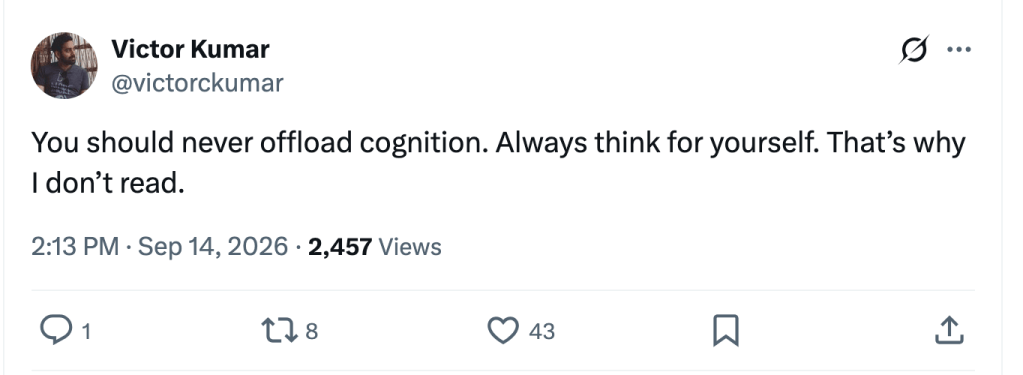
Admittedly, I was slightly fuming at first, but then I realised that Victor Kumar makes a really neat point. Tying reading and cognitive offloading together in this way, he brings out (and debunks, at least implicitly) two misconceptions at once: (1) Cognitive offloading is often unduly restricted to the use of AI devices and then simply contrasted with analog skills like reading or writing. (2) At least in philosophy, reading is often unduly restricted to the passive intake of someone else’s thought and then simply contrasted with thinking for oneself. Schopenhauer famously put this as follows: “When we read, someone else is thinking for us: we merely repeat his mental process …” (More on this here.)
Neat as this point may be, there is a worry about deskilling I’d like to address in the following. People often debunk arguments about deskilling through AI use in similar ways by pointing out that we seem to have handled cognitive offloading through various means quite well in the past, suggesting that AI, and especially LLMs, might just turn out to be the next form of refined tool use, allowing us to offload torturous tasks to the LLM, while using the freed time and capacity for higher cognitive endeavours.
What this kind of argument seems to miss is a tipping point at which cognitive offloading, despite our best intentions, might well turn into deskilling. Compare cooking: Of course, there was a time during which we learned to prepare food in such a way that we prevented poisoning ourselves in the process. Gradually becoming shared knowledge, this skill became widespread and implemented thanks to a lot of offloading and division of labour. Certainly, this process can be seen as a great improvement. But now we’ve reached a level of offloading in food production where we increasingly allow for outright self-harm by stuffing ourselves with fast food and make do with industrial cruelty to non-human animals, resulting in harm and diseases on an evergrowing scale.
Returning to AI use, then, we shouldn’t miss the tipping point at which cognitive offloading might turn into all kinds of self-harm.
Why much academic writing isn’t thinking. A response to Lavinia Marin
Especially since the arrival of LLMs, there are quite a few pieces that claim “writing is thinking” or portray writing as thinking in a certain way (even Nature featured a piece on it). The idea is that you don’t just jot down what you thought out beforehand. Rather, the writing and rewriting process often produces thoughts that have not been anticipated by the writer. This is crucial in processes of learning, knowledge-production, artistic endeavours, or therapeutic ambitions. Although I don’t seem to have put it quite that way, I am myself a vocal advocate of that claim. In what follows, I don’t want to revoke my earlier claims. But still: I want to convince you that it’s even worthwhile to entertain the idea that much writing isn’t thinking in this sense, and that that might just be fine.
My idea goes back to recent exchanges with my colleagues Lavinia Marin and Timm Lampert. Lavinia pointed out to me that writing papers in the so-called hard and even some social sciences has no epistemic function. Papers get written to communicate work set-ups and results at conferences, to publish and to get funding. Today, Lavinia detailed this and a number of further points in an intriguing blog post (which I advise you to read as a whole). About writing in these sciences, she says the following: “Writing is just this process where you sit down and add up words. The hardest part is sitting down. … The way many academics treat writing today is that writing is not supposed to produce any new knowledge, insights or thinking. Writing is the wrapping of your results. This is at least for large parts of science, so alpha sciences, beta sciences, all that empirical stuff. “Apply ass to chair”, as Austin K Leon likes to say.” Timm took up this idea and suggested that much applied work based on logic, mathematics, and indeed programming with the aid of LLMs might fit this account.
This is of course somewhat anectdotal, but if this picture isn’t entirely off the mark, it does reveal some insights, not least in explaining why the academic responses to Large Language Models are such a mixed bag. The philosopher in me immediately wants to raise his voice and declare how much gets lost in this view on writing. Yet the historian in me cautions me to wait and listen. What does this mean? Here is a hunch: It doesn’t mean that people in the sciences don’t care about thinking. It just might mean that the real (epistemic) action is elsewhere. Not that long ago I stumbled across some intriguing work by Dana Jalobeanu on enacting experiments and recipes, inspiring me to rethink assumptions about early modern texts. As Dana points out in a paper on Della Porta and Bacon, experiments and recipes are records of what has been tried out in a laboratory or kitchen. The actual epistemic work is not in crafting the written text (which might sometimes just be a list of items and acts), but in all the work that precedes the writing and the work or reenactment inspired in the recipient who might try and replicate the promised results, with all the twisting and turning and trying and failing and trying again slightly differently. Once you see this, it becomes clear that the status and expectations from writing in certain sciences are vastly different from the status of writing in the humanities. In the former, much writing seems a much more social and epistemic action oriented endeavour where texts are just intermediearies and starting points for the actual work. In fact, once you see this, it becomes clear that even philosophical classics like the Descartes’ Meditations or Locke’s Essay heavily rely on the collaboration of the readers.
As I see it, this is quite a positive view of non-epistemic writing. And if writing works really like that in a number of domains, then there do seem to be good reasons to outsource such tedious exercises to LLMs. Recognising this rather strong difference between writing in the humanities and a number of sciences is really helpful to understand the different reactions to the advent of a lot of AI developments. Even if many colleagues in the humanities are not entirely skeptical about the merits of LLMs, they are worried about outsourcing too much and giving way to pernicious deskilling. Rightly so, because writing in the humanities really is different.
However, the process of introducing non-epistemic writing practices into the humanities has not begun with LLMs. It began much earlier. As most of us know all too well, there is the endless repetition of talk of the “crisis of humanties” – to which many administrators (it’s always the administrators!) responded, at least since the New Public Management developments in the 80s, by introducing success measures from the sciences into the humanities. Before we knew it, we began to write papers instead of books, grant applications, performance reviews, explained the value of potential applications of our work to various stakeholders and the average taxpayer. While there is nothing wrong with accountability per se, many complained – rightly I think – that the humanities’ competition with the hard and many social sciences is a game we can’t win. As I see it, this development lead to forms of formulaic writing in the humanities that tip the balance in favour of the (in some respects non-epistemic) paper model which I think is pernicious for many endeavours in our field (and should be countered by the reintroduction of the genre of commentary, as I argued earlier). So I think that many worries about recent technological developments are not inspired by LLMs per se, but by the way in which they accelerate an aleady problematic development in the humanities.
What’s more, the message that writing as such can be shortened and largely outsourced is not lost on students who are often already too busy. I am old enough to have grown up in a world where I learned writing by hand and the first thing I typed on a computer was my MA thesis, the authoritative book-like page on the screen making me feel at once proud and like an impostor whose scribblings were seemingly unduly dignified by the miraculous word-processor. But I keep wondering what it’s like for people who have never made this transition and are born into a world where pens and paper are part of a posh hobby like collecting vinyl records perhaps.
I’m not sure how big of a difference this makes. But what I’m reminded of is that we all (still) write, even if we happen to write non-epistemically and outsource like hell, in an environment in which those who are happy enough to have learned the art of reading and writing at school. This social environment with all its implicit forms of collective knowledge matters greatly. For the forms of writing we (used to?) learn – all the different genres of reports, discussions, commentaries, tables, proofs, translations, essays etc., all that jazz – is epistemic writing in that it trained us to think and imagine. Being trained this way, we can also enjoy the luxury of writing non-epistemically now and then, for instance when the action of thinking is happening elsewhere.
Most of all, we shouldn’t forget that meandering and serendipitous research processes inside and outside of the actual writing are a deeply human thing. Seen this way, there is no point in outsourcing, because writing and thinking – just like many other beautiful things that take time and practice to learn – are not there for the purpose of piling up huge quantities of ever more texts or lines in an academic CV. They have, as the saying goes, intrinsic value. As Lavinia highlights in her blog post, it doesn’t just happen in academic contexts but – now perhaps most of all – in our (popular) culture more widely understood:
“Much of the knowledge propagated in the popular culture is exactly from nerds and fans who have no profit mindset, but simply enjoy the sheer act of research. (I am inspired here by Celine Nguyen’s amazing essay). Research is a wonderful experience, just as painting, singing, staging a drama in your backyard, singing in a garage band, sculpting or knitting. It’s a particular form of leading a creative life, which I think we were all meant to lead. Any artistic practice is highly enjoyable in itself and helps us endure this life on earth. And we just need to recognise that reading and writing are such practices that make us more human and happier to be alive. And hence, the benefit, if you must use these economic terms, is simply experiential. Writing by hand, reading slowly are acts of sheer experiential enchantment. Ways of living our intellectual lives. If we insist on becoming more efficient about these practices, we will be refusing to future generations the access to these practices; we may be cutting them off from very human experiences that we shouldn’t hoard for ourselves.”
On identity – between datafication and finding oneself
It was probably in 2015, when a friend took me along to a workshop of professionals involved in social entrepeneurship. Located in a hip place in Berlin Kreuzberg, it was a gathering of well-educated people, mostly in their early thirties, brimming with ideas of social change. Something of an outsider myself, I quickly noticed another outsider in the room: not a philosopher, but a grey-haired social worker, hailing from a village in Brandenburg and evidently pondering on the question that seemed strikingly concrete: how to stop people joining the far-right party AfD. At that time, the AfD still wasn’t generally perceived as a major threat but more as a refuge for Eurosceptics, national conservatives, and right-wing protest voters. During the introductions, the social worker explained that he knew many people in his village who were on the verge of joining the party. Yet the other participants seemed less interested in the problem he described than in what his concern revealed about him. Rather than hearing someone worried about political radicalisation, they appeared to classify him as someone who was, in one way or another, close to the people he was talking about. His proximity to the subject became a reason to suspect his own political identity. I may, of course, have misread the situation. But my impression was reinforced by what happened afterwards: once the introductions were over, no one spoke to him again for the rest of the workshop.
A great deal of contemporary political discourse constists not so much in advocating one’s beliefs as in convicting others of (moral) failure. The social worker mentioned above may well have come with best intentions. Yet the other participants weren’t interested in what he said explicitly, but in what the social cues could be taken to reveal about his identity. For the person under scrutiny, this may well result in conflicts between self-ascriptions and ascriptions by others. Faving someone’s tweet might have earned you all sorts of reputations (when favs were still traceable), even if you might just be wishing to lend support to a friend in need, whatever the cause. You may protest as much as you like, at least in online spaces the verdict about your (political) identity will be strengthened quickly by the data unfailingly betraying your true colours. Of course, the conflicts between self-ascriptions and social ascriptions have a long history. What seems distinctive about contemporary digital culture, however, is the epistemic authority increasingly granted to data. Digital traces appear to promise objective evidence of who someone really is. What interests me is the question of whether datafication, as practised in digital contexts, leads to a new understanding of (political) identity, namely as an identity that is not discovered by self-searching within conventional human interactions, but that can be objectively inferred by referring to digital traces or behavioural data.
A notion of identity that I personally cherish is the idea that identity is initially built by keeping something secret from others. The novelist Deniz Ohde makes this point as follows:
“Every child, at some point, begins to keep certain things secret from others – especially from their parents or other primary caregivers. … At first, it may hide experiences from kindergarten, the rules of games invented with other children, daydreams in which flying is possible … Then, these games slowly become something serious. Suddenly, the child begins to regard them as a private sphere that is none of the parents’ business. Then it keeps its first crush secret, keeps also dreams at night to itself, locks the bathroom door, … begins to maintain an inner dialogue … This is the foundation of the self. The secret is a crucial aspect of individuation.” (This is my rough translation from German.)
While this understanding of identity is also rooted in interactions with others, it is so qua silence or secrecy, qua withholding what would otherwise be traceable by others. What’s more, it’s fluid, experimental, entangled and tentative. On such an account, it’s open and perhaps subject to change what one thinks about things. It’s driven as much by curiosity as by love, shame, and suffering. When we enter (political) discourse with others, this kind of identity might be challenged, changed, or confirmed by others. What is crucial, though, is that in this understanding, our identity is developed in a dialectic of privacy and public exchange, of self-ascription and social ascription. Not something objectively discovered, but continuosly negotiated.
If this is an apt sketch of how identity might come about, then it’s very much at odds with the objectivity suggested by datafication. While we might increasingly integrate datafied aspects through the digital measures, we should not be tricked into seeing them as a welcome objective replacement for our fluid forms of becoming ourselves. The fact that we can track data about our health doesn’t necessarily improve our relation to our bodies. Likewise, the fact that we can collect ever more data about what someone reads, likes, follows, or endorses does not necessarily improve our understanding of that person or our capacity to engage with them. Data may reveal patterns of behaviour, but it cannot settle the question of who someone is. We should bear this tension in the disparate notions of identity in mind – especially when assessing public figures and their political identities, or indeed ourselves and our interlocutors, by such measures.
Lesekompetenz als schwindende Situiertheit? (Video)
Hier findet sich das Video meines gleichnamigen Vortrags vom 25. Juni 2026 im Rahmen des Hagener forum philosophicum sowie als Keynote des Workshops Phänomenologie der Situation & Situierte Lektüren:
Abstract: Lesekompetenz als schwindende Situiertheit?
(Here is an English version of the talk.)
Ausgangspunkt ist die These, dass Lesekompetenz nicht lediglich eine Kulturtechnik, sondern eine historisch kontingente Form der Situiertheit ist, die bestimmte Praktiken des Denkens, Verstehens und Imaginierens überhaupt erst ermöglicht. Ausgehend von einem sozial-pragmatischen Verständnis des Lesens wird argumentiert, dass die Bedeutung von Texten nicht im Text selbst oder im lesenden Individuum liegt, sondern in den sozialen Interaktionen zwischen Leser*innen. Lesekompetenz erscheint dabei als historisch erworbene Voraussetzung für den distanzierten Umgang mit Schrift.
Anhand der Entwicklung von der mittelalterlichen Buchkultur zur scholastischen Universität wird gezeigt, wie sich Texte zu epistemischen Instrumenten abstrahieren konnten. Erst die zunehmende Beherrschung schriftsprachlicher Strukturen ermöglichte eine Loslösung des Textes von seinem materiellen Träger sowie neue Formen systematischen und reflexiven Denkens.
In einem zweiten Schritt werden Auswirkungen digitaler Medien auf diese Form der Lesekompetenz untersucht. Während die Buchkultur durch Distanz, Abstraktion und eine relative Entkopplung von unmittelbaren Handlungskontexten gekennzeichnet ist, binden soziale Medien schriftliche Kommunikation erneut eng an affektive Relevanzmarker, soziale Bewertungen und unmittelbare Anschlusshandlungen. Online-Kommunikation folgt damit zunehmend der Pragmatik gesprochener Sprache („fingered speech“).
Der Vortrag schließt mit der Überlegung, dass die für Buch- und Wissenskultur zentrale Fähigkeit epistemischer Distanznahme keine selbstverständliche anthropologische Konstante, sondern eine historisch fragile Errungenschaft ist. Sollte sich die soziale Funktion schriftlicher Texte grundlegend verändern, könnte auch die daran gebundene Form der Lesekompetenz und damit eine wesentliche Bedingung wissenschaftlicher und imaginativer Praxis allmählich verloren gehen.

„Das ist aus dem Zusammenhang gerissen!“ – Eine verfehlte Verteidigung?
In Deutschland wird derzeit über den Kabarettisten Dieter Nuhr debattiert, dem vorgeworfen wird, kürzlich einen ausgesprochen schlechten Witz über Femizide gemacht zu haben. Nachdem die öffentliche Empörung nicht abebbte, erklärte er in den sozialen Medien, er habe nie einen Witz über Femizide gemacht; sein eigentliches Anliegen sei vielmehr die Kritik am Missbrauch des Begriffs „strukturell“ im Zusammenhang mit Behauptungen über strukturelle Gewalt von Männern gegen Frauen gewesen. Nuhrs Verteidigung besteht also darin, dass der Witz falsch kontextualisiert sei, wenn man ihn auf Femizide und nicht etwa auf strukturelle Gewalt von Männern beziehe. Allerdings ist fraglich, ob dies eine gelungene Verteidigung darstellt, denn die Rede von Femiziden setzt ja in der Tat eine strukturelle Form von Gewalt gegen Frauen voraus. So gesehen beruft sich seine Verteidigung lediglich auf eine anders nuancierte Paraphrase des Vorwurfs. (Welche Nuancierung? Nun, einmal betont man strukturelle Gewalt gegen Frauen; das andere Mal strukturelle Gewalt von Männern.) Mir geht es aber gar nicht so sehr um die mislungene Verteidigung Nuhrs an sich, sondern um den allseits verbreiteten Topos, etwas sei „aus dem Kontext gerissen“ bzw. falsch rekontextualisiert worden. Der Topos ist bei genauerem Hinsehen nämlich etwas eigenartig. Warum? Nun, Textverstehen ist oft nichts anderes als Rekontextualisierung.
Rekontextualisierung als Verstehen. – Wenn man davon ausgeht, dass jemand, der einen Text zu verstehen sucht, diesem zwangsläufig mit eigenen Voraussetzungen begegnet, dann ist Verstehen immer Rekontextualisierung. Es sei denn, man versteht unter Verstehen so etwas wie ‚ein Foto von einem Text machen‘. Ich ordne einen Satz oder eine Szene immer in meinem Horizont ein. Natürlich kann ich von meinem persönlichen Horizont Abstand nehmen, kann mich weiter informieren und weitere Aspekte betrachten, aber auch das ist eine Veränderung des Kontextes. Rekontextualisierung von Äußerungen ist also die normale Form des Verstehens. Übrigens auch des Verstehens von eigenen Äußerungen. Eine Grundform dieses Tuns ist das Zitieren. Denn beim Zitieren geht es oft um das Übertragen einer Äußerung in den Kontext einer Erklärung. Wenn dies zutrifft, dann scheint der Vorwurf, etwas sei aus dem Kontext gerissen, merkwürdig.
Absichtsvolles Missverstehen? – Jetzt kann man natürlich einwenden, dass es – zumal in politischen Debatten – häufig vorkommt, dass eine Äußerung willentlich missverstanden wird. Hier wird dann behauptet, man versuche eigentlich nicht, eine Äußerung zu verstehen, sondern man versuche, eine wohlverstandene Äußerung unangemessen auszulegen. Arnd Pollmann zufolge geht es dabei „um strategische Landgewinne. Man will der Blase beweisen, auf der richtigen Seite zu stehen. Das eigene Weltbild wird stabilisiert, indem das irritierende Contra ignoriert, verfälscht oder karikiert wird.“ Das scheint mir in der Tat eine treffende Beobachtung. Allerdings setzt die Idee der Verfälschung voraus, dass es eine unverfälschte Form der Deutung gibt. Natürlich kann man hier mit Recht auf das Principle of Charity verweisen, dem gemäß Äußerungen so rational wie möglich zu interpretieren sind. Allerdings lässt der bloße Verweis unerwähnt, dass dieses Prinzip auf geteilte Überzeugungen angewiesen ist. In diesem Sinne setzt die Idee der unverfälschten oder zumindest charitablen Deutung ein geteiltes Weltbild voraus. Gerade dies scheint beim absichtsvollen Missverständnis aber nicht gegeben zu sein. Was hier „absichtsvoll“ genannt wird, ist meines Erachtens lediglich die unterstellte Möglichkeit, jemanden auch anders verstehen zu können, als er oder sie es gerade tut. (Aber – um beim Beispiel zu bleiben – das hängt davon ab, ob ich die Äußerung des besagten Kabarettisten als frauenfeindlich einordne oder nicht. Und gerade das steht bei den unterschiedlichen Deutungen ja zur Debatte, kann also nicht als gegeben vorausgesetzt werden.) „Anders verstehen“ heißt in so einem Fall, jemandem ein Weltbild zuzuschreiben, das ich ihm aufgrund der getätigten Äußerung gerade absprechen will. Das Problem ist also, dass die charitable Interpretation davon abhängt, welche Einstellungen ich meinem Gegenüber sonst noch zuschreibe. Bei tiefgreifenden Dissensen über politische Fragen können ganz unterschiedliche Dinge rational erscheinen.
Zitate als Belege. – Ein Grundproblem bei all diesen Moves, also beim Vorwurf des falschen Rekontextualisierens und dem des absichtsvollen Missverstehens, scheint mir in der in akademischen Kreisen verbreiteten Tradition zu liegen, Zitate oder Verweise auf Texte bzw. Filmsequenzen als Belege zu behandeln. Natürlich gibt es manchmal unmissverständlich klare Aussagen, die für sich zu sprechen scheinen, aber in den allermeisten Fällen sind Äußerungen erst dann als Belege verwendbar, wenn sie im Kontext einer bestimmten Interpretation akzeptiert werden. „Das steht da doch gar nicht“ oder „das hab ich nicht gesagt“ hilft nicht weiter, wenn Äußerungen doch erst durch Kontextualisierung interpretierbar werden. Zitate sind daher gerade in Streitfragen nichts, das für sich als Beleg für eine Einstellung herangezogen werden könnte (es sei denn, es geht um die Frage, was jemand wörtlich gesagt hat).
Unangemessene Rekontextualisierung. – Aber auch wenn die meisten Verstehensakte auf Rekontextualisierungen angewiesen sind, gibt es angemessene und unangemessene Rekontextualisierungen. In diesem Sinne ist es völlig berechtigt, wenn sich eine Autorin oder ein Autor an der Interpretation der eigenen Äußerung beteiligt. (Nuhr allerdings scheint mit seiner Kontextualisierung gerade die für ihn missliebige Deutung unmerklich zu bestätigen.) Das ist aber, wie man so schön sagt, ein dialektisches Geschehen, bei dem man sich nicht schlicht darauf berufen kann, etwas anderes gesagt oder gemeint zu haben. Gleiches gilt natürlich auch für die Interpretierenden. Deshalb bleibt letztlich allen Beteiligten nur, sich weiter offen auszutauschen oder stur zu beharren.
Reading Competence as a Disappearing Form of Situatedness?
As at least some of you know, I work on reading, specifically reading as a social practice. My basic idea is that the meaning of texts is not determined by the text itself or by the individual reader, but by the interactions among readers. This thesis rests on numerous assumptions. Today I would like to focus on one of them and show the extent to which our reading practices depend on the condition of what is called reading competence. Reading competence is itself a form of situatedness. The abilities required for reading are not innate, not hard-wired, but laboriously acquired. Reading competence is therefore a form that has developed slowly and can also disappear again. In what follows, I want to discuss the development of a book culture, its transformation into an online culture, and the possible disappearance of these cultures.
Reading competence – the interplay of decoding ability and understanding written texts – is often understood as a cultural technique. By contrast, I see reading competence as a historical yet contingent condition of a particular way of being-in-the-world, which in turn gives rise to cultural techniques. Referring to Thomas Bedorf’s conception of situatedness, I would say that it is a decisive factor within a historical apriori, that is, within the “structural conditions of possibility of a situation, which are historically variable and organized through regimes of power/knowledge” (11). Reflection on historically different contexts – contexts in which reading competence was not, is not, or may not be a universal given – makes it possible to recognize this form of situatedness. The point is that reading competence, in this sense, is not itself a practice but rather the condition for the emergence of certain practices. Different forms of reading may indeed be conditioned by different forms of situatedness. Yet I want to emphasize that reading competence, or readership itself, is a form of situatedness that first makes certain practices possible, and whose disappearance could cause those practices to disappear as well.
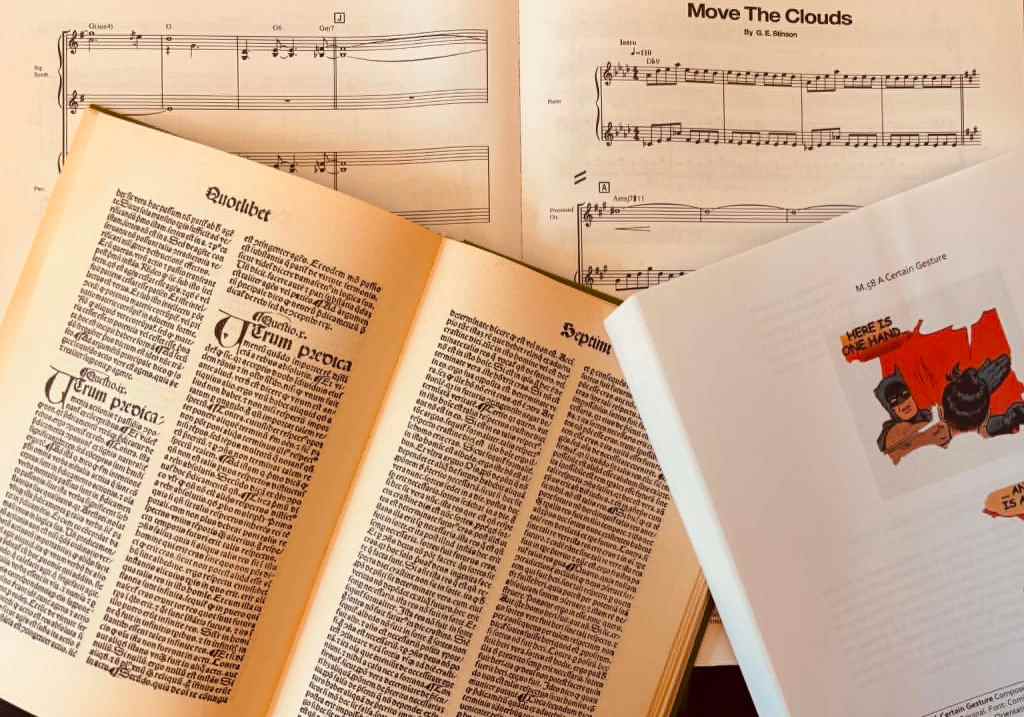
Let us begin with the following observation: we share a particular practice, namely, the ability to read. Let us add another observation: when we read the texts of others and when we write, we generally assume that others can and could do so as well. But can we read just anything? Medieval texts, musical notation, or logical formalizations, for example? If not, it is because we have not acquired certain abilities. The idea behind this is that we could simply acquire them. But could we really? Might we not instead imagine that the reading competence we share is something we can lose? What exactly would be lost then? Presumably certain ways of accessing the world, certain forms of world-disclosure, certain epistemic possibilities. As I will argue, above all a particular capacity for taking distance in thinking and imagining. Two questions arise here:
- What does it mean not to possess this competence and to acquire it gradually?
- How could it also be lost again for us?
Accordingly, I want to develop two scenarios: one past and one future. Let us begin with reading competence and its acquisition.
What Is Reading Competence?
Reading is notoriously difficult to define. According to a common definition, reading means “mentally or aloud reproducing written or printed words by following symbols with the eyes or fingers.” Whatever definition one adopts, the concept seems to oscillate between, on the one hand, a physiological and perceptual process of “taking in” or “reproducing” what is written and, on the other hand, the process of “understanding” the text. The term “reading” refers to both aspects, and the two are connected. Nevertheless, one may arguably do one without the other. One can read without understanding, and one can understand without currently “taking in” text. Anyone who has ever tried to translate a difficult passage in a foreign language can easily recognize this phenomenon. One takes in the written words without understanding them, stores them in memory, and only later does the correct translation “dawn” on one. Reading is therefore not a success verb; yet experienced readers today often no longer notice that the processes of decoding and understanding can come apart. The distinction is easily overlooked but important. The perceptual intake of written signs is usually described as decoding, which in turn refers to the internal or external “pronouncing” of written words. Watching children learn to read—slowly producing the sounds of a word until they recognize its spoken form – quickly reveals how much effort is required to acquire this type of decoding competence. Understanding what a word means (whatever exactly that may entail) is a very different process. Sometimes recognition of the sound coincides with the word suddenly making sense. Sometimes the sound is there, yet it obviously cannot be connected to a meaning. To grasp how these processes diverge, we must make a little effort.
The Discovery and Objectification of the Written Text
Imagine monastic life in the twelfth century. Reading was presumably often tied to looking at a manuscript page, a page filled with a stream of letters and abbreviations, frequently lacking punctuation, paragraph breaks, and all the structuring features to which we are accustomed. How, then, does a text become an object in the sense we know it—something abstracted from the physical page on which it appears? Ivan Illich, who studied this tradition and its transformation, writes about the shift from the murmured reading of monks, bound to the manuscript page, to the structured scholastic text:
“With the separation of the text from the physical object, the Schriftstück, the world itself was no longer the object to be read but became the object to be described. Exegesis and hermeneutics became interventions into the text rather than into the world. Only now, when the world is understood as coded information, can the history of the ‘readability of the world’ become an object of research.” (Ivan Illich, In the Vineyard of the Text, 1991, p. 124)
This idea radiates in many directions. What seems decisive to me is that, at a certain point in history, the text itself could become an object. For that to happen, a certain fluency in reading had to develop. Compare musical notation or formal symbolic languages. Some people can “read” an entire piece of music or a logical inference. Beginners like me must laboriously translate notation into actions on an instrument. Before a melody emerges, I must play each note slowly, one by one. For a melodic flow to arise, I have to memorize the notes – much like a child learning to read.
The difference is that today’s child grows up in a culture surrounded by adults who read fluently. According to Illich, medieval monastic reading before the development of more organized textual structures should be imagined as similarly laborious. Yet in that culture, competent reading had not yet become a habitual adult skill. What I mean is this: we find here a reading culture in which reading remains closely bound to contact with the material carrier of the text, a culture in which the text as an abstract object – something one can simply think about – is not yet available. As Illich suggests, a form of world-disclosure that is ordinary for us simply did not exist there.
What changes with the rise of the scholastic form? Written language is distinctive: together with acquired reading competence, it enables distance and thereby playful, dialogical, and systematic forms of engagement – not least epistemic and imaginative reading, both of which require a certain distance from the physical text. Scholastic texts typically require readers first to understand their organization. The quaestio format follows a set of rules that became increasingly refined over time. Today we may find this tedious, much as we may find the structure of a standard academic article tedious: thesis, counter-thesis, one’s own position, argumentation, and responses to objections.
The form may seem dull, then as now. But the point is that it structures the text in such a way that the structure itself becomes readable. We can abstract it, recognize it, and transfer it elsewhere. Reading becomes a structure that can be stored and carried away. The text becomes an abstract, tool-like instrument of thought or imagination, no longer tied to the immediate reading of a page. You know – or at least expect – what comes next. The reduction in cognitive load produced by this structure is immense.
As Lavinia Marin has shown, the text became the university’s epistemic instrument. The history of this kind of text is inseparable from the history of the university itself. The text became the instrument of thinking par excellence. For this to happen, the text first had to become abstractable through structure. Consider what this means. Perhaps you are like me: when I think about an idea or phenomenon, I often make progress the moment I remember a particular formulation or passage that strikes me as insightful or problematic. If I want to think about situatedness, I turn to Thomas Bedorf’s book, locate relevant passages, and remember them. This may seem ordinary, but it is not without presuppositions. How do we know how to use books this way? How do we know to read from left to right, to jump around and return to passages, to make notes and reflect on them, to remember them later?
These are all techniques of book culture, made possible by abstracting from the physical page to something we assume describes reality and can be appropriated by us. We who are gathered here learned this laboriously, step by step—from identifying letters to skillfully navigating books, cross-referencing other books, recalling passages, and writing our own texts. But because it was learned, it is conceivable that we—as a group, perhaps even as a species—could unlearn it. And this brings me to a possible future.
Foundations of Distanced Reading
Looking back briefly, the abilities I have emphasized depend on a certain condition: texts that are structured as epistemic instruments and can be grasped through that structure. Crucially, such structures allow distance from the physical page or from a particular act of reading aloud. We are so proficient in this distanced relation to texts that we can discuss them without having read them fully or linearly. Given the contingency of these abilities, it is conceivable that they could fade away. But why should they? I want to prepare an answer with two thoughts about the preconditions of our reading culture.
1. Text Use Requires Shared Purposes and Contexts of Action
Following Ruth Millikan, I assume that linguistic expressions are cooperative signs that arise and stabilize through use by producers and consumers of signs. Greeting rituals provide a simple example. If I say “hello” and no one ever responds, the sign will not become established. The same applies to written texts. Reading is only one half of a cooperative process involving readers and producers. These signs stabilize because they serve shared functions and purposes. They belong to contexts of action in which certain functions can be fulfilled. If I handed you a shopping list, you would probably understand what I wanted from you. That you do not go shopping for me simply reflects the absence of the relevant context of action. The point is this: text use becomes stable only where shared functions and contexts of action exist.
2. Text Understanding Is Guided by Relevance Markers and Affective Components
But how is cooperation between users of signs established? Following Dan Sperber and Deirdre Wilson, I would answer: through relevance. Suppose I say, “It won’t be much longer.” You will likely relate that statement to my lecture. You interpret my words under the assumption that I am saying something relevant to you. Nothing in the sentence itself specifies that reference. Without relevance, the words are undecidable. You can decode them however you like, but the text remains uninterpretable. Often such relevance markers are tied to affective components that direct attention. The statement is not only relevant to your estimate of time; it may also address your boredom and produce relief.
From these two thoughts I draw the conclusion that written texts, too, are cooperative signs whose intelligibility depends on relevance markers and affective framing supplied by producers for consumers. Shared purposes and relevance markers explain both how texts become interpretable and why people undertake the effort of learning to decode them in the first place. If nobody around you used texts for thinking anymore and that function were delegated to large language models, your motivation to use texts in this way would likely diminish gradually as well. If canonical texts were no longer supplied with relevance markers – or were negatively framed – you might cease paying attention to them altogether and no longer understand why anyone ever struggled through Kantian anthropology.
From Book Culture to Online Culture
If the increasing fluency in handling texts during the rise of the medieval university transformed books into epistemic and imaginative instruments, how might digitization and social media change our relation to texts? The key difference, in my view, lies in linguistic form. Book culture follows the grammatical and pragmatic rules of written language. Online culture follows the grammatical and pragmatic rules of spoken language.
This may sound surprising, since online communication is written. My thesis, however, is that online culture rebinds writing to features characteristic of spoken language and oral culture. Digital culture produces a hybrid form: a written language that functions more like speech and is therefore sometimes called fingered speech. Why? Consider speed and affective embedding. Books are often used at a distance from immediate contexts of action and affective engagement. Online culture works in the opposite way. Written texts are directly connected to affective markers and prompts for action. You immediately see how many likes a post has received, who endorsed it, and what you are expected to do next – like, comment, share. Texts are surrounded by relevance markers resembling those found in face-to-face conversation. This has significant consequences for reading, decoding, and understanding.
The spread of literacy allowed texts to become increasingly detached from immediate contexts of action and relevance markers. Spoken language remains closely tied to such contexts. Written texts also depend on them, but in a distal and decoupled form, such that producer and consumer need not share a situation. This is one reason book culture allows abstraction and distance. Books do not simply land on your desk. They are recommended by friends or introduced through educational canons. Compared with online communication, books are associated with relatively few and relatively distant relevance markers.
Online communication is fundamentally different. Texts are embedded in a thoroughly affective environment. Not only are you told something is important and worth reading; you are also confronted with gamified evaluations and visible group affiliations. Following James Gibson, one could say that book culture and online culture present readers with fundamentally different affordances for action and interpretation. In book culture, texts can be handled creatively as instruments of thought or imagination because of this decoupling. Online texts, by contrast, are immediately embedded in affective and action-oriented contexts. Consider a tweet quoting another tweet. In book culture, quotations often function as evidence to be considered. On social media, they are instantly connected to in-group and out-group markers. The gamified context encourages immediate responses such as comments or likes. Of course, book culture is not free of affective framing. But these framings are far more detached from the act of reading itself. One can simply close a book without doing anything. This means that the decoupling of reading from immediate action contexts is a distinctive feature of book culture, even though books are never entirely detached from social contexts.
Conclusion: Consequences for Reading Competence
What effects does this have on decoding practices and text comprehension? In online culture, decoding occurs alongside markers of group membership, avatars, images, and indicators of social approval. Before reading the words, you already know a great deal from names and pictures. Understanding is then displayed not primarily through interpretation but through a follow-up action: a comment, a repost, a like. Reading comprehension is made visible through responses similar to those found in ordinary spoken interaction, where one nods, replies, or otherwise signals understanding. In genuine written communication – in book culture and, if you like, newspaper culture – these contexts of action and affective markers remain at a distance.
At first glance, one might think book culture and online culture compete, with one replacing the other: here distance and epistemic engagement, there affective communication marked by features of orality. But matters are not so simple. Online culture presupposes book culture. First, affectively embedding written texts requires the prior ability to abstract texts from their original contexts. Just as medieval monks first had to detach texts from the physical page before using them as structured tools of thought, we must first detach articles and texts from their distant contexts before reinserting them into the affective environment of social media. Second, although our understanding is increasingly organized through performative responses, the competence for distance-taking acquired through book culture does not simply disappear. At least for current generations, both cultures coexist, even if book culture already carries the scent of nostalgia.
Yet the affective embedding of books and screens differs profoundly. Whether digitization and the rise of typed speech will ultimately lead from the dominance of literate culture back toward a culture of orality – one that causes the possibilities of distance-taking to disappear—is something we cannot know today. What is clear, however, is this: If the culture of distanced reading, together with written language, is the precondition for the techniques of both book culture and online culture, then the form of situatedness bound up with it is contingent and therefore vulnerable.
In my view, what is ultimately at stake is not book culture as such, but the possibility of epistemic and imaginative distance—the possibility through which some of our most important capacities are realized. Whether that possibility will continue to be realized remains an open question.
Cross purposes in public discourse (audio blog)
Confronted …
Confronted with the suggestion that we should get an AI friend or AI carer, many of us are up in arms. Yet, confronted with the suggestion that we should have a long text summarized by an AI assistant, our reactions are mixed. What’s the big deal?
Texts as tools. But what for?
Reading books is slowly turning into a very special
skill again, like reading musical scores.
Currently, I’m reading an intriguing book by Lavinia Marin and am struck by a couple of thoughts that answer a number of questions I have been pondering on for the last year. The motto above captures the issue quite well. Drawing on Ivan Illich’s commentary on a 12th century text, Lavinia clarified how texts, in the context of early universities, might have become abstract “things” that allow us to think about and with them. At some point, then, written texts became, not just records of what someone had written, but tools for thinking. Things that allowed you to distinguish sections, jump back and forth, keep your attention on one paragraph, while side-glancing at another, and so on. Like you might now rush to the final sentence, wonder whether you’re really interested, and decide whether to stay on or go. Will you stay with me for a few more paragraphs? What I hope to do in what follows is suggest that our way of reading written texts might be changing in some crucial ways. And if it’s true that texts have been, inter alia, tools for thinking that might change, too.
Let me begin with an illustration: (1) I just went for a run. After some initial thoughts about the light drizzle my attention returned to a puzzling passage from William of Ockham’s commentary on De interpretatione. I first read this text very intently over thirty years ago when pondering on my MA thesis, but now came back to it with quite different questions. What I’m saying is: the basic ideas in the text stuck with me over thirty years, but now some new questions (about medieval theories of written language) drew me back in and had me wonder again what it all meant. (2) When I came back from my run, I gulped down some glasses of water, while setting eyes on the social media app Bluesky. My attention came to rest on what I took to be a slightly insulting response to a post of mine. I wanted to reply immediately but thought better of it, realizing that it kept nagging me until I wrote a lame retort. (3) Returning to my thoughts about reading books as being a special skill, I inserted a thesis into an LLM, prompting it to list empirical studies on the issue. The summaries the LLM generated had me think a bit, until I realised that the suggested stuff pushed me away from my initial questions and so I closed the pertinent tab.
Now I’m sitting here, writing and wondering what all of this means. Let’s just characterize these moments: Experience (1) is something I had learned at school and uni: I read texts; they stick with me; I think about them – interested but somehow dispassionately. Here, the text is a tool for thinking. Why so? Well, there are many points to be made, but a crucial part is that the text doesn’t come with indicators of immediate relevance. It’s not addressed to me; I have to make an effort to get it; the few relevance indicators that made me read it are kind of remote (like “you should read Ockham’s commentaries on Aristotle”). If linguistic sign use (the production and/or consumption of signs) is generally related to action cycles or to factors of relevance, this kind of reading experience is decoupled from either. Now, my hunch is that this decoupling of reading experience from immediate action cycles or relevance factors is actually what allows written texts to be tools for thinking: in being open to various readings they allow for internal dialogues with myself much more than spoken texts, a conversation for instance, ever could.
Now contrast this with experience (2). A crucial difference is that, even though it’s written language, the text not only addresses me directly but also elicits an affective response. Reading social media posts comes with lots of social cues (for instance about the desirability of aligning with them), signaling and pressure to respond. If what I recently wrote about so-called fingered speech is correct, this kind of reading experience is very much socially embedded in the way spoken language is, while the written form still suggests that it can be treated like a common written text – which is what I attempted in postponing my retort. My hunch is, then, that such texts are tools for thinking only for those who have undergone other experiences (like 1) with written texts. By and large, however, social media posts are tools for social alignment. If they fail in that, they prompt misalignment, and very quickly so. To see this, imagine yourself in a class or conference setting and think about how you socialize there in relation to a book and what sorts of exchange you might envision. Now imagine that you have just read a couple of outrageous social media posts by some interlocutor in the room. I guess that this might cause some irritation even if the interaction about the book is still sort of fine. Ultimately, the social media experience lures us into a different mode of interaction.
Finally, compare these experiences to the final example (3) with the LLM. The strange thing is that the LLM might be said to look like, depending on prompted style, an experience in line with (1) where the text is a tool for thinking, while at the same time the reaction of the LLM is as fast as the affective social media experiences in line with (2) can be. I don’t know what to make of this, but a first hunch is that this experience (3) drives me to consider both former experiences as meaningless. Why? I kind of see that the arduous production of a text in response to experience (1) can be done in a second, while I’d need days. On the other hand, the LLM also seemingly imitates an affective stance by generating kind sounding sentences on my prompt. I don’t know whether LLMs are tools then. Butr they clearly disrupt known uses of texts.
Summing up, I see three different reading (and pertinent writing) cultures: (1) one that has emerged during some centuries and allows us to use texts with sustained imagination as tools for thinking, (2) social media interactions that still look like written texts but have the relevance indicators and social cues of immediate interaction, and (3) texts that look like interactions and seemingly share elements of both while being neither. There is a lot of food for thought here. But what I wonder now is whether the kind of reading we’re socialized with mostly affects other modes of reading. In other words, has my exposure and upringing with experiences like (1) primed me for other text uses? Will so-called ‘digital natives’ be primed by the more interactive reading culture as illustrated in experience (2)? Will that mean that, for them, texts will no longer work as tools for thinking? Obviously, I don’t know. But it strikes me as a conversation worth having. It seems, then, that written texts can be tools for the various kinds of actions we perfom or undergo: (1) texts can be tools for thinking, (2) they can be tools for social signaling and hence mainly affective tools, or (3) they can be both and none of these tools at the same time, in that the products of LLMs might look like the imitation of either, while they are, in fact, just a distant echo of our reading and writing cultures. (OK, I don’t really know how to end this.)

