
Imagining features of a text’s author is part and parcel of the reading process. This might range from imagining the voice of the writer (especially if you know them) to their political identity. While having recourse to imagining the author is often decried as committing the intentional fallacy, it’s obviously an important part of comprehending the perspective from which a text is written and understanding the kind of action a text is embedded in. But apart from imagining the author, it’s equally crucial to imagine the responses of other readers to the text at hand. What will the neighbours say, if they see what I’m reading? As I see it, then, reading texts is a social practice in that it requires, inter alia, imagining the author and other readers (for a more detailed sketch, please see below).* If social imagination of this sort is indeed crucial in reading, it’s clear that the possibilities of AI use present us with many and somewhat polarising challenges: While the polite and impersonal voice of LLMs suggests for many the ideal of an ideal neutral author, others stress their unreliability in the light of common biases and bullshitting. In any case, our reading processes are greatly affected by the virtues or vices we ascribe to AI text production. In what follows, I would like to suggest that we might benefit greatly from reflecting on our ways of dealing with (AI) authorship.
Recently, a couple of social media users on X used the LLM Grok to summarise their political leanings based on an analysis of their tweets. It was one of many memelike uses of LLMs as a supposedly reliably neutral commentator on some state of affairs. The expectation of many users (often framed as politically right leaning) seems to be that the LLM is a reliably neutral ‘reader’ of their tweets and thus that onlookers will be aptly infomed about the diagnosed political leanings. My personal reaction to seeing these tweets wasn’t the perhaps intended “oh, that’s what they are like” but rather “why on Earth would someone have an LLM summarise and publicly display their political leanings?” Yet it doesn’t matter much what I think. What’s interesting is that some people like to be ‘read’ by LLMs. As I said, my hunch is that many people think that LLMs are neutral readers.
By contrast, many others (often framed as politically left leaning) will quickly point out that, firstly, there are no neutral readers and, secondly, the very idea of LLMs being neutral is owing to a problematic set of biases (about certain perspectives being construed as neutral). Their expectation seems to be that such uses of LLMs is reliably biased, portraying white male perspectives framed as neutral. My personal reaction to seeing such reactions wasn’t the perhaps intended “oh, that’s what’s going on” but rather “why on Earth would someone portray an LLM as biased?” Yet it doesn’t matter much what I think. What’s interesting is that some people take LLMs to be ‘reading’ in a biased way, which means, after all, reading with a (human) perspective.
What both, left and right leaning, attitudes disclose is that they project virtues (neutrality) or vices (biases) onto LLMs as readers and anticipate or attempt to guide the reactions of fellow human readers. However, we should begin to recognise that LLMs are not readers in the way we are or desire to be. LLMs may provide us with new ways of imagining what others make of our texts. But they are not readers in the way we are or desire to be. Yet,what they do is change how we imagine readers, including ourselves. LLMs, then, challenge the ways in which we read in many unprecedented ways. One of them being, that we are either suspicious or proud of them picking up on what we deem important. Asking ourselves (and others) whether something we read involves AI use is a new and crucial line of demarcation in our reading culture.
___________
* The five dimensions of reading a text as a social object:
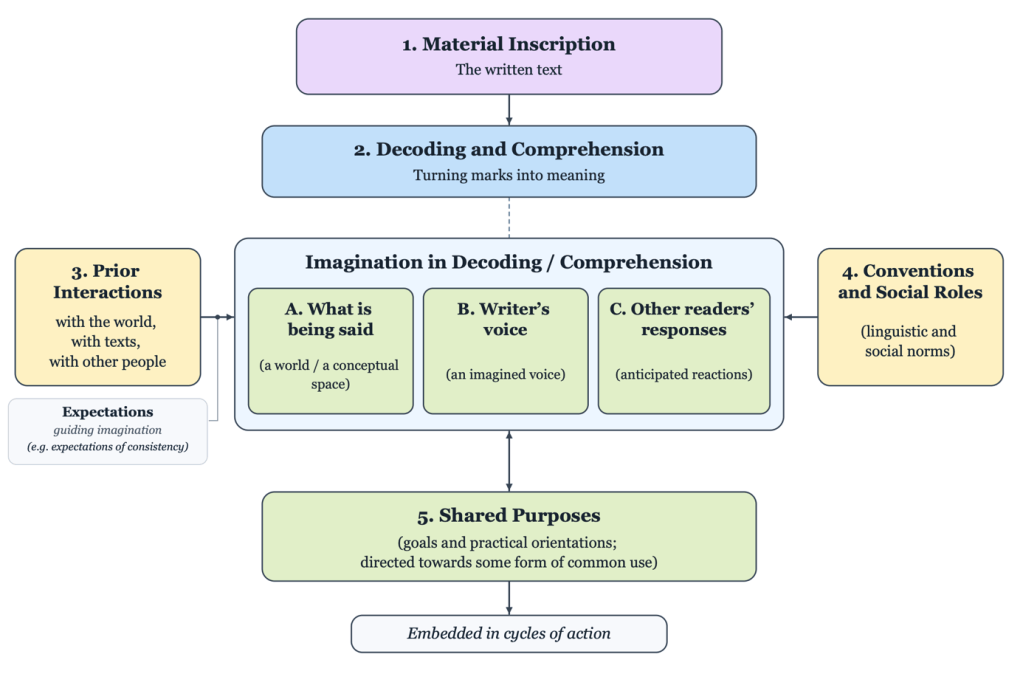
The first dimension is material inscription. The second is the process of decoding and comprehension. Put simply, decoding consists in sounding out what is written into spoken language. Comprehension of what is written turns on linguistic knowledge and the decoding process. Now let us zoom into the processes of decoding and comprehension via the reader’s imagination: This imagination is directed at three items:
- First, there is the imagination of what is being said. One might call this the imagination of a conceptual space or a world within a mental model.
- Second, there is the imagination of the writer’s voice, which feeds back into the comprehension of what is said.
- Third, there is the imagination of the responses of other readers. For instance, one might experience what is said as shameful, dangerous, good, or something else.
These imaginative operations of decoding and comprehension depend on prior interactions. In fact, the imagination in the flow of reading is guided by expectations that constrain what is imagined and projected into the future text (cashed out, for instance, as expecations of consistency). The prior interactions are:
- on the one hand, interactions with the world and with texts;
- on the other, interactions with other people, such as writers and other readers.
These prior interactions, in turn, have to be understood in relation to certain linguistic conventions and social roles. Finally, what mediates between these imagined and actual interactions between readers and others, or between readers and the world, are shared purposes. These purposes, in turn, are directed towards some form of common use, embedded in cycles of action.

