
A major conference on early modern philosophy brought together guests from all over the world on the Hagen campus. Organizer Prof. Martin Lenz explains what it was all about.
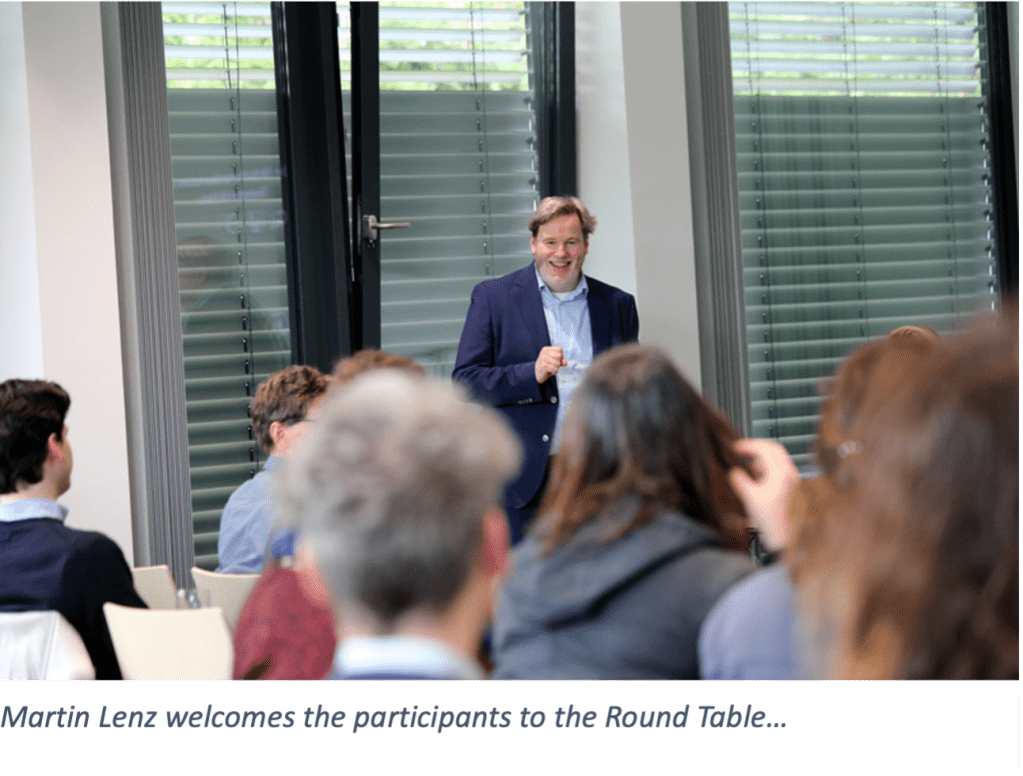
The society has come full circle: In 2004, the European Society for Early Modern Philosophy (ESEMP) was founded with a conference at the FernUniversität in Hagen – on the initiative of Hubertus Busche, who headed the Philosophy I department at the time. Now, around 20 years later, the professional society is inviting participants back to Hagen: to the 7th International ESEMP Congress: “Why and How Do We Study Early Modern Philosophy Today?”
Martin Lenz has headed ESEMP for the past three years, and since 2024, he has also lead the Philosophy I department. He was the lead organizer of the international meeting in Hagen. The German Research Foundation (DFG) supported the conference with its diverse program – from the Early Career Session to the round table. Keynote speakers were Mogens Lærke (Oxford) and Anik Waldow (Sydney).
Clearly identify aims
“We talk far too rarely about the aims, why we pursue our studies in the first place,” Lenz says, highlighting a basic assumption of the conference. What does this mean? “In philosophy, we have what’s known as canon expansion, for example. This means we’re trying to expand the canon with people who have hardly been read before.” These usually include members of underrepresented groups – such as female philosophers. But why expand the canon at all? Why not stick with the older works? “In this case, the answer seems to be a political one,” explains Lenz. “There is the goal of equality, which is followed by a research agenda.” As a researcher, he identifies with this concern. Nevertheless, it is important to reflect explicitly on such objectives, the “why?” – if only to choose the right method for one’s own work.
Utilizing a variety of methods
“And our methods in philosophy have become very diverse these days,” Lenz says, addressing the second major conference question: “How?” Sitting in a quiet room with dusty books? Academic work increasingly rarely corresponds to this image. “Digitalization has brought us many possibilities.” As an example, Lenz cites the so-called Digital Humanities – a still fairly young movement within philosophy that utilizes digital tools. “It’s often about making texts accessible, producing editions, or recognizing frequencies,” says Lenz. “For example, I could instruct an artificial intelligence system to search for all dissertations on a certain topic in a specific region.” Such a computer analysis can, among other things, help to counteract prejudices and subjective misconceptions: “You can then see, for example, that ‘Philosopher X’ wasn’t actually as dominant in their era as assumed.”
“How did we get here?”
For Lenz, the questions of “how?” and “why?” lead to fundamental considerations about the relevance of his discipline. “If we want to understand ourselves, we find ourselves in different histories – depending on our individual backgrounds. For example, can one understand the FernUni as a project if one is unfamiliar with the educational policy situation in North Rhine-Westphalia in the 1970s?” For him, history is not a linear process that inevitably ends in progress; it is asynchronous and dependent on subjective preconditions. “How did we get here? And why haven’t we all arrived at the same point?” Properly applied, philosophy helps answer such questions and organize narrative threads in the history of ideas.
Suggesting alternatives
Although philosophy often remains self-referential, it can provide new food for thought: “Philosophy does not thrive on progress, but on repeatedly returning to themes. It could be viewed as a great conversation spanning all time – within this, however, one often discovers alternatives to the prevailing thinking.” Lenz also locates the lively debates of the international conference in this interplay of old and new, established and alternative.
A vibrant campus
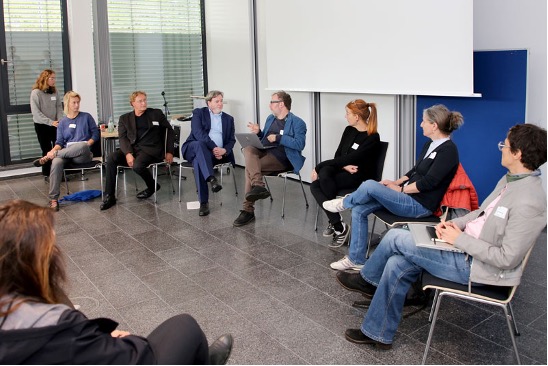
Breaking down established structures wasn’t just about the content: “With the conference, we also offered mentoring for researchers in early career phases.” They were assigned mentors in keeping with specific keywords, thus creating professional tandems. “Established people then attended lectures given by younger people and were able to provide feedback – and, conversely, gather new ideas themselves.” The plan worked, with all generations mingling at the conference. “My impression was that it was very well received.” The coordination both beforehand and on-site paid off. A large team was needed to effectively support the many people on campus and during the supporting program in Hagen. “There was a lot to do!” emphasizes Martin Lenz. “I would like to express my sincere thanks to everyone who helped.”
**
Interview and photos by Bendedikt Reuse
Translated from the German by Martin Lenz
 Handling Ideas
One thought on ““The aims are discussed far too rarely” – An interview about the latest conference of the European Society for Early Modern Philosophy”