
What makes LLMs so successful? I don’t mean their functions in pattern recognition and so on. I mean: why do we or at least many of us use them in so many contexts? I guess they seem to provide something that we often miss in our interactions with fellow humans: politeness. – Let me explain: Whenever I read social media posts, I notice that the tone is often quite problematic: Going by the common modes of expression, we’re often surrounded by dogmatists, cynics, know-it-alls, bullies and other short-tempered fellows. Now, I doubt that people usually behave “in real life” as they tend to do on the internet, but the trouble is: on social media, style is all we have.
My guess is that we’re not exactly made for this disembodied kind of communication: we lack typical cues of body language and the humor of face-to-face interactions or the restraint that we once learned to exercise in mail exchanges. Contradicting your interlocutor with a friendly smile might be fine, as might be breaking troublesome news in a sincere piece of writing. But contradicting a stranger who hasn’t quite made their point yet or bursting out with bad news on the spot doesn’t go down well. Although we do it all the time now, we’ve not adapted well to communicating this way.
By contrast, LLMs are made exactly for this kind of environment. In fact, they have no other environment called “real life”. There is quite a bit of discussion on the politeness of LLMs, but it’s clear that they have been trained to react with polite and partly even deescalating language. Now, while I don’t think that the polite language is the reason we initially turn to these devices, it’s what makes us or some of us stay with them. It’s utterly frightening to see how some people seem to assume that they’re entering real therapeutic or romantic relationships, but given the typical reactions of LLMs the attraction is quite understandable.
Thinking about this on and off, I’m inclined to conclude that these LLMs satisfy a need we have especially in the online culture: politeness. This conclusion came as a real surprise, though. After all, politeness is often mistaken for mere formal behaviour and thus distinguished from real friendliness. In a culture that often prides itself on “authentic” rather than polite communication, I would have thought that chat bots prompt cynical reactions rather than any temptations. But the standards of authenticity don’t work in online interactions with strangers that don’t belong to one’s tribe. There, interactions with people trying to sound authentic prompt more often than not hate or misunderstandings at best. In this environment, the most formal blather of chat bots mimicking politeness seems to be rather attractive.
The moral is: let’s practise politeness – online as much as offline. In online contexts, this means first of all practicing polite conversation. (Having just finished a paper on the notion of conversation, I realise that polite conversation is one of the great achivements of humanity that might be under threat through digital communication.) And one of the first things to remind ourselves of is that conversations do not, at least not first and foremost, consist of claims, arguments or evidence. In this spirit, let me finish with a passage from Michael Oakeshott from his The Voice of Poetry in the Conversation of Mankind (1959):
“We are urged, for example, to regard all utterances as contributions (of different but comparable merit) to an inquiry, or a debate among inquirers, about ourselves and the world we inhabit. But this understanding of human activity and intercourse as an inquiry, while appearing to accommodate a variety of voices, in fact recognizes only one, namely, the voice of argumentative discourse, the voice of ‘science’, and all others are acknowledged merely in respect of their aptitude to imitate this voice. Yet, it may be supposed that the diverse idioms of utterance which make up current human intercourse have some meeting-place and compose a manifold of some sort. And, as I understand it, the image of this meeting-place is not an inquiry or an argument, but a conversation. In a conversation the participants are not engaged in an inquiry or a debate; there is no ‘truth’ to be discovered, no proposition to be proved, no conclusion sought. They are not concerned to inform, to persuade, or to refute one another, and therefore the cogency of their utterances does not depend upon their all speaking in the same idiom; they may differ without disagreeing.”
*
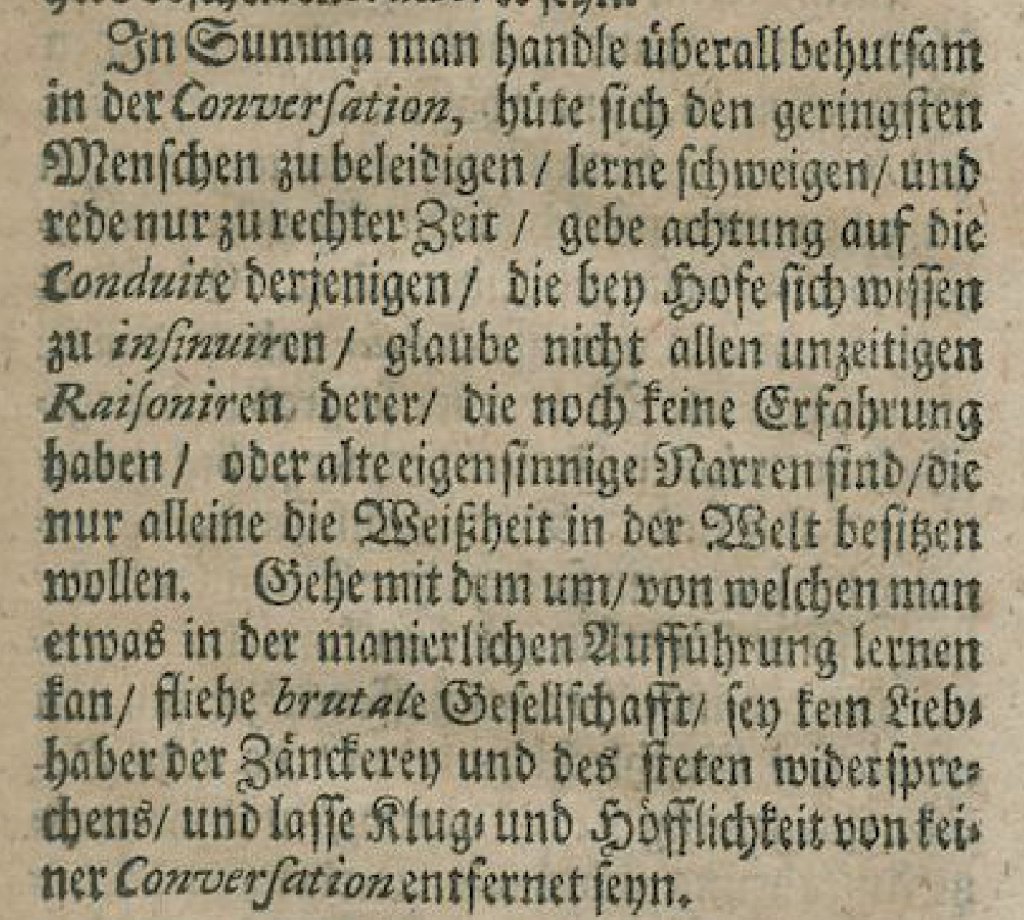
Friedrich Wilhelm Scharffenberg: Die Kunst des Twitterns (Chemnitz 1723):
 Handling Ideas
Finally had a chance to read this, almost a month after I saved it to read later…
I really enjoyed this. I don’t think I’ve seen anyone else saying anything like this elsewhere, either.
LikeLiked by 1 person
Thanks, Sara! Yes, I had a couple of interesteing conversations about this observation by now.
LikeLike