
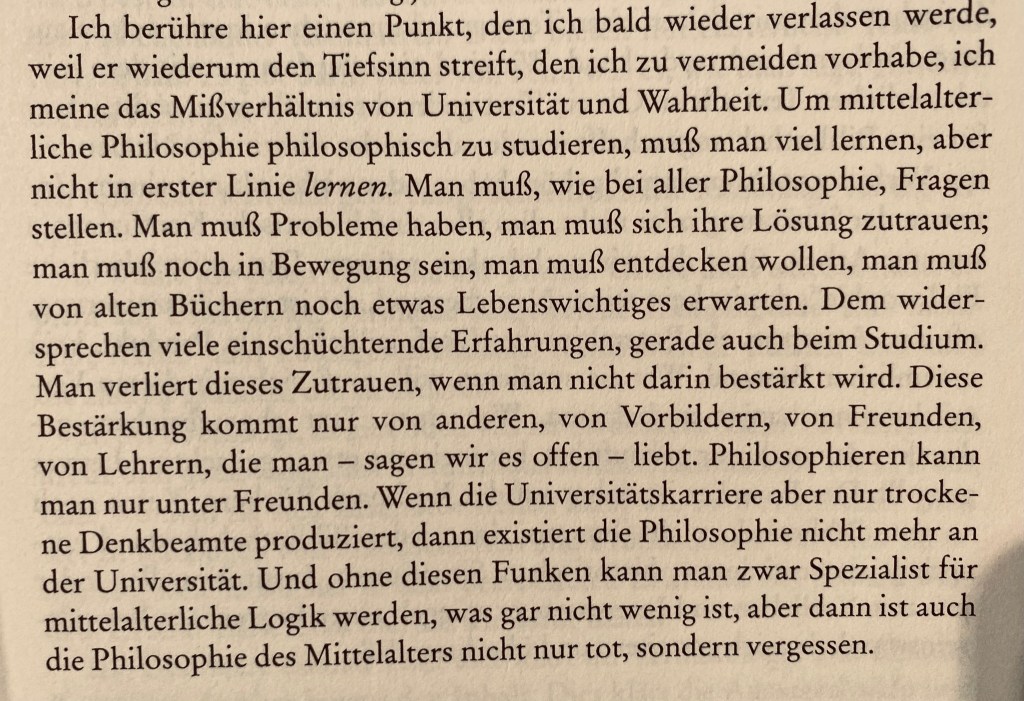
“I am touching on a point that I’ll soon leave behind again, since it relates to the profoundness that I intend to bypass, I mean the disparity between university and truth. To study medieval philosophy in a philosophical way one has to learn a lot, but one should not prioritise learning. As with any kind of philosophy, one has to ask questions. One has to have problems; one has to have confidence in being able to solve them; one still has to be on the move, wishing to make discoveries, wishing to learn something of vital importance from old books. This is countered by many intimidating experiences, especially during one’s studies. One loses this confidence if one is not encouraged. This encouragement comes only from others, from role models, from friends, from teachers whom one – let’s be frank – loves. Only among friends can one do philosophy. But if university career paths merely produce sober thinking clerks (Denkbeamte), then philosophy does no longer exist at universities. And without this spark you might still become a specialist in medieval logic – which is no small endeavour – but then medieval philosophy is not just dead but forgotten, too.”
Kurt Flasch, Historische Philosophie, 2003*
In times of increasing worries about ChatGPT and education systems more generally it’s soothing and inspiring to re-read some of the works of my teacher Kurt Flasch. Neither he nor my PhD supervisors Burkhard Mojsisch and Gert König were very good at preparing me for a career on the international job market, but they surely inspired some resilience against its crushing mechanisms. Re-reading the passage I translated above made me think about love of teachers again. Not in the recently well-rehearsed sense of academic ‘metoo stories’, but in the sense of what I’d like to call love as imitation. I know there are a lot more topics in the offing, but the idea of love in academia is, as far as I can see, perhaps the least understood.
So what does it mean to love a teacher? – Quite simply, to love one’s teacher means wanting to be like them. While it might involve interacting with them on some level, the crucial aspect is wanting to become like them, and that means, for instance, approach problems like them; speak, sound and listen like them; read like them or perhaps even enter into the form of life displayed by them – in one word: imitate them. (As I have argued earlier, love is, amongst other things, the ability and desire to understand another person. A strong way of understanding the other, then, is imitating them.) When I was a student, I had a couple of professors I really loved in that sense. I ended up following their courses, not primarily because I was into the topic all too much, but because I thought that, whatever they would teach, I would be learning something worthwhile. But how do you learn, how does that kind of love play out? While I was (back then) completely unaware what that meant, I just attempted to imitate them. This was quite palpable to me. When I wanted to pursue a certain (stylistic) approach, I would simply hear and try to imitate their voice in or their style when writing. – You might find this strange, but that’s probably what’s going on when we learn to find our voice in any kind of art, be it playing music, trying to paint or draw, or trying to speak and write.
Shouldn’t we aim at independence? – I guess the reason why imitation is so underrated in teaching is that we’re told to value independence. This is a fair point, but there are two issues that should be considered in response: Firstly, there is no independence without belonging. We’re not monads but always relating to a form of life and style that allows us (and others) to recognise that we’re engaging in the kind of practice we wish to engage in. How do I know I’m playing music if there is no one I’m relating to in my musicianship? Secondly, when we imitate we are never perfect imitators or impersonators – we end up appropriating and making things our own. So when I imitate my favourite teacher, you won’t hear Kurt Flasch but – willy nilly – an appropriation of his approach. In fact, the initial enthusiasm for pursuing something is fostered most by imitating a role model, be it a musician, an actor or a philosophy professor. In doing so, we might begin by rehearsing the things – half understood – we value most. After a while, though, we’ll find them pervading what we take to be our own voice.
Where to go from here? – Being a teacher myself, I think I should be aware of the facts surrounding the imitative ways of learning. After all, students don’t do as we say but imitate what we do. So if we act mainly as competitors on “the market”, students will see and imitate us in this respect. If we’re policing them as potentially fraudulent users of ChatGPT, they might follow suit. But what if we were to follow through with the idea that the best kind of philosophy develops in a community of friends?
_____
* Kurt Flasch, Historische Philosophie, 2003, S. 67:
 Handling Ideas
this is so true; thank you
LikeLiked by 1 person
I very much agree with Flasch that “only among friends can one do philosophy”. What helped me regain my love for (doing) philosophy at a time where I questioned much of my professional life were informal meetings with a small group of “Mittelbau” colleagues where we cooked, dined, and discussed some (usually older) paper on some philosophical topic outside of our areas of specialization — without any felt need to “get it right”.
LikeLiked by 1 person