
Imagine a tulip! Now let me tell you that every tulip is a flower. – What is the difference between these two previous sentences? Among the many differences, the first invites you, diligent reader, to do something, whereas the second does not. Arguably, the first sentence is somehow incomplete without your cooperation. You have to do some imagining and it is not set in stone that what you do is entirely predictable to me, the author of that imperative clause. For one thing, I can’t anticipate the colour of your imagined tulip. Although I’m almost certain that you imagined a coloured tulip, not a colourless one. In what follows, I’d like to suggest that certain (philosophical) texts demand our cooperation. But they do this not just in the sense that our reading might be less boring if we actively think along. Rather, our thoughts and experiences are part of the argument or project. I think this suggestion matters greatly in that this cooperative feature of texts is often ignored, especially in early modern texts. Hence, the way early modern arguments work is often misunderstood.
As some you know, I’ve just co-organised a workshop on reading as a social practice.* While my head is brimming with thoughts of my interlocutors that I have yet to work through, I’ll try to wind down by following up on an issue that had occupied my mind since I began pondering on my Socializing Minds and was brought to light again especially when listening to a brilliant talk by Dana Jalobeanu on “Interactive Reading of Francis Bacon’s Novum Organum” (you can find the abstract here). According to her, Bacon’s
“Novum Organum was actively read in a distinctive, collaborative manner that requires careful reconstruction. Focusing on the early Royal Society, I show that some of the virtuosi pooled their intellectual resources to decipher and interpret Bacon’s text. Their reading practices were not solitary acts of comprehension, but collective efforts to engage with, extend, and enact Bacon’s larger project. Rather than treating the Novum Organum as a self-contained treatise, these readers approached it as a repertoire of experiments (“instances”) and methodological exemplars, and as a “to-be-completed” fragment of the broader, unfinished Instauratio Magna. They became active collaborators, interpreting, testing, and “relieving” (Beale, 1666) parts of Bacon’s work, subsuming the results into their own projects.”
In the discussion of the paper, we considered whether the prompting of such interactive reading might have been a more common strategy. I vividly remembered Locke stating that he makes his argument for the origin of ideas dependent on the readers’ cooperation:
“I suppose what I have said in the foregoing Book will be much more easily admitted, when I have shown whence the understanding may get all the ideas it has; and by what ways and degrees they may come into the mind;—for which I shall appeal to every one’s own observation and experience.” (Locke, Essay II, I, 1)
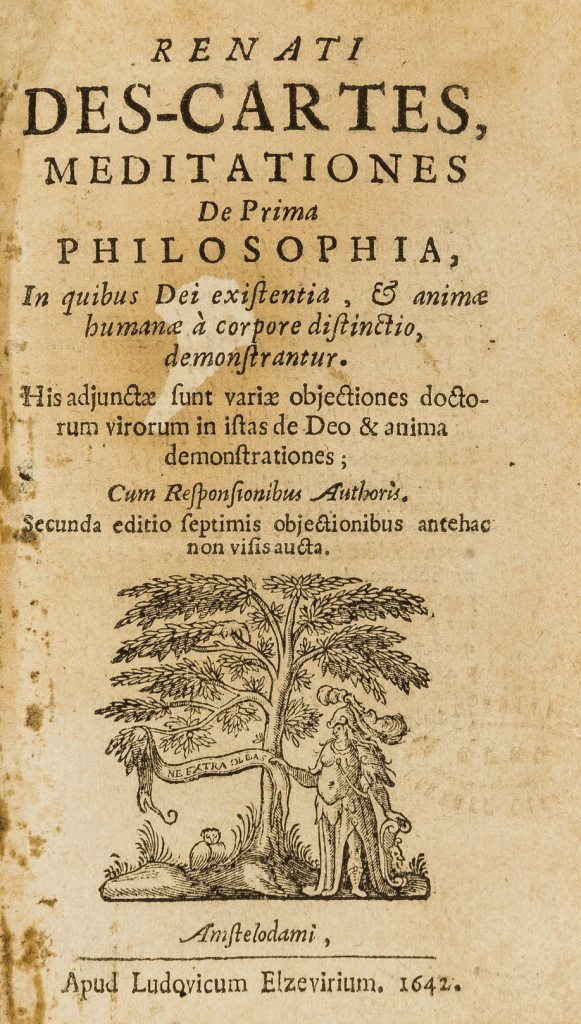
This appeal is not a mere trope. The argument relies on the readers’ experience. Likewise, Descartes’ Meditations are not a solitary exercise. Apart from the fact that Descartes was adamant that they be published with the Objections and Replies, he insists from the beginning that the reader meditate with him.
As Catarina Dutilh Novaes has shown in her The Dialogical Roots of Deduction, logical and mathematical thinking have often been designed as dialogical activities in ancient and medieval contexts. While she paints an intriguing picture of this practice, she repeats the assumption that early modern authors pushed it to the fringes in favour of a mentalistic and individualistic understanding of reasoning (see this paper for a bit more discussion). As I see it, the prompts of collaborative reading show that this picture needs correction.
At the workshop I asked Dana what she thinks might make us so ignorant of this collaborative strategy in early modern texts. Her reply was that readings inspired by 19th-century assumptions about philosophy being a systematic endeavour might have contributed strongly to this. Indeed, if you think that a text gives you a system, you will assume that it was designed with the aspiration of providing a systematic whole. Something that does not rely on the (contingent and only partly predictable) cooperation of the reader.
Of course, this doesn’t mean that the 19th century leaves us with a final shift to systems or at least to texts that merely count on the readers’ silent comprehension. If you think of texts appealing to future readers, as for instance in Nietzsche or in attempts at ameliorative conceptual engineering, you recognize something like trend of collaborative reading, named “philosophic prophecy” by Eric Schliesser.
Why don’t we recognize this when we’re met with it, then? Does the common paper model, favouring the defence of claims., make us blind to these reading strategies? Be that as it may, perhaps the advancement of prompts for LLMs will raise awareness of this feature again.
______
* I’m enormously grateful to everyone at this fabulous workshop. Special thanks to Dana Jalobeanu and Valentina Sperotto for discussing this mode of early modern reading.
 Handling Ideas