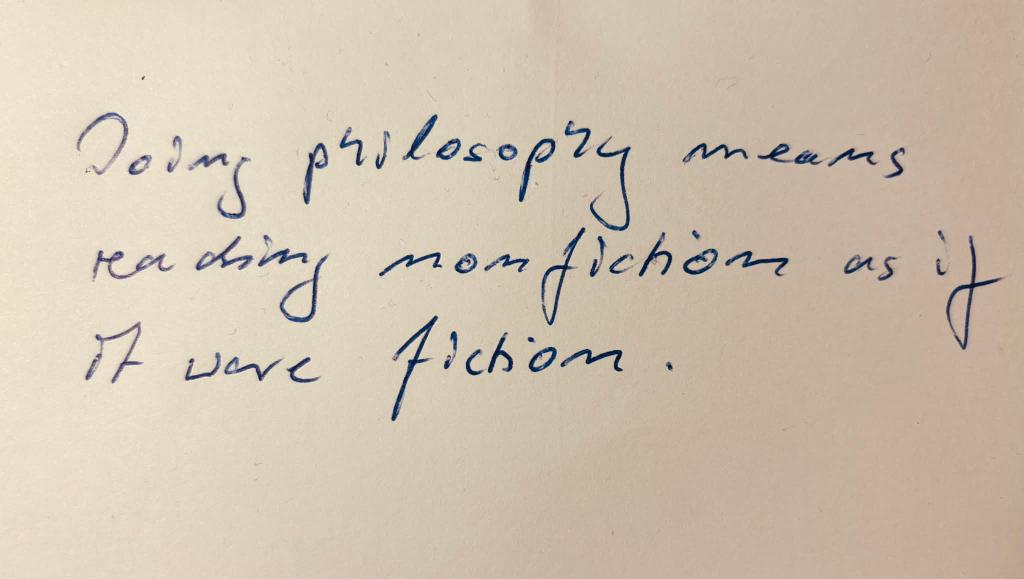
Doing philosophy …

Published
Bringing philosophy to everyone through walking, talking, and making
Reflections on Sound, Life, and Literature
The Metaphilosophy Blog
A blog on (writing) philosophy
what it's like to move instruction online
Tidying up my bookmark toolbar by blogging
Karen Rann investigates the invention of contour lines
A Philosophy Blog
Philosophical Temptations
The Vim Blog ▽
Out of the crooked timber of humanity, no straight thing was ever made
fortuitous encounters of words and sights
A blog on (writing) philosophy
A blog on (writing) philosophy
A blog on (writing) philosophy
A blog on (writing) philosophy
Getting distracted by ideas
A blog on (writing) philosophy
A blog on (writing) philosophy
A blog on (writing) philosophy
The Official Blog of the American Philosophical Association
An Everyperson Monthly on Philosophical Practice
A blog on (writing) philosophy
A blog on (writing) philosophy
News and notes for the medieval philosophy community
A Group Blog in Modern Philosophy
news for & about the philosophy profession
A blog on (writing) philosophy
 Handling Ideas
I am currently preparing for a demonstration lesson in which I’m planning to analyze the fictional case of Ivan Ilyich in philosophical terms — so I was wondering whether the converse might be true as well 🙂
LikeLiked by 1 person
By all means 🙂
LikeLike
This seems to me a very deep thought. We also read very good fiction as an interpretation of our world, not just as entertainment. The fictious simulation of a world is a method for getting insights about the facts by which we are surrounded., arranging them in a new pattern. Making a new world in art or philosophy (in the sense of Nelson Goodman), and interpreting the world, we have to live in, are not sharply distinguishable activities, it seems to me. Philosophies like the one to be found in Plato’s “Republic”, Leibniz’ “Monadologie” or Peirce “Evolutionary Love” are like fictions, I would almost say like fairy tales. They give us a way to see our world without just stating facts. The same happens in Dostojevski’s “Idiot” or in Melville’s “Moby Dick”. The criticism of speculative philosophy is often motivated from the inability to read philosophy like fiction: “Are you serious? the world consists of monads?” Believing philosophy to be a plain explanation of facts is not taking it seriously enough. Good fiction and good philosophy is much more ambitious than explanatory theory. They want us to understand the world in a new way: “Try to look at the world like a play of shadows of eternal ideas, like a system of souls mirroring each other…”
LikeLiked by 1 person
Many thanks for this. When trying to formulate the idea, I wasn’t sure about the many directions in which it strikes out (and I’m still not quite sure). But your reading sounds like a great way foreward and worth pursuing much further.
Initially, I was thinking of the ‘open attitude’ that reading fiction requires of us, i.e. the openness for ambiguities that seem constitutive for fiction. Such ambiguities seem completely undesirable in common nonfiction. But then it struck me: much philosophy seems to thrive, not exactly on ambiguity, but on our attitude of reading the texts (and the world) with the kind of openness that we usually seem to reserve for fiction (perhaps things are not what they seem; what if things were entirely different etc.).
Saying that “making a new world … and interpreting the world … are not sharply distinguishable activities” articulates the required attitude even more clearly. What’s more, it also shows reading to be an act of writing (kind of).
Francis Bacon was clearly onto something when recommending fables to counter the idola …
LikeLike