Can the penny drop too late? Unrecognised slowness in (teaching) philosophy

Non scholae sed vitae discimus.

Once upon a time I received a flattering mail from a student, thanking me for teaching him to ask structured questions. “Although I really hated it at the time,” the student wrote, “I realised I could make great use of the technique some years later, especially since the pandemic started.” It goes without saying that this mail made me very happy, but what I’d like to point out is not that the penny dropped, but that it dropped too late. Too late, that is, to make it into the student evaluations. What we should conclude is that perhaps many of the crucial effects of teaching and learning manifest themselves much later in life than is standardly assumed. At least assumed when we design and assess tests of what has been learned. – Now that the murmur about hopes and worries about the coming academic year is all around, I often think of this mail and related experiences. What the student emphasised was that he could now make use of something he had learned so much earlier that it seemed almost disconnected to the course work. The lesson that I learned from this mail is that I have come to plan my teaching with way too much focus on goals that are supposed to be achievable within the time span of a course, visible at the latest in the assignments, visible ideally to the students, too, so that they can assess their “learning experience” accordingly. In what follows, I want to argue for a different timing in teaching philosophy. I’m a slow reader, thinker, and writer – and I have come, after a long time, to think that’s a good thing after all, so please bear with me. 

Student evaluations. ­– Although it is well known that student evaluations reflect biases rather than educational progress, they are still often taken as a legitimate form of feedback. “Well, of course, they’re bad, but they tell us at least something about the level of satisfaction,” is a line I often hear. The common response is to improve the questions on evaluation forms and think twice about using them too much in hiring and promotion. But as I see it, the problem is that both criticisms and refinements obscure the fact many effects of learning manifest themselves much later. When we advise students and teachers to focus on skills that afford employability, we pretend that the things we teach can be recognised as skills of that kind. Learning to ask questions or, as some prefer to say, “the right questions” certainly means acquiring a skill, but it’s clear that the student didn’t recognise this as something valuable at the time. The upshot is: Many learning goals might not be recognised as such during the time of instruction.

Learning outcomes. ­– What do you do if learning goals might not be recognised as such during the course. Well, you might just tell your students: “trust me, I’m a philosopher”! But that is not good enough when it comes to values such as accountability. So the alternative is to formulate different learning goals or outcomes, ones that are recognisable. Reading up on some of the pertinent literature, I was impressed to begin with. The fact that students cannot relate their performance to verbs such as “understand” or “analyse” in learning outcomes was met with the advice to formulate goals that can be recognised. So we are encouraged to use verbs such as “being able to present”, “respond to” etc. No doubt it’s easier to recognise that you’ve presented something rather than recognising whether you actually understood something. “Presenting” is a success verb, you can tell when it has been done. “Understanding” might seem to be a success verb, too, but arguably it’s an ongoing process. So it’s less clear what constitutes an understanding. While the advice to reformulate learning outcomes accordingly made sense to me when I read it, I have come to doubt it again. I’m expected to teach philosophy, not how to present. Of course, I also care deeply about how philosophy is presented, but does that mean that I can teach philosophical skills best by confining the goals of the course to something recognisable? I doubt that the answer is a clear ‘either-or’. But I think it’s problematic to give up on goals that we deem essential to philosophy. It’s not problematic because it’s simplistic; it’s problematic because it makes a false promise. “Doing philosophy”, “understanding” or “philosophising” are not success verbs. If anything it’s a coming-of-age kind of thing. Arguably, then, we don’t do our students a favour if we mainly aspire to “teach to the test”.

Some politics behind it. – Of course, it would be too simplistic to decry the status quo and glorify the olden days. But it’s important to see where much of this mind-set (aiming at recognisable goals in teaching) might come from. At least in many parts of Europe, an important turn was taken with the introduction of the so-called Bologna reform. While many aims struck me as noble back then, the way this reform has been carried out entails a number of consequences in line with the thinking criticised above. But whatever might drive this development, it’s not a law of nature that philosophy is taught as an easily reconisable skill set. At the same time, I am aware that the current zeitgeist will not allow for a straightforward acknowledgement of the slowness and indeed uselessness that doing philosophy might require. This is why I’d like to close with a quote by Richard Rorty that we might want to bear in mind when flying under the radar:

“So the real social function of the humanistic intellectuals is to instil doubts in the students about the students’ own self-images, and about the society to which they belong. … Somewhere deep down, everybody – even the average taxpayer – knows that this is one of the things colleges and universities are for. But nobody can afford to make this fully explicit and public. … This tension between public rhetoric and private sense of mission leaves the academy in general, and the intellectual humanists in particular, vulnerable to heresy hunters.” (Richard Rorty)

Did Descartes read Wittgenstein? Video of my inaugural lecture (from 2017)

Introduction and laudatio start at minute 9:30. Lecture starts at 20:50.

Above you can see a video of my inaugural lecture (Did Descartes Read Wittgenstein? Towards a Conceptual Geography), held on 31st of October in 2017 at the University of Groningen. Taken together with my regular course on methodology in the history of philosophy for research master students at our faculty, the preparation of this lecture may be said to have served as the main source of ideas for this blog, which I started about nine months after presenting the lecture.

The lecture (beginning at minute 20:50) is preceded by a brief introduction through the Rector and a laudatio by Dean Lodi Nauta (beginning at minute 9:30). In the meantime, the original text of the lecture has been turned into a small paper, kindly published in a special issue of Magyar Filozófiai Szemle (2022/1) edited by Judit Szalai and Olivér István Tóth, and now even translated into Russian by Marija Weste.

The main reason for keeping the video for posterity is of course a soundbite, early on in the lecture, by my daughter Hannah who was then just under a year old. At some point in her life, it might please her to have one of her early public oppositions to my views on record. Along with some other videos, my lecture used to be stored on my Youtube channel under “Going Loopy”, the name of my alter ego on soundcloud. But since my university decided to close brand accounts with Google, these videos are no longer accessible on Youtube. Thus, I thought I might as well make it available here.

Writing is decision-making. Introducing reflective tasks in examination (in the light of ChatGPT)

It’s true, even though I said that I wouldn’t worry too much about students using ChatGPT, a few doubtful cases have made me wonder what to do about it. I’ve seen a lot of good advice and discussion already (see e.g. this piece by Matthew Noah Smith among further discussions and resources), but nothing has quite convinced me for my own endeavours and settings. What I am particularly worried about is that some students might stop entirely with working through crucial hardships of writing: trying out formulations, thinking carefully about structure and terminology, setting goals, failing, revising, refining and trying again. Obsessing (especially in how we grade) about the quality of the product (the exam or essay), we might forget about the point of teaching writing. After all, it’s not the odd successful exam or essay but reflecting on shortcomings and setting priorities that will foster learning. As Irina Dumitrescu aptly puts it: “But the goal of school writing isn’t to produce goods for a market. We do not ask students to write a ten-page essay on the Peace of Westphalia because there’s a worldwide shortage of such essays. Writing is an invaluable part of how students learn. And much of what they learn begins with the hard, messy work of getting the first words down.” The main reason for emphasising such tasks, then, is not to torture students, but to teach them thinking successfully and affording control over the process of thinking. So before I set out my ideas for examination, let me briefly motivate my approach.

Two phases of writing. – As I see it, writing is a kind of decision-making. While (1) tacitly articulating things in one’s head and attempting to write them down might count as thinking, (2) coming down on a certain way of phrasing means to decide or commit oneself to a particular mode of expression. It’s crucial to see that these are two very different phases and the way from phase one to phase two might be very long and disparate. As a student, I simply could not get to phase two without very torturous and long processes of trying things out. And sometimes I would never even reach phase two. Other times, I would need to write down two to three pages in order to end up writing and committing to a phrase that I had initially formulated in my head. It felt like slowly working towards finally writing down a phrase legitimately that I had idly considered in the beginning of writing my text. (Even if you’re different from me and do everything in your head before writing down a single line, you need to practise weeding out bad formulations before.) When you do this in handwriting, the constant crossing out and revising remains visible. Today, computers and formatting allow even the most hapless scribbles to look like parts of a finished book manuscript. The perfection of layout suggests a perfection of presentation that leaves the traces of desperate revisions invisible. Coming to phase two, then, means to have ruled out plenty of unsatisfactory formulations and alternative modes of structuring. Arguably, shortening this process of phase one by jumping on the next best phrase or sidestepping it completely by leaving it to ChatGPT means sidestepping thinking altogether and ending up with at text that no-one ever decided on.

Accordingly, I want to discourage students generally from unreflectively holding on to the first form of words that passes through their minds. Rather, I’m looking for tasks that make students ponder on their work and encourage second thoughts. So I hope to design something that works even for students who are not resorting to ChatGPT or other forms of cheating.

What I want students to go through. – Is this a fitting expression, and what is left out in using it? Does this structure work, given the content? What would change if I presented things in a different order? What is the main point I need to get across? How did I come to think of this as the main point? Should I rather focus on a seeming side-issue? Etc. Between the blank page and a successful piece, there are so many things and versions and other potential pieces that might be equally successful. Despairing over such choices is a crucial part of the process of writing. Leaving it to ChatGPT means learning nothing, nothing at all about writing and about yourself, let alone about ways to find your voice. Drawing out the gloomy consequences of leaving thought-processes to machines, Maarten Steenhagen sees us heading “towards a de-skilled society. More and more, thinking itself is being turned into a service, a product that is offered by some company or other. When people look for answers or want to understand something, they turn to Google, Bing, or to social media. There, they are likely to find easily digestible, byte-sized snippets that will do for most practical purposes.”

So what are the tasks I’m going to try out in my courses? – How can I see and evaluate whether students thought about the presentation of their ideas? I guess by asking to do so explicitly. So in future exams and essays I will add two kinds of tasks to the standardly requested answers (or papers).

  1. On the level of content: Instead of having students just write down answers to exam questions, I will ask them to motivate their answer in relation to an insight they had. Ideally, this insight should relate to a previous discussion in class. It could take the form of “I think this or that in the light of the following idea, premise, assumption, argument (where the specific item relates to a discussion in class)”. If one wants to extend this procedure, one could add further steps to the motivation, such as an objection to the answer given and a tentative response to the objection. (This idea builds on my teaching of structured questions.) So whereas the actual answer is the item to be graded, the additional items (motivation, objection, response) ensure a relation to the previous action in class (or whatever you ask it to be related to). Obviously, the addition items allow for a fine-tuning of the grade, too, but the main point is to encourage reflection, ideally by means of relating to actual discussions in class so as to introduce elements that cannot be achieved by ChatGPT.
  2. On the level of articulation: Here, I would ask students to add a reflection on their formulations or terminology. Either positively, by explaining why they have chosen a certain form of words, or negatively, by explaining why they have decided against a certain form of words. The precise term or phrase is for the students to pick. What they need to do is say something like “I used the term necessary because this excludes the possibility of exceptions.” Or, “I first thought about using the term thing but then I realised that what I meant could also include processes.” Again, the point is not to turn this into a demand for whater-tight arguments for certain modes of expression, but rather to encourage and monitor some level of reflection on one’s own language. It goes without saying that this also could be done or requested in relation to discussions in class. (Ideally, this exercise will also train the grasp of “operational concepts”, i.e. the means through which we express certain contents. See on this my conversation with Daniel-Pascal Zorn.)

While these tasks are thought of in relation to exam questions, they could also be introduced in essays and other assignments. Here, they could easily be requested in the form of footnotes offering some self-reflection.

I don’t know if these and related tasks will prevent ChatGPT from being used and abused, but at least the request to invoke discussions that happened in class will be difficult to mimic for such a device. In any case, they would take some reflection for making the relation, ensuring at least some reflection on part of the student.

At this point, I’m just beginning to experiment with tasks that encourage reflecting on one’s texts. I’m pretty sure, there are many people who have already thought of this and related issues more thoroughly. (* I am particularly grateful to Sara Uckelman for sharing her reflections. You can follow up on these on FB.) Please feel free to add ideas or, as always, comment on the ones presented.

***

As it happens, this blog is now up and running for five years. So I’d like to thank you all for your continuous reading, encouragement, and discussion.

Enthusiasm and the Myth of the Given. A response to Tom Poljanšek

“But the deception of sober persons lies precisely in the fact that, simply put, they imagine that there were something like a completely unenthusiastic experience of the things themselves. … Listening to music without apperception, haha.”

Tom Poljanšek 

Not just philosophers eye enthusiasm with suspicion. Often contrasted with sobriety, it is seen as a distortion of our view on reality, of things as they really are. However, one might counter this take on enthusiasm by pointing out that it rests on a dubious assumption that is, in the wake of Sellars, often called the Myth of the Given or Givenism, i.e. the idea that things could be viewed for what they are, as raw data, without (distorting) attitudes or judgments. This is one of the points suggested by Tom Poljanšek in his great ode to enthusiasm. (Here is a longer conversation about Tom’s work.) In this brief response, I would like to point to some reasons for my agreement with the claims running through his ode.

In the passage quoted above, the sober person is portrayed as assuming to have a privileged epistemic access, i.e. access to the “things themselves”, in virtue of being undisturbed by enthusiasm (or perhaps other strong attitudes or emotions). According to the sober person, then, enthusiasm works like an interpretation or judgement of a fact or thing. While the thing as such is given, the attitude of the enthusiast (who is taken to interpret or judge it, perhaps unbeknownst to themselves) is taken to distort it. In taking the attitude of sobriety as an undistorting approach to things, sober persons take themselves to be realists in opposition to enthusiasts, who are seen as judging, projecting, interpreting and hence distorting what is given. Taking things this way, the sober one is a Givenist who not only takes themself to differ in attitude but in epistemic privilege. Some psychologists took this idea of opposing enthusiasm and ran even further, claiming that depression yields a more realistic attitude to the world. But, as Tom points out, Givenism is a “deception”.

Givenism and the rejection of it as a myth have a long dialectical history. But the appeal to bare, undistorted data, things or facts has not ceased, especially when philosophers pride themselves on their immunity against ideology and unbalanced emotion. In this spirit we find, for instance, Gilbert Ryle, claiming that only (analytic) philosophy is immune to ideology, or Timothy Williamson, claiming that realism is a “sober philosophy”. What is new, at least by my lights, in Tom’s approach to the issue (and his implicit rejection of Givenism) is the introduction of enthusiasm into this history. Higlighing at once the social, epistemic, and psychological dimensions of enthusiasm, he exposes unfounded rejections of enthusiasm as a form of falling prey to Givenism. We might conclude, then, that sobriety is an attitude that might, mutatis mutandis, come with the same virtues or vices as enthusiasm and thus doesn’t afford epistemic privilege. There is no content we could entertain without attitude.

One might now wish to object that, even if sobriety is merely a sort of attitude, it might be a more appropriate attitude in epistemic endeavours than, say, enthusiasm. But what would make sobriety more appropriate? Arguably, the supposed realism of sobriety is owing to Givenism. So the assumption of one attitude being more or less appropriate might boil down to a matter of changeable conventions. As I see it, then, it’s not that one attitude wins out against another. Rather, it takes all kinds of attitude to approach the world. In this spirit, we might say that there is also a givenism about attitudes. Neither sobriety nor enthusiasm are attitudes as such or work in themselves. It takes a bunch of enthusiasts to make me feel sober or a sober person to make me feel enthusiastic.

Love as imitation. A note on the role of love in academic teaching and learning

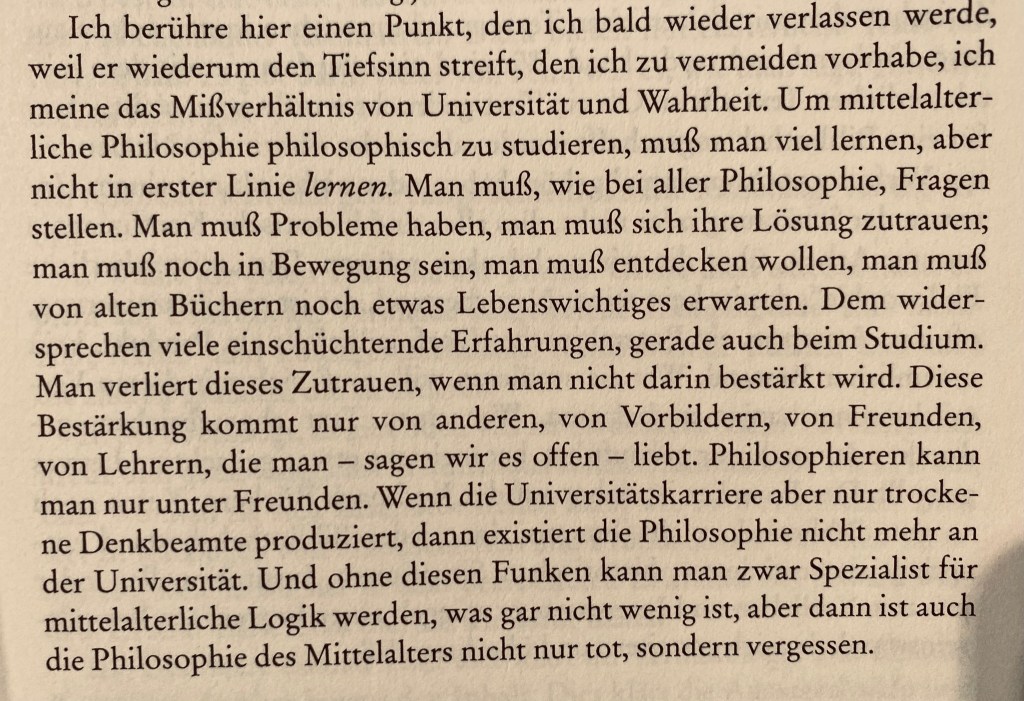
“I am touching on a point that I’ll soon leave behind again, since it relates to the profoundness that I intend to bypass, I mean the disparity between university and truth. To study medieval philosophy in a philosophical way one has to learn a lot, but one should not prioritise learning. As with any kind of philosophy, one has to ask questions. One has to have problems; one has to have confidence in being able to solve them; one still has to be on the move, wishing to make discoveries, wishing to learn something of vital importance from old books. This is countered by many intimidating experiences, especially during one’s studies. One loses this confidence if one is not encouraged. This encouragement comes only from others, from role models, from friends, from teachers whom one – let’s be frank – loves. Only among friends can one do philosophy. But if university career paths merely produce sober thinking clerks (Denkbeamte), then philosophy does no longer exist at universities. And without this spark you might still become a specialist in medieval logic – which is no small endeavour – but then medieval philosophy is not just dead but forgotten, too.”

Kurt Flasch, Historische Philosophie, 2003*

In times of increasing worries about ChatGPT and education systems more generally it’s soothing and inspiring to re-read some of the works of my teacher Kurt Flasch. Neither he nor my PhD supervisors Burkhard Mojsisch and Gert König were very good at preparing me for a career on the international job market, but they surely inspired some resilience against its crushing mechanisms. Re-reading the passage I translated above made me think about love of teachers again. Not in the recently well-rehearsed sense of academic ‘metoo stories’, but in the sense of what I’d like to call love as imitation. I know there are a lot more topics in the offing, but the idea of love in academia is, as far as I can see, perhaps the least understood.

So what does it mean to love a teacher? – Quite simply, to love one’s teacher means wanting to be like them. While it might involve interacting with them on some level, the crucial aspect is wanting to become like them, and that means, for instance, approach problems like them; speak, sound and listen like them; read like them or perhaps even enter into the form of life displayed by them – in one word: imitate them. (As I have argued earlier, love is, amongst other things, the ability and desire to understand another person. A strong way of understanding the other, then, is imitating them.) When I was a student, I had a couple of professors I really loved in that sense. I ended up following their courses, not primarily because I was into the topic all too much, but because I thought that, whatever they would teach, I would be learning something worthwhile. But how do you learn, how does that kind of love play out? While I was (back then) completely unaware what that meant, I just attempted to imitate them. This was quite palpable to me. When I wanted to pursue a certain (stylistic) approach, I would simply hear and try to imitate their voice in or their style when writing. – You might find this strange, but that’s probably what’s going on when we learn to find our voice in any kind of art, be it playing music, trying to paint or draw, or trying to speak and write.

Shouldn’t we aim at independence? – I guess the reason why imitation is so underrated in teaching is that we’re told to value independence. This is a fair point, but there are two issues that should be considered in response: Firstly, there is no independence without belonging. We’re not monads but always relating to a form of life and style that allows us (and others) to recognise that we’re engaging in the kind of practice we wish to engage in. How do I know I’m playing music if there is no one I’m relating to in my musicianship? Secondly, when we imitate we are never perfect imitators or impersonators – we end up appropriating and making things our own. So when I imitate my favourite teacher, you won’t hear Kurt Flasch but – willy nilly – an appropriation of his approach. In fact, the initial enthusiasm for pursuing something is fostered most by imitating a role model, be it a musician, an actor or a philosophy professor. In doing so, we might begin by rehearsing the things – half understood – we value most. After a while, though, we’ll find them pervading what we take to be our own voice.

Where to go from here? – Being a teacher myself, I think I should be aware of the facts surrounding the imitative ways of learning. After all, students don’t do as we say but imitate what we do. So if we act mainly as competitors on “the market”, students will see and imitate us in this respect. If we’re policing them as potentially fraudulent users of ChatGPT, they might follow suit. But what if we were to follow through with the idea that the best kind of philosophy develops in a community of friends?

_____

* Kurt Flasch, Historische Philosophie, 2003, S. 67:

Why should we encourage the study of canonical authors? Some reflections on the recent Collegium Spinozanum

Had you asked me three weeks ago what historians of philosophy should focus on, I would have replied that there is too much focus on individual authors, be they canonical or underrepresented figures, and return instead, at least every now and then, to the question of how certain texts fare in debates or in relation to problems. However, that was three weeks ago. Last week, I co-organised and participated in a summer school on Spinoza, the fourth edition of the so-called Collegium Spinozanum. Having experienced this, I am all in favour of focusing not only on individual authors, but on canonical ones. The reason is not that the current diversification attempts are bad or wrongheaded. Rather, I see studying canonical authors as a means to an important end in its own right: building a (research) community. In what follows, I’d like to explain this in a bit more detail and also say some things about forms of interaction and support in academic contexts.

(Collegium Spinozanum IV – Photo: Irina Ciobanu)

Unacknowledged reasons for being canonical. – The case for or against studying canonical authors is often made for supposed greatness versus political reasons. Great authors, it is assumed, are deemed thus because they were “great thinkers” who still speak to our concerns. Underrepresented authors, by contrast, are taken to be either just “minor figures” or “unduly neglected greats”. There is much that can be said critically about such lines of reasoning, but what I’d like to stress now is that these reasons largely ignore the community of readers, i.e. the recipients. Focussing on reasons in the “object of study”, they obscure the point that a good part of the reasons for choosing such an object might lie in the recipients and their common interests. But arguably it’s these common interests that shape a real community, not the supposed “lacuna in the literature”. So when a number of people thinks that we should read Spinoza, this might not be triggered by Spinoza (alone) but by the fact that there is something that speaks to certain people at a certain slice of time. In any case, this was the feeling I had when listening to all the papers and conversations at our summer school: We form a real community in that we want to talk and understand each other – a feeling that was not just sustained through the week but also by frequent references of participants to earlier editions of the Collegium (see the FB page related to earlier events).

A common corpus and language for diversity. –  Given the diversity of interests (ranging from well-rehearsed arguments in Spinoza to seemingly remote theological questions, from detailed historical reconstructions to actually practised meditations), reciprocal understanding required and found a common corpus and language in Spinoza’s works. We were mostly about 60 people in the room, with quite different leanings, but everyone had at least read Spinoza’s Ethics and understood how parts were referenced. This point is by no means trivial when you’re part of a group composed of people from very different academic stages (ranging from professors near retirement to third-year BA students) and various geographical regions. All too often, the diversity of assumed expectations and backgrounds silences people and lets impostor syndrome run wild. If you’re at a conference on a historical topic rather than a fixed author, you’ll shut up almost everyone when you steer the discussion to some notoriously understudied authors or areas. “Oh, you haven’t heard of this anonymous treatise from 1200? It’s quite important.” A relatively small corpus, by contrast, does not only facilitate the conversation, it ensures that I’m going to learn many new things about texts that I thought I knew inside out. 

“Canonical” doesn’t mean “well-known”. – Let me return to this last point once more. The status of being a canonical author is often equated with the assumption that we know this author fairly well (and thus should enrich our historical picture by studying underrepresented figures). But this is only true insofar as we repeat canonical interpretations of canonical figures. Once we enter into new conversations and accept that what (at least partly) drives our questions is owing to the interests of the recipients rather than to “the object of study”, we can see why every generation must start anew or, in Sellars’ words, why “the probing of historical ideas with current conceptual tools” is “a task which should be undertaken each generation”. This point should not be underestimated. What we did during this recent summer school on Spinoza was having a vast number of philosophical conversations, trying to push the limits as far as we could see. We were talking mereology, necessity, demonology, intuitions, the evil, and at the same time wondering how Ricœur and Wittlich or we ourselves were faithful to Spinoza’s texts or whether Spinoza had lied to his landlady. In this sense, the reference to the canonical author does not reinforce canonicity, but works like crossroads and allows for striking out in all directions. 

Ultimately, the focus is not the author but the community of readers. – The diversity of backgrounds as well as that of approaches should make clear that, ultimately, the focus of conversations is often not the author but the facets afforded by the interaction of the community. So the point of focussing on an author, a canonical one at that, is not to adhere to the canon or trying to restate ‘the intention of the author’. The point is rather what the author affords to us: growing into a community of readers, a corpus accessible across the globe, a common language to converse about many things we might only begin to understand.  

Summary. – At the end of the collegium, I tried and failed to sum up what we achieved together. Instead, I could only quote a poem by Robert Frost that I wish to restate here:

The Secret Sits

We dance round in a ring and suppose,

But the Secret sits in the middle and knows.

(Collegium Spinozanum IV – Photo: Irina Ciobanu)

Local challenges for the summer school. – Since summer school participants do not have angelic properties, they do need all sorts of things, not least a place to sleep. At the time of the summer school, Groningen also hosted two concerts of an infamous German rock band, entailing that most available accommodation was booked out long in advance. Had it not been for our personal efforts and our colleagues from the university’s summer school office, Isidora Jurisic and Tatiana Spijk-Belanova, the summer school could not have provided accommodation for the participants. A lesson for the future is that a university town should probably balance its interests accordingly and take responsibility for leaving some resources for such events.

Thanks. – It doesn’t go without saying that this wonderful event wouldn’t have been possible without the participants, all attentive and present till the very last moment. In particular, I would like to thank my co-organiser, Irina Ciobanu, and the inventor of the whole affair, Andrea Sangiacomo, who ran the first three summer schools on Spinoza since 2015, as well as our keynote speakers who are, besides Andrea, Raphaële Andrault, Yitzhak Melamed, and Gábor Boros. Thanks also to the Groningen Faculty of Philosophy and to the German Spinoza-Gesellschaft for financial support.

How to read (part ten): What if authors are not consistent?

At a recent conference, a colleague kindly pointed out that my interpretation of Spinoza had changed over the last two weeks, since I gave two rather different answers to the same question. Of course, it’s possible that I change or even improve my interpretation in the course of two weeks, but the suggestion was not really that I had improved my position. Rather, the assumption seemed to be that my utterances were inconsistent. Although we could settle the matter most amicably, such a situation can be quite a nightmare. Am I talking nonsense? Am I inconsistent without noticing it? Am I just opportunistically changing my views to align with certain people in the audience? Of course, I could also blame the listener: Was he being uncharitable? This matter is difficult to figure out. But rather than trying to figure out who is to blame, it might be better to ask what it is that affords (criteria for) consistency in the first place.

Let’s first look how important this is. It’s a common and rational expectation that authors be consistent. (This is why I include the following musings in my series on how to read.) If you read someone asserting that p and then asserting not-p, you can easily recognise their inconsistency by the very form of words. Of course, most types of inconsistency are a bit harder to detect, but once you notice them, you seem be faced with a choice: Either you find a factor that explains the inconsistency (away) or you have to doubt the rationality of the person whose text you read. Factors to deal with apparent inconsistencies are abundant features in interpretations. Faced for instance with Wittgenstein’s earlier and later philosophy, many readers think that he changed his mind or that he shifted his focus. A sensible and charitable reading of such changes will harmonise inconsistencies and look for evidence that confirms the assumption of a change of mind or focus. Even if it’s tricky to settle on a clear story of the changes in Wittgenstein, his case is fairly straightforward because he explicitly declares that he found his earlier work problematic. It’s harder, though, if no such evidence can be found. Of course, one might still assume that there is an explanation that resolves the inconsistency, but if no evidence can be found, we must also allow for the assumption that an author is in fact inconsistent.

But what does such a verdict amount to? I think we’re faced with a choice again: Either we assume a failure of what we call rationality, or we consider the option that consistency is too high a bar. What if authors are, by and large, more inconsistent than we like to admit? I think there is an explanation that leaves the rationality of the author untouched and focuses on what affords consistency. In philosophy, such factors might be found most straightforwardly in the debates that the author’s text is related to. What looks like a failure of rationality might in fact boil down to a change of debate. For me, some of the most obvious examples are to be found in medieval commentaries. Reading Ockham, I often thought he was inconsistent because he addressed problems for his position in one text, while he seemed completely oblivious to these problems in the next text. After a while, however, it dawned on me that the contexts and stakes were different. One text was a commentary on Aristotle’s logic; the other text was a mainly theological commentary on the Sentences of Peter the Lombard. Having noticed this changed my expectations as a reader across the board. While we might expect an author today to be consistent or “systematic” across their works, this might not have been a common expectation in other times or contexts.

Noting changes in genre or shifts in contexts is certainly good advice for texts of the past. But what about our own practices? Is consistency really a feature of what we call rationality? Or might the phenomenon by much more “local”, pertaining more to certain stable contexts such as debates rather than to minds? For the time being, I’d like to settle for the assumption that consistency is a feature of debates rather than authors.

Can we think what someone else thinks? Four letters on Gadamer by Ismar Jugo (guest post)

[With this guest post, I’d like to continue to present some of the works by my students that came out of research internships. During these internships, I often try to steer students towards a particular genre. This way, I hope to encourage students to experiment with different genres that allow for a focus different from “defending a claim”, as is often the case in essays. My own MA thesis (written in 1996) consisted of a translation, a commentary, and an interpretive introduction. Probably since the so-called Bologna reform, the forms of academic writing have become increasingly restricted even for students. Considering Helen De Cruz’ recent post, I’m hoping for the revival of various genres in the future. Having had a traditional essay, a review, a vlog and some other forms on this blog, the following piece consists of a series of letters. – ML]

Letter I

Dear Martin,

At the time I found out that I needed to do a research internship, I knew I would ask you. The reason was that you are one of the few professors that seem to explicitly think in front of the classroom. You bring yourself in dialogue with yourself, and thereby create the possibility of dialogue among everyone attending your class. This is a horrible exercise for a lazy student because it asks a lot of people to engage in a dialogue. Understanding someone else is, for good reason, a philosophical problem with huge ramifications in all aspects of human life, from all scientific enterprise till the very conversation a couple has after a fight. If understanding is such a huge aspect in our lives, then delving into the problem of understanding is a crucial step for every human being.

When I followed your classes I thought that I understood your train of thought quite well. Entering your train of thought took me some effort. I needed to write everything down and revise my notes before class. I was sure I understood what you were trying to convey. The question that we pose in this research internship is if it is possible to enter someone’s thoughts in the first place. Can we think what someone else is thinking? Can we see what someone else is seeing? Can someone recount their experiences in language so that we can experience the same experiences through a correct interpretation of words? Somewhere somehow, I got the idea that when I interpret a story, an utterance, or a philosophical essay in the right way, I could see, experience what the author saw and experienced. This never meant for me that the experiences of people were experiences of an objective reality, but of a subjective experienced, meaningful reality. So we could never say how things really were, but only how things were for humans and by language we could express that experience. If we interpreted the words of the subject that expressed it, then we could re-experience the experience. Is this view a naïve one?

The reason why I put my naïve theory of understanding forward is because I learned somethings of our “mutual friend” Hans-Georg Gadamer. We agreed that my first letter for this research internship would be about the second part of Wahrheit und Methode. More specifically, it is about the second part of the second part that is titled ‘Grundzüge einer Theorie der hermeneutischen Erfahrung’. I chose this part because here Gadamer discusses the main concepts of his hermeneutics, like hermeneutische Zirkel, Vorurteil and Wirkungsgeschichte. For Gadamer, I would be very right to write my own understanding of understanding down so explicitly like I have done above. Part of my process of understanding his notion of understanding is to work on my pre-understanding (Vorverständnis). If we want to be objective, we need to be as clear as possible on our pre-understanding. We need to know how we understand something to be able to see the difference in someone else’s account. In other words, I need to know how I understand X to create the possibility that I can see how someone else understands X.

I was surprised how concrete Gadamer was in his account. He clearly states that a hermeneutically schooled reader does two things:

1) The reader is aware that a text can be totally different from her expectation that she has before reading it.

2) The reader is aware of the meaning that she expects to find in a text and works from this expected meaning onwards to be able to make apparent what the text tries to convey.

The purpose of being aware is that we can work with our prejudices and expectations. By this we make room for die Sache selbst of a text:

Sieht man näher zu, so erkennt man jedoch, daß auch Meinungen nicht beliebig verstanden werden können. Sowenig wir einen Sprachgebrauch dauernd verkennen können, ohne daß der Sinn des Ganzen gestört wird, so wenig können wir an unserer eigenen Vormeinungen über die Sache blindlings festhalten, wenn wir die Meinungen eines anderen verstehen

This quote is interesting for our research purposes as is the concept of die Sache selbst in relation to a text or speech. Gadamer seems to think that there is something in a text limits the way we can understand it. When we engage in a dialogue with someone or engage in reading of a text, we cannot simply hold on to our pre-understanding about which a text writes or the other speaks of. There is something, an X (die Sache selbst?), that makes any interpretation impossible and a range of interpretations possible. This makes a lot of sense because any interpretation of a text cannot be right. Therefore, there must be something that limits the interpreter. But what is this? And can we assume its presence in a text?

Can we access each other’s thoughts? For now, it seems with Gadamer that we can access each other’s thoughts, by abiding to his two practical virtues of a good reader. This makes way for die Sache selbst of a text or utterance. If we would understand Gadamer in this way, should we then assume that the author can put his thoughts in a text and that the thoughts are die Sache selbst of a text. Is this the case of Gadamer? And what does it mean for our question when it is not? I will keep these questions in mind when I go on reading Wahrheit und Methode.

Before I end this letter, I want to discuss Gadamer’s view on bias (Vorurteil). He claims that prejudice or bias became discredited in the Enlightenment and that we still discredit it now. The Enlightenment knows two forms of prejudice. First, the prejudice that arises due to the authority of the speaker or author. Gadamer is a great philosopher, and he says so-and-so and because he is a great thinker according to a lot of philosophers, so-and-so must be true. Therefore, we can be prejudiced when we listen or read because of the status of an author or locutor. Second, and I like this one, we can judge too hastily. If we do not take our time and make good use of our Reason, we can judge too quickly on a matter. So if we do not take our time reading or listening, then we can make judgements about a matter from prejudice. In other words, if we want to understand someone’s message, we need to be aware that we can be biased towards certain people, and that we need to take our time.

I know I did not discuss everything I could from the part of Wahrheit und Methode that I read. When I looked at the wordcount, I thought that this letter would be too long if I would include the other concepts that Gadamer discusses. I will send another letter this week about the rest of the text. Next week on Monday I will send you a letter on the third part of Wahrheit und Methode that is focused on language and understanding.

I wish you all the best and thank you for reading my letter,

Ismar.

Letter II

Dear Martin,

In the first letter I wrote to you, I stayed much on the surface of the matter. In this letter I will try to give a short overview of the main themes I encountered in Wahrheit und Methode that are interesting for the question we asked the text. At the end of the letter, I will ask myself what Gadamer would think of the question: Are the thoughts of others accessible? I doubt if he would accept the question as we asked it.

Gadamer thinks that our prejudices play a fundamental part in our understanding of a subject matter (die Sache). This is not the case for a reason that understands itself as absolute reason which is able to attain knowledge of a subject matter outside of its historical and cultural embeddedness. Gadamer does not think that reason that understands itself as absolute is right, because reasons self-understanding is itself historical. To use an observation of my own, when René Descartes tries to unthink everything he knows in his Meditations, he still is dependent on language. His reason did not learn this language by itself, but language is something he is learned to do. Let us not even speak of the practice of doing philosophy or science. If it is the case that the self-understanding of reason is influenced by our historical and cultural disposition, then absolute reason does not exist. It is the case that the self-understanding of reason is influenced by its disposition. Therefore, absolute reason does not exist.

We can find this argument in the section named “Die Rehabilitierung von Autorität und Tradition.” In that text part we can also find Gadamer’s positive account of prejudice. According to Gadamer, there are two forms of prejudice that exist. We can fall into prejudice or prejudgment (Vorurteil) when we do not make disciplined use of our reason. If we judge to quickly, pre-judge (Vor-urteil), then we can jump to wrong conclusion that are untrue of the subject matter (die Sache). Second, prejudice can arise when we rely on authority instead of our own reason. If we rely on the authority and do not think of ourselves then we can make wrong judgement about the subject matter. On the first form Gadamer agrees with ignoring any further engagement. I must say that I agree with it as well and I do not think that many people would disagree with it. On the second form Gadamer has something interesting to say. He argues that there is no absolute difference between questioning authority and following tradition, because both can be grounded on a rational judgement. So we can use our reason and follow tradition. Why is this important for Gadamer to point out?

We are always already within tradition because we are part of the historical process that human beings research. When we make history our object of inquiry, we tend to forget that we are part of the object of study. Think only of the phenomenon that there is branch of history that inquires the history of history writing. But why write history? Why are we interested in our past? According to Gadamer we are being ‘addressed’ (angesprochen) by history. The reason that we can be addressed is due to our embeddedness in tradition. Being embedded in tradition enables the objects around us to appear as meaningful. What is meaningful for us is familiar what is not meaningful for us is unfamiliar. In this sense tradition is something that enables a certain disclosure of the world. We choose what parts of a tradition are continued and what parts are not, through using our reason. I think that Gadamer misses an account of power relations in his theory of traditions. This is present, however, in Walter Benjamin’s Über den Begriff der Geschichte where his argument against historicism is that we are always confronted with the perspective of the victor in historical sources. This is something to think about.

From the text part “Das Beispiel des Klassischen” I found one very interesting idea. The reason why we should study the classics is because the classics are such part of our reasoning that a self-reflective reason cannot but engage with them to know where his thoughts stand on. The classics play a pre-reflective role in our reasoning. Is Gadamer making a case of abiding to our established canon? And isn’t there something to say for this? Can we not read Kant and still understand certain ideas that we find in later philosophy?

In “Die Hermeneutische Bedeutung des Zeitabstandes” we can find the following quote that is interesting for our question:

Wenn wir einem Text zu verstehen suchen, versetzen wir uns nicht in die seelische Verfassung des Autors, sondern wenn Man schon von Sichversetzen sprechen will, so versetzen wir uns in die Perspektive, unter der der andere seine Meinung gewonnen hat. ” (P. 276)

Can we access each other’s thoughts? One thing that we cannot do is access each other’s mental states (seelische Verfassung). We can place ourselves (sich versetzen) in the perspective wherefrom the other formed their opinion. Does this mean that we can access each other’s perspective, according to Gadamer? And if so, then how would we do that?

According to Gadamer, we should not focus on the inner experience of the author. We should focus on the message at hand and the subject matter (die Sache) which is the object of the message. The most we can do here is to try to discover the objective truth of the message by entering into the perspective and even adding to the arguments that would be reasonable from that perspective. How can we do this? Of course, Gadamer refers to the hermeneutic circle that starts with the anticipation of meaning that we think we will get out of the message. When we walk to the beach, we expect there to be water. Likewise, when we want to interpret a text, we expect there will be a meaningful message. A message, like this letter, exists from parts- letters, words, sentences, paragraphs- and the assumed coherent meaning of the whole. The parts of the text make us adapt the coherent meaning of the whole and the coherent meaning of the whole makes us fit the parts together. Think of a poem where all the words together make the poem the poem that it is. You will read the poem expecting that there is coherent meaning that can be distilled from the whole. Word for word, sentence for sentence, your eyes move over these words and the individual words acquire their meaning through each other. The meaning of the whole is dependent on the sum and the specific order of the words. If there is one word or sentence missing, then the meaning of the whole is different. There is a circular movement between the coherent meaning of the whole and the specific words in their order. This is the road Gadamer presents to us, if our destination is the perspective of the other.

I could go on with other parts of the text I read. But for now, I think we have enough to entertain in our thoughts. I hope I described the concepts well enough. Wahrheit und Methode is such a rich text that it takes me longer to process it then I thought it would take. And, in the meantime I read an article on the relationship between Davidson’s and Gadamer’s philosophy. I will report on that in my next letter!

Kind regards,
Ismar.

Letter III

Dear Martin,

In this letter I will not engage with the text Wahrheit und Methode. Instead, I will take a little excurs to an article. The title is “Gadamer and Davidson on Language and Thought” and it is published in 2012 by David Vessey. Vessey argues in the beginning of his article that ‘bringing together analytic and continental philosophy (…) by bringing together Gadamer and Davidson makes sense given their shared commitments.’ What do you think about this ‘bringing together’ of analytic and continental philosophy? And what do you think about the relation between Davidson and Gadamer? Is an article like David Vessey’s not the proof that the Analytic-Continental divide only exists in virtue of us holding it there?

In Truth, Language, and History Davidson comments at length on Gadamer’s hermeneutics. In the text “Gadamer and Plato’s, Philebus”, Davidson argues that the difference between him and Gadamer is that for Davidson a shared language is not necessary for a dialogue or understanding. We can still communicate with one another, even when we do not have a shared language. The reason for this possibility is that we can still have a shared relation to the world and from that basis we can accurately understand what the other is trying to convey. To use an example, we can take a malapropism from the famous boxer Mike Tyson. When Tyson lost a boxing match in 2002, a journalist asked him what the next step will be in his career. And Tyson replied: “I just might fade into Bolivian.” We all understand that Tyson meant “oblivion” instead of “Bolivian”, so the point of his sentence comes across, despite the malapropism, despite he did not use the proper word. In other words, Davidson seems to say that we can have a different language but as long as we can make each other understand what we mean, we can have a dialogue and come to an understanding.

For Davidson a shared language is not necessary for having a successful conversation. We do not all share the same words, and, in many conversations, we encounter words we never heard before. In a dialogue the speaker and the listener have a prior theory. The idea of a prior theory is that the speaker and the listener have a preliminary idea of what they can expect from contextual information about the situation and the persons involved. In the process of a dialogue, on the one hand, the listener may have to change his or her prior theory to understand the speaker. The speaker, on the other hand, needs to change the use of words to make his or her point and get the information across. “Understanding occurs when the listener’s revised theory corresponds with the intended theory of the speaker,” writes Vessey. Successful theories are “passing theories”, according to Davidson. Passing theories occur when the listener has understood the intention of the words of the speaker. We could say then that in a conversation the speaker wants to convey A using the words x, y and z. The listener has the prior theory B. In the conversation the speaker senses that he needs to use the words x, y and h, instead of x, y and z, so that A is understood. If the listener understands A from the used words, then we have a case of a passing theory. If the listener does not understand A from the used words, we have a failed theory. The speaker will be challenged to revise his use of words again. I must admit, I really like Davidson’s theory of language because it seems like a clear description of what is happening when two people interact.

Now Vessey’s argument is that 1) Gadamer’s conception of dialogue (Gespräch) is different of Davidson’s and 2) this difference points towards a deeper disagreement between Davidson and Gadamer. Vessey even deploys a false conclusion in the middle of his article. In this conclusion the disagreement between the two thinkers is resolved by concluding that Davidson talks about language and communication in general, and Gadamer about a specific instance of dialogue. The true conclusion is that both thinkers have a deeper disagreement that lays in their conflictual understanding of the relation between language and thought.

For Gadamer a Gespräch is not simply the transfer of information between two interlocuters. It is rather the joint act of finding the best way to articulate a specific understanding of a subject matter (die Sache). This means that it is a social activity that has transformational power for the participants. With transformational power we mean to say that a dialogue changes our understanding of the world by transforming our understanding of a subject matter. The ultimate outcome of a dialogue is a ‘fusion of horizons’, which is an agreement on a common understanding of the subject matter or a disagreement on the understanding of a subject matter. In the latter, there needs to be a shared awareness that the disagreement does benefit the general understanding of the subject matter. Thus, either way there is some improvement in our understanding when there was a fusion of horizons.

Vessey argues that Davidson misses the point of Gadamer’s concept of dialogue. In de Gadamer’s dialogue the participants do not need to have a shared language, but the participants build towards a shared language so that they can have a shared understanding of the subject matter. This misunderstanding on Davidson’s part comes from a deeper misunderstanding about Gadamer’s idea on the relation of thought, language and reality. Vessey does not claim it specifically, but if Davidson wanted to argue against Gadamer, he should have argued against this part of Gadamer’s philosophy. Before I explain Gadamer’s position, I will reconstruct Davidson’s position.

For Davidson thoughts are dependent on language but thoughts do not need to be lingual. This means that language enables us to have thoughts but not all the thoughts that we have are lingual per se. To be a thinking, rational creature is to be able to express different thoughts and to interpret the thoughts of others. The content of the thoughts that we have is caused by external reality that operates independently from us. To establish what the proper cause is of my beliefs, we enter into a high-level triangulation. Which means that we must recognize others to have beliefs and thoughts as well. If we have the possibility to recognize thoughts and beliefs from others, then we have a concept of thoughts and beliefs. And, if we have a concept of thoughts and beliefs then we must have language. (Here I miss something: does he mean that having a concept implies having language?) Therefore, language is necessary to establish the empirical contents of our thoughts in triangulation. In short, language is necessary for thoughts and beliefs because it makes it possible to have the correct thoughts and beliefs about the world through triangulation.

Gadamer would probably argue that this view on language and thought is too instrumentalist. Language is perceived here as a tool that we can pick up and use to communicate our thoughts with. The purpose of this tool would be that we can have the correct, or true thoughts about the world. This contradicts his own position, where we are always already in language. We cannot unthink language, as we have seen with the example of the Cartesian meditation, where we could only deny everything through language. Language makes thought possible, according to Gadamer. Thinking implies a meaningful understanding of a subject matter, and this understanding is expressed in language. Therefore, any subject matter appears to us within language and expresses already a certain understanding of the world.

Vessey does not make it all to clear, according to me. I argue that there is an implication that he misses to point out clearly. The differences that Davidson and Gadamer have in their commitments about language and thought, implies a different understanding of our relation towards reality. For Davidson, what is there is there, irrespective of the words you use or the language you speak. Whereas for Gadamer, what is there is there in a certain way. The use of words, the culture and epoch we are born in makes reality appear as it appears to us. This does not mean that there is nothing outside our framework, there is the subject matter (die Sache), but the way the subject matter does appear to us depend on what words use to make it present to ourselves and others.

Maybe I am mistaking and misusing a term, but I think that we came to see that hermeneutics is an ontological enterprise. Gadamer’s hermeneutics is ontological. Davidson seems to accept a certain world that we can understand better or worse, so it seems that he stays on a more epistemological side by accepting certain naturalist ontology. I hope this makes sense and please correct me if I am wrong or to rash in my argumentation.

Letter IV

Dear Martin,

I did not write you a letter for a while. Nevertheless, I was busy with the subject of hermeneutics in many different ways. As we noted, understanding is always there: when you are in a conversation, reading a book or article, or when you perform an activity. As a subject you understand this as this or that as that, consciously or unconsciously, and understanding seems to open the world for us in a certain way. And the way the world is opened up, determines the way in which we think we can move around in it and so how we eventually move around it. This makes me remember one of the first classes you gave me in my first year. You tried to explain to us that sitting on a chair already assumed a certain understanding of the object, the situation and many other factors such as our self-understanding. This struck me a lot as a person who was sitting at that moment. 

According to my planning, I am supposed to write about the second chapter of part II – “Wiedergewinnung des hermeneutische Grundproblems”. I am reading this at the moment, but the theme of this letter will be about subsection d of the previous chapter of part II, Das princip der Wirkungsgeschichte. This subsection was left out of the last letter, but is of tremendous importance for our question: Can we access each other’s thoughts?

The central concept of this chapter is Wirkungsgeschichte and this concept, as you know, is central to Gadamer’s philosophy. Concepts that are related to the concept of Wirkungsgeschichte are situation, horizon and historical objectivism. This last concept refers to the hermeneutical school that thinks that we can understand the past objectively, which is not possible when you accept the concept of Wirkungsgeschichte. Interestingly, Gadamer praises the methodological stringency of the historical objectivists – and the method of statistics- but he tries to explain that they cannot move beyond or outside history itself with any method or whatsoever. We are historical subjects, our consciousness is historical, so history works through us.

The method of statistics and historical objectivism suggest that we can attain the objective truth of a subject matter by following a method. A method is perceived as a means to come to an end. Gadamer disagrees that this is ‘objective’ understanding of a subject matter is possible. The reason for this impossibility is that Wirkungsgeschichte is always at play in any interpretation. This means two things. First, the questions that arise in us, and so what we ask, are influenced by the working of history itself. An interesting example is an event like the war in Ukraine. The history of Russia and Ukraine becomes of interest due to the war which asks for our attention right now. The second point Gadamer wants to make is that we lose ourselves in the immediacy of the truth at hand when we confront an historical object. The truth of the object is lost due to our falling into the immediacy of the truth at hand. An example could be that when we read the concept ‘God’ in a Medieval text, we bring our modern, Western interpretation of the term with us. We need to correct this tendency which is, I think very natural, so that the text itself can start to speak to us. A result of not being aware of our historical situatedness could be, then, that we do not put current problems into their proper historical context, while even are smallest problems are part of our shared traditions.  (I read in a text by Davidson- I do not know which one- that Gadamer was a relativist, but more and more it seems that he is really concerned with the question of objectivity. At least, he still aims at it, and he tries to find ways to come to it. Do you see that as well?)

In the text, Gadamer moves from the concept of situation to the concept of horizon and ends at the conscious construction of two horizons which need to ‘cancel each other out’ (Abhebung). We will start with the concept of situation. The concept of situation asks of the reader to take a look around and think about our current position, or this is what it made me do. Situation is related to Hegel’s concept of substance, which is defined as the sum of our subjective convictions and behaviours. We can never move beyond our situation because we are always within a situation. When we try to objectify our situation then we are in the situation of objectifying our situation. It makes me think about objectifying yourself: you can never take yourself as an object of thought because that which objectifies always falls out of the objectification. In other words, you can never look at yourself because it always requires something looking and this what sees (the eye of the mind?) is not perceivable. Likewise, objectifying your subjective convictions and behaviours leads you to performing the act of objectifying your subjective convictions and behaviours, which is in itself a behaviour that comes from a subjective conviction. And objectifying the objectifying of our subjective convictions and behaviours etc.

After describing the concept of situation, Gadamer moves on to the concept of horizon. “Alle endliche Gegenwart hat ihre Schranken,” he writes. Thinking about our situation needs to make us aware of the limitations of our situation. Implicitly, I think, this relates to understanding of our pre-judgements or our horizon of expectations. Instead of making this relation, Gadamer starts to introduce the concept of horizon. Horizon is defined as our point of view, wherefrom everything becomes visible. Awareness of our horizon enables us to see what is important and what not, it puts events, things etc. into perspective. We always move within a horizon and we never move outside of a horizon because our horizon moves with us. Apropos the concept of horizon, I would like to pose some questions: where does a horizon come from? Does it come from our experiences or is it imposed on us by our culture/history? Is it a combination of both, because, on the one hand, our experiences are shaped by our culture, and, on the other hand, there first is the experience of a culture before it can shape our experiences later on?

One of the most important aspects of understanding is trying to find someone’s horizon. We want to find the other’s point of view, so that we can understand the person’s expressions from out this second person perspective. It is easy to see the critique that Gadamer has on this because he is very critical, but like with his critique on historical objectivism and statistic, he is not dismissing everything as wrong. This is apparent in the following quote:

Der Text, der historische verstanden wird, wird aus dem Anspruch, Wahres zu sagen, förmlich herausgedrängt. Indem man die Überlieferung vom historischen Standpunkt aussieht, d.h. sich in die historische Situation versetzen und den historische Horizont zu rekonstruieren sucht, meint man zu verstehen. In Wahrheit hat man den Anspruch grundsätzlich aufgegeben, in der Überlieferung für einen selber gültige und verständliche Wahrheit zu finden. Solche Anerkennung der Andersheit des anderen, die dieselbe zum Gegenstande objektiver Erkenntnis macht, ist insofern eine grundsätzliche Suspension seines Anspruchs.” (p.287)

When we read closely then we see that this quote exists out of two parts. The second part of the quote starts with the sentence ‘In Wahrheit’. In the first part, Gadamer argues that understanding is placing ourselves within the situation of the Other and that, let’s call it, a simple theory of interpretation argues that understanding is just reconstructing the Other’s horizon. In the second part of the quote, Gadamer makes clear that in this way we are pacifying the words of another because we do not let it claim any Truth (with the big T) – notice how the term Wahrheit has two meanings in the sentence. It seems that Gadamer argues that respecting the true difference between the self and the Other, we need to not only reconstruct a horizon but also let the Other make a truth claim which ‘touches’ us. Is Gadamer arguing that when we only understand someone relative from her horizon, that we cannot lose and the other cannot be right in some ways? Isn’t this idea in some way a critique against liberalism, where everyone can have their ‘own’ opinion about whatever?

After making this point and posing four questions on the concept of horizon, Gadamer redefines what a good construction is of making a historical horizon. Understanding does require the construction of a historical horizon but it does not mean that we leave our own contemporary horizon behind so that we can wholly place ourselves in the horizon of the Other. We cannot place ourselves in the shoes of the Other, and if we would try to do that then we would break them because we cannot put off our own shoes ever. The following quote exemplifies that:

Denn was heißt Sichversetzen? Gewiß nicht einfach: Von-sich-absehen. Natürlich bedarf es dessen insoweit, als man die andere Situation sich wirklich vor Augen stellen muß. Aber in diese andere Situation muß man sich selber gerade mitbringen. Das erst erfüllt den Sinn des Sichversetzen. Versetz man sich z.B. in die Lage eines anderen Menschen, dann wird Man ihn verstehen, d.h. sich der Andersheit, ja der unauflöslichen Individualität des Anderen gerade dadurch bewußt werden, daß man sich in seine Lage versetzt.” (p. 288)

I want to read this quote from the perspective of our research question: Can we access each other thoughts? It seems that two things need to be done: 1) we need to place ourselves in the situation (horizon?) of the Other and 2) we need to bring ourselves to the party, so to say. This second point is important here for Gadamer. If we want to grasp the point of view of the other, as it is, the point of view of the Other and not of ourselves, then we need to keep being aware that we are interpreting from our current point of view. Later, he calls this the superior wide view that comes with the difficult task of the Wirkungsgeschichtliches Bewusstsein.

Vielmehr ist Verstehen immer der Vorgang der Verschmelzung solcher vermeintlich für sich seiender Horizonte,” writes Gadamer. In the process of historical understanding, we need to momentarily construct two horizons so that we can lift the constructed difference, to see how the past made our current standpoint possible and to see how the standpoint from the past Other is effectively different. Is understanding then for Gadamer always understanding ourselves? And, are Gadamer’s claims only important in relation to interpreting the past? For me it seems, at least, that they are evenly important for understanding, let’s say, you or someone from a different culture. What do you think of this?

Thank you for taking the time to read my letters. I missed writing them a lot and in the same manner, I missed our discussions.

Kind regards,
Ismar.

Worlds, norms, and empathy. A conversation with Tom Poljanšek (podcast)

This is the tenth installment of my series Philosophical Chats. In this episode, I have a conversation with Tom Poljanšek who is currently working as a postdoc at the University of Göttingen.

Our conversation is inspired by his recent book Realität und Wirklichkeit: Zur Ontologie geteilter Welten and zooms in on topics such as the relation between reality and appearance, relativism, bureaucracy, norms, Musil’s Man without Qualities, and empathy as well as Tom’s approach to writing this book. Here is a rough overview:

Introduction 00:00

Tom’s book  01:20

Rules – from semantics to politics   22:00

Implicit rules and trust        28:26

Empathy – and how it figures in sharing experience       40:40

How to read work by students and others openly            51:50

On mapping philosophy and being part of the map        55:40

Philosophy as orientation    01:11:00

***

If you prefer to watch this conversation as a video, see below:

Worlds, norms, and empathy. A conversation with Tom Poljanšek

How can you ask and structure questions?

For the last four years or so I’ve tried to integrate exercises for asking questions in my courses. (Here is a blog post on my first attempt.) To my great surprise, students in my faculty now kindly selected my musings and instructions about questions as a “best practice in teaching and learning”, and my faculty nominated me for the pertinent award given by our university.

In what follows, I post a promotional video featuring one of my students* and myself as well as the text that I wrote for the award jury.

Structured Questions

If you ask students whether they have questions about any given text, you’re often met with embarrassed silence. It’s hard to admit that you’re confused. Although asking questions is a crucial activity, how to do this is hardly ever explained. By teaching to structure and analyse questions, I attempt to achieve five things:

  1. Countering embarrassment by suggesting that genuine questions require confusion;
  2. Showing how confusion generates the motivation of a question by having students spell out what (passage) precisely causes confusion;
  3. Showing that confusion is often the result of (frustrated) expectations as a reader;
  4. Detailing how to analyse such expectations as hidden theoretical assumptions;
  5. Having students estimate what possible answers might look like, e.g. by estimating how assumptions in the text differ from one’s own assumptions. 

While stimulating active learning, most steps can be achieved without requiring new information, but rather by developing an understanding of how one’s confusion arises. Accordingly, students are encouraged to enter into a dialogue with their own hidden assumptions and with others, for instance, by articulating how their background assumptions might differ. It is designed to stimulate self-directed learning and exchange as well as benefitting from seeing diversity in assumptions.

The technique of structured questions is an active learning device and was positively evaluated by students at my Faculty. I designed it to foster self-directed learning and interaction with texts and interlocutors. Being geared towards texts and discussions generally, it should be easily transferable to other disciplines. Here is some more information about it:

Questions are an ubiquitous genre in academic exchange. In the analysis of old philosophical texts, questions are a crucial guide in approaching material and in entering a dialogue about it.  As an instructor, I’ve often been surprised by how hard students find it to formulate questions themselves, even if they are good at giving answers. Discussions with students made me realise that the reason is only partly psychological (i.e. owing to embarrassment). Even in philosophy, it is hardly taught how to articulate genuine questions and what (partly tacit) components questions consist of.

I often teach and write (on my blog) about reading and writing texts. So I designed a format for asking structured questions about texts to foster an understanding about one’s own confusions and actually benefit from confusions.

Ideally, the question focuses on a brief passage from the text. It must be no longer than 500 words and contain the following components:

– Topic: say what the question is about (the passage or concepts that cause confusion);
– Question: state the actual question;
– Motivation: give a brief explanation why the question arises (use your assumptions or frustrated expectations);
– Answer: provide a brief anticipation of at least one possible answer (e.g. by guessing at the implicit assumptions in the text and how they might differ from yours).

What did I want to teach in designing this? My initial goal was to offer a way of engaging with all kinds of difficult texts. When doing so I assumed that understanding (a text) can be a general aim of asking questions. I often think of questions as a means of making contact with the text or interlocutor. For a genuine question brings two aspects together: on the one hand, there is your question, on the other hand, there is that particular bit of the text that you don’t understand or would like to hear more about.

In order to enter into dialogue, readers or interlocutors need to learn to consider questions such as: Why exactly am I confused? Could it be that my own expectations about the text send me astray? What am I expecting? What is it that the text doesn’t give me? Arguably, readers need to understand their confusion to make genuine contact with the text. One’s own confusion needs to be understood. The good news is: this often can be achieved without acquiring new information. Instead, bringing together one’s own expectations or assumptions with those of the text (or those of other readers) initiates a meeting of minds.

I began to implement this technique in autumn 2019 with first-year students and have since then introduced it in all my courses. While it was designed with medieval philosophical texts in mind, I realised that it can be used in various contexts and indeed both for approaching texts and discussions. What I didn’t anticipate was that it also seems to help in contexts of blended learning. Last year, I received a number of mails from students thanking me for how this technique had helped them to engage in self-study and prepare for exchanges in online contexts. Since it is geared towards articulating one’s confusion about texts in general, it should be easily adaptable to other disciplines.

________

* I’m very grateful the students of our faculty and in particular to Maddalena Fazzo Cusan who kindly agreed to speak on behalf of the faculty’s programme committee at the very last minute.