
Author: Martin Lenz
In addition to running the Handling Ideas Blog, Martin Lenz is professor of philosophy at the FernUniversität in Hagen. He specialises in medieval and early modern philosophy.
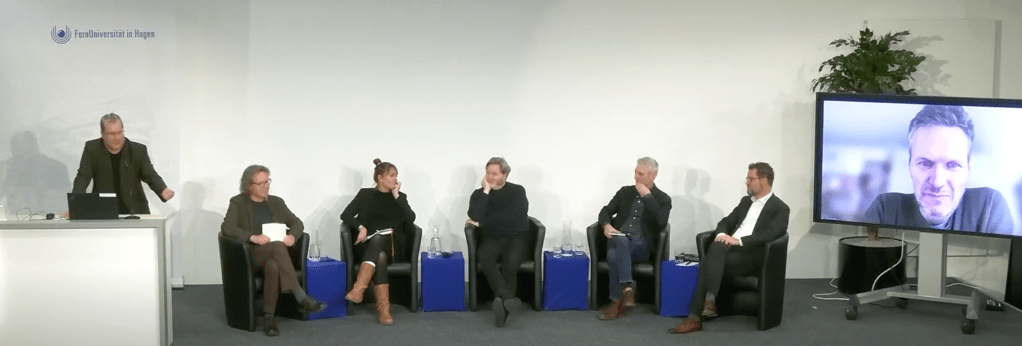
Dauerstellen? Department? Tenure-Track? Podiumsdiskussion zur Fakultätsstruktur (Video)
In Öffentlichkeit und Politik wird immer häufiger über dauerhafte Karriere- und Beschäftigungsperspektiven jenseits der Professur diskutiert. Erste Universitäten haben diesen Diskurs aufgegriffen und bereits Dauerstellenkonzepte entwickelt, die neue Wege aufzeigen und die prekäre Situation von Wissenschaftler*innen verbessern. Welche Strukturen werden erprobt, welche Überlegungen stehen dahinter und welche Herausforderungen stellen sich bei der Umsetzung? Darüber hat sich die Fakultät für Kultur- und Sozialwissenschaften der FernUniversität in Hagen im Rahmen der Wissenschaftsgespräche ausgetauscht. Denn auch unsere Fakultät hat sich dazu entschlossen, entsprechende Konzepte zu entwickeln. Zu einer Podiumsdiskussion hat die Fakultät daher interne und externe Gäste eingeladen, die von Best-Practice-Beispielen und ihren Erfahrungen berichten: Prof. Dr. Thomas Bedorf, Dr. Roland Bloch, Prof. Dr. Martin Lenz, Prof. Dr. Tobias Rosefeldt und Prof. Dr. Julia Schütz. Moderation: Dr. Patrick Heiser
A rough but workable guide to plan an essay
I keep noticing that one of the greatest worries of students is finding a workable research question for their essays – one that allows them to structure their work and keeps them in line with what they intend to promise. I’ve written on this before at length on this blog (here, a Groningen student reviews three of my posts), but I think I managed to break down the issue even more. – I’ve just finished an exciting three-day seminar on “Spinoza’s Ethics. An introduction to doing philosophy systematically for beginners.” The idea was to bring out the systematicity of the Ethics to such a degree that students could continue working with the text independently without loosing grip of the general framework. On the last day, I wanted to turn the tables and have my roughly fourty students work, not primarily through the text, but through potential essays on this book. Hence, I divided them into six groups and gave them pertinent tasks. In a feedback round, most students and I agreed that this was a surprising success. Therefore, I simply want to share the set-up of the tasks:
At the beginning, I asked the students to:
- find some friction (in the text),
- provide concrete evidence for this friction by providing at least two passages or sentences from the text,
- provide a motivation of why the friction arises,
- provide at least one possible answer as to how to state the friction and how to amend it.
By asking for a friction, I could rule out explorative works that have no natural boundaries and can keep students on the preparatory reading path forwever. By asking for concrete passages of text, students will have a constant fall-back place when themes would have them meander into the wilderness of the space of reasons. By asking for friction in the text, I also wanted to make sure that the friction arises from an immanent reading, rather than from an external criticism (e.g. of the sort: I don’t like this kind of philosophy, so here is why I prefer something else – which doesn’t really engage with the material). This approach mostly yields ambiguous uses / understandings of particular terms. Not everyone is interested in that kind of focus, but the promise is that this provides a workable way in and out, while one still has time to draw in all the pertinent aspects related to working through the friction.
Eventually, the student groups came up with six workable research questions. The evidence and motivations made for a pertinent structure, the possible answer for a fairly clear hypothesis. In the discussion of these approaches, we then tried to establish what the chapters / sections should look like: i.e. how they should implement the friction, motivation, and the answers. (In fact, this idea for planning essays is derived from my account of questions.)
Especially for beginners, it’s also important to counter the feeling that they don’t yet know enough to come up with a proper question. I addressed this worry by making clear that any philosophical thesis can (and indeed will be) countered at some point. So one shouldn’t waste their time by trying to immunise their work against criticism. Whatever you’ll say can be criticised. So you might as well get started immediately.
Of course, this is not waterproof. But my sense was that students now had an idea about how to move from reading to planning their writing – and that’s all I want.
***
Many thanks again to my great students in this course!
Paraphrases as validations. Or how using your own words (tacitly) carries interpretations
A: Marriage is a speech act.
B: Why do you devalue traditional rituals?
A: I don’t! I just made a point about the constitutive role of language for marriage.
B: Oh, but why did you say that marriage was nothing but talk?
…
It’s common to paraphrase texts, whether written or uttered, with our own words. In fact, students are often encouraged to “use their own words” when asked to restate or summarise an argument. Such instructions are usually intended to allow for checking whether something has been understood correctly or for translating technical terms into common language. The misunderstanding in the example above can serve as an illustration: While A made a point about the act or marrying requiring the people getting married to actually say “yes”, B took A to mean that marriage reduces to talk and is thus devoid of any further value. So B took A’s utterance in a reductive sense, while A meant it in a constitutive sense. These different senses are brought out in the paraphrases. B specifies to have taken the initial sentence in the sense of “nothing but”; A clarifies to have meant “the constitutive role”. Paraphrases are ubiquitous and yet very difficult to master, at least in philosophical contexts. Attempting to outline a simple doctrine often forces me to re-write for hours on end. But what precisely is it that makes paraphrasing so difficult? As the little example shows different paraphrases can already come with different interpretations, which in turn entail different evaluations.
In what follows, I hope to gesture at an answer that shows how paraphrases (tacitly) depend on interpretations and thus also determine evaluations of the paraphrased positions. What’s more: I hope to give a reason for dispelling the common myth that you can present a position without already being committed to an evaluation. I’ll close with some thoughts about how paraphrases also validate the paraphrased thoughts.
Problems with paraphrases in philosophy
While exercises of paraphrasing might be “basic tasks”, they are generally highly contentious and often even lie at the core of academic disputes. On the one hand, paraphrases can be historically problematic in that they introduce ideas unheard of at the time of the original expression; on the other hand, paraphrases can be systematically problematic in that they introduce unwanted (metaphysical) commitments. Historically speaking, the early modern use of the term “man” commonly has a wider scope (including women) than the twentieth-century use that renders it identical to the expression “male human (being)”. At the same time, this etymology is complicated by the fact that the pre-twentieth-century use of “man” is often tacitly referring to human males as the standard. Thus, depending on the context, the paraphrase of “man” with the term “human being” might count as anachronistic, although it is etymologically apt. Metaphysically speaking, we might wonder whether the expression “the present King of France” commits us to non-existent objects. Whichever side you take on such matters, a crucial function of the paraphrase lies in directing the attention or focus of the interlocutor. Thus, it clearly affects the philosophical approach to a given thought or content and also the direction a conversation about it might take. Hence, the worry arises whether different paraphases tacitly commit interlocutors to contrary interpretations. Arguably, such worries are rooted in a holistic understanding of sentence meaning. Assuming that the meaning of a given sentence is not atomistcally determined, but by a set of other sentences that the given sentence is related to, I will worry whether get the implications right. Going back to the initial example, speakers A and B construe the meaning of the initial sentence via different sets of related sentences or implications.
This kind of problem becomes clearly palpable in teaching contexts. A helpful example is Anselm of Canterbury’s Proslogion. Confronted with the phrase “something than which a greater cannot be thought” (aliquid quo nihil maius cogitari possit), many students begin by asking whether that renders God’s greatness subjective. Given the phrasing in Anselm, this question reveals a certain kind of modern understanding of the term “thinking”. Reading “… cannot be thought”, they render “thought” as an activity that they (or even an ideal thinker) can perform and thus as the individual mental act of a subject. This reading drastically changes when students are exposed to an understanding of “than which a greater cannot be thought” as “greatest possible”, such that it can be seen as a metaphysical modality rather than a subjective act. Again, it’s paraphrases, both tacit and explicit ones, that bring out different commitments. Thus, the seemingly simple task of “saying the same thing in your own words” requires a careful interpretation of the phrase that is to be paraphrased. As I see it, then, giving a paraphrase depends on a specific interpretation of the initial phrase. Where does this leave us?
The interpretation-ladenness of paraphrases
If our paraphrases are guided by specific interpretations, then this means that there is no such thing as a neutral report or presentation of a position. If I present Anselm’s formula in my own words and mistakenly say, for instance, “God is the greatest being, according to Anselm” (as opposed to “God is the greatest possible being”), then I’ll be mistakenly implying that God is the actually greatest thing (and something greater could be thought). However, most problematic paraphrases are not owing to such obvious blunders. Rather, they can depend on quite nuanced understandings. Now, my point is not that there are problematic interpretations; my point is rather that the paraphrase we choose commits us to a limited set of possible interpretations (as opposed to a different set of possible interpretations owing to a different paraphrase) and that there are no paraphrases that come without implications (and thus specific interpretations contrary to others). If this is correct, then there is no innocent or neutral paraphrase of a given expression. This, in turn, allows us to rid ourselves of a persistent myth: the myth that one could paraphrase a position and only then decide what to make of it. This myth often translates into a common thesis or essay structure, suggesting that you can structure your work by first presenting a position neutrally and only then evaluating it. This is impossible because the paraphrase already commits you to a specific interpretation – whether you know it or not.
The validating nature of paraphrases
But why, you might ask, is this so? Why can’t I simply paraphrase a position neutrally, leaving it open for various possible commitments? I have to admit that I have attempted this for a long time. But it doesn’t seem to work. The reason is that paraphrasing is a strangely bi-directional activity. On the one hand, a paraphrase is a bit like an (indirect) quotation, trying to convey what someone (else) has said. (Of course, we also continuously paraphrase our own expressions.) On the other hand, a paraphrase is like an appropriation, trying to convey what you have understood. These two aspirations can come apart, of course, both in historical and current readings. But what is even more important is that the appropriation often carries with it a sort of validation. In trying to appropriate someone’s form of words, I validate what has been said – by embedding it into my own thoughts. In fact, we often present and paraphrase claims that we take to be commonly accepted without specific references to any particular author. People now constantly say that mariage is a speech act, without particular reference to Austin or a theory of performative utterances. This thought has become part of a fairly common way of thinking about the role of language. Its ubiquitous paraphrases have made it part of the public domain, as it were. This way the initial thought gets validated in various formulations.
To see this, it’s vital to realise just how ubiquitous paraphrases are. In fact, most of the things we say are paraphrases of others’ words. In fact, we learn to speak and practise our daily interactions by constantly saying, in slight variations and paraphrases, what we hear and read others say. And since it often doesn’t matter who precisely said what, the exact authorship of the paraphrased sentences fades – until we fully embrace the thoughts ourselves and think we are original.
So paraphrasing is a continuous and indeed necessary activity we practise in our daily lives, often used to validate thoughts in new contexts. This feature of validation, I submit, carries over when we, as philosophers, present the position of someone else. To what precise extent remains to be seen. But it’s clear that the concomitant validation plays a crucial role in the way we learn and pick up thoughts both in daily interactions and as philosophers who appropriate thoughts of others into our understanding of the world and the claims of current or past interlocutors.
An afterthought:
If this is remotely correct, using ChatGPT or other tools for paraphrases (instead of learning and constantly practising the validation of thoughts ourselves) might have highly problematic consequences for our (linguistic) interactions with others and indeed ourselves.
ESEMP CfA: Why and How Do We Study Early Modern Philosophy Today?
Call for Abstracts
The European Society for Early Modern Philosophy (ESEMP) invites submissions of abstracts for presentation at the 7th international conference of the ESEMP:
Why and How Do We Study Early Modern Philosophy Today?
25-27 September 2025
FernUniversität in Hagen, Germany
Keynote Speakers: Mogens Lærke (CNRS) and Anik Waldow (University of Sydney)
The aim of this conference is to bring together leading experts and young talented scholars from all over the world to explore ways of approaching early modern philosophy and reflect anew on the aims of doing so. While all papers on the period are welcome, talks highlighting the respective aims or methods of studying EMP are particularly encouraged.
Following recent discussions in the field, we might wonder, for instance, whether we should favour historical over so-called rational reconstructions of texts or what precise aims are served by extending the canon. Likewise, we might ask how advances in the digital humanities shape our field. Even if one works in more traditional ways, one might inquire whether common assumptions about how to place and study texts, figures or debates still stand. This does not mean that papers should focus on these issues alone; rather it is an invitation to reflect on the aims or methods guiding the study at hand.
A second focus of our conference concerns (practical) issues concerning especially early career researchers. In this spirit, the conference includes a mentoring programme intended to connect mentees with experienced researchers who will provide advice on papers.
Submissions
We invite submissions of abstracts for papers addressing all aspects of early modern philosophy. To submit, please email an abstract – between 500-700 words and anonymised for blind review – to Tanja Moll (tanja.moll@fernuni-hagen.de). Please use ‘ESEMP 2025 abstract’ as the header of your email. The email should contain the author’s details (name, position, affiliation, contact details). The mail and the abstract should contain three keywords to which the abstract relates (indicating theme, author, and method / aim highlighted, if applicable). Please use the PDF format for submission and prepare the text of the abstract for blind refereeing.
If you would like to take advantage of the mentoring programme, please say so in your mail. If you would like to act as a mentor, please also indicate this in your mail. We will try to match mentors and mentees in relation to the keywords provided in the mail.
Please direct any questions you might have to Martin Lenz: martin.lenz@fernuni-hagen.de
Procedure
The deadline for abstract submission is 15 January 2025.
Papers will be selected by the board of the ESEMP.
Notifications of acceptance will be made by 28 February 2025.
For each talk, there will be time for a 30-minute presentation, with about another 15 minutes for discussion. All accepted papers will be eligible in case of the publication of the proceedings.
Upon acceptance
We do not request that you pay a fee, but membership of the ESEMP is compulsory to present a paper at the conference. (Annual membership fee: 30 EUR; reduced annual membership fee: 15 EUR).
To become a member of the ESEMP, please use our application form or contact the Treasurer of the ESEMP: hubertus.busche@fernuni-hagen.de
Leitfaden für das Schreiben philosophischer Arbeiten
Einige Mitglieder des Hagener Instituts für Philosophie haben einen ausgezeichneten und dennoch recht kurzen Leitfaden zum Schreiben philosophischer Arbeiten verfasst, den ich auch hier jedem ans Herz legen möchte. Er bietet nicht nur formale Hinweise, sondern hilfreiche Anregungen und Beispiele für Dinge, die man beim Schreiben und bei Prüfungsvorbereitungen grundsätzlich vermeiden bzw. erstreben sollte.
Lenz über Lenz. Ein Willkommensvideo für Hagener Studierende
In diesem Video stelle ich mich kurz meinen Studierenden vor, indem ich etwas über meinen Zugang zur Philosophie, zum Lesen philosophischer Texte als Begegnungen mit Anderen sowie zum Überwinden von Hürden beim Arbeiten erzähle.
________
Falls Sie Interesse haben, finden Sie hier eine automatisch generierte Transkription, die auf der Videoplattform der FernUni erstellt wurde, wo dieses Video mit Untertiteln gesehen werden kann:
Transkript*: Lenz über Lenz
*Bitte beachten: Das Transkript wurde automatisiert erzeugt und wurde nicht nachträglich gegengelesen oder korrigiert. Abweichungen vom Wortlaut können daher nicht ausgeschlossen werden. Bei Rückfragen wenden Sie sich bitte an: inklusive-videos@fernuni-hagen.de
Hallo, mein Name ist Martin Lenz und ich bin Professor für Theoretische Philosophie an der FernUniversität in Hagen. Das bin ich erst seit einigen Monaten. Davor war ich in Groningen und davor in Berlin und anderswo. Und deshalb denke ich, es ist ganz hilfreich, wenn ich mich Ihnen ein bisschen vorstelle. Und wer sind Sie? Das kann ich natürlich nicht wissen, zumindest im Augenblick nicht. Und deshalb habe ich gedacht, es ist das Beste oder das Zweitbeste, denn das Beste wäre, dass wir direkt ins Gespräch kommen. Deshalb ist es vielleicht das Zweitbeste, dass ich Ihnen etwas über meinen Zugang zur Philosophie erzähle. Vielleicht interessiert Sie das ja. Und wenn Sie glauben, dass das kein guter Zugang ist, dann ist das vielleicht auch ein interessanter Ausgangspunkt für Reibung.
Gut, wie also bin ich hierher gekommen? Das heißt, wie bin ich zur Philosophie gekommen? Was mich immer fasziniert hat, waren Dinge, vor allen Dingen Texte, die ich nicht verstanden habe, dunkle Texte. Und davon, so sagt man, gibt es ja in der Philosophie reichlich. Typische schwierige Passagen oder ganze Werke, die schwierig zu lesen sind. Man weiß immer so gar nicht ganz genau, was mit schwierig eigentlich gemeint ist. Das ist nämlich recht unterschiedlich, je nach Tradition, in der diese Texte stehen. Aber wenn man jetzt erst mal als Leser frisch herangeht, dann ist eigentlich vieles in der Philosophie recht unverständlich. Und das hat, glaube ich, damit zu tun, dass man nicht so genau weiß, wovon es eigentlich abhängt, ob man etwas verstanden hat. Ich will das verdeutlichen an einem Kontrast. Wenn Sie eine Gebrauchsanweisung nehmen, dann haben Sie die Gebrauchsanweisung wahrscheinlich verstanden in dem Moment, in dem Sie in der Lage sind, das darin Gesagte umzusetzen, also das Radio einzuschalten, den Schrank aufzubauen, möglichst richtig rum. Wenn Sie das vollbracht haben, dann scheint das, was Sie da tun, dem Text irgendwie zu entsprechen und gerecht zu werden und darf als Verständnis gelten. Bei philosophischen Texten und auch anderen Texten, natürlich teils literarischen Texten, ist das ganz anders. Und das fand ich immer, immer sehr faszinierend. Einerseits ist es manchmal unklar, worum es überhaupt geht. Manchmal sind aber auch schon die Voraussetzungen schwierig. Ich habe dann vor allen Dingen zunächst mittelalterliche Philosophie studiert und hatte es oft mit solchen Texten zu tun. Das hier ist eine Inkunabel, ein sogenannter Wiegendruck aus dem 15. Jahrhundert, von einem Autor aus dem 14. Jahrhundert, Wilhelm von Ocken. Und da ist es schon schwer genug, das überhaupt zu lesen, weil viele Abkürzungen in diesem Text stecken. Wenn man also die Wörter nicht immer richtig versteht, bei Handschriften ist es noch schlimmer mit den Abkürzungen. Und dann muss man das Latein verstehen und dann muss man es vielleicht übersetzen. Ich weiß noch, wie ich meine erste Questio übersetzt habe, wie ich ganz stolz war, das geschafft zu haben. Es waren nicht viele, ein paar Seiten, ich hatte ein paar Tage daran gesessen. Und dann stellte ich fest, dass ich kein Wort verstehe von dem, was ich da übersetzt habe. Das Deutsch war schon durchaus lesbar, aber der Text war eben gespickt mit Terminologie, für die es auch keine Wörterbücher gibt und dergleichen mehr. Und da muss man ganz viele andere Texte lesen, um den Text, den man selbst übersetzt hat, überhaupt nur annäherungsweise zu verstehen. Das ist einerseits frustrierend, aber eben auch faszinierend. Und na ja, inzwischen habe ich versucht, aus dieser Not oder aus diesen Nöten eine Tugend zu machen. Und die Tugend liegt eigentlich darin, dass die Konfusion und das Unverständnis als etwas anderes zu sehen, nämlich als eine Möglichkeit zur Begegnung. Wenn ich etwas nicht verstehe, dann heißt das, dass mir wirklich etwas anderes, etwas Fremdes gegenüber tritt, das ich eben nicht sofort einordnen kann, sondern wo ich erst mal überlegen muss, was ist denn da überhaupt? Was sind da für Annahmen gemacht und so weiter? In dem Sinne kann gerade dort, wo ich erst mal gar nichts zu verstehen scheine, eine wirkliche Begegnung stattfinden, Meeting of Minds, wenn man so will. Weil ich einerseits überlegen muss, welche Annahmen diesen Text plausibel machen, also welche Annahmen der Autor, die Autorin vorauszusetzen scheint. Und auf der anderen Seite muss ich mich auch mal fragen, welche Annahmen ich mache als Leser, die mich daran hindern, etwas zu verstehen. Warum hindern die mich? Na ja, in dem Augenblick, in dem ich etwas nicht verstehe, scheine ich eine bestimmte Erwartung zu haben, die frustriert wird durch den Text. Der Text scheint etwas anderes tun zu sollen, als er eben tut, als er eben sagt. Und es ist eine bestimmte Annahme, die mich dazu zu bringen scheint. Und in dem Augenblick beginne ich, mich selber besser zu verstehen, weil ich begreife, dass ich bestimmte Voraussetzungen mache, die der Autor des anderen Textes eben gar nicht teilt oder zu teilen scheint. Und diese Art von Auseinandersetzung erlaubt dann eben eine wirkliche Begegnung und einen Einstieg in den Text. Ja, das ist sozusagen die Tugend, die ich versucht habe, aus dieser Konfusion zu machen.
“Begegnung” ist das Stichwort. Ich meine, natürlich hoffe ich, dass wir uns möglichst viel begegnen können. Ich hatte jetzt meine ersten Prüfungen und Seminare und das war alles sehr, sehr schön. Ich war wirklich erstaunt, freudig erstaunt, wie toll das erste Seminar war. Also die Leute waren ganz, ganz wunderbar vorbereitet, hatten alles gelesen und drängten darauf, diese Sachen jetzt zu diskutieren. Das alles lief über drei Tage, sehr nuanciert. Das war sehr spannend, einerseits zu sehen, aus welch verschiedenen Richtungen diese Texte eben angegangen wurden und andererseits auch, wie dann im Gespräch doch Gemeinsamkeit entstand und ein gemeinsames Arbeiten sich entwickelt hat, das eben sehr produktiv war. Bei den Prüfungsgesprächen, in mündlichen Prüfungen war es ganz ähnlich. Man spricht mit ganz unterschiedlichen Menschen und bekommt entsprechend unterschiedliche Zugänge zu den Texten, die alle für sich sehr interessant sind. Deshalb möchte ich natürlich Sie ermuntern, auch in die Seminare zu kommen und viel teilzunehmen und andererseits eben auch im Selbststudium diese Erfahrung der Konfusion produktiv zu nutzen.
Abschließend habe ich mir überlegt, möchte ich Ihnen vielleicht noch einen Tipp geben zum Arbeiten mit philosophischen Problemen und da kann ich wieder bei mir ansetzen. Ich habe lange Zeit einen Punkt nicht verstanden, eine Unterscheidung nicht verstanden, die mich sehr blockiert hat und sehr daran gehindert hat, produktiv zu schreiben, produktiv auch zu diskutieren und zu arbeiten, selbst noch zu Postdoc-Zeiten. Das ist der Unterschied zwischen den Phänomenen selbst, den Sachen selbst und dem, was man darüber sagt. Das ist ein ganz wichtiger Unterschied. Ich habe immer gedacht, naja als Philosoph oder die Philosophen wenden sich eigentlich den Phänomenen oder Begriffen zu und wenn man das versucht zu tun, sich zum Beispiel fragt, was ist Freiheit und dann anfängt zu überlegen, merkt man sehr schnell, das ist uferlos. Man kann in alle möglichen Richtungen gehen, alle möglichen Aspekte beleuchten und es scheint gar keinen natürlichen Anfangspunkt, Ausgangspunkt oder prinzipiellen Punkt zu gehen, auf den man sich berufen kann. Diese Uferlosigkeit hat mich sehr blockiert. Ich dachte, naja, also wenn ich jetzt etwas dazu sagen will, dann muss ich erstmal schauen, was ich dazu eigentlich denke und das herauszufinden, wo soll ich anfangen. Und dann habe ich gesehen, dass die Auseinandersetzung eigentlich gar nicht beim Phänomen ansetzt, sondern bei dem, wo jemand etwas über dieses Phänomen sagt. Einen konkreten Satz, eine Passage, ein Argument. Wenn Sie sich jetzt nicht fragen, was ist Freiheit, sondern sich fragen, okay, da schreibt jemand, “Freiheit ist die Abwesenheit von Zwang”. Dann können Sie sich konkret fragen, okay, was heißt das? Warum das? Was heißt jetzt Zwang? Etc. Also Sie können sich dann anfangen, ganz konkret mit diesem einen Satz auseinanderzusetzen und in ein Gespräch einzusteigen. Sich zu fragen, wie kann das motiviert sein, so etwas zu sagen? Oder ist das plausibel oder ist das unplausibel? Haben Sie einen anderen Begriff davon? Oder so etwas. Aber es steht dann um diesen Text herum, ein Gedankenraum, in dem Sie um diesen Text herum spazieren können. Und immer wieder, das ist das Entscheidende, darauf zurückkommen können. Sich also nicht einfach verlieren. Und deshalb ist es so wichtig, sich klarzumachen, dass wir eben nicht fragen, was ist Freiheit, sondern was hat jemand über Freiheit gesagt? Oder was sagen Sie in Ihrem Kopf selbst, wenn Sie daran denken? Aber wichtig ist eben, einzusteigen auf der Ebene des Gesagten. Dann merkt man auch, okay, also hier beginnt nicht das Explorieren eines uferlosen Phänomenraums, sondern hier beginnt ein Gespräch über etwas, das gesagt worden ist. Das war eine ganz entscheidende Einsicht, die sozusagen mein Arbeiten dann auch sinnvoll begrenzt hat und kanalisiert hat, weil man mit ganz konkreten Passagen zu tun hat und eben nicht ins Uferlose drängt. Und deshalb wäre mein Tipp eben einerseits diese Unterscheidung zu beachten und andererseits, wenn man zu arbeiten beginnt, sei es, dass man sich auf eine Klausur vorbereitet, sei es, dass man sich auf eine Prüfung vorbereitet, dass man von einem ganz konkreten Stück Text ausgeht und sich hier erst mal fragt, okay, was ist denn da gesagt, was kann ich darüber sagen? Vielleicht, was hat jemand anders darüber gesagt oder so? Ja, aber dass man sehr konkrete Ausgangspunkte hat, bei denen man beginnt und die einem auch erlauben, immer wieder da anzudocken. Das ist oft das, was Kohärenz schafft im eigenen Denken und auch Struktur.
Ja, vielleicht finden Sie diesen Punkt sogar kontrovers und da können Sie von dem Konkretgesagten ausgehen, um mir zu widersprechen. Das fände ich auch sehr interessant. Gut, in jedem Fall hoffe ich, dass Sie Freude haben hier am Studium und dass Sie auch aufs Lehrgebiet zukommen, das heißt nicht nur auf mich, das natürlich auch, aber eben auch auf mein wunderbares Team, von dem ich hier umgeben bin und dass Sie vielleicht schon der einen oder anderen Person kennengelernt haben. In jedem Fall wünsche ich Ihnen alles Gute, einen guten Start und freue mich auf Begegnung.
How to read (part thirteen): Imagining the author’s desk
I suppose I’ll never quite forget how clueless I was when reading Wittgenstein’s Tractatus for the first times. Why, to name one confusion of many, did he not bother to provide more motivation for the very first sentence: “The world is everything that is the case”? Was there some common or perhaps divine intuition that I just failed to have? For me at least, things changed drastically when I read somewhere that Wittgenstein was greatly inspired by gestalt psychology. According to the approach he might have had in mind, then, we start grasping stuff from a holistic totality and analyse our way into details rather than from atoms from which we piece together an initially fragmented world. I’m not saying this is the whole story. But for me it provided a possible motivation that helped me understand a sentence that seemed to have been written without justification. Crucial context had been provided by something that seemed utterly absent from the text itself. However, once I took gestalt psychology into account, many things began to add up. By contrast, when texts are sufficiently current or explicit about their inspirations, their motivations seem fairly obvious. So much so that you can predict an author’s response to a given question as soon as you know some of their basic claims. Given demands of consistency, you sort of know what Ruth Milllikan would respond to the question of “whether ChatGPT can think”, even if she has not done so explicitly (just for the record, I’d say she’d point to her considerations of Swampman). But when texts are sufficiently remote in time or cultural conventions, it’s vital to take into account their sources of inspiration. In fact, I think scholarly forms of reading largely consist in re-establishing contexts of this sort. In what follows, I want to motivate this approach to reading and provide some further distinctions along the way.
Imagining the author’s desk. – One of the first things you learn as a student of medieval philosophy is that you have to start by reading much of the Aristotelian corpus. Even if you don’t follow this advice, you’ll soon find that Aristotle is all over the place. Explicit and indeed implicit references to his works are woven into the fabric of most medieval philosophical texts. When you look at critical editions of medieval works, you’ll learn another important thing: Many medieval texts are full of often unacknowledged quotations from other authors. When you read William of Ockham, you’re often faced with a jumble of chunks from Henry of Ghent, Duns Scotus, and others. This reading experience changed my attitude to texts generally: When I read a text, I (also) want to know which books were lying on the author’s desk when writing the text. The reason for searching such sources is not just a curiosity about the author’s inspirations or the phenomenon of intertextuality; often the material that inspired the author helps you understand the text at hand. Ockham, for instance, will presuppose that his readers also read Boethius or Aquinas. So he wouldn’t bother explaining an issue when a brief reference to a theory of an earlier author would do. While Ockham’s own brief reference can leave you clueless as a modern reader, looking at his sources might provide just what you need to understand where he is coming from. This means that you can figure out what Ockham was trying get at when looking at earlier stuff. Accordingly, the more material on Ockham’s desk you can identify the better you’ll understand his frames of reference and – perhaps – ways of thinking.
Leaning from Jenny Ashworth. – For students of philosophy, (early) modern philosophy is often introduced as an era in which philosophers shook off the reverence and references to prior authorities. Accordingly, these texts (seem to) encourage a mode of reading as if they were written straightforwardly “for you”, i.e. without the need to recur to earlier, especially scholastic, sources. As I see it, such authors were basically just better at hiding their sources. Jennifer Ashworth’s work on post-medieval scholasticism, even in figures such as John Locke, debunk this myth of textual autonomy, pushing the contextualisation to an instructive extreme. While Locke seems to pretend, even at the time of writing his Essay, that he is completely out of touch with Aristotelian and scholastic sources, Ashworth and others have shown clearly that he was very much inspired or at least wrestling with this material (here is one of Ashworth’s papers on this issue). What helps, then, in understanding such authors is the diligent study of contemporary and earlier texts and trying to get a picture of the books in their libraries.
What to look for. – Studying an author’s sources or gathering them from scrupulous critical editions is a good starting point for getting at the ‘material basis’. But you’re not doing a plagiarism check. (Of course, you might do, and conclude that all authors were less original than you thought, but that would merely betray a lack of understanding intertextuality.) So in what way can you exploit such sources? As I see it, imagining the author’s desk can get from very concrete kinds of inspiration, i.e. the very words someone actually quotes, to fairly abstract modes of thinking: so you’re looking for quoted words, imitated styles, related kinds of arguments, common principles, terminology, leading concepts or models. One thing that made me apply this strategy of reading more explicitly as a proper method was the realisation that I use unacknowledged forms of inspiration much of the time myself. When I wrote my PhD dissertation on Ockham’s philosophy of mental language, for instance, I was greatly inspired by my studies of linguistics, especially text linguistics. Even though hardly any of that made it into my text, certain ways of linguistic reasoning continuously served as a backdrop for my reading and writing. So if I write like this myself, it’s not entirely outlandish to assume that other people were and are inspired in similar ways.
Figuring out how an author ‘thinks’. – Eventuallly, this approach to reading might get you into very elusive interpretive territory. Going from what other texts might have inspired an author’s writing, you might get a feel for more abstract kinds of inspiration. Does John Locke think like a mechanist or does his medical background have a bearing on his thought, such that he might be said to think like a biologist avant la lettre? While this kind of issue is very elusive indeed and very hard to argue for, you might try and find some evidence in the way an author construes or exploits examples, thought experiments or analogies. While elusive, certain styles of reasoning preclude certain forms of consideration and might provide insights into what enables discoveries or inventions (or what might have blocked them).
In other words, trying to make ‘the context’ of a text concrete by imagining sources of inspiration re-establishes the conceptual space in which you can see an author moving within the boundaries that provide both consistency and limitations.
______
* Here is part one of the series on reading.
“My point is probably stupid …” Or why doing philosophy requires vulnerability
It’s August and we’re heading towards the beginning of term. In fact, I’ve already taught my first course at my new university – which was rather wonderful. Anyway, those of us teaching and learning will probably soon bump into newcomers in philosophy. And the big question is always: What shall we tell them? What’s worthwhile? What should stick? What do we wish for them? – I often wonder how I can meet the humility of the learned or of the genuinely curious student on proper terms. There is a lot of good stuff around and I often think back with great inspiration to that brief post by Sara Uckelman about empowering questions. So what’s left to say?
A line I come by in every course is “my point / question / answer is probably stupid …” I think it was Kathrine Cuccuru who said that there’s no question or point that can be both genuine and stupid. So, that’s that. But what I’m trying to counter is not just reluctance but also a genuinely false belief about the nature of (philosophical) points one is trying to make. The false belief I’m thinking of is that you can phrase or underpin a point in such a way that it is immune to criticism. This kind of perfectionism is something that many and even experienced philosophers seem to believe in. It goes hand in hand with the widespread idea that good philosophy consists in rooting out false beliefs (something I argue against here). What this approach misses is a very simple fact: In philosophy, there is no claim that is not vulnerable to criticsm. Whatever you say, can and most likely will be criticised for some reason. This might be owing to a mere lack of understanding or indeed a flaw in reasoning, but whatever it is: there is no escape – there is always a possible objection. In argumentation theory, this was dubbed the vulnerability principle. Once you understand this, trying to immunise your point against objections seems futile, simply because it would amount to a never-ending process. If this is correct, the best advice would be to speak up and make your point – and await the questions and objections not as something hostile, but as something that is to be expected and part of philosophy.
That being said, the vulnerability principle doesn’t entail that any old criticism is valid or that you should put up with impertinent behaviour (sadly not uncommon in philosophy classes). It simply means that, in the proper cases, your interlocutor’s frown might well be seen as an invitation to elaborate, never as a put-down.
All of this is more easily said than done. In fact, it took me half of a life-time or so to get this. The tricky bit is that shame and shaming govern a lot of our interactions. The attempt to hide shame or avoid exposure of supposed ignorance is probably a salient part (not only) in philosophy classes. If there is a way of coping with this it is most likely not avoidance but openness to the sort of vulnerability that comes with it. So, yes, the vulnerability of the argument goes hand in hand with the vulnerability of the person making the argument. The best thing to remember is that there is no other way: there is no point to be made without becoming vulnerable to criticism. But as Brené Brown put it, there is no connection without vulnerability (here’s a ted talk on this).
So whenever you want to say something about your point being stupid, you can just pass over that part and make your point.
(Academic) migration. Rambling about transformative experience
“We asked for workers. We got people instead.” Max Frisch
Currently, migration is often taken as a politically divisive issue. Unlike travel, it doesn’t seem to have any positive connotations. And although academic migration is more or less part of the business, even this kind of migration has come under pressure. So I surprised even myself a bit when, in a heated conversation, I found myself saying that migration is a form of freedom. The sentence tumbled out before I could make clear sense of it. For better or worse, my interlocutor left it at that, indicating without scrutiny that something worth pondering on further had been uttered. What on earth did I mean?
As I write this, I have just returned to Germany after working and living for twelve years in the Netherlands.* I didn’t plan to return when I moved abroad initially, and I currently wonder what returning will turn out to be like. Of course, there were and are moments of recognition and alienation on either side of the border. But I don’t yet understand my experience very well. Thinking about my own life in terms of moving around, nothing has been as transformative as my first move to Budapest in 1994, where I stayed for just over one and a half years. Why “transformative”? Because I think it turned me into a different kind of person and it changed my view on my country of origin. It’s this change I think of as freedom. It seems to have provided a (mental) space I couldn’t otherwise inhabit.
Admittedly, given that the reasons for migration are often political persecution, poverty or other more or less forced forms of mobility, it might sound cynical to speak of migration as freedom. Moreover, taking my own case of chosen migration, the position of privilege from which I reason might flatten my voice from the outset. Nevertheless, my assumption is that at least certain aspects of migration cut across very different motivations and experiences.
Do you know this sense of half-conscious recognition when meeting a stranger abroad who happens to originate from your home region or close by? It might just be some give-away accent or funny turn of phrase that you instantly recognise. There seems to be a similar sense of recognition pertaining to those who have lived abroad or migrated. While it’s a common thing in academia, then, it still seems possible to recognise people who share this kind of experience.
What is it that is being shared? The conceptions we have of ourselves and of our countries of origin as well as of our linguistic and social certainties are seriously challenged when we have to orient ourselves in a new environment. In this sense, I like to think of migration as what philosophers call transformative experiences, i.e. “experiences that radically change the experiencer in both an epistemic and personal way”. I guess it’s a common experience that learning a second language deepens your understanding of your first language. Likewise, moving to a different country will change your outlook on your country of origin. Among other things, it’s for this reason that coming of age, apprenticeship and higher education are often related to times of itinerancy and migration. The Erasmus programme of the European Union bears testimony to this.
Now if this is correct, then it’s close to an aberration that political communities focus so much, if not only, on the negative aspects of migration. Shouldn’t we think that we have quite a lot to learn from people who share this kind of experience? Seeing how governments and even institutions of higher learning capitalise on both migration as well as xenophobia, this question sounds hopelessly naïve to my ears. But the point remains, migration is a good thing. In some of the following posts, I hope to spell out why that is the case.
_______
* By the way, as I write this, I also realise that this blog has now been up and running for six years. A huge thank you to all of you for reading and thinking along!

