Reading as a Social Practice. Sketching a long-term project (from March 2025 onwards)

Currently, Irmtraud Hnilica and I are sketching guiding ideas for a project that has been in the making for some time. Below is a small blurb. Please feel free to get in touch, if you’re interested in collaborating:

According to an ever-growing consensus, there is a reading crisis today. It ranges from illiteracy and a lack of text comprehension to a reduced willingness of pupils and students to engage with complex texts. This development has been recognised as an area of ​​action. The German Federal Ministry of Education and Research (BMBF), for instance, has initiated measures to promote reading with significant funding for empirical educational research. By contrast, our project Reading as a Social Practice is meant as a reflexive evaluation of the reading crisis.

For starters, it is questionable what exactly this crisis consists of. Many academic disciplines are working on this question and related issues, but the expertise remains largely fragmented. Setting out from the disciplinary perspectives of philosophy and literary studies, our project aims at bringing together the fragmented expertise across disciplines and examining what reading actually is. The reading crisis, as well as the observation that a countervailing reading hype can be observed at the same time (associated, for example, with the social media phenomenon #booktok), is placed in a historical and systematic context. Considering, for instance, forms of reading aloud and quietly, various biblical interpretations, the novella tradition (where reading is presented as a social phenomenon), the salon culture and book clubs, reading is mostly a social practice. A communal bond weaves readers and books into larger contexts. Our project explores this by looking at three main areas:

1. Reading Theories and Text Types. – The project builds on theories of hermeneutics and tries to advance these further. Reading, we submit, is essentially determined by interactions between readers, which can decentre different text types, on which it nevertheless remains dependent.

2. Reading Cultures and Canon Formation. – The history of reading is examined as a history of social practices. In doing so, mechanisms of inclusion and exclusion come into focus. The social practice of reading, through its associated potential for distinction, usually swings in both directions.

3. Reading Scenes and Interventions. – Using specific reading scenes, we will examine, for instance, autosociobiographical texts from authors with a background of social climbing to explore the conditions for success and failure of reading practices as well as possible interventions. What role, for instance, does the opportunity for identifying reading play in reading socialization?

***

You’ll find a number of texts under the category Reading as a Social Practice on this blog.

Witnessing reactions to ideas. A response to Michael Hampe’s autobiographical philosophy

Her eyes are wide open, her left hand covering her mouth to suppress a scream. – Imagining this kind of scene, ideally in black and white, you know you’re probably watching a classic horror film. This kind of scene is called a reaction shot. It’s designed to show the reaction to an event rather than the event itself. This kind of shot is certainly intriguing in many ways. The reactions to events guide our empathy, letting on what it’s like to undergo a certain event, even if we’re not seeing the event as such. We know that something scary or funny or beautiful is being seen. Seeing the event, we can then make up our minds as to whether we agree with the sentiments displayed. Once you get to know someone, you might be quite interested in how they in particular react to something. Unsurprisingly, there is by now a whole genre of “reaction videos”, designed to show initial reactions to music or films or whatever. In a manner of speaking, philosophical works can be seen as reaction shots to ideas. In this case, too, you might be quite interested in how a certain philosopher reacts to certain ideas. Knowing someone fairly well, you might be able to anticipate their reactions. Still, you might be surprised or curious as to how that person will phrase their response to a particular idea. Reading Michael Hampe’s book What for? A philosophy of purposelessness (Wozu? Eine Philosophie der Zwecklosigkeit)*, which comes with a decidedly autobiographical approach, it dawned on me that this approach is perhaps the ideal form of what a philosophical reaction shot could be.

Why bother? ­– Although I have a strong interest in philosophers’ attempts to overcome teleology, my wish to read this book was mainly driven by what I already know about the author. There are some authors whose reactions to thoughts are just interesting to witness. And Hampe is a great writer: the way he challenges and recombines patterns of ideas is just a treat, to say nothing of his style. This book is no exception. It consists of three parts: (1) an autobiographical exploration of purposes and their conditions and boundaries; (2) a reflection on the actual approach as a sceptical stance with its ethical and political repercussions; (3) the discussion of a set of inspirational sources ranging from Aristotle and Spinoza to Weil and Wittgenstein.

Picturing the invisible. – The book is beautifully composed: Starting out by probing into thoughts about how we might experience our first conscious beginnings of getting drawn into speech, attention, and purposes, Hampe skillfully navigates through the dialectics of purposes and what its boundaries might be. One of the crucial (Wittgensteinian) ideas Hampe develops is that we live our lives by adhering to a certain picture. That is, you might have a certain picture of individual events you wish to happen, like a picture of yourself reading a book in the library tomorrow; thus, you might behave in such a way that you make the pictured event happen. At the same time, you might follow a more abstract or super-picture governing your actions as pertaining to your life or a life project. Taken in this light, the question whether you can dip into purposelessness (which is still close to impossible to imagine) amounts to the question whether you can devise a different picture to govern your life. Sometimes we seem to manage this. But how can you express what this amounts to? Trying to express this resembles the practice of negative theology. That is, eventually it seems inexpressible. However, witnessing Hampe reacting to this thought goes beyond this somewhat helpless gesture. He writes: “The relief that occurs when all purposes disappear is quite different from that which occurs when a certain purpose is achieved.” (“Die Erleichterung, die eintritt, wenn alle Zwecke verschwinden, ist eine ganz andere als die, die eintritt, wenn ein Zweck erreicht wird.”). Comparing kinds of relief is one of Hampe’s many ways to explore what purposelessness might mean.

Scepticism as a way into purposelessness. – Hampe’s kaleidoscopic autobiographical approach is embedded and recflected in a nuanced sceptical approach (with a touch of Buddhism, Montaigne, Rorty and other pragmatists). Again, the crucial merit is not to develop a theory or to “defend a position” but to react to the historically grown array of philosophical and scientific stances to the world and ourselves, as they oscillate between ascribing and denying purposes. Here, it is especially the dismissal of hierarchical thinking (ingrained in most attempts at how we see and evaluate what we see) that takes the lead in dipping into purposelessness. Taking this dismissal of hierarchy as a trait of dismissing a universe with final causes, Hampe suggests, inter alia, that Spinoza’s anti-teleological thought can be redescribed as a way of dismissing hierarchical orders in nature and second nature. Along similar lines, we can see Hampe reacting to his readings of a vast array of other philosophers, not attempting to present their thoughts in a historical reconstruction, but in a way that Jay Rosenberg has called creative reading.

Situatedness. – In keeping with the picturing approach to capture desires, life goals and projects, Hampe thinks that what makes me me and you you is not an essence but the fact that we find ourselves in certain situations. It’s not our supposed character traits but arrays of situations gone through that seem to determine our responses to the world. It’s no surprise then that Hampe, like Rorty, seems commited, not to an ethics of principles, but to an ethics of sensitivity, educated through diligent attention and literature. In like manner, Hampe suggests it’s our historical situatedness, rather than philosophical originality, that makes renewed interest in old topics worthwhile. Thus, we might say of Hampe’s treating (anti-)teleology what Hampe himself says of of others treating the topic of love: “It would be strange to claim that Shakespeare’s works represented a sort of ‘progress’ over those of Homer… One can no longer write about love today like Homer or Shakespeare … People love at different times and in different situations. It is because of these changes, and not because of any genuinely new philosophical insights, that love must be written about again and again.” (“Es wäre merkwürdig zu behaupten, dass die Arbeiten von Shakespeare einen ‘Fortschritt’ gegenüber denen von Homer … darstellten. Man kann heute nicht mehr wie Homer oder Shakespeare über die Liebe schreiben … Menschen lieben zu unterschiedlichen Zeiten in unterschiedlichen Situationen. Aufgrund dieser Wandlungen und nicht wegen irgendeiner genuin neuen philosophischen Erkenntnis muss immer wieder über die Liebe geschrieben werden.”)

Accordingly, we might say that our renewed interest in people writing on old philosophical issues is not a belief in progress but an interest in contemporary reactions, i.e. reactions situated like we are situated, to these issues. Autobiographical reactions might be most revealing about their situatedness and thus most pertinent to this purpose.

______

* Incidentally, there will be a seminar on Michael Hampe’s “Wozu?” as well as a talk by him in Hagen. – Here is a post with some more reflections on the autobiographical approach.

Thou shalt not read sloppily on your phone! The ethics of reading (1)

“What the philosopher establishes in their labors are not truths or theses, but rather scores, scores for thinking with.”

Alva Noë, The Entanglement, 115

If it’s true that so many people and especially ‘students these days’ fail at reading, there must be an ethics of reading. And of course, there is more than one. While many ideas in this field are revolving around the relation between reader and text (just think of the principle of charity), I’m currently more interested in the relation between readers. After all, it’s not so much between reader and text but between readers within a certain group that we try to enforce certain values.* Spinoza or his œvre will not show much offence, if you read sloppily. But your instructor, your fellow student or your colleague are already waiting for their gotcha moment. Indeed, many philosophy classes are thinly veiled occasions for blaming others of sloppy reading or, if they’re aiming higher, of missing the argument. What many philosophers or indeed other academic readers tend to overlook is that such (ethical) standards are relative to the profession or shared philosophical endeavour. If you’re reading for pleasure or reciting some passage to a friend, quite different standards might apply.** But even within philosophy, there are different sets of standards. In what follows, I want to look at these standards more closely, hoping to suggest that many common complaints about students these days etc. might be off the mark.

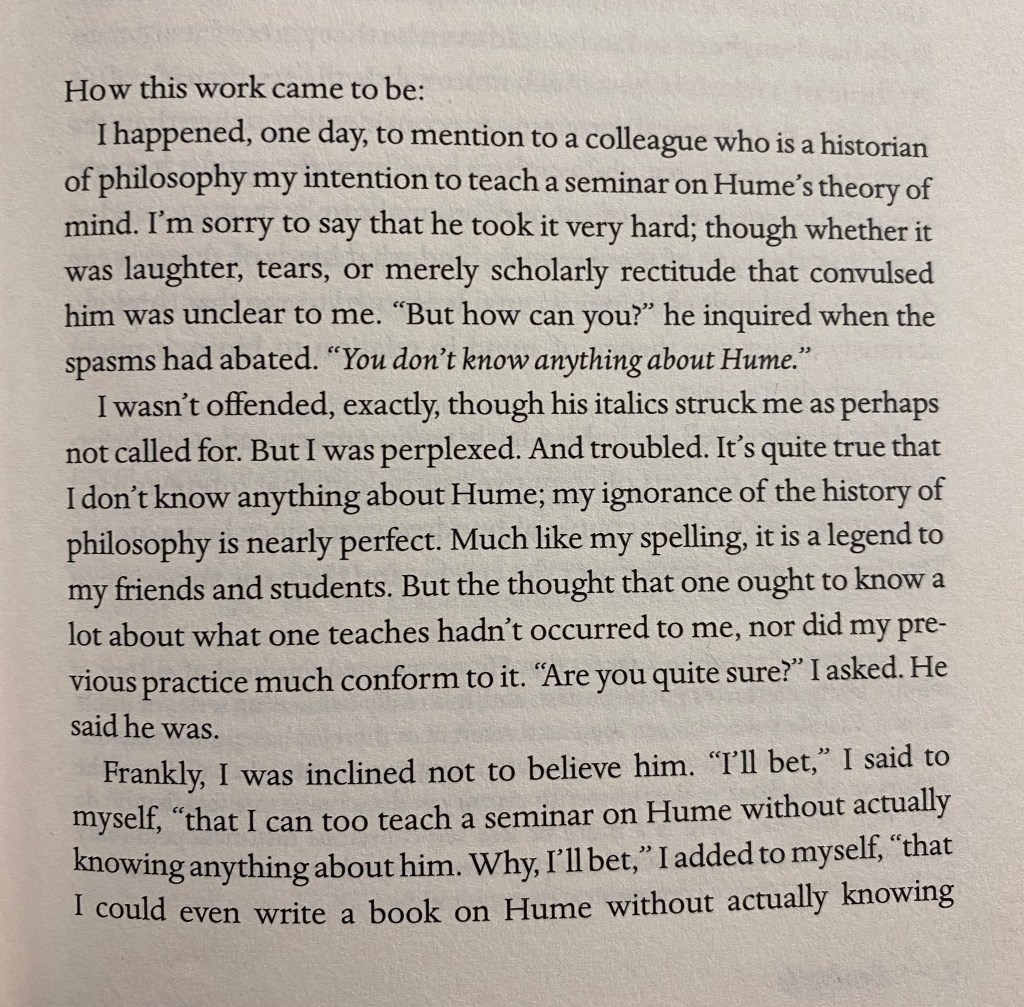
The ‘fake it till you make it’ reader. – I guess we all know this particular student who comes to class, is rather quiet when we ask for a summary of the text, but greatly enlivens the discussion when we turn to a particular argument. As instructors, we can sense that this student “didn’t do the reading”, but we let them get away with it – just this once – because it’s the discussion we care about most for the moment. If you haven’t been this student yourself, here is how it works: You just wait till the discussion reaches a very particular point (and it will), then you make up your mind about the point, deriving most insights from the summaries before and the heat of the moment. If you actually did bring the text, you might quickly search for the pertinent passage and even shine with terminological digressions. It’s a great skill, but it doesn’t require the kind of devoted reading that is encouraged by old dons. The skill is not based on “wrestling with the text” but on distilling crucial information and turns from what is being said. By and large, this kind of skill is greatly honoured in philosophy classes and in essay writing. We use words like “smart” to describe such behaviour, even if we might chide the student for not going all the way and reading the damn book properly. (By the way, I don’t think Jerry Fodor lied when he said that he thought he could write a book about Hume “without actually knowing anything about Hume.”)*** Hence, we might say that the ethical core value in place is not so much being a serious reader but rather being a serious discussant of pertinent ideas.

Now change just some parameters. – Instead of listening to your fellow students, you ask ChatGPT for a summary and for what’s in certain paragraphs. The same honoured skill is applied, but instead of honouring the skill we now focus on the decline of mankind as we knew it. But has anything relevant changed in what the student does? Remember, the student didn’t read the originally set text but gathers information from a likely somewhat flawed summary. Granted, the student might be better off listening to fellow students rather than feeding off tech products, but for the particular ethics applying to what happens in class or on the page, the student may still be doing what matters most, i.e. engaging in a serious discussion of a thesis or argument. In fact, many philosophers I know trust their rational reconstructions much more than poring over the ancient texts. We even have debates about whether we should really have students read an actual text by Kant, let alone the original German, rather than, say, the smart secondary texts in our ubiquitous “just the arguments” summaries. So if we don’t care all that much about teaching “the text”, let alone “the original”, why do we worry so much about students when they take this endeavour to the next level?

I’m not saying textual scholarship doesn’t matter; and you wouldn’t have much fun in my history of philosophy classes when ignoring the texts. What I’m saying is that different ethics of reading apply to different sub-disciplines in philosophy. I often tell students that, while philosophers care most about problems, historians of philosophy also care about texts. So the stakes are different. And it’s this difference that we signal to our students when we focus on, say, the structure of the argument as opposed to the frilly bits and bobs in the text.

______

* I’m greatly inspired by Adam Neely’s The Ethics of Fake Guitar, who makes a similar point about adherents of different genres of music favouring different core values.

** Already in relation to an earlier post, Marija Weste convinced me that there is less of a difference between different types of texts (say, philosophical texts versus novels), but much more of a difference between professional academic reading as opposed to non-professional kinds of reading.

*** Here is the passage I have in mind from Fodor’s Hume Variations:

However, ChatGPT tells me: “Jerry Fodor’s claim that he could write a book on Hume without knowing him is not meant to be taken literally. It highlights his approach to philosophy, which is to focus on the enduring theoretical insights of philosophers like Hume, rather than necessarily adhering to historical interpretations. Fodor uses Hume’s ideas as a source of inspiration for his own work in cognitive science, particularly his theories about the mind and language.”

Books, powerpoints, tabloids, and tote bags. What do we care about in reading?


Do we really let ourselves be encouraged to present our ideas with flashy powerpoint slides and then wonder why students don’t bother reading books anymore?

Last weekend, I had an inspiring seminar on Hume’s Treatise and so I was just about to write another blogpost about reading philosophy. This time I wanted to try a slightly different angle and focus on what we care about when reading. What is it that matters to us – beyond the issue of what might matter to our instructors in the context of a Hume course? Why do we pick up a book like Hume’s Treatise? What steps might we have gone through in advance of picking up such a brick? What makes us pick up big philosophy books and carry them around? Here are a couple of half-baked thoughts, not on reading philosophy but on some perhaps substantial changes in what figures in our reading practices between different generations.

Signalling readership to others. – The smooth passage from my associations about reading philosophy to ones about why we carry books around eventually transported me to a passage in Deniz Ohde’s autosociobiography Sky Glow (Streulicht) that I recently read: Here, the narrator focuses, among other things, on hopes and fears in her attempts at social climbing. One scene has her getting ready for going to evening school and decidedly picking up a canvas tote bag with the logo of a German weekly newspaper (Die Zeit), hoping she is going to make the impression of belonging to the group of … well, of what precisely? Perhaps the group of serious readers and thinkers. The scene is an acute portrait of how we signal readership to others. Of how we want to be seen as readers. We signal that we read and, even in reading, we signal to others that we read. Reading is a status symbol and indicative of a supposed lifestyle. The creators of adverts on tote bags and elsewhere have known this for a long time. What I find so heart-wrenching about this particular scene is that this person’s signalling happens in a world that doesn’t really care any longer about the status of being a reader. As readers of the novel, we might assume that the narrator, presenting flashbacks of her younger self, has learned this the hard way at some point. But the protagonist clearly doesn’t know this at the time at which the scene is set. She cares about reading and cares about being seen as a reader. But reading is no longer seen as a status symbol, at least not in the same way as it used to be.

Changing signals. – Books used to be indicators of intellectual status, wealth and time, lots of time. Being a reader could be signalled by carrying and hoarding books. I am not sure what exactly has initiated crucial changes in such indicators. (That said, I hope to find out more about changing reading cultures in due course.) But by now even the book-loving scholar in the humanities is more of a distant cliché than a reality. Today’s academics mostly pride themselves on being “busy” or even “stressed”, and many might in fact often be too busy to read or at least to read as much as they list in their bibliographies. ­– Now, I don’t want to complain about decreasing literacy or interest in reading. My point is rather that the indicators of readership may have changed. If this is correct, we’re faced with the the following question: Would we recognize new indicators for what they are? Instead of carrying a dusty book to class your students might prepare a flashy powerpoint presentation. What these students signal to their instructors is still competence (or so I think), but it is not signalling competence in the way I have learned to signal competence in my youth. But even when I grew up in the 1970s and 80s, reading had already become a mass phenomenon. Not only in the sense of many people having the necessary literacy, but also in the sense of the world being a place packed with words. Adverts and signs were populating the streets. Newspapers were everywhere. Children read their comics on the loo. Workers read newspapers for breakfast, pacing through headlines and pictures. (Of course, for most of us this is common, but if you study medieval and early modern philosophy, you’ll find that our common reading culture is markedly different.) Now if reading is happening everywhere, mere (signalling of) reading is no longer a socially distinctive marker.

Reading is not replaced, but happening differently. – This ubiquitousness of reading has simply exploded. Given the recent changes in technology and design allowing for digital reading and bullet-point presentations or summaries of one’s reading, it is plausible to assume that reading is turning into a different thing altogether. Firstly, reading does no longer signal a socially elevated status. Showing off by being a bookish person does make you look old-fashioned at best, but it doesn’t mean you’re wealthy or smart. Secondly, the practice of reading is no longer visible in books or paper alone, but basically baked into every device we see or touch. I can read my phone or in my phone. People send me texts all the time. Every pling sound is a demand to read more. If this is correct, reading doesn’t need to be signalled, simply because it’s everywhere. As my colleague Irmtraud Hnilica pointed out, we “can’t expect [our students] to be just like us.” The difference might just run much deeper than I used to think.

Where do I belong? – If reading neither needs to be signalled nor signals that I’m special, where does that leave me? Me as a member of the group of serious readers? And where does it leave you? We have to accept that reading is nothing special and we have to accept that reading is a practice somewhat different from the olden days. So what? I grew up in a different, somewhat old-fashioned world and now ended up learning to summarize books with bullet-points. Once you’ve learned that and have very little time on your hands, you might want to save time by reducing reading to reading bullet-points even more. And our students don’t do what we tell them. Rather, they imitate what they actually see us doing.

Let me close with two suggestions: Firstly, we need to learn to recognize different practices of reading. The fact that the hallmark of being an avid reader is no longer that you carry a dusty book around doesn’t change that much. Phones do not replace reading, but they affect the way we read, our reading culture. Overall, we read much more than we used to, say, in modern times. Secondly, we need to be cautious in thinking that technological designs of reading are in any way innocent. As Daniel Martin Feige has argued convincingly, especially the digitalized forms and designs of reading and talking about reading are not guided by their aptitude but by the possibilities of monetization: While it might not make a difference to the texts if I read Hegel on a kindle, the increasing transformation of our verbal or written exchanges about such texts into specific formats provided in commercial media (Apple, Microsoft, Google etc.) subscribes to their economic models (see Feige, esp. p. 43 and 55). Put plainly, the fact that our exchanges about books are often happening in the form of showing each other powerpoint presentations (at conferences or in class) might not so much be owing to the advantages of that format, but because some people earn lots of money if that format is demanded everywhere and if further (educational) expectations are driven in line with such a format. I wouldn’t put it past people that they encourage the use of powerpoint and, by extension, other digitally convenient forms of streamlining content for monetary rather than educational reasons. Having our book summaries and discussions done by ChatGPT tightens this transformation. In this sense, the new ways of reading and the new ways of indicating social status aligned with the virtues of reading are still following the money, as much as booksellers might have already done in the past. But the current changes and transformations in our practices might leave us with something of a generational gap. If all of this is correct, we might wonder whether we really have a decline of literacy – or perhaps rather a change in practices.

Are we talking literacy or buffalo wings? Notes on “The average college student today”. Guest post by Irmtraud Hnilica

When my dear colleague Martin Lenz sent me a link to Hilarius Bookbinder’s blog post “The average college student today”, I immediately knew this would be a lamentation about how students nowadays couldn’t care less, wouldn’t make the effort, and simply didn’t read. Not that I have psychic abilities about blog posts. But Martin and I have an ongoing discussion about the topic of literacy and the so-called reading crisis. When I clicked the link to read the post, I was slightly concerned. Martin had only commented that “things sounded quite bad”. Well, what sounded very bad to me was – for starters – the title of this blog post. Why would a professor even write about the average college student? The average college student is merely a statistical construct, not to be found in any classroom. In my fifteen years of teaching experience at six German universities spanning institutions such as the FernUniversität in Hagen, LMU München and HU Berlin, I have yet to encounter a single homogenous study group. And labelling those with whom one seeks to engage in meaningful academic work as average seems condescending to me. I find it odd to point out something so obvious, but one simply cannot expect cooperation or trust from people one does not respect. And students must trust their academic teachers that the challenging material they ask them to read really is worthwhile. I, personally, am not sure whether I would take reading suggestions from someone who comes across as condescending and uninterested in what matters to me. Would our average professor (as Martin called Bookbinder in his reply)? I absolutely don’t think so.

Hilarius Bookbinder claims to write as a concerned, even alarmed professor. And if it’s true that students read way less than a decade ago – and it very well might be – then that is a serious matter. But Bookbinder adopts a rather resentful tone and weaves students’ identities into his somewhat unclear reasoning. Suddenly, it’s not about reading skills anymore, but about students’ culinary preferences. They seem to love buffalo wings, while the professor clearly despises them. Just a fun fact? Not at all. Bookbinder repeatedly returns to it. Actually, he completely lost me at his feverish choice of a picture to illustrate his article. It features a young woman reading a menu, seemingly contemplating that the buffalo wings look good. The woman depicted has brown eyes and curly brown hair. I might not have considered her ethnicity, if Bookbinder hadn’t previously published another article, questioning why white men no longer want to go to college. And I think that’s exactly what this is all about. Add a touch of some classism – buffalo wings are often seen as working-class food – and it becomes evident that this is not truly about learners’ reading skills, but rather about the individuals themselves, who might be female, first-generation academics and come from diverse ethnic and cultural backgrounds.

I consider it part of our duty as academic teachers to stay open and curious about our learners. We can’t expect them to be just like us. Of course they have their own unique cultural references. They even listen to, god forbid, Taylor Swift! There’s by the way a chance that they actually do read a lot. And there is statistical evidence that women read more than men. Let’s stay curious about today’s students and start a new conversation about literacy, rather than becoming bitter about a generation that might not share our preferences. If we create a non-judgmental space for students’ diverse cultural references and interests, they could eventually come around for some shared reading practice and open up for the books we want to introduce them to.

Irmtraud Hnilica

Leseszenen (3): Wortsalat – oder mein erster Roman nach Jahren

„Die Luft verändert sich – fein Säure – Luft – mein Gesicht – Ausdruck – Konsistenz“ – Was war das? Zugegeben, ich war etwas müde, aber meine Augen schienen wie haltlose Flummis über die Buchseite zu hüpfen, hier und da ein Wort treffend, hin und her, vor und zurück, und lieferten diesen Wortsalat, aus dem ich keinen Sinn entnehmen konnte. Etwas beunruhigt versuchte ich, meinen Blick auf der Seite zu fixieren. Wo ist das Verb? Haben diese Sätze keine Verben? Der erste Satz hatte doch eins: „verändert sich“, aber danach? Und wie hing das zusammen? Ich richtete mich etwas auf und las den Abschnitt noch mal. Jetzt ergaben die Sätze Sinn, aber sie sagten mir nichts: Die Rede von der Luft und der feinen Säure – woran knüpfte das denn an? Na gut, es handelte sich um den Anfang des Romans. Da dürfen die ersten Sätze schon mal kryptisch sein, aber das Unbehagen wollte sich nicht ganz auflösen. “Eine ängstliche Teilnahmslosigkeit“ – das gehört nicht nur in den Roman, das gab mein Gefühl wieder, das mich beschlich, als ich merkte, dass ich mich nicht in den Text hineinfinden konnte. Meine Augen sprangen weiter hin und her. Abermals wies ich mich zurecht und zwang mich, aufmerksam, ja: aufmerksam, weiterzulesen. Nach ein paar Minuten und einige Absätze weiter rastete es ein, mein gewohnter Lesefluss kam zurück und ich tauchte ein in die Welt, die der Text mir suggerierte.

Nach vielen Jahren las ich endlich mal wieder einen Roman, jedenfalls hatte ich es mir fest vorgenommen. Deniz Ohde: Streulicht, erschienen 2020. Nach dieser anfänglichen Verunsicherung, dem Wortsalat, vergewisserte ich mich nochmal durch einen Blick auf den Klappentext:

Konsistenz ist ein Kraftakt, schoss es mir durch den Kopf. Es ist nicht so leicht, die Wörter zu sinnvollen Einheiten zu verbinden. Linearität und Interpunktion helfen natürlich. Aber dazu dürfen die Augen nicht wandern, und auch die Gedanken müssen beim Geschriebenen bleiben, oder? Oder müssen die Gedanken umherirren, um das Verständnis durch die Verknüpfung mit Gefühlen und eigenen Erfahrungen zu konturieren? Das Lesen war mir entglitten, zwar nur für ein paar müde Augenblicke, aber hinreichend verunsichernd. Ich wälzte mich hin und her. Erinnerte mich ans Gitarre-Üben: Wenn etwas nicht klappt oder blöd klingt, Metronom langsam stellen und ganz ruhig von vorn beginnen; das Tempo erst steigern, wenn es gut klingt. Beim Lesen war es jetzt genauso.

Aber die Verunsicherung war jetzt latent geblieben. War das neu? Könnte es an COVID liegen? Viele Leute hatten von kognitiven Einschränkungen erzählt. Oder lag es doch daran, dass ich seit vielen Jahren keinen Roman mehr gelesen hatte? Nur noch Fachbücher, und das meist am Schreibtisch, oft sogar nur in digitaler Form. Es mir hingegen bequem machen, ein Buch aufschlagen und für viele Stunden so verharren und lesen, das hatte ich ewig nicht getan. Warum eigentlich? An Lust mangelte es eigentlich nicht, an Lesestoff auch nicht. Natürlich hatte ich wenig Zeit, aber seien wir ehrlich: Wer hat die schon?! So recht erklären konnte ich mir das also nicht. Aber wenn der Habitus erstmal gebrochen ist, ist es schwer, neu zu beginnen. Zu Beginn dieses langen Lese-Hiatus war allerdings etwas viel einfacheres geschehen. Meine Sehkraft hatte nachgelassen. Wenn ich nicht ausreichend Licht oder Abstand zum Text hatte, war es eine große Anstrengung. Irgendwie war das leicht beängstigend und mir war gleich der Linguistikdozent aus Bochum wieder eingefallen, der seine letzte Vorlesung damit begonnen hatte, von seinem schwindenden Augenlicht zu sprechen. Das Lesen am Bildschirm brachte diese Probleme nicht mit sich. Aber erst, als ich mir nach einigen Jahren eine Lesebrille gekauft hatte, konnte ich mich zum Lesen wieder betten. Und erst vor drei Tagen war Streulicht eingetroffen, das ich dann geradezu rauschhaft verschlungen hatte.

Es fällt mir noch immer schwer zu sagen, was diesen Text so fesselnd und besonders macht. Sicher, es ist ein moderner Bildungsroman, der auch als Autosoziobiografie gehandelt wird. Doch das Poetische scheint mir das Soziologische zu übertreffen. Vor allem ist der Text voller Ambivalenzen, die für die Protagonistin ebenso offen zu bleiben scheinen wie für die Leserschaft, also zumindest für mich:

Die Rede vom „Gesicht“ ist geradezu leitmotivisch. Das Kapitel hebt an mit: „Mein Gesicht war etwas, das ich verstecken wollte.“ Was für ein Satz! Was für eine Selbstbeobachtung! Hören wir hier die spätere Reflexion der Erzählerin oder die Formulierung der beschriebenen Protagonistin? Eine Formulierung, die zwar mit dem Wunsch harmoniert, „[e]ine unverfängliche, alltägliche Geschichte“ zu erzählen, doch nicht mit der verletzlichen Exponiertheit, die die Erzählerin mit dieser biografischen Verallgemeinerung präsentiert. Und geht es denn für die Protagonistin wirklich um Unverfänglichkeit oder nicht doch oder zumindest ebenso sehr um das im Sturz beinahe verletzte Auge? Zumal auf letzteres in der Schilderung einer Narbe unterm Auge zum Ende des Romans nochmals rekurriert wird („Das schwindende Kollagen führte auch dazu, dass langsam eine Narbe sichtbar wurde unter meinem linken Auge“, heißt es 155 Seiten später). Oder war die Narbe doch von dem Hundebiss, der bereits zu Beginn erwähnt wird? (Aber der Arzt hatte doch versichert, dass „nichts zurückbleiben“ werde.) So legen sich die Möglichkeiten der verschiedenen Lesarten und auch der Selbstinterpretationen der Protagonistin und Erzählerin fortschreitend wie Schichten übereinander, ohne dass sie zwingend auf eine bestimmte Schicht reduziert würden. Von der “Sauberkeit und Sorgfalt” will ich gar nicht erst anfangen.

Wie nach Filmen bin ich immer auch bei Romanen gespannt, nachher Besprechungen zu lesen, um den inneren Dialog auszuweiten. Eine habe ich bisher gelesen. Und das barsche und meines Erachtens irrige Urteil am Ende ärgert mich so sehr, dass ich mich innerlich an eine Replik mache.

Aber während ich dies schreibe, bin ich mir sicher, dass ich dem Reichtum dieses Romans nie gerecht werden könnte. Nicht mal mit geübten Augen. Aber weiterlesen will ich. Den nächsten Roman.

The average professorial laments – and remarks on reading. A reply to Steven Hales

Currently, there is a piece on “the average college student” (in the U.S.) making the rounds. It’s sparking both frustrated nodding about the problems in student performance and some eye-rolling about professorial arrogance.* Although I have met a number of students from the U.S., I have taught mostly in the Netherlands and in Germany, so my more positive experience might be owing to regional differences. But I’m not entirely sure. What’s perhaps most striking about the piece is that its merciless judgements are based on, well, not much exactly. In what follows, I’ll focus on Steven Hales’ remarks on reading, point out some problems, and then make some suggestions.

Hales’ section on reading starts by pointing out that “most of our students are functionally illiterate.” This is a drastic remark. Did he do tests? We are not told, but we get something like a definition detailing that this status amounts to being “unable to read and comprehend adult novels”. How the heck does Hales know? If he has any ways of learning about his students’ reading habits, he keeps them to himself. I’m left wondering how I would figure out what my students read. Well, of course I could ask them and sometimes indeed do. Could I judge from such conversations whether they “comprehend” the texts in question. That depends: partly on my own comprehension skills and partly on what students like to disclose. I remember my first shock when coming as a postdoc to Cambridge and being told by students as well as some colleagues that they had given up reading novels because there was only so much time – and that had to be spent on professional reading. What I’m saying is that there might be reasons for changing one’s reading habits, especially in academia, and it might be quite hard to figure out what a student actually thinks about their reading for pleasure, especially in a conversation with a professor. It’s not that I don’t believe Hales that at least some students don’t do the reading; it’s that Hales’ doesn’t tell us how he knows.

I’m not saying there are no ways of knowing or at least making educated guesses at what people read and comprehend. We do that all the time. So I’m not saying you need rigorous testing or anything like it to get an idea of whether someone read something and whether their reading aligns with yours. But given the drastic type of judgment, I’d expect a modicum of information about such ways. What this lack of information leaves me with is the assumption that the conversations informing Hales’ inferences about adult novels might have been quite superficial. Talking to my 8-year-old daughter about how she feels, I often get the reply “good”. If I don’t inquire further and about particular details, I’ll be left with that. More to the point, I know from my own student life that when a professor asked me something about my private endeavours or my thoughts on a text, I could become so shy that I would respond with utter nonsense. What now? Well, perhaps Hales did have thorough attempts at conversations about Richard Powers’ novels and he just doesn’t tell us. Perhaps some of these conversations didn’t go very well. The question to ask is: why! I’m not saying that Hales’ judgment is necessarily flawed, but I would expect it to be based on something – and the mere assertion that the average student is functionally illiterate suggests that something else is lacking here.

Since I like to inquire about reading habits among students and colleagues, I know that people can be become somewhat monosyllabic when you ask them about how they read. “I just, well, read,” is the reply I get most of the time. It takes time to tease out actual expectations from a genre or assumptions about the texts at hand. So what do you do when you think your students are bad at reading?

  • First of all, ask them about it. Better still, start a conversation. To steer such conversations, it’s helpful to bear in mind that acts of reading are first and foremost defined through the interaction between readers. Reading is as much about belonging (to a certain group) and relating to styles and attitudes as it is about texts. So when it comes to conversations, the ‘text itself’ is a long way off. It’s the interaction between readers that settles important prior questions: Whether you belong to the same group, share expectations or desires or frustrations etc. Above all, it takes trust to converse about literature.
  • A second point to bear in mind is that there is often a stark difference between reading, talking about reading, and performing relatedly in class. I might read all night through but never establish a comfortable way of talking about that in a semi-professional environment. Talking in front of peers or judgmental professors is quite different from enjoying reading. So, encourage such conversations very gently.
  • Finally, what we Gen X people recognise as a reading culture does not immediately translate into the contemporary environment rich with gamification of interaction. Hales is ready to identify phones as the culprit, but that strikes me as too quick. Even if it feels very alien, we have to make an effort to find the reading culture outside of the places in which we expect it. Even social media foster reading, e.g. in the form of “BookTok”.

So on the whole, many of the problems described might be owing to expectations being at odds. Of course, some people really don’t like to read. But if you call them “illiterate” it strikes me as setting a problematic example if all you offer is your very own word for it.

______

* See also the blogs Daily Nous and Leiter Reports for extensive discussion.

Leseszenen (2): The Cat in the Hat und die Vorlesevorbilder

Wenn ich meiner Tochter Hannah vorlese, dann kommen mir oft Vorlesevorbilder in den Sinn. Das heißt, ich denke dann gleichzeitig an andere Leute, die gut vorlesen, und frage mich, wie ich da wohl abschneide. Ich bin recht reich beschenkt: Neben meiner Mutter haben mir im Laufe der Jahre auch Freunde und Freundinnen vorgelesen. Und dann gibt es da noch die Stimmen von professionellen Vorlesern (ja, meist waren das Männer), wie etwa die von Hans Paetsch, in meiner Erinnerung. Zwar versuche ich meist nicht, die Stimmen zu imitieren, aber sie helfen mir bei der Intonation und der Rollenverteilung …

„Falsch lesen! So ist das langweilig“, ruft Hannah aus. Da ich fast schon wieder selbst eingeschlafen wäre, zucke ich etwas schuldbewusst zusammen. Hannah kennt die meisten Geschichten tatsächlich im Wortlaut auswendig und verlangt regelmäßig, dass ich hier und da falsche Namen, Gegenstände oder Handlungen einfüge. „Hannah brachte alles durcheinander“, lese ich. Aber Hannah lacht nur höflich. Dass ich ihren eigenen Namen benutze, fand sie anfangs echt lustig, aber jetzt muss ich mir schon was Besseres einfallen lassen. Gleichzeitig soll ich die Geschichte auch noch aus dem Englischen übersetzen, denn ihr Patenonkel hat ihr die englische Originalversion der Katze mit Hut geschenkt. Hannah ist davon wenig beeindruckt und schlägt vor, ein anderes Buch zu versuchen „Also wieder Mamma Muh?“ Das finde ich wenigstens selbst amüsant. „Lieber Pettersson und Findus – es liegt da, unter der grünen Jacke.“ Beim Aufrichten merke ich, dass mein Fuß eingeschlafen ist; ich stolpere Richtung Jacke. „Das dauert ja ewig!“ nörgelt es mir hinterher. Hannah ist viel zu wach. Vermutlich sollte ich „die kostbare Zeit“ genießen, aber im Hinterkopf formuliere schon wieder an der E-Mail herum, die ich heute noch abschicken will. „Da ist kein Buch“, gebe ich zurück, während ich die Jacke etwas zu lange anstarre, „aber hier liegt Mamma Muh.” – „Na gut.“

„Kühe leben doch nicht in Baumhäusern!“ Während ich die Krähe intoniere, denke ich an Hans Clarins Stimme. Gleichzeitig huscht mir Der Souffleur, ein altes Lied von André Heller, durch den Hinterkopf: „Hat sich das Herz nicht irgendwo gebunden“ kräht Heller, den aus Faust zitierenden Souffleur intonierend; und in meiner Erinnerung knistert die Schallplatte dabei. – Hannah dreht sich und versetzt mir unabsichtlich einen kleinen Tritt. „Die kostbare Zeit“ tönt es mir aus allen Elternratgebern der Welt entgegen, während mich der Tritt ins richtige Lesetempo zurückruft. Ob ich mich wohl an diesen Moment erinnern und Hannah mal davon erzählen werde? In meinem Kopf herrscht eine große Kakophonie. Wieder funkt mir die E-Mail beim Sinnieren dazwischen. „Nicht einschlafen!“ – „Natürlich nicht! Möchtest Du noch was essen?“ – „Ich hab doch schon Zähne geputzt!“ – Wer hat dieses Kind bloß so gut erzogen, frage ich mich, als ich mich zum letzten Drittel der Geschichte aufraffe, die ich fast „auf Autopilot“ lesen kann. Dank Hans Clarin gelingt mir die Krähenstimme recht gut, aber ich weiß nie so richtig, wie ich die Kuh intonieren soll. Also nehme ich meine gewöhnliche Stimme und lasse sie etwas freudiger klingen. Statt des Baumhauses lasse ich die Kuh jetzt ein Flugzeug zusammenbauen, bleibe ansonsten aber beim Verlauf der Geschichte.  

Hannah beginnt langsam regelmäßig zu atmen und ihr rechtes Bein zuckt leicht zusammen. Ich lese jetzt kompletten Unsinn, aber sie beschwert sich nicht. Ich mache das Licht aus; und während die Stimmen noch sachte nachhallen, will sich die E-Mail wieder in den Vordergrund drängen. Bevor ich selbst einschlafe, fällt mir noch die Stimme meines Vaters ein, wie er mit leicht angestrengtem Ton aus einer Zeitung vorliest.

Leseszenen (1. Versuch): Wie ich zum ersten Mal „Philosophie“ las

Die Erinnerung ist amüsant. Es wird wohl das Jahr 1983 gewesen sein und ich also 13 Jahre alt, als ich mich eines langweiligen Nachmittags entschloss, in die Stadtbibliothek – oder soll ich „Stadtbücherei“ schreiben? Denn das Wort „Bibliothek“ dürfte ich damals noch nicht gekannt haben – zu gehen. Ich weiß gar nicht, warum ich hinging; vermutlich hatte mich meine Klassenlehrerin ermuntert, und ich hatte meine eifrigen Momente, wenn mir langweilig war. Ich ging also los und heute habe ich keine Idee mehr, wie das war, aber ich muss mich furchtbar gelangweilt haben. Auch der Weg war langweilig, langweilig und grau, grau, grau – und bestimmt hat es auch genieselt. Meine Erinnerung schwenkt aber immer sofort in die Bücherei, eines der ehrwürdigsten Gebäude der Stadt – jetzt ist natürlich eine Kneipe drin –, und ich sehe die langen Gänge mit den dicken und nicht ganz so dicken, aber wohlgeordneten Büchern genau vor mir.

Da war es, Buchstabe P, Philosophie! Das Wort verstand ich nicht, aber ich kannte es oder erkannte es wieder, denn ich hatte es in einem Interview eines Magazins gelesen. Da ging es um einen Musiker, der etwas „Philosophisches“ gesagt haben sollte. Ich fand den Musiker gut, also wollte ich jetzt wissen, was Philosophie ist. Meine Eltern kannten sich da auch nicht aus, aber die kannten sich sowieso mit nichts aus, außer mit Arbeiten gehen, jeden Tag, und immer ganz früh aufstehen. Jedenfalls ging ich jetzt in die Abteilung „Philosophie“ und schaute die Buchrücken entlang. Ja, ich konnte zwar lesen, schon lange, aber ich verstand dennoch nichts oder fast nichts. Gleichwohl – „gleichwohl“ hätte ich mit Dreizehn nicht mal buchstabieren können – gleichwohl also, gleichwohl fand ich die braunen und roten Buchrücken mit den silberfarbenen oder schwarzen Buchstaben sehr beeindruckend. Bücher können staubig aussehen, auch wenn gar kein Staub darauf zu sehen ist. Schließlich griff ich ein Buch heraus und las ehrfürchtig: Theodor – wer heißt denn so? – Theodor Litt: Einleitung in die Philosophie. Aha. Das war doch was. Ich schlug es gleich in der Mitte auf: „Zur Reflexion zweiten Grades“ stand da als Überschrift – kursiv, also musste es wichtig sein. Ich erinnere mich vage, was ich dachte, etwa so was: Reflexion – das ist sowas wie Nachdenken. Also Nachdenken über das Denken?

Hm, das klang interessant, also rätselhaft. Was das wohl heißen sollte? Naja, ermutigt durch den Griff zum Buch, aber immer noch ein bisschen gelangweilt, drehte ich mich um.

Die Bücher hinter meinem Rücken waren rot, größer und sahen schöner aus. Eine Gesamtausgabe: Sigmund Freud, den Namen hatte ich schon gehört. Ah, die Traumdeutung, das klang fast vertraut. – Schlecht sortierte Bibliothek, denkt ihr? Nein, aber hinter mir fing (für mich damals unbemerkt) schon die Abteilung Psychologie an. – Ich blätterte: Äußere Reizquellen (für Träume), las ich. Ich versuchte mir das zu erklären. Ja, wenn morgens der Wecker klingelt und ich weiterschlafend von einem Wecker träume, das muss eine äußere Reizquelle sein. Jetzt war ich mächtig stolz auf mich. Ich hatte was verstanden. Aber die Traumdeutung war mir definitiv zu dick, als Buch. Ich musste ja den ganzen Weg nach Hause laufen. Also zog ich ein anderes Buch raus. „Zwang, Paranoia und Perversion“ stand da drauf. Ich wusste nicht, was Paranoia ist, aber das Buch war nicht so schwer zu tragen und die anderen Wörter hatte ich schon mal gehört.

Das klang interessant. Ich war jetzt interessant, mit dem Buch unterm Arm. Ich nahm das Buch also mit und machte mich stolz und ein bisschen verwandelt auf den Heimweg.       

_____

Die Leseszenen sind ein Versuch, über verschiedene Leseerfahrungen zu schreiben – zur Vorbereitungs des im letzten Post genannten Leseprojekts mit Irmtraud Hnilica.

On autosociobiography and Tracey Thorn as a philosopher

Where do I begin? I’m getting into a new genre, fairly new at least for me: autosociobigraphy. While the term seems to have been coined by Annie Ernaux (see here for a volume on the genre), this kind of autobiography is perhaps not entirely new: As I understand it, it is an autobiography that does not merely give an account of one’s own life, but also presents it as a sociological or political analysis.* So this genre doesn’t just add a bit of reflection. Rather, it seems to be designed as an approach to (social) reality through a first-person narrative. Of course, sociology is not the only discipline in which this kind of approach is a clear enrichment. But although we also see autobiographies of philosophers and receive them as philosophical works, the potential of this genre leaves much space to be explored.** So, how about an autophilobiography? After all, a decidedly personal approach opens up the possibility to give pride of place to experience – a concept much cherished but also often banned for a supposed lack of universality. A fairly recent attempt at an autobiographical approach to philosophy I can recommend is Michael Hampe’s What for? A philosophy of purposelessness (Wozu? Eine Philosophie der Zwecklosigkeit). Reading this made me think that this is what I, among other things, want: If you are a more regular reader, you’ll know that I attempt to use a decidedly personal perspective now and then to make a point (a perhaps obvious piece is the one on the phenomenology of writing). Yet, once we allow that the autobiographical approach doesn’t have to be implemented in an entire book, we can see that there are a lot of reflections that are worthwhile bits of philosophy in this sense. Let me give just one example:

Being interested in the history of music in the 20th century in particular, I swallowed Tracey Thorn’s Bedsit Disco Queen where she describes the music scene of her early years before Everything But The Girl was formed in Hull, England. This as well as her more recent Another Planet can certainly count as autosociobiographies. While Thorn is a great singer and writer, I was equally taken by her reflections on singing in her essay collection Naked at the Albert Hall. Reading her account of singing inspired me to reconsider Spinoza’s philosophy of mind and particularly his account of philosophical therapy (I just finished a paper draft involving Thorn and Spinoza).  I think that Thorn, while describing her way into singing, is really expressing a kind of reflection that Spinoza would deem an approach to philosophical therapy in the sense of re-ordering ideas about what matters. Let me just quote from her first essay in Naked at the Albert Hall:

“When did you know you could sing? people ask me. How did you even start? Where does your voice come from, is it from inside your head or inside your body? … I’ve written before that it was a disappointment to me when I realised I wouldn’t be Patti Smith, but that was a little way off in the future when I first heard her in 1979. … My first reaction to Patti Smith was one of possibility. I wanted to be her because a) on the cover of the record she looked like a boy, and I felt that I pretty much looked like a boy, and she made looking like a boy a beautiful thing; and b) the first time I tried to sing along with those opening lines on Horses, I realised in fact that I could sound like her. … Low, dark boyish, it existed in a space that seemed familiar, and contained the echoes of the sound I was tentatively exploring in the privacy of my bedroom. Joining in with her I found that we did indeed occupy the same ground, and without knowing how or why I had an immediate sense of my voice ‘fitting’. Imagining this to be a conceptual ‘fit’, I of course believed that I sounded a bit like Patti Smith because we were alike, it was a metaphysical connection being made. And in doing so I fell into the first and most basic misconception about vocal influence – the idea that it transcends the physical. Now I believe that the reason she implanted herself into my imagination as my first vocal influence was the simple accident of vocal range … My perfect, ideal range. Still the place I most like to sing. … Almost the entire Horses album is pitched perfectly for me … Joining in with Patti on these songs was a joyous experience, utterly secret … The basic physical coincidence of our vocal ranges connected us not just ideologically, but physiologically. … The lungs propel air, which passes through the vocal chords, making them vibrate and producing the sound we use for either speaking or singing. But unlike any other instrument, these components are your own actual body parts, and the sound you make is both defined and limited by your anatomy. As an instrumentalist you might practice and adapt your technique in order to follow the style and sound of players you like … But as a singer there is only so much you can ever do to adapt the sound of your voice to emulate singers. We label as inspirational those whose sound lives somewhere close to our own …” (Thorn 2015, 3-6)

There is a lot in these observations. A couple of years ago, I took her observations as an anchor to think about active forms of listening to music. But now I think this goes deeper and exemplifies how we re-evaluate experiences and thus change (narratives about) ourselves. Apart from the aspiration and attraction depicted, it is clear that the author, Thorn, takes her body to be in agreement with that of Patti Smith, at least as far as the conditions for singing are concerned, and that that agreement is physiological. At the same time, the author realises that this agreement is easily confused with one of personality. But what she is describing is a common concept of her physiologically determined vocal range in agreement with that of Patti Smith. In Spinoza’s terms, Thorn, getting this more distinct concept of her physiological likenesses with Patti Smith, is revealing an agreement in nature. Arguably, while the initial exposure to Smith’s voice in 1979 is a confused attraction, the account Thorn gives in 2015 is a therapeutic disentanglement of the initially confused concept, distinguishing the external or distal cause, Smith’s voice, from the internal or proximate cause, her own voice, and the resonance between them, i.e. the agreement.

(An early attempt at scribbling down Tracey Thorn’s account as it relates to Spinoza’s Ethics)

____

* Dirk Koppelberg kindly corrected me on FB and offered the following charactrisation: “As I read Annie Ernaux, she does not “also” present a sociological or political analysis of her life but delivers an aesthetically arranged and composed description of it that illuminates certain sociological and political determinants of her life. This kind of writing seems to me an aesthetically challenging alternative to a sociological and political analysis in the strict sense.”

** The autosociobiographical approach will also figure in a project on reading as a social practice that I’m currently planning together with Irmtraud Hnilica. Stay tuned for updates on this project soonish.