A Special Issue on Intersubjective Readings of Spinoza

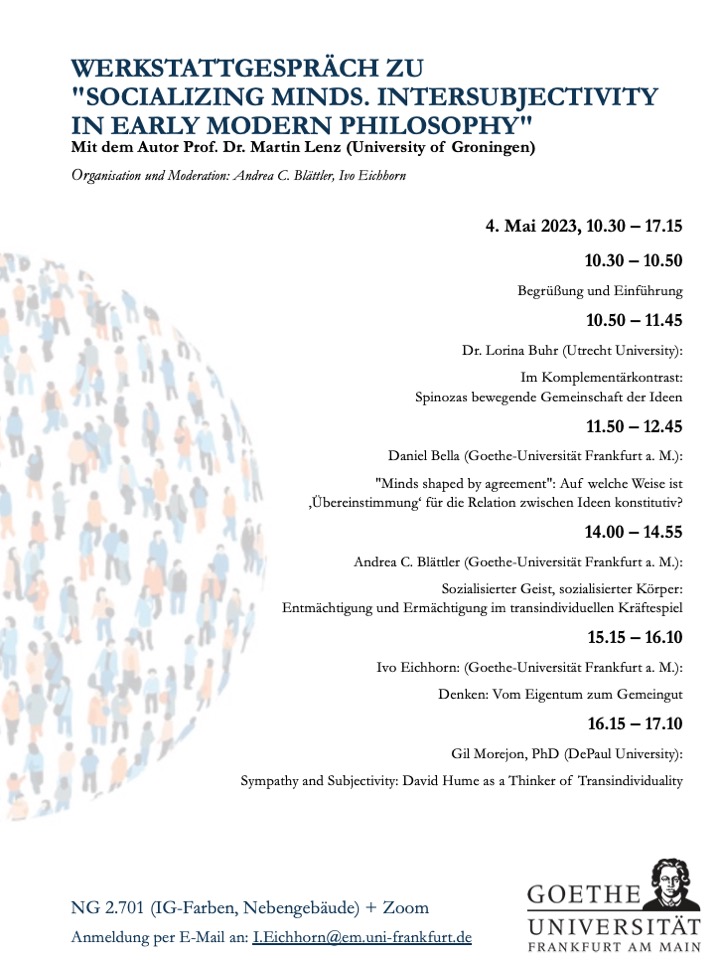
2023 is a year that keeps on giving … Right after the publication of a Symposium on my book, I now have the pleasure to announce a special issue on intersubjective readings of Spinoza, published in the Journal of Spinoza Studies – open access – in the good company of a discussion between Sanem Soyarslan and Steven Nadler. The special issue comprises most of the contributions to a greatly inspiring Werkstattgespräch on Socializing Minds,* kindly organised by Andrea Blättler and Ivo Eichhorn at the Goethe-Universität Frankfurt. I am enormously grateful to everyone involved in the Werkstattgespräch and the special issue. Here is a list of the contributions in the order of my replies:

Martin Lenz, General Introduction

Daniel Bella, Agreement or Contrariety? A Dialogue

Lorina Buhr, Contrariety and Complementarity: Reading Spinoza’s Intersubjective Holism of Ideas with Aristotle’s Two Accounts of Motion

Andrea Blättler, Socializing Minds, Socializing Bodies: Implications of a View to the Bodily Side of Lenz’s Spinozist Theory of Mind

Ivo Eichhorn, From Thinking as Property to Thinking in Common: A Note on the Vocabulary of Appropriation in Martin Lenz’ “Socializing Minds”

Martin Lenz, Reply to Comments

____

* Here is the original announcement of the workshop:

A Symposium on “Socializing Minds”

It is with enormous gratitude to everyone involved that I share the news of a special issue on my Socializing Minds that has now been published online with BJHP. It’s been edited by Tamás Demeter and going back to a wonderful workshop that was organised by Tamás Demeter. I list the contributions (some of which are open access) in the order of my replies:

Susan James, Models of contact: ontological, linguistic, medical, and political

Eric Schliesser, Locke’s Humean conventionalism

Kathryn Tabb, Divine intersubjectivity? On Lenz on Locke

Tamás Demeter, The social and the medical in Hume

Charles Wolfe, Social minds, social brains

Martin Lenz, Reply to comments

How to read (part eleven): With texts against interpretations

A telling fact about human intelligence is that we can hold a lot of false beliefs and still survive or even live a jolly good life. For all I know, there are flat-earthers around whose beliefs don’t seem to interfere much with other beliefs. It’s telling because it raises the question of how much really depends on our knowing the truth (imagine the word capitalised). Much less spectacular but vital for philosophers and historians of philosophy, the same might be true for our understanding of texts.* Many of us might live with grand misinterpretations without ever noticing. (I, for one, lived with a mistaken understanding of what the term “proposition” means roughly until I wrote a paper about it. ) This fact triggers at least two responses: (1) A fair amount of people think that this sad state of affairs can be amended by proper reading which will eventually lead to a proper understanding. “I just read carefully and see what it says”, or something like that. (2) To this a more sceptically inclined colleague might respond: “Well yeah, but it’s all down to your interpretation.” These fairly common yet opposed responses give rise to two opposed myths about reading: The first is that the text simply contains what we can say about it. This kind of hermeneutical givenism is often met with what one might call interpretationism, that is, the idea that there is no text an sich but only interpretations. This opposition is frustrating because it polarises approaches that actually depend on one another. As I see it, the relation between them is not one of contrariety but of a dialectical swinging back and forth. Even if there is not one single correct understanding of a text, there are many false ones. If this is correct, we should exploit this fact for (becoming aware of) our practice of reading by looking for frictions between what we think we know and what the text presents us with. In what follows, I would like to share some ideas how to exploit such frictions. The crucial point is that a claim on what a given text is about should be refined in the course of confronting the actual text. You may start with the assumption that a text is about X. If you’ve done some proper work, you should find that the text is about Y. Here is how:

What are philosophical texts about? – Contrary to a widespread assumption, the answer to that question is normally not given in the text itself. Philosophical texts typically consist of arguments for a certain claim. That’s at least what should be true of our currently most common genre, the philosophical paper or essay. Thus, a good way to read those is to begin by identifying the conclusion that is argued for and then to look for the premisses supporting to the conclusion. How do you find the conclusion, though? What’s often overlooked is that this question is twofold. It has a textual or grammatical sense and a topical or disciplinary sense. In the textual sense, papers or passages often contain a line saying “the aim is to show”, an explicit statement with the defended view or a “therefore” (or “thus” or a similar word or phrase) introducing a conclusion. You should by all means look for such items when reading, but I suppose that the assumption of what a given text or passage is about is settled well in advance by what I call topical sense. Usually, you don’t just bump into a text wondering what it’s about. That question is normally settled by a a course instructor, secondary literature or a bibliography listing this text under a course title or keyword. In this sense, the conclusion is generally embedded in a topical network of a topic (the nature of the mind) as related to a discipline (like philosophy of mind), a common problem (how do mind and body interact), and a set of positions (say, dualism vs monism) on that problem. So even if you look for the conclusion in the text, it will be the topic suggested by the instructor or some other context that guides your search for the conclusion. I bet that if you were to list Cinderella in a syllabus for a consciousness course, people would start looking for the pertinent points in the text. What this comes down to is, again, twofold: On the one hand, a philosophical text is about (arguing for) a conclusion; and identifying the conclusion settles what you take the premisses to be. However, on the other hand, the conclusion is commonly assumed in advance, since the text is given to you in a topical context that suggests and constrains potential conclusions. If this is correct, it seems that prior interpretations (taken on authority) often settle what a text is about. Try reading Descartes’ Meditations as a text that is not in some sense about dualism and you’ll see what I mean. It’s not impossible, but many people will think you’re avoiding the elephant in the room.

Points of contact. – Guiding topical assumptions might seem problematic, but they are not. They belong to the way we receive the text. Rival interpretations often argue about the right topical context. They can be quite controversial and seem mutually exclusive. Just think of the Bible as a religious text as opposed to a historical document. Sometimes they seem more complementary. You can see the Bible as both a historical document and a religious foundation. The point is, then, not to avoid such contexts (and go for givenism), but to see what actually connects text and interpretations. In other words, you should look for points of contact. What are the interpretations arguing about and how do they relate to the text. Interpretations worth your time do not only argue about the proper topical context but do so by also pointing out a concrete term or passage in the text. This is the proper point of contact. Interpretations and related disagreement must have a clear textual basis.

Where are you now and what is next? – If you have found one or several points of contact, you can begin to see what the text is about – in keeping with various interpretations. Don’t downplay this! Figuring out a point of contact is an achievement going well beyond engaging with doxography or an individual interpretation. You could now write something about the state of the art. But note that, so far, you have not begun to work with the text as such. But how do you begin that and why should you bother? Many people won’t even delve into different interpretations but stick to a doxography telling them authoritatively what certain texts are about. Although doxographies initially derive from engagements with the text, they don’t make these engagments explicit. No one today will actually argue that Locke was an empiricist. Such interpretations are taken for granted, not in the sense that they are taken to be true, but in that they are taken to belong to an interpretive tradition. (In the same way, we wouldn’t call a map of Paris from 1250 or from 1950 false; although it still tells us something, we know that it’s outdated.) If you want to move on, you should know what you want. Do you actually want to read the text or do you want to pass an exam? Are you interested in a certain kind of philosophy or do you want to see how it was or is done, that is, written? As I like to put it, if you’re merely doing philosophy, it’s enough to get the hang of some interpretations. If you want to do history of philosophy, you have to engage with the text. But how?

Build up friction between the text and the interpretations. – Topical contextualisations or doxographies are often taken as a starting point, but they do obscure (earlier) failures of understanding. Students often don’t notice that they have mainly learned to project an interpretation into a text, rather than reading a text. So how do you move ahead? Start from your point of contact, but rather than taking an interpretation for granted, ask yourself what the term or passage in question is about. Begin by trying to explain the passage in virtue of the other parts of the same text. How? Explanations like “Locke is an empiricist” or “This passage contains Locke’s account of linguistic meaning”, for example, will commonly block actual reading. You’ll notice this when you ask for details in the text. Once people parse Locke’s famous claim that “Words in their primary and immediate Signification, stand for nothing, but the Ideas in the Mind of him that uses them …” with the assumption that Locke discusses meaning, they are likely to think that “signification” means “meaning”. Arguably, Locke’s text doesn’t offer any such account. So what do you do instead?

  • Provide an analysis of the content and style of the passage as such: explain (technical) terms, see how they hang together and get taken up. Look at logical operators and connections between sentences. See whether it contains arguments or explications of terms. See whether it contains examples. References to other authors or texts. See whether it contains metaphorical expressions. Ask yourself what work the metaphors do.
  • Make a strict distinction between the content and the function of a passage in the overall text. Does it function as an introduction or is it a refinement of something earlier? Is it a key passage in the text itself or part of a larger argument?
  • See whether the technical terms used are part of a common terminology. Study the terminology through dictionaries, handbooks or related texts.
  • Check the translation (if it is one) for consistency with regard to technical terms. Is it a use of terms that’s still common or now part of a different discipline?

Going through some of these considerations will quickly challenge the interpretive ideas. You will likely notice that a text, once you look at the whole, can be part of quite different topics or disciplines and also that the priorities provided in the text rarely match what is deemed relevant in current interpretations. As Jenny Ahworth has shown with regard to Locke’s notion of signification, sometimes a different understanding of one technical term can turn over whole traditions of reading a text. But even if you don’t intend to contribute original research, you’ll have made a first step to developing a solid and independent understanding.

____

* Here is part one of my series on how to read.

Reviving the commentary as a philosophical genre

When I was in my final school years and reading lots of Goethe, my German teacher recommended I read some commentaries by Erich Trunz. This was an amazing discovery: Trunz explained the texts on various levels and, above all, he left out none of the difficult passages that seemed impossible to grasp. When I began reading philosophy at Bochum university I found like-mined approaches, especially in medieval studies. But especially the so-called secondary literature on modern philosophy was often disappointing: True, the interpretations were often quite elegant, but they mostly bypassed the dark passages that clearly required a professional interpretation to make any sense whatsoever. The often fleeting remarks on Wittgenstein’s Tractatus and its numbering system, for instance, left me in despair. Was I not seeing the obvious or were the interpretations I consulted just not geared towards explaining the text? Only much later it dawned on me that the commentary was a philosophical genre in its own right and, outside more philologically inclined circles, a rather rare treat. These days, this is especially perplexing, given that the “diversification of the canon” requires reading unfamiliar material and thus a lot of detailed commentary. But apart from a couple of good examples (especially in classics and medieval studies), one can’t say that the commentary is exactly fashionable again. (See Barry Smith on the neglect of this genre.) Students are often entirely unfamiliar with the genre and sometimes seem to conflate it with what is known as an “opinion piece” in newspapers. After some sketchy remarks here and there, it is high time, then, to say more clearly why a revival of this genre is overdue.

So what is a commentary? – My rule of thump is that commentaries focus on explaining given texts, the linguistic forms of utterances themselves, rather than merely on ideas and arguments. Commentators do not solely attempt to say what a text is saying and what it means or has meant, but also why it is expressed in the way it is expessed. This means that the structure of the commentary follows the text and not the interpretive ideas or goals of the commentator. The beginning of a commentary is thus marked by a quotation of a word or passage from the text itself. Commentaries are often provided along with critical editions or translations of primary texts. They range from occasional annotations to “dark” passages or unfamiliar terminology to full-blown interpretations, giving background information on related texts or tracing unacknowledged sources. That said, a commentary can of course also be a part of a larger interpretation and typically occurs when a specific text passage or term forms the point of contact between different interpretations of a text. In fact, many introductions or guidebooks are commentaries in disguise. But besides critical editions of ancient and medieval texts, it’s mainly Wittgenstein’s work that seems to have invited the genre of commentary.

Why bother? – Do you know Beethoven’s 5th Symphony? Of course you do! Most people only know the opening theme, though. Secondary literature focussing on “central themes” is a bit like that. Arguably, you need a line-by-line commentary of Wittgenstein’s Tractatus to get beyond the famous Proposition 7 (see e.g. Duncan Richter’s commentary). The point is, then, that understanding a thought, argument or concept is different from understanding a text. But if philosophers care mainly about the former, why bother with the latter? Aren’t the essential ideas enough? Getting the “essentials” of the Tractatus, for instance, is like getting a Readers Digest or worse perhaps a cartoon version of it. Nothing wong with cartoons, you say. Of course not, but why bother with philosophical texts in the first place? But here is a more important point: It is often said that the text as such only really matters, if we consider it or the author an authority we want to defer to. Arguably, then, if we value independent thinking we can bypass the textual details. However, this gets things the wrong way round. For who tells you what “the main point” of a text is, if not an authority that you implicitly defer to? As I see it, then, the supposed “main points” are taken on mere authority and are in fact the outcome of earlier textual work of past generations. It is the detailed commentary that equips you with the material necessary for independent study and thought.

How to write a commentary? – Getting a glimpse of the scholarly work going into a commentary often makes the idea of writing such a thing overwhelming. But fear not, it’s doable. Especially these days with so many searchable resources at hand, you often don’t even need to travel. Here are a couple of preparatory moves, though, that might help you getting into the right frame of mind for beginning to write a commentary:

  • Pick and prepare a bit of text: Pick a text you like and find a bit tricky. Not too much: just a couple of lines. The text is your guide. So actually write it down. No, don’t copy it. Only if you actually write it, you will begin to see tricky bits. Write it down, number the sentences, underline words that you want to focus on, and highlight sections that you find tricky.
  • Think about the origin of the text: Make clear to yourself how the text made it onto your screen: Is it from an early print, a student or critical edition, a translation? Who edited it and when and why? Is the spelling in keeping with the original, is there something standardized? All these things tell you something about the material basis and politics involved in the text and might matter to what you actually find on the page.
  • Translation: If the text is in a foreign language, then try to translate it or write out a given translation beneath or beside it. If you don’t know the language, try to get at least keyterms. Check every keyterm and ask yourself whether you can think of a better alternative. Making a translation is the best way to see what you really don’t get. In my experience, many sentences begin to become unclear if you try translating or paraphrasing them.
  • Paraphrase: If the text is in your native or working language, try to make a paraphrase or transfer bits into formal language.
  • Variants: If you waver between different paraphrases, write down both or more. These are possible interpretations. If applicable: Have someone else make a paraphrase, too.

Now that you have a version of the text, you can begin with the actual commentary:

  • Start with a term you find central: Explain briefly why the term is central. Try saying how its centrality affects the rest of the passage you’ve picked. Say how the term relates to (modern or contemporary) cognates (similarities, differences). Say in what sense the term is part of a terminology.
  • Move on to a phrase you find difficult: Say what makes the phrase difficult for an imagined reader (even if it’s no longer dark for you): a certain grammatical feature, an unknown lexical meaning, unfamiliar terminology, strange wording etc. Now spell out some resources that help(ed you) figuring out what the phrase means: a grammar, dictionary, related texts that come with similar phrases.
  • Where does the idea expressed by the phrase come from? Hardly anything you find in a text is (entirely) original. This means that there is often something to be gained from asking genealogical questions: Where does this idea come from? Is it almost a quotation? Does the terminology perhaps just signal a slight shift of interest?

When writing your commentary, there are some obvious techniques to be used:

  • What if you can’t figure something out? Take the phrase and google it! Likely someone else has commented on it. Or something similar is in a different text that helps you figure it out.
  • Make connections within the text: Try to see whether the terms you commented on shed light on the dark phrases. Check logical connectives and see whether they are well used. Check for omissions, enthymemes, implicit assumptions etc. and write them down. Relate these notes to other parts of the same or a different text.
  • Think of audiences: Who will understand thee text better with your comments. Will it help students, people new to the material or fellow specialists? Try too gear your comments to one of those audiences. Ideally begin with students who had no exposure to the material.
  • Contextualise your priorities: Even if you try focussing on “the text as such”, your interests and what you find worth commenting on will be in keeping with certain interpretive traditions. Make them clear to yourself and use them for deciding how to move forward.

It goes without saying that there are many other factors that you could take into account, but if you follow at least some of these stepts, you’ll end up with a bit of commentary on a bit of text that might present you with a way forward or a spark for doing something else with it. Perhaps you’ll extend it, move on to another text or integrate it in an interpretation. I for one will begin to make the commentary a decisive part of writing exercises for students. My hope is that we might write more commentaries in the future. In the meantime, I’d love to hear your thoughts, suggestions or about your favourite commentaries.*

_______

* Thanks to Susanne Bobzien, Nicholas Denyer, Michael Kremer, and Michael Walschots for some first suggestions.

Reason and evidence as disguised authorities in philosophy

Currently, philosophy often enjoys the status of being a critical discipline – a discipline not grounded on authoritative beliefs but as a discipline critically examining such beliefs. Given that philosophy can also be seen as a form of life, for instance, this view of philosophy as a critical discipline is of course not without alternatives. So how did this image of philosophy become so popular? There is of course more than one answer, but writing up a paper on the Condemnation of 1277 made me realise that this view of philosophy might have been pushed greatly by being targeted through this and other condemnations in the 13th century. (If you want to get a clearer idea about the condemned view, the paper is here.) Here are two of the condemned propositions:

“Man may not be content with authority to have certainty about any issue.” (Proposition 150)

“One should not believe anything unless it is self-evident or can be manifested from self-evident principles.” (Proposition 37)

One thing that’s interesting about the view represented by the condemned propositions is that it is taken as a rejection of authority tout court. In being critical, the view seems to reject anything requiring authority or the testimony of others. However, what goes often unnoticed is that this view relies on something that is not conceptualised as an authority but taken to be very authoritative: human reason.

Apart from endorsing all sorts of ableisms, this view obscures that human reason is not just a tool but also turns out to be taken as a source of claims. If we restrict claims to what is knowable through our natural faculties and exclude claims going beyond the pertinent evidence, crucial tenets, such as the omnipotence of God or the creation of the universe, fall away immediately. In this sense, second-order claims about standards of evidence directly affect first-order beliefs. Arguably, a lack of evidence for something does not entail the inexistence of that something. Thus, the lack of evidence might grant being agnostic about something’s existence, but not the denial of existence. However, quite a number of condemned propositions (50-65) seem infer restrictions to God’s omnipotence. As is well-known, the whole understanding of the world order depends on whether we assume the possibilityof divine interventions or not.

In disguising authoritative first-order claims as merely resting on “self-evidence” or “natural reason”, philosophers mangage to sell their view as the mere outcome of critical reflection, rather than reliance on authority. As I see it, the image conjured up by the condemned propositions and the subsequent interpretations helped to create the myth of the ruthlessly rationalist philosopher, as associated with the so-called Enlightenment or indeed with early analytic philosophy. In his Don’t Think for Yourself, Peter Adamson provides a pertinent picture of this view. Taking philosophy as starting from “blank slate” rather than from some authoritative belief means

“… that it would indeed be possible, in sufficiently ideal conditions and with sufficient talent, for a single human being to become an accomplished intellectual with no help apart from resources of the natural environment. Those of us who did not grow up alone on a remote island depend on teachers and routinely take authorities at their word. But there is no absolute need to turn to other humans to achieve enlightenment. You can, quite literally, do it yourself.” (Don’t Think for Yourself, 2022, xii)

According to this image, a proper philosopher rejects reliance on authority and rather thinks for themselves, ideally relying on nothing but natural faculties. This and related images capture and transmit metaphilosophical assumptions. The disagreement figuring in the Condemnation of 1277 affords an image of Enlightenment philosophy avant la lettre. Thinking of this image as opposed to another kind of philosophy allows for portraying those disagreeing with the supposed Enlightenment philosophers as irrationalists. In this sense, the image of the “blank slate” Enlightenment philosopher comes with a cluster of predicates that are mutually reinforcing in historiography, philosophy, and even propaganda.

This blank slate image is quite prominent to this day. One element of this image is the idea that philosophy needs to return to and start from a blank slate, i.e. a state without superstition, prejudice, pseudo-problems, linguistic vexations etc., as it is propagated by some of the condemned propositions, and more famously in Descartes’s Meditations, Locke’s “underlabourer” in the Essay, Wittgenstein’s ideal of purification in the Tractatus-Logico Philosophicus, Carnap’s attack on metaphysics or the Letter against Derrida’s Honorary Degree.

What is it, then, that recommends this image of philosophy over other images of philosophy? As noted, it’s the supposedly undogmatic, instrumental, and critical character that makes philosophy of this kind seem particularly attractive and applicable. This image of purity lends itself to the assumption of political and ideological innocence. In this spirit, Hans-Johann Glock writes: “If the big philosophical beasts are anything to go by, then culpable political lapses may be rarer within the analytic movement than in continental philosophy.” (What is Analytic Philosophy, CUP 2008, 195) Accordingly, Glock thinks that “a failure of reason was a necessary condition to support the [Nazi’s] cause.” (164) This verdict is not only interesting as an expression of the enormous trust into the power of reason in analytic philosophy. It also contradicts Horkheimer and Adorno who would see a single-minded emphasis on reason as degenerating into reason instrumental to totalitarianism.

It’s important to note, though, that both the supposed instrumental character and the freedom from ideology seem to differ from the Aristotelian recommendation of philosophy as the best actualization of human nature, which is spelled out in tandem with the distinction of human reason from perception that we share with nonhuman animals and vegetative functions of the soul that we share with nonhuman animals and plants. But while the teleological hierarchy of the soul’s functions is no longer endorsed today, the distinctions from other psychological features (such as emotion) is still operative. This hierarchical view of psychological functions still privileges reason in distinguishing it from perception, desire, and emotions for instance. So the prioritizing of reason does not only construe it as nobler than belief (in authority), but also nobler than other cognitive, emotive, conative, and physiological functions. The upshot is that we inherit a certain reason-focused image of philosophy. Arguably, it rests on an understanding of philosophy that promotes a dismissive attitude towards faith or belief that is not fulfilling certain evidential standards. However, what remains mostly unsaid is that “natural reason” can be seen as an authority itself.

Invisible disability ­and ableism on the rise through (Long) COVID

Revealing something commonly invisible seems quite a challenge. But ever since hitting on the tweet below I have looked at ordinary scenes in the streets with different eyes:

Along with the caption I found the picture quite telling, but just in case you’re wondering: It’s quite a strain to move past with a stroller and impossible to move ahead with a wheelchair in such situations. While I’m not sure that this phenomenon is a Dutch thing, it’s certainly sufficiently thoughtless to deserve being called ableism. I’d also call it invisible ableism, because it is not commonly noticed as presenting barriers until being pointed out. Had I not seen the tweet, I wouldn’t have noticed the phenomenon. Our world is full of such barriers. When they go unnoticed or remain untouched, they will continue to make disabilities invisible. People with pertinent disabilities will often (have to) resign to stay put.

While such thoughtlessness is bad for people with disabilities, it’s likely to get worse in the coming years. On the one hand, COVID keeps spreading and Long COVID has been and is gravely underestimated. According to a fairly recent paper, “Long COVID is an often debilitating illness that occurs in at least 10% of severe acute respiratory syndrome coronavirus 2 (SARS-CoV-2) infections. More than 200 symptoms have been identified with impacts on multiple organ systems. At least 65 million individuals worldwide are estimated to have long COVID, with cases increasing daily.” If this is correct, the amount of disabilities will rise significantly. On the other hand, not only laypersons but even medical experts are often still uninformed and in denial of the severity of the pertinent diseases, so much so that we’re now seeing what’s called sustained medical gaslighting.

I wouldn’t have become aware of these facts myself, had it not been for the many instructive conversations and writings by friends, such as Eric Schliesser’s pieces on Long COVID (see here for a comprehensive interview). By now I know (of) quite a number of people who are severely affected. I don’t know what’s to be done. But we certainly need to listen and face the severity of the situation. This means not least removing invisble barriers for others and perhaps our (future) selves. That would involve at least to return to better measures of protection and also of accommodating our likely growing disabilities with more flexible responses. At workplaces, for instance, the issue is no longer just a matter of “work-life balance”. Our inaction or action will be decisive for the livelihood of the coming generations, no less.

Take care!   

Can the penny drop too late? Unrecognised slowness in (teaching) philosophy

Non scholae sed vitae discimus.

Once upon a time I received a flattering mail from a student, thanking me for teaching him to ask structured questions. “Although I really hated it at the time,” the student wrote, “I realised I could make great use of the technique some years later, especially since the pandemic started.” It goes without saying that this mail made me very happy, but what I’d like to point out is not that the penny dropped, but that it dropped too late. Too late, that is, to make it into the student evaluations. What we should conclude is that perhaps many of the crucial effects of teaching and learning manifest themselves much later in life than is standardly assumed. At least assumed when we design and assess tests of what has been learned. – Now that the murmur about hopes and worries about the coming academic year is all around, I often think of this mail and related experiences. What the student emphasised was that he could now make use of something he had learned so much earlier that it seemed almost disconnected to the course work. The lesson that I learned from this mail is that I have come to plan my teaching with way too much focus on goals that are supposed to be achievable within the time span of a course, visible at the latest in the assignments, visible ideally to the students, too, so that they can assess their “learning experience” accordingly. In what follows, I want to argue for a different timing in teaching philosophy. I’m a slow reader, thinker, and writer – and I have come, after a long time, to think that’s a good thing after all, so please bear with me. 

Student evaluations. ­– Although it is well known that student evaluations reflect biases rather than educational progress, they are still often taken as a legitimate form of feedback. “Well, of course, they’re bad, but they tell us at least something about the level of satisfaction,” is a line I often hear. The common response is to improve the questions on evaluation forms and think twice about using them too much in hiring and promotion. But as I see it, the problem is that both criticisms and refinements obscure the fact many effects of learning manifest themselves much later. When we advise students and teachers to focus on skills that afford employability, we pretend that the things we teach can be recognised as skills of that kind. Learning to ask questions or, as some prefer to say, “the right questions” certainly means acquiring a skill, but it’s clear that the student didn’t recognise this as something valuable at the time. The upshot is: Many learning goals might not be recognised as such during the time of instruction.

Learning outcomes. ­– What do you do if learning goals might not be recognised as such during the course. Well, you might just tell your students: “trust me, I’m a philosopher”! But that is not good enough when it comes to values such as accountability. So the alternative is to formulate different learning goals or outcomes, ones that are recognisable. Reading up on some of the pertinent literature, I was impressed to begin with. The fact that students cannot relate their performance to verbs such as “understand” or “analyse” in learning outcomes was met with the advice to formulate goals that can be recognised. So we are encouraged to use verbs such as “being able to present”, “respond to” etc. No doubt it’s easier to recognise that you’ve presented something rather than recognising whether you actually understood something. “Presenting” is a success verb, you can tell when it has been done. “Understanding” might seem to be a success verb, too, but arguably it’s an ongoing process. So it’s less clear what constitutes an understanding. While the advice to reformulate learning outcomes accordingly made sense to me when I read it, I have come to doubt it again. I’m expected to teach philosophy, not how to present. Of course, I also care deeply about how philosophy is presented, but does that mean that I can teach philosophical skills best by confining the goals of the course to something recognisable? I doubt that the answer is a clear ‘either-or’. But I think it’s problematic to give up on goals that we deem essential to philosophy. It’s not problematic because it’s simplistic; it’s problematic because it makes a false promise. “Doing philosophy”, “understanding” or “philosophising” are not success verbs. If anything it’s a coming-of-age kind of thing. Arguably, then, we don’t do our students a favour if we mainly aspire to “teach to the test”.

Some politics behind it. – Of course, it would be too simplistic to decry the status quo and glorify the olden days. But it’s important to see where much of this mind-set (aiming at recognisable goals in teaching) might come from. At least in many parts of Europe, an important turn was taken with the introduction of the so-called Bologna reform. While many aims struck me as noble back then, the way this reform has been carried out entails a number of consequences in line with the thinking criticised above. But whatever might drive this development, it’s not a law of nature that philosophy is taught as an easily reconisable skill set. At the same time, I am aware that the current zeitgeist will not allow for a straightforward acknowledgement of the slowness and indeed uselessness that doing philosophy might require. This is why I’d like to close with a quote by Richard Rorty that we might want to bear in mind when flying under the radar:

“So the real social function of the humanistic intellectuals is to instil doubts in the students about the students’ own self-images, and about the society to which they belong. … Somewhere deep down, everybody – even the average taxpayer – knows that this is one of the things colleges and universities are for. But nobody can afford to make this fully explicit and public. … This tension between public rhetoric and private sense of mission leaves the academy in general, and the intellectual humanists in particular, vulnerable to heresy hunters.” (Richard Rorty)

Читал ли Декарт Витгенштейна?Диалогический подход к чтению


Автор: Мартин Ленц (Гронинген)

Перевод: Мария Весте

Читал ли Декарт Витгенштейна? Вам будет приятно услышать, что историки, как и философы, отрицают это. Историки скажут вам, что Декарт—это философ 17-го века, а Витгенштейн—философ 20-го века. Философы согласятся с этим, но поспешат добавить, что Витгенштейн справедливокритиковал концепцию разума Декарта. Как вы знаете, Декарт утверждал, что все наше знание коренится в интроспекции: то, что я думаю, является абсолютно достоверным, в том, что это касается вас, я не уверен. Витгенштейн атаковал эту идею, утверждая, что интроспекция или взгляд внутрь себя не может дать знания, поскольку знание и мышление основаны на социальномвзаимодействии. Так что и историки, и философы скажут вам, что Декарт не читал Витгенштейна.

Однако при ближайшем рассмотрении видно, что они отрицают связь между этими авторами по противоположным причинам. Историк отрицает ее, утверждая, что не следует пытаться понять более раннего автора, например Декарта, через более позднего автора. Таким образом, историк выступает против анахронизма. Философка, напротив, отрицает эту связь потому что она читает анахронистически, а значит, читает Декарта глазами более позднего автора, то есть через Витгенштейна. Таким образом, мы имеем методологическое противоречие. Так стоит или не стоит смотреть на Декарта витгенштейнскими глазами? 

В моем понимании, мы должны читать исторические работы, ориентируясь на современные темы, привнося историю философии в актуальные проблемы, и наоборот. В конце концов, читая старые тексты, мы всегда привносим в них свои предположения. И дело не в том, чтобы отмахнуться от анахроничных предположений или опровергнуть их, а в том, чтобы сделать их как можно более явными.1 Как бы интересно это ни звучало, но с учетом того, что я только что сказал, это представляется несколько безнадежной затеей. Если эти ходы противоречат друг другу, то они покажутся взаимоисключающими. В методологических дискуссиях об истории философии это противоречие часто обозначается, маркируя два различных подхода: рациональная реконструкция и историческая реконструкция. Если первый подход ориентирован на оценку аргументов по современным стандартам, то второй, как представляется, стремится быть верным исторически значимым стандартам. Приняв очевидное противоречие между этими стандартами как решающее, можно сделать вывод, что только один подход ведет к правильному пониманию. В этом духе Кристиа Мерсер недавно заявила, что противоречия теперь разрешены в пользу исторической реконструктивизации или контекстуализации.2 Однако даже если бы эти направления противоречили друг другу, это не означает, что следует придерживаться только одного из них. Как я надеюсь показать, есть веские причины для того, чтобы принять кажущиеся противоречия и сделать выбор в пользу плюрализма подходов. Как мне кажется, внимание к соотношению современной философии, с одной стороны, и отдаленных исторических периодов, с другой, не только интересно, но и методологически необходимо. Почему? Ну, если мы заинтересованы в понимании концепций, таких как, например, концепция разума, нам необходимо корректировать предубеждения и смещения друг у друга, а это означает, в том числе, и выявить противоречия.

Далее я проиллюстрирую это, объединив два отрицательных ответа на исходный вопрос и сформировав положительный, синтетический ответ: Да, Декарт действительно читал Витгенштейна. По крайней мере, Декарт в моем сознании, и наверняка в вашем тоже. Потому что если кто-то, прочитав Витгенштейна, прочтет Декарта, то это приведет к диалогу двух авторов. Моя цель при этом не состоит в том, чтобы представить новую интерпретацию Декарта или Витгенштейна. Многое из того, что я говорю, будет обращаться к уже ставшим стандартными прочтениям. Более того, в моих иллюстрациях эти авторы рассматриваются как взаимозаменяемые с другими образчиками. Поэтому вместо поиска дополнений к существующим интерпретациям, я хочу рассмотреть правомерность сочетания различных и, возможно, даже несопоставимых подходов к философии и ее истории.

Таким образом, защищая синтетический ответ на поставленный выше вопрос, я покажу, что историки и философы нуждаются друг в друге. Но дело не только в том, что сотрудничество—это приятная вещь, но и в том, что и философам, и историкам необходимо понимать концепции, с которыми они имеют дело, а понимание—это в равной степени философское и историческое стремление.

I. ПОНИМАНИЕ ПОНЯТИЙ

Что значит понимать понятие? – Как историка философии меня в первую очередь интересует, за счет чего происходит развитие понятий, идей или идеологий. Конечно, есть и другие единицы—например, аргументы, дебаты, судьба текстов или событий, – которые мы можем изучать. Но понятие, такое как понятие разума, языка, любви или свободы, а также определенные идеи или даже идеологии, связанные с ними, составляют устойчивый репертуар в философии. В то же время такие философские понятия и идеи очень изменчивы.33 Как мне кажется, концепции и другие формы идей распространяются и закрепляются в нашем сознании с течением времени. Точно так же они могут быть забыты и снова исчезнуть или быть заменены более модными. Таким образом, понимание понятий или идей не сводится только к вопросу о том, являются ли связанные с ними утверждения истинными или непротиворечивыми; оно также требует рассмотрения условий, при которых они появляются или исчезают. Понимание понятий или идей, таким образом, требует не только определения некоторых необходимых и достаточных условий, но и исторических условий, которые делают их привлекательными.

Это можно сравнить с картой города. Конечно, если вы хотите просто проехать, то, возможно, достаточно иметь карту нынешней планировки Гронингена. Так вы будете знать, где находится вокзал, университет и т.д. Но для того чтобы понять, как устроен город или как формировать его будущее, необходимо знать различные исторические этапы. Почему, например, люди принимали те или иные решения по архитектуре, или по строительству той или иной дороги? Почему люди придерживаются тех или иных очертаний города, почему многие протестуют против введения новой трамвайной линии?

То же самое относится и к пониманию понятий, идей и идеологий. Если вы хотите просто использовать слово, то, казалось бы, достаточно знать его современное употребление. Но если вы хотите разобраться в конфликтах, которые окружают наши слова и идеи, вам потребуется дополнительный путеводитель. Но теперь философы спрашивают, почему мы вообще должны заниматься историческими значениями, если мы хотим просто участвовать в текущих дискуссиях. Однако те факторы, которые делают идеи привлекательными для нас сейчас, в большинстве случаев уже были установлены до нашего появления. Можно утверждать, что в основном мы работаем с набором идей или идеологий прошлого, а не с тем, что мы придумали бы или даже могли бы придумать. Поэтому для понимания собственных концепций нам необходима концептуальная география, отображающая прошлые и настоящие территории и климатические условия, в которых одни идеи развиваются, а другие пропадают. Как я сейчас предположу, для этого необходимо взаимодействие историков и философов, а значит, и их противоречивых на первый взгляд подходов. Поэтому сейчас я вернусь к вопросу о том, читал ли Декарт Витгенштейна, и расскажу о трех возможных вариантах ответа.

II. ПЕРСПЕКТИВА ИСТОРИКОВ

На протяжении многих лет меня особенно интересовала история понятия “разум”. Даже если внутри и вне исторического и современного канона есть много интересного, тем не менее весьма плодотворным оказывается пристальный взгляд на Декарта и Витгенштейна. Какие предположения делают они и другие авторы, когда говорят, что у человека есть разум? Особенно интересным и актуальным представляется картографирование географии этого понятия. Почему? В последние годы мы стали свидетелями, пожалуй, кардинальных изменений даже в общественном понимании этого понятия. На протяжении тысячелетий понятие “разум” относилось только к человеку, но теперь мы задаемся вопросом, следует ли приписывать разум другим животным и, возможно, даже охватить этим понятием растения и машины.44 Подобные применение понятий требует определенного исторического климата, и я лично приветствую тот факт, что мы все чаще обсуждаем мышление нечеловеческих животных. Но в то же время очень важно понимать, что мы не можем менять концепции по своему усмотрению. Мы должны не упускать из виду то, на чем мы стоим. Понятия могут быть более или менее адекватными, границы концепций меняются исторически, а это значит: в соответствии с политическими модами.

Думаем ли мы о разуме скорее как Декарт или как Виттгенштейн? Готовы ли мы в меньшей степени связывать мышление с интроспекцией индивидов и в большей—с определенными типами поведения? Здесь, например, очень важно глубокое понимание нашего картезианского и витгенштейновского наследия. Но прежде чем ответить на эти вопросы, необходимо разобраться, что подразумевается под этими понятиями. Являются ли они взаимоисключающими?

Итак, вернемся к вопросу о том, читал ли Декарт Витгенштейна! Первый ответ, который я хотел бы назвать “перспективой истории”. В каком-то смысле это самый естественный ответ—твердое “нет”, отмахивание от вопроса как от глупости, как от чистой формы анахронизма. Конечно, когда знаешь необходимые даты, искренне задавать этот вопрос уже нельзя, а может можно?

А почему бы и нет? Простой ответ заключается в том, что историки должны избегать анахронизмов и описывать то, что писали или имели в виду философы прошлого, так, чтобы это соответствовало их собственным стандартам.55 Это означает, что мы можем объяснить их работу в силу более ранних, но, конечно, не более поздних философов. Тезис состоит в том, что чтение Витгенштейна ничего не скажет нам о Декарте. Если воспользоваться нашей географической аналогией, то историки имеют верную карту концепции разума в 17-ом веке, поскольку не вставляют в нее места, которых там нет. Вот что значит избегать анахронизмов.

На первый взгляд, это чистый здравый смысл. Конечно, Декарт не читал Витгенштейна. Но означает ли это, что чтение Витгенштейна ничего не может сказать нам о Декарте? Позвольте мне рассмотреть два возражения против этого утверждения историков. Во-первых, в этом ответе игнорируется тот факт, что философы и другие авторы часто пишут для будущих поколений. Декарт, Спиноза, а также Кант, Ницше и другие писали явно для будущей аудитории. Объяснение их текстов только ссылкой на свое время обедняет их философский потенциал. По сути, это обобщение: любой исследовательский проект ориентирован на будущее. Мы не стали бы заниматься исследованиями, если бы не надеялись, что в будущем они приведут к большим знаниям. Если мы изучаем развитие идей, то крайне важно обратить внимание на их потенциальное будущее, а оно вполне может включать в себя реакцию Витгенштейна на картезианскую концепцию разума.6

Однако, отрезая прошлое от настоящего и будущего, историки в своем обвинении в анахронизме закладывают более глубокую проблему. Они претендуют на то, что мы можем смотреть на текст из прошлого, игнорируя свои собственные убеждения. Другими словами, предполагается, что мы можем понять смысл предложений, не принимая их за истинные или ложные. Я считаю, что это невозможный сценарий.Приведу простой пример: Если бы я сейчас утверждал, что “нынешний читатель этого текста—птица”, то вы бы сразу же убедились в ложности этого предложения. Дело в том, что: вы не смогли бы понять это предложение, не признав его ложность. Это означает, что вы не можете понять смысл предложения, не зная, что должно быть, чтобы оно было истинным.7

То же самое можно сказать и о чтении исторического текста. Если вы считаете, что Витгенштейн прав, то, по-видимому, вы не можете читать Декарта, не считая, что он не прав. Поэтому предположение историка о том, что к Декарту можно подойти без Витгенштейна, является иллюзией. Вообще говоря, чтение прошлых текстов только с точки зрения их собственного временного контекста – это иллюзия, она превращает прошлое в оторванную точку, никак не связанную с настоящим. Таким образом, настойчивое стремление историка избежать анахронизма неосуществимо, поскольку сами акты письма и чтения являются анахронистическими занятиями.

III. ОТВЕТ ВТОРОЙ: ПЕРСПЕКТИВА ФИЛОСОФОВ

Так читал ли Декарт Витгенштейна? Ответ философа состоит из двух частей: “Нет, не читал. Но должен был”. Почему? Ну, Декарт, очевидно, предполагал, что знание основано на интроспективных актах индивидуального человеческого разума. Если бы Декарт читал Витгенштейна, он бы увидел, что эта идея порождает огромную проблему. Почему? Знание предполагает возможность ошибиться. Но различение правильного и неправильного требует социального взаимодействия. Понять что-то неправильно—значит отклониться от социальных правил. Без других, которые могут меня поправить, говорить об ошибках бессмысленно. – Возможно, что в этом случае возражения против Декарта проходит через работы Витгенштейна, Райла, вплоть до таких авторов, как Дэвидсон и психолог Майкл Томаселло. Суть возражения такова: Декарт и другие мыслители раннего Нового времени, такие как Спиноза, Локк и Юм, просто неверно понимают, что такое разум, игнорируя его социальное измерение. Таким образом, понятие мышления Нового времени непоследовательно и не соответствует концепциям разума 20-го и 21-го веков.8 С точки зрения нашей географической аналогии, современный философ имеет лучшую карту понятия разума, поскольку это современная карта со всеми новейшими достижениями.

Однако и с этим подходом у философа есть серьезные проблемы. Отказ от картезианской идеи разума как неполноценной основывается на предположении, что мы имеем лучшее представление о разуме, чем Декарт. Это проблематично по двум причинам. Во-первых, оно принимает каноническое понимание картезианской идеи разума как данности, а прошлое—как нечто уже известное. Вместо того чтобы искать ответ на возражение, он просто отвергает идею Декарта. Почему мы предполагаем, что знаем о Декарте достаточно? Тот факт, что мы его критикуем, конечно, может означать, что он придерживался плохих взглядов. Но это не исключает возможности того, что мы просто не очень хорошо понимаем его взгляды.9 Во-вторых, при этом философ игнорирует тот факт, что современное представление о разуме как о социально обоснованном—это тоже исторически сложившаяся идея. Поэтому если историк изолирует прошлое, то философ рискует оторвать настоящее (и современные стандарты обоснованности и рациональности) от прошлого, рассматривая свои собственные стандарты как чудесным образом освобожденные от исторических условий и ограничений. Но это иллюзия.Тот факт, что философ в настоящее время поддерживает определенное понятие разума, не делает это понятие eo ipso лучше, чем исторические альтернативы, которые были исключены.10

Сейчас тот, кто видит в философии связь с наукой или техникой, может возразить, что такой прогресс отражается и в философии. Соответственно, можно сказать, что философские теории со временем прогрессируют и совершенствуются. Конечно, мы сами замечаем такой прогресс в своем мышлении. Например, мы можем дать определение какому-либо термину, а затем уточнить его, включив в него новые для нас мысли и идеи. Нечто подобное можно сказать и о крупных проектах, рассчитанных на многие годы. Однако понятие прогресса предполагает зафиксированность проекта. Ведь прогресс—это телеологическое понятие, требующее цели, которая должна быть общей для собеседников. Однако, если цели философского исследования смещаются или изменяются, то говорить о прогрессе становится проблематично или даже нецелесообразно. В этом смысле можно сказать, что более поздние философы не обязательно улучшили понимание того или иного понятия, но скорее изменили тему или, по крайней мере, фокус. Например, одно дело—задавать вопрос о понятии разума применительно к предполагаемому божественному разуму. И совсем другое дело, когда речь идет о понятии разума применительно к человеческому поведению. Хотя между этими подходами может быть интересное пересечение, трудно сказать, что они являются частью одного и того же проекта, так что одно понятие может рассматриваться как прямое улучшение другого и, следовательно, “лучше” первого.

Поэтому философ должен задаться следующим вопросом: Что именно делает мысль Витгенштейна столь привлекательной? Я думаю, что один из важнейших ответов заключается в том, что Витгенштейн переносит внимание с понимания разума как чего-то, что репрезентирует объекты, на то, что встроено в социальное поведение. Соответственно, возникает новая концепция правильности, которая не укоренена в репрезентации. Вместо этого Витгенштейн рассматривает правильность как нечто, управляемое соответствием не репрезентируемым фактам, а социальным правилам поведения.

Итак, пока кажется, что Витгенштейн и витгенштейнианцы далеки от концепции разума Декарта. Но что было бы, если бы Декарт действительно прочитал Витгенштейна? Я думаю, что Декарт воскликнул бы, что он согласен с Витгенштейном в некоторых принципиальных моментах. Поэтому перейдем к синтетическому подходу.

IV. ТРЕТИЙ ОТВЕТ: СИНТЕТИЧЕСКИЙ ПОДХОД

Надеюсь, стало ясно, что обе перспективы, и историческая, и философская, начинающие с правдоподобными предпосылками, оказываются шаткими, их слабые места, которые оба подхо сомнительными. Однако есть и хорошая новость: при совместном рассмотрении философия и история обладают инструментами, позволяющими уравновесить предвзятость друг друга. Чтобы проиллюстрировать это, рассмотрим синтетический ответ: “Да, Декарт читал Витгенштейна—в той мере, в какой Декарта рассматривает тот, кто читал Витгенштейна”. Если предположить, что вы знакомы с трудами Витгенштейна, то Декарт в вашем представлении—это тот, кто читал Витгенштейна. Вы, конечно, можете возразить, что это дешевая игра на совмещении противоположных точек зрения. Но сейчас я должен попросить вас внимательно рассмотреть этот вопрос. Так что же особенного в синтетическом ответе? Главное, пожалуй, заключается в том, что наше прочтение текста никогда не исчерпывается концентрацией нашего внимания на этом конкретном тексте. Скорее, мы вовлечены во взаимодействие, происходящее между текстами. По сути, это не что иное, как явление, известное как интертекстуальность, т.е. тот факт, что тексты и наше понимание их всегда связаны с другими текстами.11

Вы не просыпаетесь утром и не думаете: “Я думаю, следовательно, я есть”. Речевые акты и, соответственно, тексты следует рассматривать как реакцию на другие тексты, которые, в свою очередь, ведут к следующим текстам. Соответственно, тексты вплетены друг в друга, даже если это не выражено в прямых цитатах. Утверждение отвечает на вопрос, даже если этот вопрос остается неявным в тексте, в котором содержится ответ. Однако как читатели мы часто читаем тексты в ответ на наши собственные вопросы и неизбежно на основании наших, в основном, молчаливых предположений. В этом смысле “чтение—это диалогический акт”, с самого начала устанавливающий отношения между текстами и порождающий в нашем сознании новые ответы.12 В этом смысле тексты всегда обращены и к будущей аудитории. Таким образом, понимание текста будущей аудиторией, которая приходит с новыми предположениями и вопросами, не должно, по крайней мере, в принципе, рассматриваться как анахроническое искажение.

Интертекстуальные особенности могут рассматриваться как с точки зрения пишущего, так и с точки зрения читающего. С точки зрения пишущего, будущее прочтение, выходящее за рамки того, что утверждается в тексте, может быть даже предполагаемым свойством некоторых жанров. Научная статья может открыть дальнейшее обсуждение и даже может быть написана с расчетом на то, что будущие выводы будут доведены до сведения читателей и позволят им подтвердить или опровергнуть их. В повседневном общении мы тоже замечаем это явление, когда на наши попытки сформулировать связную мысль мы получаем более лаконичный пересказ и восклицаем, что именно это мы “хотели сказать”. С точки зрения читающего, разумно признать, что мы не можем просто взять в скобки свои собственные предположения. Если наше прочтение Декарта построено на предположениях, навеянных витгенштейновскими и другими более поздними идеями, то не имеет смысла делать вид, что их нет. Напротив, мы должны сделать эти предпосылки как можно более явными, чтобы вступить в подлинный диалог с текстом. Например, если мы обнаруживаем, что не понимаем или не согласны, то наша реакция не должна заключаться в том, чтобы сказать, что мы не должны выдвигать анахроничных требований. Скорее, мы можем обратиться к самим себе и спросить (с учетом текста), почему мы не согласны. Таким образом, текст проливает свет на наши собственные ожидания и предположения. Опять же, в повседневном общении мы замечаем такие ожидания тогда, когда понимаем, что ожидали, скажем, другого вывода и что “мы не ожидали так поворота”. Таким образом, мы подходим к позиции, с которой мы могли бы сказать, почему тот или иной вывод удивляет нас, но он вытекает из авторского текста. В этом смысле текст не просто дает нам повод для несогласия, но и подсказывает, какими негласными ожиданиями мы руководствуемся при чтении. Конечно, этот интерактивный процесс гораздо сложнее. Этим я пытаюсь показать, что диалогический подход объединяет историческую и философскую перспективы, не рассматривая их как противоположности. Напротив, интертекстуальность требует совместного подхода. Таким образом, как мне кажется, выбор между исторической и рациональной реконструкцией—это не решение в пользу одной из них как “или-или”, а решение касающееся фокуса внимания. Как таковая, ни одна из них не является преимущественной, поскольку они требуют друг друга и зависят друг от друга. 

Если это так, то это означает, что мы не должны искать “правильный” подход к текстам в истории философии. Исторический контекстуализация или рациональная реконструкция уделяют внимание разным аспектам диалогического взаимодействия с текстом. Если философы игнорируют контексты, считая их несущественными, они упускают из виду, что их собственные суждения о релевантности столь же условны и спорны, как и ими же забытые тексты. Если сторонники исторической контекстуализации упрекают философов в игнорировании контекстов, то они упускают из виду, что важнейшей целью философского чтения является понимание не только исторического источника, но и собственных рассуждений при столкновении с кажущимися странными текстами. Однако контекстуализация исторических источников также неверно понята, если она главным образом истолковывается как подчинение “правильному пониманию истории”.13 При этом важно видеть, что смещение фокуса внимания касается не только методологического подхода к текстам, но и цели обращения к ним. Если взаимодействие диалогическое, то это означает, что целью является не только изучение исторических текстов или обогащение канона, но и изучение наших представлений и суждений. Историческое чтение предполагает встречу умов, а не просто изучение умов прошлого. Таким образом, когда цель переносится с понимания прошлых других на себя нынешних, оправданно, что подход ставит во главу угла рациональную, а не на историческую реконструкцию.

V. ДИАЛОГИЧЕСКОЕ (ПРО)ЧТЕНИЕ ДЕКАРТА И ВИТТГЕНШТЕЙНА

Ключевым аспектом диалогического чтения является то, что оно не нацелено на текст как на просто единичный отдаленный исторический объект. Напротив, оно взаимодействует с историческим текстом таким образом, который позволяет ориентироваться как на предположения и установки читателя, так и на изучаемый текст и связанные с ним тексты. В этом отношении следует ожидать смещения фокуса чтения. Таким образом, речь идет не только (1) о концепции разума у Декарта, но и (2) о нашей реакции на эту концепцию и (3) о наших (возможно) витгенштейнианских предположениях, которыми мы руководствуемся в своей реакции. К этим моментам вполне можно подойти с позиций того, что мы часто называем стандартным прочтением, а затем увеличить масштаб критических точек соприкосновения в данных текстах. В предыдущих разделах я попытался предложить наброски таких стандартных прочтений Декарта и Витгенштейна, не вдаваясь в текстуальное обсуждение. Но и в таком виде эти моменты могут показаться достаточно статичными, даже если предоставить больше текстуальных обсуждений. Однако, как мне кажется, эти шаги следует рассматривать лишь как отправные точки. В дополнение к этим шагам возникает вопрос о том, что мы можем узнать из таких диалогических столкновений о (4) концепции разума Декарта и о (5) наших витгенштейнианских предположениях. В конце концов, так называемые стандартные прочтения являются хорошей отправной точкой, но они не должны заслонять того факта, что большая часть нашей истории (и наших негласных предположений) осталась неизвестной и ее еще предстоит сделать явной.

В свете этих более общих замечаний я хотел бы высказать несколько кратких предложений по пунктам (4) и (5). Прежде всего, я хотел бы обобщить два вывода, которые следуют из синтетического подхода к прочтению Декарта и Витгенштейна.

– Как многие до и после него, Декарт писал для будущих поколений. Как общеизвестно, Декарт очень хотел, чтобы его знаменитые “Медитации” были опубликованы с возражениями и ответами.14Обращение Витгенштейна к этому тексту можно рассматривать как еще одно возможное возражение против картезианской концепции разума. Даже если не соглашаться с подходом Витгенштейна к картезианской традиции, нет никаких принципиальных причин исключать работы Витгенштейна или вообще кого бы то ни было из списка легитимных ответов Декарту. Соответственно, обвинение в анахронизме неверно истолковывает даже дух, в котором были опубликованы “Медитации“.

– Противопоставив Декарта Витгенштейну, мы можем узнать кое-что и о нашем витгенштейнианском наследии, которое до сих пор определяет современные тенденции анти-индивидуализма. Однако такое анти-индивидуалистическое понимание философии Декарта связано не с текстами Декарта, а, вероятно, главным образом с хрестоматийными исследованиями 19-го и начала 20-го века. Возможно, не Декарт, а Витгенштейн и другие авторы 20-го века одержимы идеей индивидуализма. Как мне кажется, такой способ прочтения Декарта в значительной степени обусловлен нашими установками. Это не отменяет такого прочтения, но, вероятно, можно показать, что оно в большей степени обусловлено упором на наши собственные заботы или опасения 20-го века, чем на тех, которые лежат в основе рассуждений Декарта.15

Из этих соображений историки философии часто стремятся “исправить протокол”, выставляя то или иное прочтение анахроничным. Как я уже отмечал, гораздо интереснее было бы взглянуть на анахронические предположения как на вложения в диалог. Поэтому я хотел бы предложить, что так мы можем узнать что-то новое о наших собственных интерпретационных предположениях. Если мы не будем сводить наши интересы к размышлениям о том, какое прочтение менее анахронично, мы сможем открыто обозначить различные тексты или аспекты, которые определяют наше понимание. Вместо того чтобы спрашивать, чье прочтение правильнее, мы можем спросить, как Декарт мог или, скорее всего, ответил бы на обвинения Витгенштейна. Важно отметить, что мы не должны принимать любое стандартное прочтение как данность. Более того, мы даже не должны считать, что нам уже слишком хорошо известна позиция Декарта. Простое утверждение, что концепция разума Декарта является или не является индивидуалистической лишает нас возможности вообразить, что мог бы сказать Декарт, столкнувшись с обвинением в индивидуализме.

Что же мог ответить Декарт? Хотя здесь не место для исчерпывающего обсуждения, можно высказать несколько предположений. Декарт мог бы сказать, что его концепция разума действительно имеет социальное измерение. Хотя об этом уже говорилось ранее,16 до сих пор часто игнорируется тот факт, что Декарт не исходит из индивидуалистического понимания разума. Скорее можно полагать, что его концепция разума является социальной в двух смыслах. Во-первых, в том смысле, что он начинает “Медитации” с сомнения во всех предрассудках, с которыми нас воспитывают. Если Декарт считает, что нам необходимо освободиться от популярных верований, то его предположение должно состоять в том, что нормальное состояние нашего разума состоит в том, что он заселен чужими верованиями, будь то в результате нашего воспитания или какого-то более целенаправленного образования. Однако существует и второе социальное измерение, которое не сразу бросается в глаза. Как известно, Декарт мыслит человеческий разум всегда в связи с разумом Бога. Как и во многих средневековых концепциях, разум в понимании эпохи раннего Нового времени является социальным в том смысле, что он рассматривается в связи с Богом. Более того, именно отношение к Богу определяет истинность и ложность наших идей. Согласно пониманию Декарта, Бог дает истинность нашим идеям, и именно отклонение от божественной воли и стандартов является нашим заблуждением.17 В каком смысле это является социальным представлением о разуме? Декарт утверждает, что ошибка возникает не из-за неправильного представления о предмете как таковом. Скорее, я могу ошибаться потому, что моя воля простирается дальше, чем мой интеллект. Поэтому моя воля может распространяться на неизвестное, отклоняясь от истинного и хорошего. И таким образом, можно сказать, что я ошибаюсь и грешу. Объединяя ошибку и грех, Декарт апеллирует к давней традиции, согласно которой ошибка относится к уровню произвольных суждений и действий. Соответственно, не существует резкого различия между моральными и эпистемическими ошибками. Я могу ошибаться в действиях или ошибаться в мыслях. Источник моей ошибки, таким образом, не в том, что я неправильно представляю объекты, а в том, что я отклоняюсь от пути, предписанного Богом. Именно таким образом могут ошибаться даже совершенные когнитивные агенты, такие как падшие ангелы и демоны. Итак, в первом приближении наш разум можно считать социальным в том смысле, что истинность наших представлений—это не просто свойство, обусловленное связью между разумом, формирующим представление, и объектом, а скорее, требующее связи с авторитетным существом – Богом. Возможно, что именно отношение нашего разума к другому разуму—разуму Бога—дает истину. Таким образом, решающим является отношение между разумами, а не между разумом и объектом. Однако в рассуждениях Декарта об ошибках есть и интригующая точка соприкосновения с Витгенштейном, которая может стать явной только тогда, когда мы анахронически прочтем Декарта, имея в виду позднего Витгенштейна. 

Итак, я предлагаю следующее: концепция разума Декарта не только является социальной в том смысле, который был описан выше. Скорее, предположения Витгенштейна о социальном разуме можно рассматривать как вдохновленные традицией, объединяющей как Декарта, так и Витгенштейна в понимании ошибки. Вероятно, оба они придерживаются волюнтаристского понимания ошибки. Разрешите объяснить.

Начнем с того, что предложим параллельный вариант формулировки понятия ошибки у Декарта и Виттгенштейна: Согласно Декарту, ошибка коренится в отклонении от божественных норм. По Витгенштейну, ошибка коренится в отклонении от социальных норм.18

Для рассматриваемого вопроса важно то, что Бог представляется нам как некий стандарт, которому мы можем соответствовать или от которого можем отклоняться при репрезентации объектов. Таким образом, ошибка объясняется через отклонение от божественного стандарта, а не через репрезентативную модель. Конечно, можно возразить, что божественные стандарты далеки от социальных стандартов и лингвистических правил. Но Витгенштейна могли вдохновить следующие три момента: определение ментальных актов как одного из видов действия, объяснение ошибки и правильности через нерепрезентативный стандарт и неиндивидуалистический подход к стандарту, поскольку именно отношение людей к Богу налагает на нас нормы. В этом смысле ошибка не может быть приписана отдельному индивиду, неверно представляющему объект; она должна быть связана с разумом, который соотносится с нормами, установленными Богом.

Если принять это историческое сравнение хотя бы в качестве предположения, то можно сказать, что божественные нормы играют у Декарта теоретическую роль, аналогичную социальной практике у Витгенштейна. Чтобы увидеть это, полезно вернуться к различию между теологическими интеллектуалами и волюнтаристами. Теологические интеллектуалисты исходят из того, что божественные нормы могут быть обоснованы ссылкой на более фундаментальную норму, например, Бог желает добра, потому что оно хорошо. Теологические волюнтаристы, напротив, полагают, что нечто является хорошим именно потому, что Бог желает этого, а не потому, что существует некий дополнительный стандарт добра. Витгенштейн, по-видимому, следует этой волюнтаристской идее, говоря следующее: “Следование правилу сходно с подчинением приказу.” (ФИ 206)

Как же Витгенштейн видит это традиционное теологическое различие? Учитывая его многочисленные рассуждения о воле даже в ранних работах, становится ясно, что его творчество было пронизано подобными соображениями. Наиболее ярким является его замечание о волевом унтаризме, приведенное в “Заметках о беседах с Витгенштейном” Вайсмана (1956): “Я думаю, что первая концепция является более глубокой: Добро—это то, что определяет Бог. Ибо это отрезает путь к любому и всякому объяснению “почему” это хорошо…”. Здесь Витгенштейн явно встает на сторону волюнтаристов.19 Действительно, представление о том, что следование правилам—это послушание, можно рассматривать в полном соответствии с утверждением о том, что ошибка состоит в нарушении общей практики, так же как и волюнтаристская традиция, которой следует Декарт считает, что заблуждение—это отклонение от божественных норм. Если эти утверждения направлены в плодотворное русло, то они могут открыть путь к переосмыслению мысли Витгенштейна в контексте долгой традиции волюнтаризма. Возможно, они преуменьшат претензии Витгенштейна на оригинальность, но в то же время сделают более доступными и его работу, и традицию волюнтаризма.

Этим я хотел бы предложить, что диалогическое прочтение открывает необычные, но полезные способы взглянуть на Декарта в диалоге с витгенштейнианскими постулатами. Оно необычно тем, что высвечивает Декарта как сторонника более социального взгляда на разум, а семантику Витгенштейна – как связанную с теологической традицией волюнтаризма. Она поучительна тем, что открывает новые возможности взглянуть на этих авторов, а также на наши собственные интуиции, которые могут быть связаны с идеями волюнтаризма сильнее, чем кажется на первый взгляд. Если акцентировать внимание на вопросе истинности и ложности у Декарта и Витгенштейна, то можно увидеть, что они оба одобряют понимание ошибки как поведенческого отклонения. А это, конечно, крайне важно для концепций разума и понятия ошибки, которые до сих пор лежат в основе наших подходов в философии разума и семантике.

Вероятно, существует, по крайней мере, два различных способа понимания ошибки. Один способ—это модель искажения: если вы смотрите на джин и думаете, что это вода, то вы неверно представляете факты. Другой способ – это модель отклонения от установленных стандартов: если вы смотрите на джин и думаете, что это вода, то ваш разум не может вести себя в соответствии с созданными нормами. То, что может показаться просто пересказом, на самом деле является другой моделью: первая – моделью репрезентации, вторая – моделью действия или поведения. Если принять это различие, то становится ясно, что понимание разума у Витгенштейна опирается на модель, которая старше той модели, на которую опирался Декарт. Возможно, его вдохновило чтение Августина, Декарта, Спинозы или Шопенгауэра, которые используют эту модель в разных обличьях.

Привлекательность этой модели очевидна: рассмотрение ментальных актов как формы девиантного или конформистского поведения позволяет отнести эпистемические ошибки к той же категории, что и моральные. Когда я начал рассматривать авторов в соответствии с этой моделью, я сначала подумал, что просто слишком анахроничен, но затем, перечитав записные книжки Витгенштейна, я понял, что он использует эти идеи открыто. При трактовке девиантного поведения как ошибки эта концепция разума, видимо, идет очень далеко и лежит в основе не только Витгенштейна, но и, например, современных представлений о воплощении и телеологических концепций о ментальном содержании.

VI. ЗАКЛЮЧИТЕЛЬНЫЕ ЗАМЕЧАНИЯ

Я надеюсь, что стало понятно, что историческая и рациональная реконструкции—это скорее акценты в диалоге, чем конкурирующие подходы. Как мне представляется, синтетический подход может дать новое понимание основ, имеющих важное значение, но оставшихся незамеченными в современных концепциях разума. Наши нынешние идеи не лучше старых, они просто формируются в новых условиях. Но вернемся к методологической точке зрения: открытое противопоставление философских и исторических подходов приводит к новым открытиям, которые могут помочь в понимании концепций; оно уравновешивает те предубеждения, которых придерживается каждая дисциплина в отдельности. Сформулируем это еще раз в терминах нашей географической аналогии: cогласно синтетическому подходу, концептуальный географ имеет обе исторические карты—17-ого и 20-го вв. Теперь и философ, и историк могут возразить, что синтетический подход не различает должным образом эти две карты, а смешивает прошлое и настоящее. На это я отвечу, что разграничение карт—это всего лишь эвристическая точка отсчета, которая начинается с более или менее канонических прочтений. Но мы должны видеть одну карту сквозь другую, и наоборот. Тогда историк философии и философ могут начать учиться друг у друга. Что дает такой обмен мнениями? Пожалуй, только рассматривая разные концептуальные карты, в которых проступают разные детали, можно оценить богатство концептуального ландшафта. И именно здесь мы нужны друг другу. Для синтетических подходов очень важно не путать концептуальные карты и картографируемый ландшафт. Мы должны понимать, что мы всегда являемся лишь частью этого огромного ландшафта, мы перемещаемся по нему и занимаем разные места в старых и новых слоях карт. Учитывая все разговоры о необходимости “новых идей” для решения стоящих перед нами задач, позвольте мне в заключение заметить, что не всегда нужны новые идеи; иногда нам просто нужны люди, которые понимают идеи.

ССЫЛКИ

Adamson, Peter 2016. All 20 Rules for History of Philosophy. URL https://historyofphilosophy.net/all-20-rules-history-philosophy. Accessed: 27 February 2022.

Ariew, Roger 2015. Objections and Replies. In Lawrence Nolan (ed.) The Cambridge Descartes Lexicon. Cambridge, Cambridge university Press.

Avramides, Anita 2000. Other Minds. London – New York, Routledge.

Bloor, David 2002. Wittgenstein, Rules and Institutions. London, Routledge.

Burge, Tyler 2007. Foundations of Mind. Oxford, Oxford University Press.

Calvo, Paco – Fred Keijzer 2009. Cognition in Plants. In František Baluška (ed.) Plant Environment Interactions: Signaling and Communication in Plants. Berlin, Springer. 247–266.

Corneanu, Sorana 2011. Regimens of Mind. Chicago, university of Chicago Press. 

Francks, Richard 2008. Descartes’ Meditations: A Reader’s Guide. London, Continuum. Franklin, Stanley 1995. Artificial Minds. Cambridge/MA, MIT Press. 

Kemp, Gary 2012. Quine versus Davidson. Truth, Reference, and Meaning. Oxford, Oxford University Press. 

Klein, Julie 2013. Philosophizing Historically/Historicizing Philosophy. In Mogens Lærke – Justin E. H. Smith – Eric Schliesser (eds.) Philosophy and Its History: Aims and Methods in the Study of Early Modern Philosophy. Oxford, Oxford University Press. 

1Это переработанная версия моей инаугурационной лекции в Гронингенском университете в 2017 году. Я благодарен Оливеру Тоту за его проницательные комментарии к последнему варианту. – См. об отношении между философским или апроприационистским подходом как противопоставлению историческому или контекстуалистскому подходу в Laerke, Schliesser и Smith 2013.

2См. Мерсер 2019, а также Вайнберг 2019, где представлены оригинальные ответы Чарли Хунемана, Эрика Шлиссера и мои.

3Ad hoc, я принимаю понятие как более базовую единицу, связанную со словами, выражающими его. Я часто использую “понятие” и “концепция” как взаимозаменяемые с “идеей”. В некоторых контекстах под “идеями” я подразумеваю концепции как фигурирующие в конкретных утверждениях, то есть несколько более крупные единицы, такие как набор убеждений, выраженных (наборами) предложений. Таким образом, можно провести различие между “концепцией разума” и “витгенштейновской идеей (или концепцией) разума”. Хотя я не придерживаюсь здесь технического понимания понятия “идея”, я нахожу многое из того, что я думаю, созвучным и, более того, выраженным гораздо лучше, чем я мог это сделать в Келоз (Queloz 2021. гл. 1). В отличие от этого, “идеологии” являются более всепроникающий единицами, включающими в себя целые системы идей, убеждений и установок. Самое главное, что я не воспринимаю слово “идеология” как в любом случае уничижительное, поскольку не считаю, что существует неидеологическое состояние мышления или дискуссии. В острой необходимости я бы согласовал свое понимание идеологий с пониманием сформулированным у Смита (Smith 2021. 158-177).

4См. о разуме животных Millikan 2004, о познании растений Calvo и Keijzer 2009, а также об искусственном разуме Franklin 1995.

5Обвинение в анахронизме встречается очень часто, но крайне редко обсуждается подробно. См. критическое обсуждение в Rorty 1984 и Adamson 2016.

6Здесь я в основном опираюсь на то, что Шлиссер называет “философским пророчеством” (Schliesser 2013).

7В этом отношении я вслед за Дэвидсоном утверждаю, что смысл устанавливается в силу того, что мы считаем истинным, а не наоборот. См. о семантике Дэвидсона (Kemp 2012. 65-86).

8Подобная карикатура на возражения против концепции разума Нового времени наиболее ярко развита у Райла. См. обсуждение Lenz 2022. 1-29.

9Так называемый дуализм Декарта стандартно используется и преподается как противопоставление современным представлениям о разуме. Таким образом, искажается целый ряд важных принципов. См. например, Francks 2008. 9-74.

10Подобное предположение опирается на широко оспариваемую идею о том, что более поздние по времени этапы совпадают с прогрессом в этой дисциплине. См., например, Lenz 2019, где обсуждается недавняя книга Скотта Соамса.

11См. об интертекстуальности Margolis 1995. гл. 5.

12Я заимствую эту подходящую фразу у Клейна 2013 с. 156.

13В этом отношении я не согласен с Мерсером 2019, который, вместо того чтобы сформулировать цели исторического исследования, предлагает руководствоваться в исторических исследованиях ограничивающим принципом “сделать все правильно”.

14См. Ariew 2015.

15См. более подробную дискуссию у Lenz 2022, гл. 1, и Avradimec 2000.

16См. Burge 2007 сс. 420-439.

17См. поучительную дискуссию в Corneanu 2011. 84-90.

18Последующее обсуждение волюнтаризма Витгенштейна во многом основано на Lenz 2017.

19См. Bloor 2002 сс. 126-133, где также обсуждается волюнтаризм Витгенштейна.

Did Descartes read Wittgenstein? Video of my inaugural lecture (from 2017)

Introduction and laudatio start at minute 9:30. Lecture starts at 20:50.

Above you can see a video of my inaugural lecture (Did Descartes Read Wittgenstein? Towards a Conceptual Geography), held on 31st of October in 2017 at the University of Groningen. Taken together with my regular course on methodology in the history of philosophy for research master students at our faculty, the preparation of this lecture may be said to have served as the main source of ideas for this blog, which I started about nine months after presenting the lecture.

The lecture (beginning at minute 20:50) is preceded by a brief introduction through the Rector and a laudatio by Dean Lodi Nauta (beginning at minute 9:30). In the meantime, the original text of the lecture has been turned into a small paper, kindly published in a special issue of Magyar Filozófiai Szemle (2022/1) edited by Judit Szalai and Olivér István Tóth, and now even translated into Russian by Marija Weste.

The main reason for keeping the video for posterity is of course a soundbite, early on in the lecture, by my daughter Hannah who was then just under a year old. At some point in her life, it might please her to have one of her early public oppositions to my views on record. Along with some other videos, my lecture used to be stored on my Youtube channel under “Going Loopy”, the name of my alter ego on soundcloud. But since my university decided to close brand accounts with Google, these videos are no longer accessible on Youtube. Thus, I thought I might as well make it available here.

Writing is decision-making. Introducing reflective tasks in examination (in the light of ChatGPT)

It’s true, even though I said that I wouldn’t worry too much about students using ChatGPT, a few doubtful cases have made me wonder what to do about it. I’ve seen a lot of good advice and discussion already (see e.g. this piece by Matthew Noah Smith among further discussions and resources), but nothing has quite convinced me for my own endeavours and settings. What I am particularly worried about is that some students might stop entirely with working through crucial hardships of writing: trying out formulations, thinking carefully about structure and terminology, setting goals, failing, revising, refining and trying again. Obsessing (especially in how we grade) about the quality of the product (the exam or essay), we might forget about the point of teaching writing. After all, it’s not the odd successful exam or essay but reflecting on shortcomings and setting priorities that will foster learning. As Irina Dumitrescu aptly puts it: “But the goal of school writing isn’t to produce goods for a market. We do not ask students to write a ten-page essay on the Peace of Westphalia because there’s a worldwide shortage of such essays. Writing is an invaluable part of how students learn. And much of what they learn begins with the hard, messy work of getting the first words down.” The main reason for emphasising such tasks, then, is not to torture students, but to teach them thinking successfully and affording control over the process of thinking. So before I set out my ideas for examination, let me briefly motivate my approach.

Two phases of writing. – As I see it, writing is a kind of decision-making. While (1) tacitly articulating things in one’s head and attempting to write them down might count as thinking, (2) coming down on a certain way of phrasing means to decide or commit oneself to a particular mode of expression. It’s crucial to see that these are two very different phases and the way from phase one to phase two might be very long and disparate. As a student, I simply could not get to phase two without very torturous and long processes of trying things out. And sometimes I would never even reach phase two. Other times, I would need to write down two to three pages in order to end up writing and committing to a phrase that I had initially formulated in my head. It felt like slowly working towards finally writing down a phrase legitimately that I had idly considered in the beginning of writing my text. (Even if you’re different from me and do everything in your head before writing down a single line, you need to practise weeding out bad formulations before.) When you do this in handwriting, the constant crossing out and revising remains visible. Today, computers and formatting allow even the most hapless scribbles to look like parts of a finished book manuscript. The perfection of layout suggests a perfection of presentation that leaves the traces of desperate revisions invisible. Coming to phase two, then, means to have ruled out plenty of unsatisfactory formulations and alternative modes of structuring. Arguably, shortening this process of phase one by jumping on the next best phrase or sidestepping it completely by leaving it to ChatGPT means sidestepping thinking altogether and ending up with at text that no-one ever decided on.

Accordingly, I want to discourage students generally from unreflectively holding on to the first form of words that passes through their minds. Rather, I’m looking for tasks that make students ponder on their work and encourage second thoughts. So I hope to design something that works even for students who are not resorting to ChatGPT or other forms of cheating.

What I want students to go through. – Is this a fitting expression, and what is left out in using it? Does this structure work, given the content? What would change if I presented things in a different order? What is the main point I need to get across? How did I come to think of this as the main point? Should I rather focus on a seeming side-issue? Etc. Between the blank page and a successful piece, there are so many things and versions and other potential pieces that might be equally successful. Despairing over such choices is a crucial part of the process of writing. Leaving it to ChatGPT means learning nothing, nothing at all about writing and about yourself, let alone about ways to find your voice. Drawing out the gloomy consequences of leaving thought-processes to machines, Maarten Steenhagen sees us heading “towards a de-skilled society. More and more, thinking itself is being turned into a service, a product that is offered by some company or other. When people look for answers or want to understand something, they turn to Google, Bing, or to social media. There, they are likely to find easily digestible, byte-sized snippets that will do for most practical purposes.”

So what are the tasks I’m going to try out in my courses? – How can I see and evaluate whether students thought about the presentation of their ideas? I guess by asking to do so explicitly. So in future exams and essays I will add two kinds of tasks to the standardly requested answers (or papers).

  1. On the level of content: Instead of having students just write down answers to exam questions, I will ask them to motivate their answer in relation to an insight they had. Ideally, this insight should relate to a previous discussion in class. It could take the form of “I think this or that in the light of the following idea, premise, assumption, argument (where the specific item relates to a discussion in class)”. If one wants to extend this procedure, one could add further steps to the motivation, such as an objection to the answer given and a tentative response to the objection. (This idea builds on my teaching of structured questions.) So whereas the actual answer is the item to be graded, the additional items (motivation, objection, response) ensure a relation to the previous action in class (or whatever you ask it to be related to). Obviously, the addition items allow for a fine-tuning of the grade, too, but the main point is to encourage reflection, ideally by means of relating to actual discussions in class so as to introduce elements that cannot be achieved by ChatGPT.
  2. On the level of articulation: Here, I would ask students to add a reflection on their formulations or terminology. Either positively, by explaining why they have chosen a certain form of words, or negatively, by explaining why they have decided against a certain form of words. The precise term or phrase is for the students to pick. What they need to do is say something like “I used the term necessary because this excludes the possibility of exceptions.” Or, “I first thought about using the term thing but then I realised that what I meant could also include processes.” Again, the point is not to turn this into a demand for whater-tight arguments for certain modes of expression, but rather to encourage and monitor some level of reflection on one’s own language. It goes without saying that this also could be done or requested in relation to discussions in class. (Ideally, this exercise will also train the grasp of “operational concepts”, i.e. the means through which we express certain contents. See on this my conversation with Daniel-Pascal Zorn.)

While these tasks are thought of in relation to exam questions, they could also be introduced in essays and other assignments. Here, they could easily be requested in the form of footnotes offering some self-reflection.

I don’t know if these and related tasks will prevent ChatGPT from being used and abused, but at least the request to invoke discussions that happened in class will be difficult to mimic for such a device. In any case, they would take some reflection for making the relation, ensuring at least some reflection on part of the student.

At this point, I’m just beginning to experiment with tasks that encourage reflecting on one’s texts. I’m pretty sure, there are many people who have already thought of this and related issues more thoroughly. (* I am particularly grateful to Sara Uckelman for sharing her reflections. You can follow up on these on FB.) Please feel free to add ideas or, as always, comment on the ones presented.

***

As it happens, this blog is now up and running for five years. So I’d like to thank you all for your continuous reading, encouragement, and discussion.