Writing is decision-making. Introducing reflective tasks in examination (in the light of ChatGPT)

It’s true, even though I said that I wouldn’t worry too much about students using ChatGPT, a few doubtful cases have made me wonder what to do about it. I’ve seen a lot of good advice and discussion already (see e.g. this piece by Matthew Noah Smith among further discussions and resources), but nothing has quite convinced me for my own endeavours and settings. What I am particularly worried about is that some students might stop entirely with working through crucial hardships of writing: trying out formulations, thinking carefully about structure and terminology, setting goals, failing, revising, refining and trying again. Obsessing (especially in how we grade) about the quality of the product (the exam or essay), we might forget about the point of teaching writing. After all, it’s not the odd successful exam or essay but reflecting on shortcomings and setting priorities that will foster learning. As Irina Dumitrescu aptly puts it: “But the goal of school writing isn’t to produce goods for a market. We do not ask students to write a ten-page essay on the Peace of Westphalia because there’s a worldwide shortage of such essays. Writing is an invaluable part of how students learn. And much of what they learn begins with the hard, messy work of getting the first words down.” The main reason for emphasising such tasks, then, is not to torture students, but to teach them thinking successfully and affording control over the process of thinking. So before I set out my ideas for examination, let me briefly motivate my approach.

Two phases of writing. – As I see it, writing is a kind of decision-making. While (1) tacitly articulating things in one’s head and attempting to write them down might count as thinking, (2) coming down on a certain way of phrasing means to decide or commit oneself to a particular mode of expression. It’s crucial to see that these are two very different phases and the way from phase one to phase two might be very long and disparate. As a student, I simply could not get to phase two without very torturous and long processes of trying things out. And sometimes I would never even reach phase two. Other times, I would need to write down two to three pages in order to end up writing and committing to a phrase that I had initially formulated in my head. It felt like slowly working towards finally writing down a phrase legitimately that I had idly considered in the beginning of writing my text. (Even if you’re different from me and do everything in your head before writing down a single line, you need to practise weeding out bad formulations before.) When you do this in handwriting, the constant crossing out and revising remains visible. Today, computers and formatting allow even the most hapless scribbles to look like parts of a finished book manuscript. The perfection of layout suggests a perfection of presentation that leaves the traces of desperate revisions invisible. Coming to phase two, then, means to have ruled out plenty of unsatisfactory formulations and alternative modes of structuring. Arguably, shortening this process of phase one by jumping on the next best phrase or sidestepping it completely by leaving it to ChatGPT means sidestepping thinking altogether and ending up with at text that no-one ever decided on.

Accordingly, I want to discourage students generally from unreflectively holding on to the first form of words that passes through their minds. Rather, I’m looking for tasks that make students ponder on their work and encourage second thoughts. So I hope to design something that works even for students who are not resorting to ChatGPT or other forms of cheating.

What I want students to go through. – Is this a fitting expression, and what is left out in using it? Does this structure work, given the content? What would change if I presented things in a different order? What is the main point I need to get across? How did I come to think of this as the main point? Should I rather focus on a seeming side-issue? Etc. Between the blank page and a successful piece, there are so many things and versions and other potential pieces that might be equally successful. Despairing over such choices is a crucial part of the process of writing. Leaving it to ChatGPT means learning nothing, nothing at all about writing and about yourself, let alone about ways to find your voice. Drawing out the gloomy consequences of leaving thought-processes to machines, Maarten Steenhagen sees us heading “towards a de-skilled society. More and more, thinking itself is being turned into a service, a product that is offered by some company or other. When people look for answers or want to understand something, they turn to Google, Bing, or to social media. There, they are likely to find easily digestible, byte-sized snippets that will do for most practical purposes.”

So what are the tasks I’m going to try out in my courses? – How can I see and evaluate whether students thought about the presentation of their ideas? I guess by asking to do so explicitly. So in future exams and essays I will add two kinds of tasks to the standardly requested answers (or papers).

  1. On the level of content: Instead of having students just write down answers to exam questions, I will ask them to motivate their answer in relation to an insight they had. Ideally, this insight should relate to a previous discussion in class. It could take the form of “I think this or that in the light of the following idea, premise, assumption, argument (where the specific item relates to a discussion in class)”. If one wants to extend this procedure, one could add further steps to the motivation, such as an objection to the answer given and a tentative response to the objection. (This idea builds on my teaching of structured questions.) So whereas the actual answer is the item to be graded, the additional items (motivation, objection, response) ensure a relation to the previous action in class (or whatever you ask it to be related to). Obviously, the addition items allow for a fine-tuning of the grade, too, but the main point is to encourage reflection, ideally by means of relating to actual discussions in class so as to introduce elements that cannot be achieved by ChatGPT.
  2. On the level of articulation: Here, I would ask students to add a reflection on their formulations or terminology. Either positively, by explaining why they have chosen a certain form of words, or negatively, by explaining why they have decided against a certain form of words. The precise term or phrase is for the students to pick. What they need to do is say something like “I used the term necessary because this excludes the possibility of exceptions.” Or, “I first thought about using the term thing but then I realised that what I meant could also include processes.” Again, the point is not to turn this into a demand for whater-tight arguments for certain modes of expression, but rather to encourage and monitor some level of reflection on one’s own language. It goes without saying that this also could be done or requested in relation to discussions in class. (Ideally, this exercise will also train the grasp of “operational concepts”, i.e. the means through which we express certain contents. See on this my conversation with Daniel-Pascal Zorn.)

While these tasks are thought of in relation to exam questions, they could also be introduced in essays and other assignments. Here, they could easily be requested in the form of footnotes offering some self-reflection.

I don’t know if these and related tasks will prevent ChatGPT from being used and abused, but at least the request to invoke discussions that happened in class will be difficult to mimic for such a device. In any case, they would take some reflection for making the relation, ensuring at least some reflection on part of the student.

At this point, I’m just beginning to experiment with tasks that encourage reflecting on one’s texts. I’m pretty sure, there are many people who have already thought of this and related issues more thoroughly. (* I am particularly grateful to Sara Uckelman for sharing her reflections. You can follow up on these on FB.) Please feel free to add ideas or, as always, comment on the ones presented.

***

As it happens, this blog is now up and running for five years. So I’d like to thank you all for your continuous reading, encouragement, and discussion.

Love as imitation. A note on the role of love in academic teaching and learning

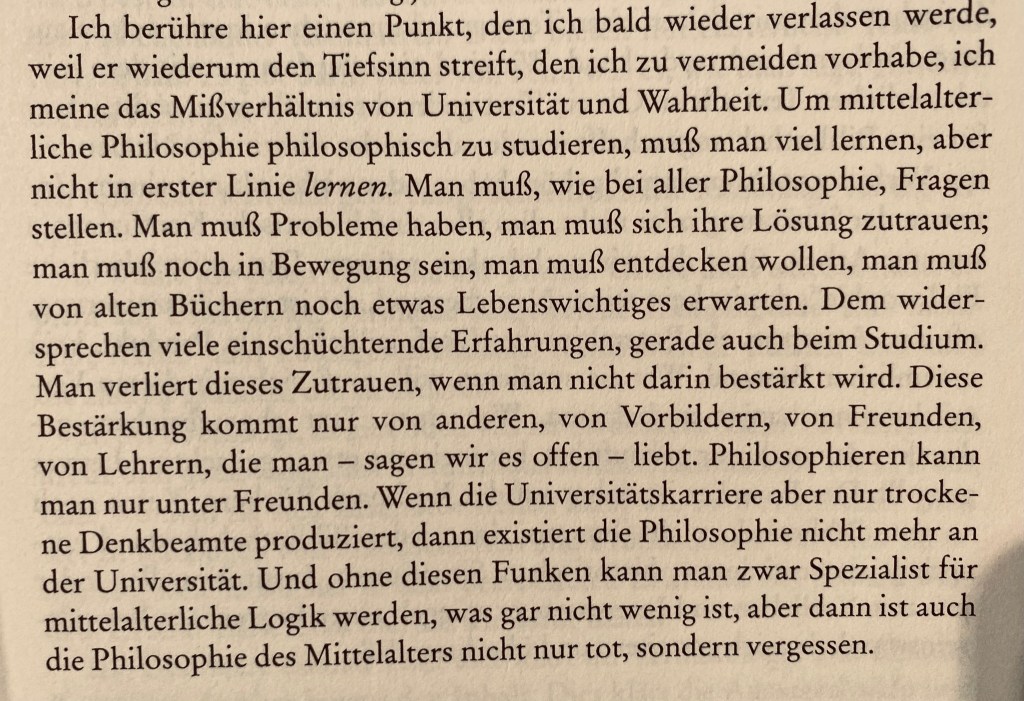
“I am touching on a point that I’ll soon leave behind again, since it relates to the profoundness that I intend to bypass, I mean the disparity between university and truth. To study medieval philosophy in a philosophical way one has to learn a lot, but one should not prioritise learning. As with any kind of philosophy, one has to ask questions. One has to have problems; one has to have confidence in being able to solve them; one still has to be on the move, wishing to make discoveries, wishing to learn something of vital importance from old books. This is countered by many intimidating experiences, especially during one’s studies. One loses this confidence if one is not encouraged. This encouragement comes only from others, from role models, from friends, from teachers whom one – let’s be frank – loves. Only among friends can one do philosophy. But if university career paths merely produce sober thinking clerks (Denkbeamte), then philosophy does no longer exist at universities. And without this spark you might still become a specialist in medieval logic – which is no small endeavour – but then medieval philosophy is not just dead but forgotten, too.”

Kurt Flasch, Historische Philosophie, 2003*

In times of increasing worries about ChatGPT and education systems more generally it’s soothing and inspiring to re-read some of the works of my teacher Kurt Flasch. Neither he nor my PhD supervisors Burkhard Mojsisch and Gert König were very good at preparing me for a career on the international job market, but they surely inspired some resilience against its crushing mechanisms. Re-reading the passage I translated above made me think about love of teachers again. Not in the recently well-rehearsed sense of academic ‘metoo stories’, but in the sense of what I’d like to call love as imitation. I know there are a lot more topics in the offing, but the idea of love in academia is, as far as I can see, perhaps the least understood.

So what does it mean to love a teacher? – Quite simply, to love one’s teacher means wanting to be like them. While it might involve interacting with them on some level, the crucial aspect is wanting to become like them, and that means, for instance, approach problems like them; speak, sound and listen like them; read like them or perhaps even enter into the form of life displayed by them – in one word: imitate them. (As I have argued earlier, love is, amongst other things, the ability and desire to understand another person. A strong way of understanding the other, then, is imitating them.) When I was a student, I had a couple of professors I really loved in that sense. I ended up following their courses, not primarily because I was into the topic all too much, but because I thought that, whatever they would teach, I would be learning something worthwhile. But how do you learn, how does that kind of love play out? While I was (back then) completely unaware what that meant, I just attempted to imitate them. This was quite palpable to me. When I wanted to pursue a certain (stylistic) approach, I would simply hear and try to imitate their voice in or their style when writing. – You might find this strange, but that’s probably what’s going on when we learn to find our voice in any kind of art, be it playing music, trying to paint or draw, or trying to speak and write.

Shouldn’t we aim at independence? – I guess the reason why imitation is so underrated in teaching is that we’re told to value independence. This is a fair point, but there are two issues that should be considered in response: Firstly, there is no independence without belonging. We’re not monads but always relating to a form of life and style that allows us (and others) to recognise that we’re engaging in the kind of practice we wish to engage in. How do I know I’m playing music if there is no one I’m relating to in my musicianship? Secondly, when we imitate we are never perfect imitators or impersonators – we end up appropriating and making things our own. So when I imitate my favourite teacher, you won’t hear Kurt Flasch but – willy nilly – an appropriation of his approach. In fact, the initial enthusiasm for pursuing something is fostered most by imitating a role model, be it a musician, an actor or a philosophy professor. In doing so, we might begin by rehearsing the things – half understood – we value most. After a while, though, we’ll find them pervading what we take to be our own voice.

Where to go from here? – Being a teacher myself, I think I should be aware of the facts surrounding the imitative ways of learning. After all, students don’t do as we say but imitate what we do. So if we act mainly as competitors on “the market”, students will see and imitate us in this respect. If we’re policing them as potentially fraudulent users of ChatGPT, they might follow suit. But what if we were to follow through with the idea that the best kind of philosophy develops in a community of friends?

_____

* Kurt Flasch, Historische Philosophie, 2003, S. 67:

How to read (part ten): What if authors are not consistent?

At a recent conference, a colleague kindly pointed out that my interpretation of Spinoza had changed over the last two weeks, since I gave two rather different answers to the same question. Of course, it’s possible that I change or even improve my interpretation in the course of two weeks, but the suggestion was not really that I had improved my position. Rather, the assumption seemed to be that my utterances were inconsistent. Although we could settle the matter most amicably, such a situation can be quite a nightmare. Am I talking nonsense? Am I inconsistent without noticing it? Am I just opportunistically changing my views to align with certain people in the audience? Of course, I could also blame the listener: Was he being uncharitable? This matter is difficult to figure out. But rather than trying to figure out who is to blame, it might be better to ask what it is that affords (criteria for) consistency in the first place.

Let’s first look how important this is. It’s a common and rational expectation that authors be consistent. (This is why I include the following musings in my series on how to read.) If you read someone asserting that p and then asserting not-p, you can easily recognise their inconsistency by the very form of words. Of course, most types of inconsistency are a bit harder to detect, but once you notice them, you seem be faced with a choice: Either you find a factor that explains the inconsistency (away) or you have to doubt the rationality of the person whose text you read. Factors to deal with apparent inconsistencies are abundant features in interpretations. Faced for instance with Wittgenstein’s earlier and later philosophy, many readers think that he changed his mind or that he shifted his focus. A sensible and charitable reading of such changes will harmonise inconsistencies and look for evidence that confirms the assumption of a change of mind or focus. Even if it’s tricky to settle on a clear story of the changes in Wittgenstein, his case is fairly straightforward because he explicitly declares that he found his earlier work problematic. It’s harder, though, if no such evidence can be found. Of course, one might still assume that there is an explanation that resolves the inconsistency, but if no evidence can be found, we must also allow for the assumption that an author is in fact inconsistent.

But what does such a verdict amount to? I think we’re faced with a choice again: Either we assume a failure of what we call rationality, or we consider the option that consistency is too high a bar. What if authors are, by and large, more inconsistent than we like to admit? I think there is an explanation that leaves the rationality of the author untouched and focuses on what affords consistency. In philosophy, such factors might be found most straightforwardly in the debates that the author’s text is related to. What looks like a failure of rationality might in fact boil down to a change of debate. For me, some of the most obvious examples are to be found in medieval commentaries. Reading Ockham, I often thought he was inconsistent because he addressed problems for his position in one text, while he seemed completely oblivious to these problems in the next text. After a while, however, it dawned on me that the contexts and stakes were different. One text was a commentary on Aristotle’s logic; the other text was a mainly theological commentary on the Sentences of Peter the Lombard. Having noticed this changed my expectations as a reader across the board. While we might expect an author today to be consistent or “systematic” across their works, this might not have been a common expectation in other times or contexts.

Noting changes in genre or shifts in contexts is certainly good advice for texts of the past. But what about our own practices? Is consistency really a feature of what we call rationality? Or might the phenomenon by much more “local”, pertaining more to certain stable contexts such as debates rather than to minds? For the time being, I’d like to settle for the assumption that consistency is a feature of debates rather than authors.

Worlds, norms, and empathy. A conversation with Tom Poljanšek (podcast)

This is the tenth installment of my series Philosophical Chats. In this episode, I have a conversation with Tom Poljanšek who is currently working as a postdoc at the University of Göttingen.

Our conversation is inspired by his recent book Realität und Wirklichkeit: Zur Ontologie geteilter Welten and zooms in on topics such as the relation between reality and appearance, relativism, bureaucracy, norms, Musil’s Man without Qualities, and empathy as well as Tom’s approach to writing this book. Here is a rough overview:

Introduction 00:00

Tom’s book  01:20

Rules – from semantics to politics   22:00

Implicit rules and trust        28:26

Empathy – and how it figures in sharing experience       40:40

How to read work by students and others openly            51:50

On mapping philosophy and being part of the map        55:40

Philosophy as orientation    01:11:00

***

If you prefer to watch this conversation as a video, see below:

Worlds, norms, and empathy. A conversation with Tom Poljanšek

How can you ask and structure questions?

For the last four years or so I’ve tried to integrate exercises for asking questions in my courses. (Here is a blog post on my first attempt.) To my great surprise, students in my faculty now kindly selected my musings and instructions about questions as a “best practice in teaching and learning”, and my faculty nominated me for the pertinent award given by our university.

In what follows, I post a promotional video featuring one of my students* and myself as well as the text that I wrote for the award jury.

Structured Questions

If you ask students whether they have questions about any given text, you’re often met with embarrassed silence. It’s hard to admit that you’re confused. Although asking questions is a crucial activity, how to do this is hardly ever explained. By teaching to structure and analyse questions, I attempt to achieve five things:

  1. Countering embarrassment by suggesting that genuine questions require confusion;
  2. Showing how confusion generates the motivation of a question by having students spell out what (passage) precisely causes confusion;
  3. Showing that confusion is often the result of (frustrated) expectations as a reader;
  4. Detailing how to analyse such expectations as hidden theoretical assumptions;
  5. Having students estimate what possible answers might look like, e.g. by estimating how assumptions in the text differ from one’s own assumptions. 

While stimulating active learning, most steps can be achieved without requiring new information, but rather by developing an understanding of how one’s confusion arises. Accordingly, students are encouraged to enter into a dialogue with their own hidden assumptions and with others, for instance, by articulating how their background assumptions might differ. It is designed to stimulate self-directed learning and exchange as well as benefitting from seeing diversity in assumptions.

The technique of structured questions is an active learning device and was positively evaluated by students at my Faculty. I designed it to foster self-directed learning and interaction with texts and interlocutors. Being geared towards texts and discussions generally, it should be easily transferable to other disciplines. Here is some more information about it:

Questions are an ubiquitous genre in academic exchange. In the analysis of old philosophical texts, questions are a crucial guide in approaching material and in entering a dialogue about it.  As an instructor, I’ve often been surprised by how hard students find it to formulate questions themselves, even if they are good at giving answers. Discussions with students made me realise that the reason is only partly psychological (i.e. owing to embarrassment). Even in philosophy, it is hardly taught how to articulate genuine questions and what (partly tacit) components questions consist of.

I often teach and write (on my blog) about reading and writing texts. So I designed a format for asking structured questions about texts to foster an understanding about one’s own confusions and actually benefit from confusions.

Ideally, the question focuses on a brief passage from the text. It must be no longer than 500 words and contain the following components:

– Topic: say what the question is about (the passage or concepts that cause confusion);
– Question: state the actual question;
– Motivation: give a brief explanation why the question arises (use your assumptions or frustrated expectations);
– Answer: provide a brief anticipation of at least one possible answer (e.g. by guessing at the implicit assumptions in the text and how they might differ from yours).

What did I want to teach in designing this? My initial goal was to offer a way of engaging with all kinds of difficult texts. When doing so I assumed that understanding (a text) can be a general aim of asking questions. I often think of questions as a means of making contact with the text or interlocutor. For a genuine question brings two aspects together: on the one hand, there is your question, on the other hand, there is that particular bit of the text that you don’t understand or would like to hear more about.

In order to enter into dialogue, readers or interlocutors need to learn to consider questions such as: Why exactly am I confused? Could it be that my own expectations about the text send me astray? What am I expecting? What is it that the text doesn’t give me? Arguably, readers need to understand their confusion to make genuine contact with the text. One’s own confusion needs to be understood. The good news is: this often can be achieved without acquiring new information. Instead, bringing together one’s own expectations or assumptions with those of the text (or those of other readers) initiates a meeting of minds.

I began to implement this technique in autumn 2019 with first-year students and have since then introduced it in all my courses. While it was designed with medieval philosophical texts in mind, I realised that it can be used in various contexts and indeed both for approaching texts and discussions. What I didn’t anticipate was that it also seems to help in contexts of blended learning. Last year, I received a number of mails from students thanking me for how this technique had helped them to engage in self-study and prepare for exchanges in online contexts. Since it is geared towards articulating one’s confusion about texts in general, it should be easily adaptable to other disciplines.

________

* I’m very grateful the students of our faculty and in particular to Maddalena Fazzo Cusan who kindly agreed to speak on behalf of the faculty’s programme committee at the very last minute.

How to read (part nine). Being understood. A brief flashback of having my new book discussed

When I was fairly little, say 8 years old, I often walked around with the fantasy that, while I was going about my everyday life, my doing so would be screened and viewed as a film. At the time and for a long time afterwards I always thought that I was an “open book” to others. They could not only see what I did, they would also know what my motives were and what I thought. Overall, it was a pleasant fantasy. Thinking back now to the first author-meets-critics conference on my recent book Socializing Minds, it seems not only like a scholarly event with great critiques and discussions, but also like having my thoughts screened for everyone to see. In that sense, it was the most personal event that I ever attended in academia. At the same time, it also made very clear to me what it means to be understood as the author of a text. This is why I include the following musings in my series on how to read.

In a nutshell, being understood manifested itself in three dimensions:

  1. in terms of actual content: commentators gave an account of how (well) one thought in my book (might have) led to another;
  2. in terms of counterfactual ideas: commentators located what I wrote “in the space of reasons” by contrasting it with what one could (or should) have said instead;
  3. in terms of method or style by showing how the way of writing relates to their or other ways of seeing things and how it could be transferred to other contents.

Having so many good people devote so much time to your own book stirs all kinds of feelings. But going from my experiences with paper reviews, discussions of talks or responses to blog posts I am immensely surprised how wholly, how well and how deeply a book can be understood. All responses gave sophisticated mixtures of the three points mentioned, and it became clear to me that the readers often understood me better than I understand myself, especially by employing step (2) and confronting me with intriguing counterfactual ideas. In what follows, I don’t want to give an overview of the response pieces (that would require more proper work on my part). Rather, I would like to highlight some moments of how being understood manifested itself.

Discussions of intersubjectivity invoke both theoretical and practical perspectives. When Susan James opened with her paper on “Mixing Metaphysics, Language and Medicine with Politics” I immediately realised that I had written my book from a limited perspective: As Sue argued Locke’s rules of propriety of language are not merely semantic rules but presuppose political power relations. Eric Schliesser corroborated this point the next day by calling my approach a “de-politicalization”. Interestingly, for me the writing of the book meant the opposite, i.e. a politicization of theoretical topics like (social) intentionality, while for people also educated in political theory the story has different priorities. (Luckily, I didn’t come totally unprepared, as Eric had written three blog posts on the topic that I link to at the bottom of this post.) In this respect, it’s interesting to note that scholarship in history of political versus theoretical philosophy is still pretty much separated. As both Eric’s and Sue’s contributions show, these perspectives remain impoverished, if they are not brought to bear on one another. At the same time, they leave us with the question what has priority for Locke and others, the political or the theoretical issues.

When responding to earlier reviewers who pointed out that many more authors should be included in my study, I had said that I merely want to start a conversation (in the sense explained by Regina Rini). Picking up on my questions, Katarina Peixoto’s piece engaged straightforwardly with the problem of how minds can actually interact, that is, with what I call the contact problem. But rather than confining herself to the figures I treat in the book, she expanded the scope and discussed the problem in Elisabeth of Bohemia. In a similar vain, Yoen Quan-Laurent extended the discussion by invoking Blaise Pascal. Parallels with other historical figures are not only extending our knowledge of the field. Listening to Spyridon Tegos’ talk, I thought that part of my Hume chapter would fit the medical doctrines of Pierre Jean Georges Cabanis perhaps sometimes better than those of Hume. (Note to self: I must study Cabanis much more closely when writing on imitation as a form of interaction.) Seeing the set of issues I had raised for Spinoza, Locke, and Hume applied to other figures in unexpected ways made me think that something of my approach could be “carried over” and that the conversation could be extended further into the field.

As is perhaps well-known, at least some of my authors rely on God for a great part of what they attempt to explain. Now there is a worrying objection that, once you introduce God as an explanans, why not explain everything in reference to God? Kathryn Tabb spelled out this worry, amongst other objections, in her talk on “Divine Intersubjectivity” carefully recontextualising my claims and highlighting limits I might have overstepped in my book.*

Stephen Daniel pushed this line of objection to the extreme, considering the idea that, if you start out with the idea that we’re made in the image of God etc., the need for explaining intersubjectivity might not even arise. While such an objection might sound devastating, it is not or so I think. It shows what happens when one highlights different commitments of the authors in question. And as I see it, this back and forth also makes clear why interpretive disagreements (mostly) cannot be resolved by relying on textual evidence alone. We always approach texts bearing certain priorities in mind. In such dialogues they can be made explicit.

Especially my Hume chapter I wrote with the continuous worry that I might be wrong all the way down. Does Hume’s talk about medical issues reduce to something metaphorical? Tamás Demeter did not only organise the whole conference. While revealing himself as the kindest of hosts, he also took this worry very seriously, opening up an alternative reading that makes sense of a physiological approach like mine but showing a different line of reconstruction. Like Kathryn, Tamás provided an intriguing alternative reading of my story that acknowledges the interpretive challenges but differs in crucial details. Writing a book over many years doesn’t mean that you get rid of all the scars or ideas that sometimes feel somewhat over the top. Here, I felt clearly seen with respect to what I liked as much as with respect to the scars, some of which I’d sometimes rather hide from myself.

Speaking of productive critique, some people said that I might get off lightly with regard to my Spinoza chapter. But this is not true. It’s just that the papers focussing on Spinoza were of the creative sort rather than critical. Mateusz Janik approached the discussion of intersubjectivity by introducing memory as a way of being in the minds of others (even when one is dead). At the same time, he also made my reading of specific propositions visible as one among others and especially as one diverting from Spinoza’s mode of presentation, showing how Spinoza went one way and my book imagined another way. This way, Mateusz made me actually remember how I consciously chose – back then when writing – to divert from the path Spinoza set and move on in a different way.  Charles Wolfe did not just categorise my Spinoza interpretation in “a space of imagination”, but localised my whole approach in the space of philosophy. In a manner of speaking, Charles makes me (or my approach) feel at home in a space that I didn’t realise I properly belonged to. I would like to believe that he is right. If he is, I am no unrespectable part of the world:**

What does all of this teach me? While this conference certainly had the beauty of a once-in-a-lifetime-event, it does show me that we can be understood if we find diligent, friendly and ingenious readers. It leaves me with an optimism about being understood that I haven’t had for many years.

I would like to close this post by thanking all the participants of the conference and especially my partner Marija Weste, also for joining the event and for keeping me engaged in dialogue.

______

* Slide below taken from Kathryn Tabb’s presentation with permission.

** Picture taken from Charles Wolfe’s presentation with permission. – I couldn’t help alluding to this beautiful line from Ingeborg Bachmann’s Malina: “We, too, form an acceptable part of the world.”

How to read (part eight). Reading some Davidson (podcast)

This is a first stab at an experiment in the “phenomenology of reading”, as it were: After my first post in this series, I’ve been toying with the idea of “demonstrating” some of the ‘things rushing through my head’ when reading, without prior meditation on what to say. So the idea is not to say something particularly philosophical or scholarly about the text (although this might sound like it here or there), but focus on what strikes me as a reader. In the future, I hope to continue these kind of live-comments in dialogical fashion with guests.

To get started, I’ve just picked a famous paper by Donald Davidson, his “Rational Animals”, scanned it (please find it below), read through the first two paragraphs and started commenting. Afterwards, I added one or two minutes of introduction to the sound file. That’s all. What I try to achieve is to capture very basic steps in organising or grasping what I see on the page. It’s not (yet) about the topic, position or argument that is introduced, and there is no attempt at understanding the text as a whole.* Rather, it is mainly about what Davidson says in the first paragraphs and what sort of expectations and associations I develop in confrontation with the text.

Recording the sound file (without the intro) in one go and leaving it untouched, I didn’t do any corrections or additions. Listening back to this now, this troubles me greatly. Why didn’t I say this or focus on that or put this differently?! I really had and have to stop wanting to talk about the whole text or thoughts (as in, talking about what I know about the text), rather than just go with the flow of the actual reading experience. This reveals (to me at any rate) how much what I say is normally guided by second thoughts or by wanting to sound smart.

The goal, if there is one, of this exercise is to develop questions for reading on, from the text. In a further step, these questions could then upheld and asked when reading on. In yet another step, an understanding of the whole text would have to be established and checked against these first steps, to either correct the understanding of the whole or to refine my initial questions. What is recorded, then, is the attempt to present a first grasp, while ignoring the rest of the text or an understanding of the whole.

As I said, this is just a rough start to get going and to see what happens when I try (to comment on) reading. If you can bear with this, I’m happy about suggestions for “further reading”.

________

* Roughly, Davidson’s argument for rationality requiring linguistic communication (and thus being a social trait of humans) is the following:

  • Rationality requires at least having beliefs.
  • Having beliefs requires having beliefs about beliefs (so that one can distinguish between true and false beliefs)
  • Having beliefs about beliefs requires speaking a language.
  • Therefore, being rational requires speaking a language, i.e. it requires linguistic communication (which makes rationality a social trait).

Here is the paper:

______

* Here is part nine.

How to read (part seven). A conversation with Daniel-Pascal Zorn about reading philosophy and twitter (podcast)

This is the ninth installment (not the eighth!) of my series Philosophical Chats. In this episode, I have a conversation with Daniel-Pascal Zorn who is a Lecturer of Philosophy at Bergische Universität Wuppertal. In addition to his scholarly work in comparative philosophy, he wrote a number of books and pieces that found much recognition widely beyond the confines of professional philosophy.

In this conversation, we focus on reading practices in philosophy (from 01:33 onwards) and social media, especially twitter and Daniel’s “twitter persona” (from 1:05:54).

Crucial for our discussion is a distinction between to kinds of attention or concepts, namely concepts of content and operation, the latter being the means through which we express content. You can read more about Daniel’s approach and the distinction here. You can follow him on Twitter here.

__________

Notes:

* If you prefer to watch this conversation as a video, see below:

A conversation between Daniel-Pascal Zorn and Martin Lenz about reading philosophy and twitter

* Here is the video in which Adam Neely introduces the idea of musicking (as opposed to seeing music merely as rhythm, harmony and melody). I try to liken the distinction between music and musicking to the one between content and operation.

* Part one of my series “How to read” is here.

* Finally, here is the link to a piece on the understanding of history in analytic philosophy we co-authored.

How to read (part six). What is the greatest problem in reading philosophy?

“Dutch students display the lowest levels of reading motivation in the world, and feel less involved in reading instruction than students in other OECD countries …”

You might think that the problems in “reading skills” originate from poor habits or social media or whatever. However, I have found that the greatest problem is owing to what I call dogmatic expectations: Many students seem to assume that there is one and no more than one correct interpretation of a text. How do I know? I am often confronted with the expectation of providing that interpretation. I have not been alone in wondering again and again how to deal with this expectation. To address it effectively, I submit, we need to to understand how it arises in the first place. Recently, I have had a conversation with some students about this problem. They suggested a straightforward answer: It is the way reading comprehension is taught, in many Dutch schools at least. In what follows, then, I’ll try to explain how this assumption might be baked into certain teaching practices. Before looking at the issue of “comprehensive reading” (begrijpend lezen) that seems particularly pressing in the Dutch context, I’ll first explain what’s wrong with the assumption as such.

Why is the assumption problematic? – Imagine you’ve read a piece of text, say Hänsel and Gretel and someone asks you: “What is the text about?” A seeminly harmless question. But now imagine someone corrects your first answer by saying “No, it’s not really about the two children but about cruelty.” “Well”, you might retort, “isn’t it rather …?” But at that point you’re interrupted with “No, wrong, the topic of the text is cruelty.” Philosophers have such disagreements all the time. And even slight reformulations of a known issue might actually inspire progress and have enormous impact on the state of discussion. Just take Aristotle’s De anima III.5 and look at the variety of medieval commentaries on this text, not much longer than a page, received. If you prefer a modern example, take Edmund Gettier’s famous paper “Is Justified True Belief Knowledge?”, not longer than two and a half pages, and look at the amount of ways his argument has been reconstructed. So even saying what a text is about or what is most important in it is always contestable. The idea to deny contestability and end such disagreements by with the claim that there is one reading only strikes me as dogmatism – and if no further reasons are given, such dogmatism is outright irrational. Let’s call the denial of contestability dogmatic expectation.  

Encounters with dogmatic expectations. – A dogmatic expectation is the assumption that there is one and only one true reading of a text. It is crucial to see how this cashes out as an expectation in how individual question should be answered. In teaching and learning situations, this expectation trickles down to open questions about a text, such that all individual questions that concern the understanding of a text admit of only one true answer. If you’re not used to it, you might brush this off lightly. But I noticed a number of students saying something like this: “Yes, I know you want to foster discussion, but what is the right answer to this question?” Perhaps, I thought to myself initially, they simply try to see what I think, so they can use my answer in the exam. Although I try not to encourage this kind of behaviour, it is understandable, as some instructors might actually encourage students to parrot their views in exams. However, after a while I noticed that students often weren’t looking for my interpretation or a good formulation of a point, but for the correct reading. Accordingly, the expectation was that there is one correct answer to all sorts of questions: What is the text about? What is the main point? What is the main argument? How can we reconstruct it? What does the concept of X mean today? What does the concept of X presuppose? Etc. – It’s true, such question are often asked and left alone after one satisfactory answer. We move on. But all answers are contestable. And if an answer is claimed to be “authoritative”, reasons ought to be given. So teaching situations might suggest that there is one right answer. But, at least by my lights, what is actually meant in such situations is that that one answer might be satisfactory for the purpose at hand. To make this clear, I often offer alternative readings or answers and say why they might be equally satisfactory. At some point, I noticed that a couple of students found such alternatives “confusing”. Looking at such reactions, I began to wonder whether I was encountering a pragmatic stance (“I just need a sharp formulation for the exam!”) or a dogmatic expectation (“I want to know the correct answer”). Only in-depth conversations could reveal what was actually at stake. But I was shocked when I began to see into the background of some of my students’ reading education.

Dogmatic reading through “compehensive reading”? – When asking students where they thought dogmatic expectations might come from, I received an unfailingly unanimous answer: comprehensive reading (begrijpend lezen). Apart from these conversations,* I looked at some recent papers and rely mostly on “What Textbooks Offer and What Teachers Teach: An Analysis of the Dutch Reading Comprehension Curriculum” ( = WTO). Comprehensive reading is taught early on, as early as in primary school, and often separated from other aspects of reading. Irrespectively of the details of the curriculum, a crucial ingredient of the classes is that children have to answer questions about the text:

“For example, some studies suggest that too much emphasis is put on question answering, at the expense of improving students’ reading process (Bonset & Hoogeveen, 2009 ; Rooijackers et al., 2020 ), and that both teachers and students often seem to consider reading comprehension as ‘answering questions about texts’ …” (WTO)

While such a strategy might help with some aspects of reading, at least when embedded in other forms of teaching, the most problematic feature of such exercises is that the questions are taken as admitting of one correct answer only. One teacher is quoted as saying to a child:

“Even if you have to read the text and the question ten times, you just have to do it. You read the text over and over again, until you know the right answer.” (WTO)

Now you might argue that such impatience might not reflect the possibly open nature of the pertinent questions. So even if some teachers discourage answers deviating from the textbook standard, others might still foster more open approaches to the texts. However, the children’s reading comprehension is ultimately tested through questions in multiple-choice exams admitting of one correct answer only. Worse still, many of the observed teachers did either not see the undesired effects of this method or, even if they did, they often could do nothing to prevent them:

Unfortunately, the observed teachers seemed to copy the lack of alignment in their classrooms: they often did not explicate the learning goals—even though their textbooks provided these—and strongly focused on text content and right answers. This makes it questionable if students actually internalize the intended reading strategies. Although some of the interviewed teachers criticize the text-question–answer model, it still dominates reading comprehension lessons. This problem might be amplified by a negative backwash effect of the testing culture in the Netherlands where much value is attached to standardized reading tests (Bartels et al., 2002). Instead of such tests being designed at the service of learning and teaching, teaching has become at the service of testing (Hamp-Lyons, 1997), thereby undermining the instructional time devoted to higher-order thinking skills (Cheng & Curtis, 2004).” (WTO)

Given this emphasis on correct answers, teaching and learning are often a mere means to prepare for exams that reflect this dogmatic spirit. While students might (later) learn to question such strategies, they will also learn to suppress their second thoughts, unless they find an environment that encourages doubts and cultivates ways of thinking about alternatives. If philosophy faculties aim at providing such an environment, we should counter such dogmatism most explicitly and start a conversation involving primary and secondary education, too.

Here is part seven of this series.

________

* I’m particularly grateful to Antonnie Aué and Bente Oost for a helpful conversation on reading education in the Netherlands. They also directed me to Sunday with Lubach comprising a succinct portrayal of reading comprehension as it was taught in recent years (with English subtitles).

How to read (part five). Learning to read with Jay Rosenberg

When I studied philosophy in the nineties, there was no really helpful introduction to philosophy. Or so I thought back then. Most things came to me in a piecemeal fashion, either by being taught this and that or by imitating what I found in papers or books. My studies, then, were mostly unsystematic and felt slightly random. I didn’t have a particular view or set of views, and to this day I find it hard to make up my mind. How did I manage? – I developed a strong interest in methodology, i.e. the ways in which we can approach questions or texts. This way, I didn’t learn to form opinions. Rather, I learned to find out what I believe (often unbeknownst to me). So I always thought and think of philosophy more as a set of ways or a practice of thinking, rather than a set of views. This is probably why I also felt that doxographic surveys or histories didn’t do much for me.

The first introduction to philosophy that really spoke to me came very late and as a total surprise: I’m talking about Jay F. Rosenberg‘s The Practice of Philosophy: A Handbook for Beginners. I picked it up when I was already some years into my postdoc phase. Thank God, I thought to myself, I overcame my qualms about reading stuff for beginners. Here was an introduction that had everything I could ever have hoped for: a concise primer on arguments, a hands-on approach to writing and reading, garnished with brief insightful reflections on approaches and limitations. To this day, I recommend it wholeheartedly to students and colleagues. Rosenberg’s brief remarks on different ways to read a philosopher are spot on when you want to move around in the hermeneutic circle: going from what you deem the main claim or comclusion to a creative reading that allows you to appropriate the thoughts or turns of a philosopher.

I post this part of his book below and invite you to leave your own recommendations in the comments.

Here is part six of this series.