(Academic) migration. Rambling about transformative experience

“We asked for workers. We got people instead.” Max Frisch

Currently, migration is often taken as a politically divisive issue. Unlike travel, it doesn’t seem to have any positive connotations. And although academic migration is more or less part of the business, even this kind of migration has come under pressure. So I surprised even myself a bit when, in a heated conversation, I found myself saying that migration is a form of freedom. The sentence tumbled out before I could make clear sense of it. For better or worse, my interlocutor left it at that, indicating without scrutiny that something worth pondering on further had been uttered. What on earth did I mean?

As I write this, I have just returned to Germany after working and living for twelve years in the Netherlands.* I didn’t plan to return when I moved abroad initially, and I currently wonder what returning will turn out to be like. Of course, there were and are moments of recognition and alienation on either side of the border. But I don’t yet understand my experience very well. Thinking about my own life in terms of moving around, nothing has been as transformative as my first move to Budapest in 1994, where I stayed for just over one and a half years. Why “transformative”? Because I think it turned me into a different kind of person and it changed my view on my country of origin. It’s this change I think of as freedom. It seems to have provided a (mental) space I couldn’t otherwise inhabit.

Admittedly, given that the reasons for migration are often political persecution, poverty or other more or less forced forms of mobility, it might sound cynical to speak of migration as freedom. Moreover, taking my own case of chosen migration, the position of privilege from which I reason might flatten my voice from the outset. Nevertheless, my assumption is that at least certain aspects of migration cut across very different motivations and experiences.

Do you know this sense of half-conscious recognition when meeting a stranger abroad who happens to originate from your home region or close by? It might just be some give-away accent or funny turn of phrase that you instantly recognise. There seems to be a similar sense of recognition pertaining to those who have lived abroad or migrated. While it’s a common thing in academia, then, it still seems possible to recognise people who share this kind of experience.

What is it that is being shared? The conceptions we have of ourselves and of our countries of origin as well as of our linguistic and social certainties are seriously challenged when we have to orient ourselves in a new environment. In this sense, I like to think of migration as what philosophers call transformative experiences, i.e. “experiences that radically change the experiencer in both an epistemic and personal way. I guess it’s a common experience that learning a second language deepens your understanding of your first language. Likewise, moving to a different country will change your outlook on your country of origin. Among other things, it’s for this reason that coming of age, apprenticeship and higher education are often related to times of itinerancy and migration. The Erasmus programme of the European Union bears testimony to this.  

Now if this is correct, then it’s close to an aberration that political communities focus so much, if not only, on the negative aspects of migration. Shouldn’t we think that we have quite a lot to learn from people who share this kind of experience? Seeing how governments and even institutions of higher learning capitalise on both migration as well as xenophobia, this question sounds hopelessly naïve to my ears. But the point remains, migration is a good thing. In some of the following posts, I hope to spell out why that is the case.

_______

* By the way, as I write this, I also realise that this blog has now been up and running for six years. A huge thank you to all of you for reading and thinking along!

Even afscheid nemen. An interview with Martin Lenz

[Two weeks ago, Ismar Jugo from our student magazine Qualia kindly asked me to do an interview for their series on professors who leave Groningen. Ismar wrote up a text condensing and commenting on what might have been the gist of our conversation. I am very grateful for his piece and would proudly like to share it here:]

Professors come, and professors go. This year Martin Lenz, professor in the history of philosophy, left our beloved faculty for the University of Hagen in Germany. In this Qualia-interview, we ask him some questions about how he came to Groningen, his time on our faculty, and what he will do in the future. The Qualia wishes Martin the best of luck in Hagen.

Coming to Groningen

Being in the position to interview a professor you like can be overwhelming, because you have so many questions that you do not know where to start. So, I thought that a good starting point for this interview was to ask how he ended up at our faculty in the first place? His answer was rather surprising. Instead of telling a story of a person who started out as a student, and took a linear, progressive path to the honourable position of university professor, Martin told me a story that had much more to do with chance and luck. ‘It’s quite simple,’ Martin said, ‘at a certain point I was desperate to get a job. In Germany you have a long trajectory before you are fully qualified. After finishing a PhD – which is one book-, you have to finish a Habilitation – which is another book that is distinct from what you did in the first book. This means that you can go on for a while without ever being fully qualified. I even thought about doing something else, but then I saw this job advertisement, a tenure-track position, for this faculty. When I looked at the criteria, I was surprised to see that I actually could be a good fit. Then I applied and got lucky. This luck changed my life for the better.’

While I was happy to hear that coming to our faculty had such a positive effect on Martin’s life, I was a bit puzzled when he said that he just ‘got lucky’. After his response, I had to ask how it was possible that someone who becomes a professor was just lucky? His reply: ‘After some years in academia I’ve been in quite some hiring-committees myself. And now I can say, looking from the other side of the table, that for many positions you get around twenty applicants that are an excellent fit. What you get here is that you have pool of applicants that are equally qualified, and you have to refuse nineteen of them because there is only one job. This is where I see the luck coming in. This last phase is unpredictable simply because there is nothing you can do. I guess that really is a kind of lottery.’ As someone who still needs to start his professional life, it was somehow very relaxing and encouraging to hear this. Working hard does help to get you into the pool of twenty people, and so it is essential, but luck will always be a factor that plays a huge role in your career and your life in general. Martin added: ‘It sounds really silly to say, but I can only say one thing: be yourself, because that is the best you can be, and that is what you can be best at.’ Writing this interview, I realized that what Martin said was absolutely not as silly as it may sound. Simply because there can be a competition in being something, there cannot be a competition in being you. It’s just you with yourself, and that’s it.

After establishing how Martin ended up in Groningen, and that luck plays a huge role in all our lives, I tried my luck and posed the next question. I asked Martin if he could remember the first impressions he had of Groningen. I was not only curious about how he encountered the faculty, but also what changed during his stay. He answered that it was a wonderful welcome, and that he encountered a lively, philosophical community. There was a sense that things could be changed and so he felt that he could add something to this community. One of the things Martin could do was hire Andrea Sangiacomo as a postdoc (on grant money he had received earlier still in Germany) who came up with wonderful ideas in both teaching and research. Martin is especially happy about the creation of ‘The Groningen Centre of Medieval and Early Modern Thought’, which was able to make all the good things that were already happening in the department visible to others.

Martin elaborated a bit more on his encounter with Dutch academia: ‘I really liked Dutch academia because they hire very internationally, and so you end up with an international community. Also, it presents itself as being devoid of hierarchy, and while this may be true for some part of the community it is not for others. Slowly I started to notice that the hierarchy in Dutch academia is more hidden. This is something that I had to learn.’ Yet, Martin thinks that the good thing about Dutch academia, and Dutch culture in general, is that we are used to ‘polderen’. ‘Especially in the context of a conflict,’ Martin said, ‘people do not get worked up that easily. It seems there is a kind of awareness that we all need to get on with it the next day.’ 

Being in Groningen

The first course that I followed from Martin was on Medieval Philosophy in my first year. Later in the bachelor, I took his course on “Condemned Philosophy” and Wittgenstein’s PhilosophischeUntersuchungen. When I started my research master, I had a mandatory “Core Issues” course from him on the methodology of the history of philosophy named “Philosophy and Its Past”, but I also choose to follow his course “What Is Thinking? Medieval Philosophy of Mind”. While all these courses already give an idea what Martin teaches and researches, we would need to know the courses he gave when he started teaching at our faculty to get a more complete image. I asked him my next question: What were the first courses you gave in Groningen, and did the topic of the courses you gave change over time? If so, why?

The first courses that Martin gave on our faculty were a course on Hume and a course on the History of Analytic Philosophy. Martin elaborates: ‘Two things on the Hume course. First, I was amazed that there were such great students over here. Such a nice and lively atmosphere in the classroom. Many of these students ended up doing intriguing things, and one of them just became an assistant professor.’ The second thing that Martin said was that he really discovered Hume through this course. ‘The students push you in your reading of a text by asking the question: ‘How does this work?’ And then you ask to yourself: ‘Indeed, how does this work?’ The result of this course was that I started to read Hume as an idealist because that was the only way I could make it work. This was a wonderful teaching experience.’

Martin admitted that he was quite intimidated by the course on the History of Analytic Philosophy because he never taught such a big course in his life. The course existed of eight sessions, and was part of the regular bachelor program. ‘It was a real challenge to teach something at such length,’ Martin said. ‘In this course I realized that it is not enough to just focus on the content but that it is also important to teach about how we approach a topic. This brings us to the second part of your question. The ‘why’ of the change. Why? Because I thought that I needed to teach more on the methodology of doing philosophy, the way we read texts, hermeneutics and so on. All this flew into the course that I took up then, which was the “Philosophy and Its Past” course.’ This research master course was very special for Martin. There he encountered research master students with a very wide range of interests. He had to teach them something about the history of philosophy that was not only interesting for them but that could also help them in their own field of interest. The focus on the methodology of doing philosophy was interesting and useful for everyone. And, as someone who followed this course, I can say that it was interesting and useful to think about philosophical practice from this point of view.

In my next question, I wanted to find out if there was a central message in the courses that Martin taught, because I had the idea that there was a kind of thread that connects all these courses. Therefore, I asked Martin if there was such a thread, or if I just was suspicious. ‘Well, there is and there isn’t,’ Martin answered. ‘While the content of a course is different, the way I teach courses is similar. I think of courses like jazz improvisations. Where you have a lot of voices, a lot of talents coming together, and they all contribute something. At the end there must be a piece of music that everyone remembered after the session. Of course, they will remember what they say but they will also remember what the music was. Something can be carried over to the next session. And the main ingredient in music and improvisation is surprise. So, what I attempt to do for myself and for the students is to offer ways in which we can be surprised.’ Martin sees surprise as an important didactical tool. It can make you relate to the content in a better way. In his words: ‘That what surprised you will stand out, it will be something you will think of.’   

Later in his teaching career Martin found out that the element of surprise does not have to work immediately in class. Martin: ‘Now I am old enough to occasionally receive emails where people say something like: ‘I hated your course at the time, but now after three years something kind of hit me.’ So, I realized that the way of learning philosophy is something which happens in a longer period of time than one course. Sometimes you need to have patience for something to attain the right place. This is something to trust in. It just doesn’t necessarily happen immediately.’

As students we encountered Martin mostly as a teacher, and not so much as a researcher. Recently Martin published Socializing Minds. Intersubjectivity in Early Modern Philosophy, and this made me curious about what kind of research Martin did in Groningen. He acknowledged that he promised to write this book when he got hired, and that he would prioritise it. The book just changed so much in shape during his stay in Groningen that it took him longer to finish it. One of the main things that changed was that Martin took up a more dialectical approach: ‘It is very common to take a position and to defend it. But I think that figuring out the possible positions that one could have on a topic, and try to go through them is something different. And that’s what I mean with “dialectical”: you go back and forth. Not just black and white. Now I find myself endorsing something and then getting critical of it, undermining it. It’s like a self-dialogue, at the end of the day.’

According to Martin, there is a great shift on what is important in this dialectical approach. While in this former approach it is important what the result is, so if the positions hold in light of possible objections, in the dialectical approach the importance lies more in going through the different possible perspectives on the topic. ‘It is about opening up a dialectical, dialogical space in which you can move,’ said Martin, and he continued, ‘it is a bit like the theatre where you are not guided by any constraints. So, with dialogical I do not mean ‘writing dialogues’, but I mean going back and forth through all kinds of possible positions.’ For Martin every position is a voice, and he wants play with different voices. The main reason for this is that he actually does not know what his position is at the beginning of a project, but only at the end, he starts to understand what he thinks. Martin: ‘It is about working out what I think, and that happens by going through all the possible positions and their contradictions.’ Martin stresses the point that this dialogical approach came about due to the many interactions he had with his colleagues and students in Groningen. And, as one of his students, I can say that Martin did take every proposed perspective very seriously. Martin would take a very long time trying to understand what you said and what it would mean if we accepted it. I think that he often took his students more seriously than they took themselves, and with that, he demonstrated that we should take ourselves more seriously as philosophers.

Leaving Groningen

While we could go on talking about his time in Groningen for hours, we had to move on and ask some questions about him leaving this city before he would actually leave. One of the things I was curious about is what Martin expects to miss when he leaves Groningen. Martin first mentioned that he is very nostalgic person, so he will miss many things. ‘The interactions I have with colleagues certainly, but also teaching at this faculty.’ He got adjusted to the Dutch context, and enjoyed the way the students challenged him here very much. Another thing that he will miss is the city of Groningen, and the faculty building. ‘Groningen is a beautiful city,’ Martin said, ‘and, I don’t know if it is the case in general, but it certainly it is the case for this faculty, they are very good in combining the old and the new. That is something you do not see very often.’ Martin added: ‘It is not irrelevant where things happen and where you are. And this combination of the old and the new is ingrained in the building. That is special and not unimportant.’ I can imagine that for a historian of philosophy who always has to interpret the past from the present, combining the old and the new, so to say, this building is an ideal work environment.

            Martin will leave the University of Groningen for the University of Hagen which is a university where much teaching happens online. The in-person teaching is something that he does really like, so he will need to adjust to this new reality. Nevertheless, Martin is also very excited for his new position in Hagen: ‘I will not have a position in history of philosophy but in theoretical philosophy in Hagen. This does not mean that I will wholly abandon history for theory, but it means that I can combine them. Which is very nice.’ Another thing that Martin wants to do is focus more on reading. He is not only interested in the phenomenology of reading, but he also wants to collaborate with schools. Next to that interest, he is interested in different ways of doing philosophy. He is experimenting now with using visual means to express philosophical ideas. Martin: ‘It is not the case that I would not do these things here, but there I will have a change of environment and more freedom to do what I want. Partly because my position here is described differently than it is there. There I can play more free jazz.’

            After all these intriguing answers, we had one last question that we traditionally ask professors and other staff-members who are leaving. The question is: Is there any advice that you can give to the students of this faculty? Martin had to think for a while, and then he said: ‘I do not really think that I have any advice, but one thing keeps coming back to me. This is the ‘trick’ by relevance. The idea that what we do should matter to society or something. It sounds good, and somewhere it probably is good, but it also seems to block certain routes. My advice will be that you should do what you want and not what you think other people expect from you. There are so many things that people do that are tied to other people trying to sell something, or other people thinking what should be done. What you do should not have to be useful. If you want to do it, then it certainly is already useful and important. People who already do that should keep on going.’

“Die Philosophie hat immer alles gerahmt” (Interview mit Martin Lenz)

[Anlässlich meiner Ernennung hat Benedikt Reuse für die FernUniversität in Hagen ein Interview mit mir durchgeführt und daraus einen kurzen Abriss präsentiert. Hier ist sein Text:]

Martin Lenz ist neuer Professor für Theoretische Philosophie in Hagen. Unter anderem interessiert er sich dafür, wie wir Menschen Dinge verstehen – auch aus historischer Sicht.

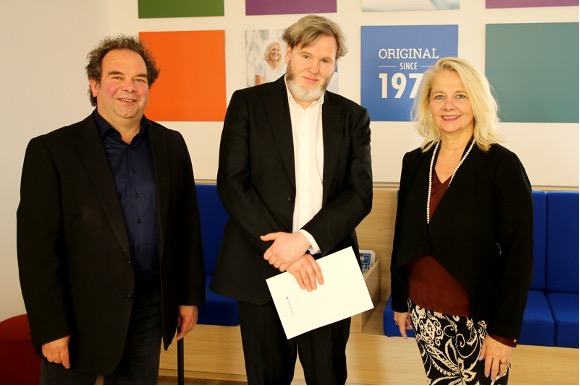
Thomas Walter (li.), Geschäftsführer der Fakultät für Kultur- und Sozialwissenschaften, und Rektorin Ada Pellert gratulierten Martin Lenz zur Ernennung.

„Vielleicht wird die Fernlehre das Modell der Zukunft sein“, überlegt Prof. Dr. Martin Lenz und erinnert an die Lage in der Corona-Pandemie zurück. Darüber nachzudenken, unter welchen Voraussetzungen Menschen lernen und verstehen, ist sein tägliches Handwerk. Als neuer Professor für das Lehrgebiet Theoretische Philosophie an der FernUniversität in Hagen sieht er die Lehre daher nicht nur als Berufung, sondern auch als spannenden Forschungsgegenstand: „Was verändert sich, wenn wir vor allem digital kommunizieren? Ich habe zum Beispiel beobachtet, dass sich in digitalen Lehrveranstaltungen ganz andere Studierende zu Wort melden.“ Für ihn ist klar: „Ich möchte bewusst digitale und nicht-digitale Formate ausprobieren, um vergleichen zu können.“ Bildungsgerechtigkeit ist ein wichtiges Thema für Martin Lenz. Entsprechend freut er sich auf das durchlässige Hagener Studiensystem: „Ich habe gehört, dass die FernUni eine wirklich interessante Studierendenschaft hat. Viele arbeiten schon beruflich und bringen eine sehr hohe intrinsische Motivation ins Fernstudium mit.“ Wegen der hohen Bereitschaft aufseiten der Lernenden ist Martin Lenz schon lange Fan von weiterführenden Bildungsangeboten – auch persönlich: „Schon als Schüler habe ich gerne VHS-Kurse besucht. Dort waren eben Leute, die sich wirklich für die Themen begeistern. Das ist einfach eine schöne Sache!“

Gerne zurück ins Ruhrgebiet

Als weiteren Pluspunkt sieht der Forscher die Lage der FernUniversität: „Mit Hagen kehre ich in die Nähe meiner geistigen Heimat zurück.“ Martin Lenz studierte in Bochum Philosophie, Linguistik und Neuere Deutsche Literaturwissenschaft und promovierte 2001. „Nach der Promotion war ich erstmal ein Jahr lang arbeitslos“, bekennt er – und spricht damit bewusst die teils prekären Verhältnisse im Wissenschaftsbetrieb an. „Dann hatte ich aber Glück, bin mit einem Antrag durchgekommen und konnte nach Cambridge gehen.“ Die Arbeit in Großbritannien öffnete dem Wissenschaftler viele Türen. „Erst dort habe ich verstanden, wie sehr Wissenschaft vom Netzwerken abhängt.“ Nach abgeschlossenem Forschungsprojekt, siedelte er wieder nach Deutschland über und habilitierte sich 2009 in Berlin. „Zum Glück bekam ich danach eine feste Stelle in Groningen.“ Hier forschte und lehrte er von 2012 bis 2024. „Eigentlich wollte ich mich danach gar nicht mehr woanders bewerben.“ Das änderte sich erst, als er die offene Stelle an der FernUniversität sah. „Die Professur klang sehr interessant, auch weil ich so meinen Schwerpunkt in der theoretischen Philosophie weiterverfolgen konnte.“

Herz fürs Unbekannte

Ein Fokus seiner Arbeit liegt auf mittelalterlicher und frühneuzeitlicher Philosophie. „Als ich angefangen habe zu studieren, dachte ich mir, mittelalterliche Philosophie ist so ziemlich das Langweiligste, das ich mir vorstellen kann“, verrät Lenz mit einem Schmunzeln. „Das Mittelalter erschien mir weit weg, seine Philosophie wenig attraktiv und schablonenhaft.“ Ein Urteil, das er mit der Zeit revidierte – vor allem, weil ihm sein Bochumer Mentor, der Philosophiehistoriker Kurt Flasch, die Vorzüge des Fachgebiets näherbrachte. „Heute komme ich immer wieder gerne auf diese Periode zurück, sie ist anregend zu studieren.“ Lenz zwinkert: „Und außerdem ist es doch leichter, über langweilige Dinge interessante Sachen zu sagen als umgekehrt.“ Wichtig ist ihm, auch abseits des philosophischen Kanons zu lesen und den unbekannten Werken Aufmerksamkeit zu schenken. Dahinter steht für ihn eine spannende wissenschaftspolitische Frage: „Man featurt ganz bestimmte Autoren, auf die man sich einschießt, sie ediert und alles von ihnen übersetzt – alles andere verstaubt in den Bibliotheken und wird nicht einmal in lesbares Latein übertragen. Warum eigentlich?“

Von der Philosophie zur Medizin

„Was mich zudem besonders interessiert ist die Verbindung von Philosophie und Medizin“, gibt Lenz einen näheren Einblick. Gesundheit und eine gute Lebensführung gingen schon in antiken Betrachtungen Hand in Hand. In diesem Sinne sei die Philosophie auch als Anleitung zum „guten Leben“ zu sehen. Doch aus medizinischer Sicht war der ganzheitliche, theoretische Blick auf die menschliche Existenz nicht immer hilfreich. „Wie kommt man raus aus der Idee, dass man immer gleich das Ganze erklären muss?“ Erst nach und nach habe die Wissenschaft dazugelernt und sei von philosophischen Betrachtungen über Gott und die Welt zu empirischen Ansätzen gekommen, die gezielt körperliche Reaktionen beobachten. „Spannenderweise entstand dieses methodische Umdenken auch in den Küchen“, erinnert der Forscher an einen frühen Experimentierraum. „Denn wo gekocht wird, geht es nun einmal um Leben und Tod.“

Verstehen besser verstehen

In Hagen hat Lenz nun die Chance, sein Lehrgebiet neu auszurichten. „Ich sehe Philosophie als eine Form von Teamarbeit. Es geht also nicht nur um meine Vision“, stellt der Forscher vorweg klar. „Was mich angeht, möchte ich mich verstärkt dem Phänomen des Verstehens zuwenden – auf drei Weisen.“ Erstens möchte er den „Zusammenbruch des Verstehens“ erforschen, unter anderem, indem er Konzepte von Wahnsinn und Normalität untersucht. Zweitens interessiert ihn die Frage nach der „Rationalität von Debatten“; hier zum Beispiel die oft gescheiterte Diskussionskultur auf Online-Plattformen. „Drittens möchte ich mehr über das Lesen erfahren. Wir lernen auf eine bestimmte Art zu lesen – und dabei kann auch einiges schief gehen“, erklärt Lenz. So wird im klassischen Deutschunterricht zum Beispiel ein bestimmtes Textverständnis abgefragt, abweichende Interpretationsmöglichkeiten kaum berücksichtigt. „Hier würde ich auch gerne mit lokalen Schulen zusammenarbeiten und das Ganze als praktisches Projekt angehen.“

Leidenschaftlicher Jazz-Musiker

Was begeistert den Philosophen abseits seiner wissenschaftlichen Arbeit? „Das ist schwer zu sagen – die Philosophie hat immer alles gerahmt“, lacht Lenz. Eine große Leidenschaft, die zweitweise sogar direkt mit der Wissenschaft konkurriert hat, verrät er dann doch: „Ich habe mich früher entscheiden müssen: Musik oder Philosophie. Die Frage ist inzwischen entschieden, aber ich mache noch immer viel Musik, vor allem Jazz.“ Das freie Musizieren mit Gitarre oder Klavier macht ihn glücklich – einen Schulterschluss zur Philosophie gibt es am Ende aber doch: „Das Nachdenken über Musikunterricht, über Improvisation und musikalische Interaktion, all das gibt mir auch sehr viel philosophisch.“

(Text und Foto: Benedikt Reuse)

A letter to students

Dear Students,

Please excuse me for addressing you via my blog, but I want to reach not just those of you whom I happen to know through my teaching, but also those whom I merely see in the streets and on news channels. Since I’m mainly based in the Netherlands and Germany, I’m mostly thinking of you as situated in these countries. Currently, there is (especially on social media) a lot of talk about the so-called pro-Palestine protests in which many of you seem to be involved. If you do or were to study philosophy, I would perhaps be teaching you or I even might have taught or might be going to teach you. Although I try to confine myself to teaching what I promise on the syllabus, I often use this blog for spill-overs of reflections on what I should be teaching or how I should go about it. And since it is common to reflect on current “issues”, I often thought – with some trepidation – about how I should respond if pertinent discussions or protests would reach my classes in some way or another. This has not really happened so far, but since I’m about to leave Groningen for Hagen while the protests are still going on, this time might be as good as any to share some thoughts with you. – On my teaching evaluations, I sometimes get the request to distinguish more clearly between “core issues” and “side issues”. OK, then: My main topic is responsibility. While we’re probably all fairly good at placing responsibility or blame on others, it’s harder to say what it means, for that other person or group, to take responsibility and what it means to take responsibility oneself. My core issue, then, is a question: What does it mean to take responsibility? Especially in the contexts of the current protests. But let me begin with some side issues perhaps.

My mother was a smoker. Not a heavy one, though. She even hid in the bathroom to smoke secretly. When my seven-year-old self asked her about that, she said that she didn’t want to be seen smoking by others. You might think that she did not want to be seen by her children in particular, but the reason she gave was that it was “unsuitable for women”. Such small exchanges had long-lasting echoes. One is that, unil roughly ten years ago, I have been a smoker myself. Was she responsible? Of course, my mother did not make me smoke and she even listed numerous reasons against it, but I felt, only half-consciously, for a long time that it was fine to smoke because my mother did it, too. I wouldn’t hold her responsible, but I also recognise that children learn by imitation and that what people with authority do seems to lend legitimacy to our own deeds and habits. So whom could I hold responsible for becoming a smoker? Well, at the end of the day I have only myself to blame. – I like this little example because it is at once simple and sufficiently muddled. We might argue that we shouldn’t be bad role models, as a matter of standards, but perhaps hiding behind a door (for the wrong reasons) is sometimes the best we can do. We might have very high standards, but we have very different histories and lots of imperfections. Being a free and responsible agent is not difficult because we might lack standards. It’s difficult because we’re muddled and mostly not alone. Going by moral standards alone, you can report on the deeds of your day as a chain of hypocrisies. Why don’t you do that then? I guess (1) because moral consistency cannot (always) be your top priority and (2) because there are (often) lots of other people to blame, too. (Interestingly, people for whom moral consistency is a priority mostly seem to focus on blaming others, but that’s for later.)

Faced with the protests, I feel, not like an omniscient narrator, but rather a bit like my mother might have felt: I try to hide behind a door (figuratively), try to say things that ring true, but perhaps not for the right reasons. Luckily, I’m not your parent.

But I am – or could be – your teacher. It’s this sense of priority that makes me write this. I’m not a friend or administrator or mere political citizen, I am a teacher. In this capacity, it’s my responsibility to be “open to dialogue”, as one of the sayings goes. I try to be, but the current situation makes that a bit more difficult. As noted, there are many pieces about the protests, good and bad. What hits home for me most is that, as a teacher, I have a duty of care towards all my students. What does this duty of care involve? It’s not easy to say. I have read many pieces by thoughtful colleagues. One of the strongest arguments comes from Eric Schliesser, who suggests that we might treat campus protests as “falling under academic freedom”. I really like this idea, not least because it emphasises the great educational potential that might outweigh all too quick calls for order. However, having seen footage of the recent vandalism in Amsterdam and of Jewish students being turned away under odious chants in Groningen, I fail to see this idea being put into practice, to put it mildly. What’s more, though, is that granting academic freedom or at least freedom of expression (these two are not the same) requires granting it to everyone involved. The moment one particular group shouts down or even intimidates others, you have the responsibility for ensuring respectful treatment of your fellow students. Especially as protesters or occupants, you have to take that responsibility. What I have seen happening, instead, is that protesters show solidarity with those supporting their particular cause. That’s low-hanging fruit indeed. But the point is to behave responsibly to your opponents. There is a battery of ethical arguments for that, but I’ve forgotten their names. What’s in a name, though?

In the light of attacks against protesters themselves, I have seen numerous discussions of open letters and missives supporting protesters. Especially among philosophers you will find intriguing and instructive hermeneutic moves about particular terms and legal responsibilities of administrators etc. I don’t know what precisely you think, but I’d probably feel great if I were to see a letter, signed by an enormous number of professors, who support my cause or at least support my right to protest. One such letter (in German) made many rounds because it said that students should be “under no circumstances … subjected to police power.” As you might imagine, the particular phrase I just quoted caused some upheaval. While calling the police should be a last resort, it should by no means be ruled out completely – for perhaps obvious reasons. What I find problematic are not so much the particular legal considerations, but the idea that actions of a particular group (i.e. of protesting students) should have no consequences. It is of course understandable that you should want to evade being punished. It is equally understandable that your teachers feel a duty of care to prevent you from being arrested by the police. The problem is that this duty of care must be extended to all students, but is in the current circumstances only extended to a particular group – a group that may well be seen as intimidating fellow students. The message that I see being conveyed (implicitly) to you is that you don’t have to take responsibility for your actions. That would mean overprotection.

However, maintaining social rules and enforcing them through the police, if need be, seems to emphasise the status quo. My insistence on social order can be met with the objection that I don’t just want people to behave nicely, but that I want to maintain, at any cost, the current powers. (It’s a stronger variant of what is known as the “tone argument”, if you like) That point sits uneasily with the fact that many of you take yourselves to protest against irresponsible agents and institutions. (Believe it or not: online, people even quoted Martin Luther King at me to make this point.) So if the status quo is taken to rest on irresponsible behaviour, how can I convince you by falling back on the status quo? – But I’m not asking you to maintain the status quo. I’m pointing out that, if you need to make your point by intimidating your fellow students or by behaving like a hooligan, you should, for the time being, have no place at a university. My point is not about order but about your responsibility to fellow humans around you. ­– Now, a common response to this charge is that the hooligan behaviour we could witness was coming from “outsiders” and that the actual protests were peaceful. That is a strange response: For if these vandalisms were indeed acts of outsiders, I would have expected at least equally visible attempts at prevention and vocal distancing from this kind of behaviour, rather than finger-pointing at others who supposedly started it. That is one way of what it could mean to take responsibility. And someone who cannot take as much responsibility is certainly not fit to organise a protest, let alone occupy part of a university. All of this goes back to the basic point of having to take responsibility for what you do – as much as you can – and especially on behalf of those who might get hurt. Remember, you cannot be morally consistent on all levels. No one expects that. But your priority should be to treat respectfully those around you, most of all your fellow students. The attempt to put the blame elsewhere, hide behind face coverings, avoid speaking to the press, let alone to opponents, is an avoidance of responsibility. In turn, I find attempts to justify such conduct infantilising at best.

Of course, the teachers’ duty of care should not just comprise all students but also allow for making mistakes. In this sense, we need to see the situation as an ongoing one where we all have to learn new things. Since most of the current protests are what is called “pro-Palestinian” and since this is perceived as the most vocal group, it is fairly clear that their voices are being heard most of the time as the loudest. What I find particularly alienating is that, while the situation is evolving, most of what I hear are repetitions of the same chants and insults over and over, often copied straight from earlier protests at US American universities. Apart from the lack of dialectic development, I also find it problematic that those of you who belong to the most vocal protesters don’t seem to be open to reflect on other voices. In the light of this stale situation, I found it particularly helpful to read this passage in a rather balanced piece by Naika Foroutan (in German):

“For the legitimacy of the protests, it would be central to include the trauma of October 7th and the need for protection of Jewish and Israeli students who feel threatened or unsafe on campus in the protest logic – before the next protests take place.”

I’d have more to add, but I think I’ve already taken too much of your attention. If you want to bring down my ramblings to three simple points they are the following: Don’t easily trust people who come with easy overviews and clear-cut definitions, let alone chants. We’re all in the process of learning. Take responsibility for your fellow students, whatever you make of their (supposed) convictions.

Take care!

All best wishes, Martin Lenz

Teaching philosophy through images and other non-linguistic media

When I studied philosophy at Bochum (Germany) in the early nineties, there seemed to be a ban on images in philosophy. My teacher Kurt Flasch, for instance, was even reluctant to use the blackboard.* To me, this seemed very strange at the time. I never asked him about it, but perhaps this “ban on images” goes back to one of his teachers, Max Horkheimer, who proposed the “Bilderverbot” as enabling a truly critical attitude to ideology. While a decidedly linguistic approach to philosophy is a crucial part of its history, I also think that it is owing to an underestimation of the senses and indeed experience as such. As I see it, the mere attempt to transform written thoughts into images or to combine these two media can afford a more holistic understanding of various issues. At the same time, our current practices are flooded by images and thus require a pertinent literacy. In what follows, I simply want to share my experience of teaching through images and close with a few thoughts non-linguistic media.

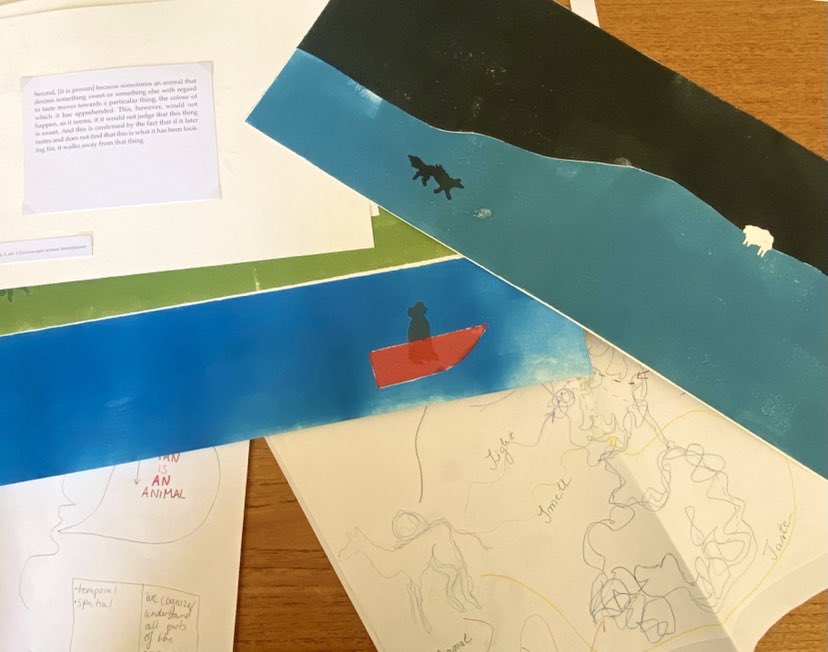
Introducing infographics. – Every now and then I have been trying to encourage students to make use of drawings, tables, graphs or other sorts of tools in their writing. We are obviously inclined to employ different styles of reasoning in keeping with our diverging talents or backgrounds. As Frege argued in his Begriffsschrift, we clearly see different aspects of thoughts when using different graphic representations of logical inferences. Following the encouraging advice of my Groningen colleague Benjamin Bewersdorf, I eventually took a random class in my course on Medieval Theories of Thinking by surpise: I wrote to my students a day before class asking them to bring coloured pencils, then handed out sheets of drawing paper and requested them to prepare infographics on the spot. I divided the students in three groups. One had to depict a conceptual distinction or problem, another had to depict a debate, and yet another had to depict a historical development. After chosing a topic, they had about thirty minutes to produce their work and then present (a) on the topic depicted and (b) on the experience afforded through the task. The outcomes were amazing.**

Three points struck me in particular:

  • Having to do such work on the fly activates different people. – At least in my experience, there is often one particular group of students that runs much of the active discussions in the course. By contrast, this kind of task seems to highlight different talents and thus also different patterns of interaction, allowing otherwise quiet students to enter the stage and allowing new forms of collaboration.
  • Using such media makes you reconsider what you (think you) know. – Having to illustrate a philosophical issue mercilessly brings out vague points or limits in our understanding. Not least presenting relations between items, concepts, interlocutors or even historical phases requires thinking through the way the relata are contrasted, for instance. At the same time, such presentations often afford an understanding of an issue in a flash of insight, rather than requiring you to move through sequential inferences.
  • The previous two points yield a third one: a new experience. – Arguably, (philosophical) learning crucially depends on the kinds of experience we undergo when exposed to a problem. Experiencing the barriers and insights through transforming knowledge that is mainly linguistically available might allow connecting to your thoughts and those of others in a different way and anchor them more deeply.

Other media and other forms of philosophy. – Infographics make for an easy start. But I’d generally try and encourage students and colleagues to think about various media or art forms for inspiration. As my colleague Andrea Sangiacomo has shown, for instance, taking the term “meditation” seriously in Descartes’ Meditationes allows for an expanded understanding of what is at stake in this philosophy and indeed in much of the philosophical tradition (see here  and here). Likewise, he is now delving into forms of dance – especially contact improvisation – to explore related ways of philosophical understanding.

Imagistic literacy? – It is one thing to recognise how the “embodiment” of thought can be explored by transforming linguistic thought to other sense modalities. Another point of such transformation is to recognise, for instance, how images work and how they connect to and are interwoven with linguistic communication. While social media are littered with images and videos, there is little understanding how they affect and indeed transform our lives from private interaction to warfare. I will keep my thoughts on this for another occasion. Suffice it to say that the attempt of transforming linguistic thought into images does not only yield new experiences; it also exposes the logical limitations of images.   

_______

* Funnily enough, an introduction to philosophy based on infographics came out in 1991 (the DTV-Atlas Philosophie). But as you might imagine, it was much frowned upon and never used or carried openly back in the day.

** Depicted is some of the outcome from my 2022 course on What Is Thinking? Medieval Philosophy of Mind. I am very grateful to my students who did great work throughout the course. Special thanks to Sam Alma for pursuing an intriguing extended tutorial by combining an essay with infographics.

How do you read what I wrote? A meditation on private language and aspirations in communication

I tell you now that my intention, the intention of the author, does not matter for understanding what I write. The next sentence, the sentence you’re reading now, claims the opposite: that the intention of the author does matter for understanding what is written. What’s going on here? The opposition between these two claims rests on an ambiguity in the notion of intention. I can tell you what the ambiguity is and I will now: (1) References to the “intention of the author” can point to a mental state – what’s going on in the mind of the writer – which seems to be something inaccessible and thus irrelevant to understanding. (2) But such references can also point to something said by the author which is expressed by the (linguistic and contextual) conventions the author uses. In the second sense, the intention is not inaccessible but something expressed by conventions accessible to everyone who is familiar with these conventions. Sounds neat, doesn’t it? Yet, I fear that understanding the ambiguity of intentions by distinguishing between the senses of (1) and (2) won’t resolve the problem. Why? Because both senses are real and matter as much as their disambiguation.

Let’s work through an example: If I tell you “I’m not feeling well today”, you don’t understand what I mean. You literally have no idea what I’m going through and what makes me say this! The upshot of what is known as Wittgenstein’s private language argument is that invoking my intentions in the sense of (1) doesn’t help with the meaning of the expression used. What does the trick, instead, is that you understand what I say by understanding the convention of using the expression “I’m not feeling well today”; that would be a reference to “intentions” in the sense of (2). But why doesn’t falling back on (2) settle the issue? Because our communication does not consist in (understanding) conventions. Rather, communication consists in swinging back and forth between (1) and (2). For even if intentions taken as (1) don’t provide meaning, they have a set of communicative functions.

It’s true, trying to understand “I’m not feeling well today” in the sense of (1) won’t work. It won’t provide the meaning of the expression. Trying to look into my head won’t work, not even for me. But the point of going for (1) is not “getting it”; the point is to aspire to get it. Here, (1) works like a teaser for the listener. We cannot get at the mental state. But the (supposed) inaccessibility of the mental state has a function in its own right. Obviously, it gets us started. Obviously, it doesn’t get us where we aspire to be. Instead, it might make us ask questions like “what’s wrong with you?”, while making us resign to a conclusion such as “oh, you probably won’t join the party then?”

However, you will retort, asking such questions and resigning to such conclusions just is going through the conventional motions in the sense of (2). That’s right, I answer. But we don’t aspire to express conventions or respond to them. Arguably, our aspirations are driven by (1). I really want to be understood, even if I have to resign to the fact that this is not even an option for me in a determinate way.

To use an analogy: (1) and (2) are like water versus water frozen into ice cubes. Only ice cubes can be counted but they are still water. If I want to count water, I’m doing the wrong kind of thing. If I want to get at determinate meanings by asking for mental states, thus taking intentions in the sense of (1), I’m like someone who wants to count water. By contrast, if I think that only ice cubes matter for counting, I’m forgetting that ice cubes are a different state of water. Communication (and understanding) is not just about getting at fixed meanings, but also about aspiration. And here it’s (1) that matters most, exactly because intentions in the sense of (1) cannot be saturated.

What can we learn from this ambiguity? I said earlier that the problem cannot be resolved by disambiguation. I can now express more clearly why that is. It’s because intentions in the sense of (1) affect intentions as conventions in the sense of (2) and vice versa. Aspiring to access inaccessible mental states is a set of conventions, too. Countless poems thrive on it, but they inform our daily communication, too. “I can’t express what mean” is a conventional way of saying the unsayable. Such utterances had no meaning if we didn’t experience the frustrated aspiration of saying something unsayable every now and then.

Why does this matter, though? You might say that it only matters for philosophy of language nerds. What does disambiguating intentions do for the rest of us, then? First, it can help us understanding (the frustrations of) communication a bit better. The swinging back and forth between aspiring to access the inaccessible and settling for understanding conventions is clearly at work when we aspire and fail to say something. Someone responds to us by saying “oh, do you really mean that?” and we realise that we missed the appropriate convention. We’re misunderstood and we know that we failed to express ourselves properly. But if communication and understanding content were exhausted by getting conventions, we could not make sense of such failures.

Let me close with two examples: Especially online communication on social media is full of such frustrations. Here, things get messy precisely because conventions are unstable. The quick pace of the turn-taking between interlocutors follows the conventions of spoken language, but the fact that it’s written suggests the conventions of writing. Often when interlocutors accuse each other for misconstruing their Tweets, what in fact happens is that one of them applies conventions conforming to the casual nature of spoken language, while the other one construes the exchange by the more robust conventions of writing. Naturally, the aspirations related to written communication are much stronger, enabling way more depth, than the quickness of spoken exchange allows for. Try thinking through exchanges and their failings with these differences in mind, and miscommunications begin to appear in a new light.  A second example is the eternal misconstrual of reading old texts as getting at the intention of the author. Working out these issues in more detail is currently beyond me, though.

What’s wrong with comparisons in philosophy papers?

Student: “Hi, I want to write my thesis on what Leibniz and Chalmers think about qualia.” 

Professor: “Why?”

Student: “Well, I want to study what Leibniz thinks and then compare that with Chalmers’ view. Then I’m going to see what I like better and write my conclusion.”

Professor: “I see. But why?”

Student: “OK, I could pick Chalmers and Dennett on consciousness instead.”

Professor: “Right! But why?”

Of course, the dramatis personae can be changed in various ways, but you haven’t been long enough in academia, if you haven’t encountered this kind of conversation. The kind of paper is ubiquitous and it has a typical structure: An all too brief Introduction is followed by Chapter 1 on author X, Chapter 2 on author Y, Chapter 3 comparing X and Y, and a tentative conclusion on why Y seems perhaps a bit superior. To keep the reader “in suspense”, such pieces commonly do not reveal the preference offered in the conclusion until the last moment and in fact they often seem to be written without any inkling as to what will be in the conclusion. As I see it, this is a very bad practice. So what’s wrong with it? Although I’ve done this sort of thing myself and although I think it’s really problematic, I find it difficult to pin down clearly what exactly is wrong with it. Let’s try then.

First off, though, let me stress that a lot of comparisons are fine. And even those that might seem close to the typical structure mentioned above are often ok. The problem is not owing to comparisons as such but to illusions about neutrality (presenting all items or authors in apt length) and a lack of a proper point of contact or aspect of the comparison (i.e. a proper tertium comparationis). What’s hard about telling good from bad comparisons is that the assessment of what actually is a proper aspect is not obvious. But let’s not get ahead of schedule.

Order of exploration versus presentation. – Generally, the order in which you explore a topic does not need to follow the order in which you present it. It’s crucial to see that comparisons guide our understanding. The “oh, this is like that” impression is what allows us to relate something new or unknown to what we already know. Seeing similarities in different things (and seeing differences in what we take to be alike) is how we acquire access to new things. Once we realise that Leibniz treats issues that we discuss under the label of consciousness it’s natural to relate it to what we know about consciousness. If we then move on to the fancy discussions in Chalmers, why not relate the two? There is nothing wrong with that. That’s how we learn and explore a field of discussion. However, understanding something (better) by comparison does not entail that the comparison sheds any light on the ongoing discussion about consciousness or Leibniz’ or Chalmers’ views. That we recognise a relation between between things does not of itself make it relevant to talk about our way of recognising it. Now, don’t get me wrong! Of course, you are free to talk about anything you like. But usually your talking about something is directed at a listener or reader or a broader audience. Presenting something to an audience supposes that it’s relevant to your audience. But not everything that is relevant to your understanding something is relevant to your audience. Likewise, it’s not relevant to someone eating what you cooked for them to witness your preparation of the meal. So ask yourself how what was relevant to your understanding might be different from what is relevant for your audience. This is what is called motivating the presentation of a topic. You motivate your presentation not in terms of your means of understanding but in terms of the state of the art.

How do you tell the difference between these orders? – There is no magic trick to tell these orders apart. Sometimes the relation is really interesting (to the audience); sometimes it’s just a tool for your own thinking. In the latter case, you should ask yourself what precisely you find enlightening for your discussion of, say, consciousness. A technical term or concept? A metaphor? An example? A whole argument? Most of the time, you’ll find that it’s just one particular aspect. But to introduce such an aspect, you usually don’t need to write a whole chapter on author X, striking out in all directions, to enlighten something in Y. Apply Ockham’s Razor! Once you realise which aspect you’re interested in, the need for a comparison of X and Y falls away. What you really want to talk about is the particular aspect in Y. For the structure of your presentation, this means that you can skip chapters 1 and 2, and start with chapter 3. But instead of a comparison, you just focus on the particular aspect in Y.

But what about …? – Planning essays with students, it’s typically at this suggestion that certain assumptions kick in. Some of the following reactions are likely: (1) “But then I don’t have enough to say!” Beginners often think that working through a given question is not enough. Rest assured, though. Once the question is broken down into subquestions, there will likely be rather too much than too little to say. (2) “But I have to give an apt account of all the positions involved!” No, you don’t! What you have to cover is the relevant aspect. Yet, there is a widespread assumption that, in order to pick an aspect from X, you have to show how that aspect figures in X’s overall work. Behind this are two related worries: The worry that you get the aspect wrong when you ignore the rest or the worry that the presentation of the aspect is not adequate if it is stripped of its context. The first worry is, again, a matter of exploration, not of presentation. The second worry goes deeper. It’s an art to present something both concisely and adequately. But unless a holistic understanding of the aspect is the precise topic, this is the point to rely on literature. Most often you’ll find that there is ample literature on some related aspect in X. – The upshot is: Address these worries by relying on literature rather than trying to figure out everything by yourself. Like everthing else, philosophy is team work. The bottom line is: Focus on the aspect in Y, not in X. Invoke X only if you need this as a context that sheds light on the aspect in question.

What if you actually want to present a comparison? – While most issues can be tackled by focussing on one part of an initially planned comparison, sometimes there actually is something to compare. This is the case when you think that X has actually influenced Y or when X promises to shed new light on the understanding of Y. Of course, in this case the focus will be on an aspect or a set of aspects, too. But rather than a mere tool for learning, the comparison is actually itself an advancement of the state of the art. In this case, it’s crucial to begin by focussing on the motivation first. Why or in what respect would this be relevant to our joint understanding? If you can’t answer that question, it’s better to apply Ockham’s Razor again. If you can, you will probably have no reason to adhere to the boring structure of presenting X and Y before you actually move to the comparison. At most, you will coinfine yourself to how they treat the aspect in question. But whatever you do, don’t leave the question of what you think about the issue for the conclusion. Your “opinion” is not an addition to the comparison. It’s what drives the comparison in the first place. So figuring out the aspect in question and why it is relevant to make the comparison just is your opinion. Thus, it’s not a matter for the conclusion but for the introduction where you motivate why the comparison is relevant.

How to read (part twelve). Can I read philosophy like I read a novel?

Yesterday, I ran a conversation with MA students on how to read. I found it rather exciting and learned many new things about reading habits as well as worries. One question from a student was particularly striking as it concerned the difference between reading novels as opposed to reading philosophy. She prefaced her question by saying she had grown up to commonly read novels with a sense of identification (for instance, with the protagonist) and missed that attitude of reading in philosophy. It seems true, I replied, that we might often appropriate the beliefs of, say, a first-person narrator in a novel, while we are mostly trained to look for points of disagreement with authors in philosophy. Witnessing any philosophy talk or reading most philosophy papers will teach you that disagreement, rejection, criticism is the hallmark of philosophical reading. So we agreed that reading literature might often be identificational (to a point), while reading philosophy is often adversarial. Now, this question started haunting me. Is it true? Well, as a child or adolescent, I certainly didn’t start reading adversarially. But is reading philosophy just different? Or is there a mode of identificational reading in philosophy? And if yes, why is it so rarely practised?

Aspiration and belonging. – Starting from my own experience, it’s striking that it took me a while to make sense of what identificational reading of philosophy could even mean. One of my earliest encounters with a decidedly philosophical book is Nietzsche’s Antichrist. It starts thus: “This book belongs to the most rare of men. Perhaps not one of them is yet alive.” I faintly rember wondering whether I might be part of the target audience. I guess I would have liked to. But reading on, I thought I didn’t, because I was neither indifferent nor did I live on mountain tops … If we want to classify this first beginning, my reading was aspirational. I wanted to belong to the chosen audience. Perhaps not primarily in understanding what was written there (that felt hopeless) but rather in strengthening, amongst other things, the bond with the friend who had given the book to me. So while I was trying to immerse myself in that book which I didn’t understand, I aspired to belong to a community of readers. It seems, then, that I experienced the duplicity of being alone with a difficult book and entering an unknown but certainly special community.

Identification as agreement and projection. – The aspiration of belonging to the community of readers, not yet necessarily readers of philosophy, grew into a set of identificational reading experiences. When I read an aphorism, I might agree (or disagree) or aspire to understand and think “that’s right” or “oh, I see” or “I want to think like that”. Especially shorter pieces of philosophy or aphorisms can work like bits out of novels. (My German teacher and philosophy teacher was the same person, so I had an easy transition from literature to philosophy) So reading them can feel like identifying or agreeing with a person. I guess that once we begin to exchange experiences of reading with others, we – as adolescents or later in life – begin projecting a persona, that is projecting ourselves as (becoming) a stable part of a community of readers. The persona we project might come with a certain set of qualities. Such projection will be aided by conventions of readership, be they explicit in the books themselves (as hinted at in Nietzsche) or as they figure in other readers we converse with. I was born 1970. When I grew up, there was a rich environment, not in my immediate family but in the neighbourhood and the bookshops in town that fostered the idea of a community of readers that I could belong to. So reading was identificational not just in the sense that one could be immersed in a world or identify with (the beliefs of) a narrator or author. Rather, there is a whole environment of smells and colours and sounds that come with bookshops, public readings, people conversing about books on the radio or television. – When we decry that today’s teenagers don’t read, do we really place enough effort on making the pertinent environment desirable?

Adversarial reading in philosophy. – Now it would be a mistake to think that this immersion in agreement with, say, a given author is devoid of adversarial moves. Determinatio est negatio. Agreement with a certain position entails the rejection of opposing positions. Preferring or being immersed in one (state of the) world excludes others. Realising this, playing with oppositions and alternatives, quickly becomes part of reading philosophy. Just as the authors you read refute others, the community of readers you are part of by now might not be as homogenous as you thought. However, what tends to be overlooked or obscured (at least for the onlookers) in academic settings is that adversarial reading rests on and thus rides piggy-back on the identificational and aspirational forms of reading that ground the community in the first place. Much of the work in philosophy requires diligent exploration, immersion in ideas, trusting and going along with thoughts. Criticism can only come after that. But in the way we structure our discussions, we all too often focus on these second steps. This is why reading often reduces to critical reading and why the first suggestions by students for essays often take the form of a refutation. As a community of philosophers we owe it to those aspiring to join that we lead by more thorough examples that also bear testimony to the joy of exploration, playfulness and aspirations of our beginnings. Not least because learning is mostly learning through imitation.   

Schweigen. Marcel Reifs Rede zum Holocaust-Gedenken am 31. Januar 2024

Nach dem Massaker des 7. Oktober 2023 war das diesjährige Holocaust-Gedenken ein Geschehen, das vermutlich genauer verfolgt wurde als in früheren Jahren. Die Rede Marcel Reifs – Sport-Journalist und Sohn eines Holocaust-Überlebenden – fiel mir zunächst schlicht deshalb auf, weil sie in sozialen Medien preisend herumgereicht wurde. Erst heute, nachdem mir ein enger Freund die Rede geschickt hat, habe ich mir endlich die Zeit genommen, sie in Ruhe anzuhören. Die Rede hat mich berührt: Sie handelt im Wesentlichen vom Schweigen des Vaters, der dieses Schweigen unter anderem deshalb aufrecht zu erhalten scheint, weil er auf diese Weise das Leben der Kinder „im Land der Täter“ schützen möchte: Die Kinder sollen in ihren Lehrern, Postboten und weiteren Mitmenschen nicht die Mörder ihrer Vorfahren erblicken. Marcel Reif stellt dieses Schweigen als Möglichkeit eines versöhnlichen Neuanfangs dar, der insgesamt tatsächlich zu einer unbeschwerten Kindheit geführt zu haben scheint.

Es liegt mir fern, Reifs persönliche Erinnerung oder Andenken zu besprechen, geschweige denn zu kritisieren. Was ich mich aber gefragt habe, ist, warum diese Rede im Bundestag und darüber hinaus derart viel Anklang gefunden hat. Damit meine ich nicht, dass es nicht eine hörenswerte Rede ist. Wohl aber scheint mir in der Betonung des Schweigens etwas zu liegen, dem nachzugehen ist. Hier möchte ich nur ein paar Beobachtungen notieren:

  1. Schweigen war faktisch die wesentliche Strategie im nicht entnazifizierten Deutschland nach 1945. – Am Edelmut des Vaters ist hier nicht zu zweifeln; auch nicht am Wert der Erinnerungen, die Reif hier teilt. Dennoch fällt auf, dass die Strategie des Schweigens Täter und Opfer eint. Natürlich schweigen sie aus ganz unterschiedlichen Gründen. Doch das Schweigen ermöglicht die Versöhnung genauso sehr, wie es die nicht verurteilten Täter schützt. Wenn der deutsche Bundestag dieses Schweigen akklamiert, scheint er damit auch das Unter-den-Teppich-Kehren der deutschen Schuld zu akklamieren.
  2. Schweigen hilft vermutlich nicht in der Weise, in der es hier sollte. – Es ist viel über die Weitergabe von Traumata zwischen verschiedenen Generationen geschrieben worden. Es ist klar und verständlich, wie der Vater (laut Reif) hoffte, die Kinder vor einer Verdachtshermeneutik zu bewahren. Gleichwohl wissen wir, dass Verschweigen nicht verhindert, dass Schmerz, Angst und Traumata weitergegeben werden. Es gibt wohl keine richtige Antwort auf die Frage, wie mit solchen Erinnerungen umzugehen sei. Doch ist Schweigen beileibe nicht die einzige Möglichkeit. Das ist in einer persönlichen Geschichte nicht zu kritisieren, doch die Zuhörerschaft muss sich nach Alternativen fragen.
  3. Das Schweigen hätte die Rede unmöglich gemacht. ­­– Das Nachdenken über Alternativen bringt schließlich auch die in der Rede etwas unterbelichtete Rolle der Mutter Marcel Reifs zur Geltung, die das Schweigen an einem bestimmten Punkt dezidiert gebrochen zu haben scheint. Es ist aber das Brechen des Schweigens, das die Reflexion wie auch das Nachdenken über den Vater eigentlich erst ermöglicht. In der Rede wird die Rolle der Mutter zwar gelegentlich betont, doch bleibt die Rolle des gebrochenen Schweigens unterbelichtet. Die zentrale Botschaft, die Reif in der väterlichen Aussage „Sei ein Mensch“ sieht, scheint sich zunächst aus dessen Schweigen zum Wohle der Kinder durch einen so ermöglichten Neuanfang – womöglich auch mit einem damit verbundenen Vergeben – zu ergeben. Aber hier bleiben Zweifel. Ist das Brechen des Schweigens durch die Mutter nicht zumindest genauso wichtig für das Durchdringen dieser Botschaft?

Zusammenfassend gesagt finde ich die Rede ebenso bewegend wie irritierend. Hier wird ein Weg beschrieben, der unumkehrbar und gut erscheint. Zugleich aber ist diese Erinnerung im Kontext eines Staatsaktes versöhnlicher als sie gerade heute vermutlich sein dürfte.

Are rationalists right-wingers? A note on whether this question makes sense and on cool deep disagreements

Are people holding racist views more often right-wing? For some, this connection is almost definitional. Let’s look at a different question: Are rationalists commonly more right-wing? I guess while you might have a view on the former question, you’ll likely have no answer to the second question. In fact, you might want to argue that the second question doesn’t make sense. Why is that, though? I don’t think there is an a priori connectedness of beliefs about race, right-wing politics or rationalism. Rather, connections between beliefs emerge in the light of their relevance. My hunch is that we see beliefs that matter to us politically as part of a holistic framework. By contrast, we seem to look at beliefs that we don’t see as politically relevant in an atomistic fashion. In other words, when things matter to us, we’re more alert to the connection between beliefs, taking one belief as indicating others. Conversely, when matters have cooled down, we tend to view beliefs in an atomistic fashion and remain ignorant about connections unless we study them carefully. Accordingly, I think that holistc versus atomistic considerations of beliefs are related to their respective relevance. If this is correct, this has grave consequences for the way we approach disagreements today and with historical hindsight. In what follows, I’d like to explore this point for thinking about (deep) disagreements.

Let’s begin by thinking about deep disagreements. Unlike peer disagreements about individual claims, deep disagreements obtain in a more holistic sense. They concern most fundamental beliefs. Common examples of such disagreements are ones between adherents of homeopathy and evidence-based medicine, about abortion or about whether a given society is racist. It’s not settled what precisely makes such disagreements deep, but if we follow some central accounts, they are deep because of different world-views or because they disagree about second-order assumptions regarding what does or doesn’t count as pertinent evidence for a claim. As far as I know, most of the literature on deep disagreements works with examples that we easily recognise as (politically) relevant. Now I am undecided whether relevance is what makes disagreements deep, but I wonder whether the choice of examples in the literature drives our views of how the depth comes about. As I see it, then, we should include historically remote* examples to study what makes disagreements deep. Arguably, disagreements about rationalism and empiricism can be just as deep as those about vaccines, but that will escape your notice if you only study disagreements that currently count as relevant.

Let’s look at another example then: Imagine you’re having a discussion about the origin of knowledge. Someone says that, ultimately, all knowledge comes down to reason and self-evident principles. Now imagine that, instead of a polite inquiry of what these principles are, this interlocutor is greeted with scorn and shouted at: “How can you make such wicked claims?!” Imagine further that she is de-platformed and banned from speaking at public events as a result of her “outrageous views”. While we’re witnessing quite a bit of shouting and de-platforming these days, it’s more often for views identified as racist, trans-exclusionary or sexist, but rarely for rationalist convictions that discredit divine illumination or revelation through the Bible. However, if you were to return to Paris in the year 1277, you’d find this view harshly condemned along with 218 further propositions. (Here I reference a paper discussing this condemnation as a form of deep disagreement.) Arguably, the disagreement between members of the Parisian arts faculty and the leading theologians around Etienne Tempier has cooled down since then and made way for other disagreements to become heated.

What I take from this is that disagreements about, say, racism are not per see deeper than disagreements about whether philosophers must accept supernatural standards of evidence. The former are just more heated than the latter. If this is correct, an immediate question is what the heat adds to the disagreement. As noted above, I think it makes for a more holistic view of the disagreement in question. If we’re interested in whether people are our political allies, it’s natural to assume that we’re more interested in detecting indicators of pertinent beliefs. Is this person a racist, we might wonder. We might see the likelihood increased, if we notice that they hold certain beliefs about the economic status quo and who deserves to participate in economic welfare. As Justin Smith-Ruiu once pointed out, this is often following associative patterns of prediction. Making moral judgments, then, is like shopping with Amazon: “People who like to eat meat also fail to care about the climate.” By contrast, outside a philosophy seminar, we’re probably less interested in figuring out whether someone is a rationalist. Admittedly, there are some papers asking whether Hume was a rationalist, but apart from a lack of heat, such questions are treated much more individualistically, i.e. with regard to the particular author. Here, identifying rationalism doesn’t serve as helping to detect a pattern common to people read as empiricists…

Such historical remoteness or closeness might already feature between different generations. The current debates about racism or sexism, for instance, seem to have been completely absent or irrelevant for the generation of my parents. When my parents were confronted with arguments about sexism, for instance, they truly didn’t know what hit them. The point of such comparison is not to judge, blame or exculpate; the point is to see that, for them, a particular take on sexism, would not have come as a holistic network of beliefs, but as individual claims here and there. Gradually, such claims grew into holistic sets that are by now identified as “progressive” or condescendingly as “woke”. While the inferential relations between individual claims remain open for debate, the set has begun to form a package of beliefs that is readily suspected once one of the pertinent beliefs is expressed. Between different generations, the depth of the disagreements about, say, sexism, might be asymmetrical in that older generations might feel more remote from certain views, thus seeing them atomistically and abstract away again quickly, while current young generations might feel the cohesion between beliefs much more strongly. So while the former might have a hard time seeing the point, the latter will feel like defending their whole world-view or form of life, when advocating for a certain belief.  

However, if we were to see rationalism (again?) as a trait going hand in hand with optimism about moral and epistemic progress, we might care more about figuring out who is and who isn’t a rationalist. Then, cool deep disagreements about rationalism might turn once more into hot deep disagreements. Conversely, disagreements that we now see as deep might cool off so much that we forget all about the holistic systems or forms of life we take them to be part of.  

____

* Historical remoteness or closeness of disagreements is not a linear trait, of course. In a globalised world, regional differences can feel as remote or close as differences in time.