Reading as a Social Practice: On Objectivism in Reading Texts

Let me begin, once more, with a question for my colleagues in philosophy: How can we spend a lifetime on a chapter in Aristotle and think we’re done with a student essay in two hours? Both can be equally enigmatic.

I have raised this question several times and received some very interesting answers. What the question, as well as the numerous justifications, clearly reveal, in my opinion, is the state of our reading culture. The difference between the amounts of time spent on such texts is, of course, often justified with regard to the professionalization of reading. Nevertheless, we as scholars and teachers are role models in our respective disciplines. So let’s take a closer look! At least with regard to the type of text (a piece of Aristotle’s work and a student paper), there should be no significant differences: both are, in a broad sense, scholarly texts. The truly significant difference lies instead in a social factor, which, following Miranda Fricker, could be described as an epistemic injustice. It is not any particular characteristics of the text, but rather certain presuppositions held by the community of readers that lead to this injustice. These presuppositions are not simply your or my private opinions about Aristotle, but are structurally embedded or institutionalized in a long history, namely in the form of an existing canon that prioritizes so-called classics over students.

Now you might say: Well, that may well be so. However, such presuppositions are external to the act of reading itself, contextual, incidental, so to speak, but not central to engaging with a text. The text, due to its inherent characteristics, must be decoded, so to speak, and thus stands, as it were, on its own. Objectively.

This almost classic objection is quite typical, not least in philosophy, but also in other disciplines, which is why I intend to focus primarily on refuting it. However, my aim here is not merely to engage in a petty feud. Rather, I consider the question of what reading is to be a fundamental question of philosophy. Surprisingly, with few exceptions, this question is almost never addressed in philosophy. Yet reading, especially the careful reading and reconstruction of written texts, is certainly among the core businesses of philosophy. But if you ask colleagues how they read, you often hear—and this is no joke—”I just read.” It seems to me, however, a major oversight not to specifically consider the conditions of one’s own activity, that is, the reflexivity inherent in reading. In keeping with my long-term project with Irmtraud Hnilica, my thesis that reading is a social practice means precisely what the aforementioned objection denies: that social factors in reading are not merely incidental, but central to reading and the development of quite different reading cultures.

In the following, I would therefore like to first take a look at our reading culture, which promotes the aforementioned objection insofar as it considers texts to be something objectively given. Here, I am interested in the question of how and since when we have considered texts to be something objectively given. Secondly, this question will reveal that the assumed objectivity of texts is an illusion. Thirdly, I would like to outline what I consider reading to be. To help you prepare, I’ll tell you now that we might best understand reading by considering it in analogy to singing songs, namely as a cyclical and ritualized activity. It is the characteristics of this social activity that produce objectivity. Fourthly, I would like to suggest how the persistent illusion leads to a degenerative mechanization of reading. Finally, I would like to ask how this approach could help us in practice to understand our own and other reading cultures.

1 On the Foundation of Objectivism in Philosophy

Let’s begin again with the objection depicting texts themselves as objectively given. If we take this objection seriously, then there should be striking differences between the texts of a student and those of Aristotle, differences that justify the varying effort required. However, even before we can look into the texts themselves, the past, our very own past, will catch up with us. Whether we like it or not, we are standing in a tradition that treats certain texts as sacred. Aristotle, as an author, belongs to this tradition; for almost 1000 years he was considered philosophus, the philosopher par excellence. Even his fiercest opponents attempt to read his texts as the consistent pronouncements of a genius. The sacralization, or, to put it more cautiously, canonization, of Aristotle’s and other works has been followed, at least since the Enlightenment, by a distinctly different reading culture. Against the comprehensive commentary literature of antiquity and the Middle Ages, there is a recurring and increasingly emphatic push for the suppression of close reading by the cultivation of so-called independent thought. For example, Schopenhauer* writes:

“When we read, someone else is thinking for us: we merely repeat his mental process. It is like when the student learns to write with the pen going over the pencil marks of the master. So when one reads, most of the thought-activity has been removed from him. Hence the palpable relief we perceive when we stop to take care of our own thoughts and move on to reading. While we read, our head is truly an arena of unknown thoughts. But if we take away these thoughts, what’s left? So it happens that those who read a lot and for most of the day, in the meantime relaxing with a carefree pastime, little by little lose the ability to think – like one who always rides a horse and eventually forgets how to walk. This is the case of many scholars: they have read to the point of becoming fools.” (Schopenhauer 1851, § 291)

Interestingly, Schopenhauer’s pessimism regarding reading is motivated by concerns similar to today’s warnings against social media, which simultaneously assert the decline of our reading and thinking abilities. If Schopenhauer were right, perhaps we should give up reading altogether, shouldn’t we? But it is precisely the assumption that a text contains the thoughts of others, which we merely follow through reading, that solidifies objectivism in relation to texts. Not surprisingly, certain texts were considered harmful. As early as the late 18th century, there was much criticism of “Lesesucht” (reading mania), particularly in Germany, with young people and women being considered “at-risk groups” in particular. At the same time, the historical-critical method was established in theological and historical disciplines. And in philosophy, alongside a methodologically grounded canonization of classics, notably by authorities like Kuno Fischer, the beginning of the 20th century saw a distinct renaissance of the efforts of the early modern Royal Society to establish an ideal language for the sciences, promising corresponding texts as objective reference systems for describing the world.

One characteristic we still share with the early 20th century is the idea that written texts can be rationally reconstructed by separating arguments from historical and rhetorical embellishments. This allows one to move directly from the surface of the text to its deep structure, to note the logical form, and to reformulate the core statements into premises and conclusions. This idea naturally suggests that the argument is embedded in the text and that one can search for it there—after some introductory instruction. Accordingly, much of current philosophy didactics is concerned not with reading itself, but with the analysis of arguments. Meanwhile, the wave of Critical Thinking, understood in this way, has also spread beyond philosophy to all those who want to teach any kind of competence.

Of course, one should learn how to analyze arguments, but one should also know precisely what one is doing. One is offering a specific translation through omission and substitution. On the one hand, it is claimed that the argument is contained within the text, but on the other hand, that the argument remains invisible without translation. Beginners are often led to believe that there should be one correct reconstruction.

Let’s take a closer look. To illustrate this, let’s consider the famous last sentence from Wittgenstein’s Tractatus Logico-Philosophicus: “Whereof one cannot speak, thereof one must be silent.”

– Firstly, you can interpret the sentence positivistically: as a restriction to what can be meaningfully said by the natural sciences. (In this case, you interpret the “must” as descriptive.)

– Secondly, you can interpret the sentence mystically and ethically: as a prioritization of the unspeakable as what is truly important. (In this case, you interpret the “must” as normative.)

– Thirdly, you can interpret the sentence as self-contradictory and, in this sense, therapeutic: because it speaks precisely of something about which one cannot speak. (The “whereof” names something that is indicated as unspeakable in the reflexive pronoun “thereof”.)

These interpretations contradict each other, but can be validated not only by the quoted sentence, but also by the contexts of the Tractatus and later writings. Once you have seen how many conflicting reconstructions of this and other classics exist, you might be quite puzzled by the idea of textual objectivity. It’s clear that the analysis of relevant arguments relies heavily on communication between logically trained readers, where the original text itself is often seen as an obstacle. Instead of focusing on how the negotiation process between readers shapes the reading experience, however, the approach remains one of optimizing the reconstruction of a classic. What emerges could easily be described as fan fiction.**

If we take this seriously and not merely as polemics, it becomes clear that philosophy, in certain schools of thought, is indeed in close proximity to entirely different literary genres. But even the insistence on philologically rigorous reading generally takes the text as the source of the doctrines and modes of thought derived from it, as is also suggested by the general distinction between primary and secondary texts. Overall, this assumption regarding reading can be described as objectivism. But how should we understand this objectivism in our reading culture?

2 The Text as a Possibility of Readings in Interpretive Communities – Objectivism as an Illusion

By objectivism, I mean the assumption that what we believe we have gleaned from the text is actually found within the text itself. On the one hand, this is a correct assumption, because all readers will confirm that they derive their interpretations from the texts. Of course, it must be added here that a text can indeed be read as a chain of propositions that are decodable and whose presence most readers will be able to agree upon. On the other hand, however, it is a misleading assumption, as can be seen from the fact that there are endless disputes about interpretations. Just think of the Wittgenstein quote. If this is true, then objectivism is, on the one hand, correct, but on the other hand, misleading. On the one hand, correct, on the other hand, misleading? Am I contradicting myself here? – Please bear with me. To resolve this apparent contradiction, we must recognize that a text is not identical to its reading. The text is a possibility for reading, while reading is the realization of the possibilities inherent in the text. Following James Gibson, we can speak of affordances that the text offers. As Sarah Bro Trasmundi and Lukas Kosch have shown, a text offers you various possibilities for action or reading. Which possibilities you ultimately choose in your reading depends on further factors. These factors are—so I argue—primarily social. Specifically, this means that whether you read a text in one way or another, and thus what meaning you derive from it, depends on your interactions with other readers.

Of course, you usually don’t even notice this because—especially in our reading culture—you are often alone with a text. But fundamentally, you were never truly alone with a text: As a child, you were, hopefully, read to. As a student, you were constantly corrected by others. And now, now that you’re an adult, you hear voices. Not in a pathological sense. The interactions with other readers are simply mostly implicit, solidified into habits, even traditions. Following Stanley Fish, I would like to call a group that shares certain interpretive habits an interpretive community. Fish locates the negotiation of meaning for texts within corresponding “interpretive communities.” You’ve learned to read menus, and you know what to do with them. And you wouldn’t mistake a menu for a poem, would you? Even before you skim the essay on your table, you know that it contains an argument because it’s a philosophical text—and if it didn’t contain an argument, it wouldn’t be a philosophical text at all. That’s how the tradition of your interpretive community dictates it.
(Taken from this quite insightful podcast.)

It is precisely the fact that a text is not identical with its reading, but rather offers possibilities for reading, that makes us prone to objectivism. The customs of certain interpretive communities are thus presented as properties of the text itself. From this perspective, objectivism with regard to the texts themselves is an illusion.

Now you might say: “Oh, it’s not so bad. Whether I believe I find the customs in the community or in the text itself is irrelevant; the main thing is that I find them!” – That may well be true. However, it becomes a problem when you are looking for something but expect to find it in the wrong place.

3 What Really Generates Objectivity – Reading, just like Singing

So how does reading work? Of course, much can be said about it. But essential points can be understood by considering reading in analogy to singing songs. Let us first return to objectivism.

Written texts have two important properties, it seems, which we also attribute to objective objects: constancy or repeatability and shareability. When I close a book, it seems the text is there constantly, or at least I can read it repeatedly. And when I lend you the book, it seems you can read the same text as me. Thus, these properties of repeatability and shareability seem to be inherent in the text itself.

On closer inspection, however, the matter is different. The aforementioned advantages also arise in a seemingly non-representational activity like singing. Listen to this:  

You just heard Bruder Jakob (Brother John, Frère Jacques)! Most of you will not only know it, but could also sing it effortlessly even if you were jolted awake at 3 a.m. Again, the song is consistently in your memory, and you can repeat it. Moreover, others can sing the same song. And you would even recognize it if someone sang it off-key or changed the rhythm.
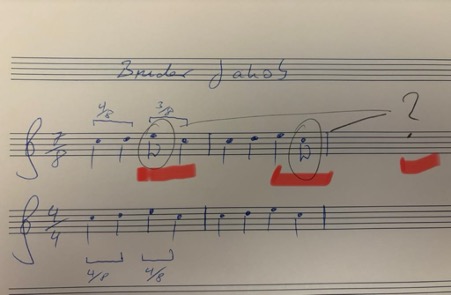
The song thus possesses a certain objectivity; it is independent of our spontaneous performance and our imagination. But it doesn’t possess this objectivity because it is written down somewhere. If you listen closely, you’ll notice that, firstly, the song is played in a 7/8 time signature instead of the usual 4/4 time signature, and secondly, that it is much more richly harmonized.
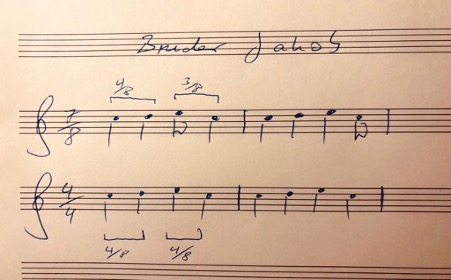
The relational object, however, is not a text; there is no physical object to which you could point. Nevertheless, it seems to be an objectively given point of reference. What establishes objectivity despite all the variance is therefore not the physicality of the object, but rather these two properties: repeatability and sharedness with others.*** Sharedness, or rather, repeatability by others, plays the crucial role here. Why? Because without social sharedness, I could not be corrected in my repetitions. Alone, I could mistake any nonsense for a repetition.
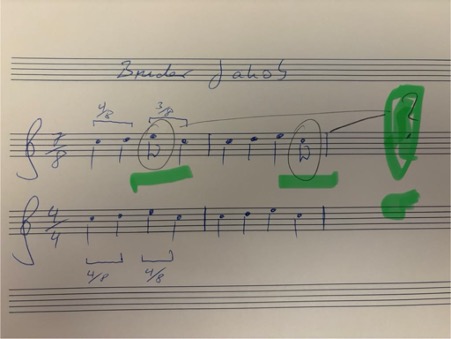
Only in agreement with others can there be anything like a correct or genuine repetition. (This is the consequence I draw from Wittgenstein’s private language argument.) Only when you affirm that the 7/8 version is also “Bruder Jakob” is it considered “Bruder Jakob.”

For precisely this reason, in singing as in reading, it is not the physicality, but the shared repetition, that is, the correct repetition, that establishes objectivity. What singing and reading have in common here is that they are embedded in a long history of social interaction.

Like reading, you may have first experienced singing by being sung to, by it being repeated, embodied, shared, and perhaps even ritualized. Just as you were initially read to repeatedly in typical situations: reading and listening were embodied, perhaps in bed with a book and pictures. Shared, that is, perhaps by your mother, your father, perhaps with other children. And perhaps as a bedtime ritual that has shaped your expectations and structured the evening. Singing, like reading, is inscribed within you as a ritual, so to speak. That’s how we learn it. Reading is embedded in these biographical narratives, not just in an abstract tradition.

In my opinion, it is precisely these factors, and especially repeatability and shared experience, that lend objectivity to what is read, objectivity to which the text, much like a song, ‘in itself,’ offers only a possibility.

So what does this analogy with singing offer us? Firstly, it clarifies how, with regard to the factors of objectivity—repeatability and shareability—we ascribe an objectivity to texts themselves, which we actually derive from their social embeddedness; unlike texts, songs don’t have any discernible objects. Secondly, it points us to crucial social sites and situations: if we want to seriously engage with reading, with the negotiation of meaning among readers, then we must go to the places where this actually happens. Accordingly, a philosophical engagement with an 18th-century text would require us to examine epistolary culture, salons, and, more generally, the establishment of conversation as a site of thought.**** While it is quite natural for many of us to have conversations about texts, this form, conversation itself, arose at some point and—this is one of my conclusions from my central thesis—plays a decisive role in the meaning and use of texts pertaining to certain genres. Alongside peer-review processes, conversation is a crucial space where, not least, philosophical reading culture takes place. Accordingly, you can locate the different interpretations of Wittgenstein in very different discussions or communities: the positivist interpretation in the Vienna Circle, the mystical one around Elisabeth Anscombe, the therapeutic one, for example, around Peter Hacker.

The basic idea is thus: The objectivity attributed to texts is an illusion, suggested by  properties of reading (actualizing affordances in the text) and projected back onto the text. Reading as a social practice is (like singing) repetitive and socially diverse. It is not the text, but social reading that creates objectivity.

As Suresh Canagarajah puts it: “Meaning has to be co-constructed through collaborative strategies, treating grammars and texts as affordances rather than containers of meaning. Interlocutors draw from other affordances, too, such as the setting, objects, gestures, and multisensory resources from the ecology. Thus, meaning does not reside in the grammars they bring to the encounter, but in the negotiated practice of aligning with each other in the context of diverse affordances for communication. In the global contact zone, interlocutors seek to understand the plurality of norms in a communicative situation and expand their repertoires, without assuming that they can rely solely on the knowledge or skills they bring with them to achieve communicative success.” This is precisely the point I am also trying to make: texts do not contain meanings, but rather offer affordances or possibilities.

4 The Consequences of the Illusion: The Degeneration of Objectivism into Mechanical Reading

If what has been said is true, then it is also possible that certain reading cultures will disappear or change. However, this does not necessarily mean that we will unlearn how to read, but perhaps only that the way we read and the places where meanings are negotiated can change. This is noticeable not only with regard to recent technologies, but also in everyday practice, especially in teaching. I believe, however, that the still widespread illusion that texts themselves are objective is leading to a degeneration in our reading culture. And here I come back to my initial observation that we might be living a scholar’s life with a chapter by Aristotle, while we spend only two hours on a student assignment.

This practice, which, incidentally, is also linked to increasing literacy, the so-called mass university, and the simultaneously stagnating number of lecturers, is initially perceived as stemming from external political pressure—and yet, it is increasingly becoming so entrenched that the guidelines for student text production—for instance, in the Netherlands and Great Britain—are themselves so schematic that one actually believes one can judge after 20 minutes of reading whether the requirements have been met. Such a mechanization of writing and reading is, of course, only justifiable if one believes that texts themselves are objective entities that are accordingly either good or bad. This mechanization is, incidentally, not a consequence of ChatGPT. Rather, it is the other way round: a reading culture that is changing in this direction consistently learns to use such technology.

From the Netherlands, I know that the mechanization of reading is already taking hold in elementary schools, where, from the very beginning, students are taught reading comprehension (begrijpend lezen) in order to test their knowledge of text structure in multiple-choice tests, and then people wonder why most young people have no interest in reading.

It seems that such uninspired role models lead to readers who, in turn, produce texts for exams that are hardly ever read. So why should anyone bother writing them themselves? Why bother reading them?

All of these are developments that, at least at universities, cannot be described independently of the introduction of New Public Management in the 1980s. (What good is it to tell a student to look at the text to understand it if there is hardly any interest in doing so outside of class? No, universities are not ivory towers; rather, cultural deserts have formed around them, in which we see primarily stakeholders instead of interpretive communities. But this criticism is nothing new and also a bit one-sided.)

Because, of course, there are places where the meaning of texts is still negotiated. We find them at literature and even philosophy festivals, on social media under #booktok, in often student-led reading groups, and, of course, in our teaching and research events. Here, reading is sometimes so explicitly social that it is actually performed. This, too, is not entirely new, of course. If we are interested in the foundations of reading, we have to go to these places. What is particularly interesting for our reading culture, I think, is that Large Language Models erode not only trust in the authenticity but also in the objectivity of texts. We are experiencing a massive desacralization of the text. Because unlike the divine authority presumed behind biblical texts, we now constantly suspect a deceptive demon. Accordingly, I believe that the academic rebellion against this desacralization is also a rebellion against the death of the illusion that texts themselves possess inherent quality. To name this desacralization does not mean falling for the grand promises of relevant AI product manufacturers. But we can also use this technology to sensitize ourselves to the fact that it is not the texts themselves, but our reading, our singing, our rituals that create meaning and make it something shared.

5 A Few Conclusions Regarding the Practice of Reading

What are the practical implications of these insights? How can we improve reading practices through such findings? Firstly, I would like to remind you that this research project on reading as a social practice is only just beginning. But if the meaning of texts in reading is essentially unlocked through the interactions between readers, then it helps not to stare at the text itself, but to always ask ourselves first: What do I expect from this text? What am I assuming it’s supposed to tell me? Is it supposed to provide me with an argument for something? What do I do if the text doesn’t meet my expectations? Should I humbly assume that I’m too stupid for it? That I don’t belong to the club of readers who say they understand or even love such texts? And why is this tome even on my desk or in my Adobe Reader?

Once you’ve confused yourself enough with these questions, you can actually look at the text and see what’s written there without immediately searching for “the argument”. People always say you shouldn’t just read, but read thoroughly: But what does “thoroughly” mean? Should I choose lots of colors to highlight the incomprehensible passages? Seriously: This instruction is about as helpful as telling you to concentrate. How do I do that? Stare into space and roll my eyes cleverly? – How do you even know when you’ve concentrated well enough? If you can say something that your conversation partner nods to politely in agreement? I can order from a menu, I can sound good with a poem, but what do I do with a philosophical text? When have I truly understood something? We can still only see this through conversation. – Is that enough, though?

Well, a fundamental insight that follows from these theoretical considerations regarding reading is that a philosophical text offers possibilities or affordances, and thus always different ways of reading it. It is a myth of completeness, particularly prevalent in analytic philosophy, that all implicit possibilities can simply be made explicit. Such completeness contradicts the necessary openness or underdetermination in texts. Think again of Wittgenstein’s famous quote. Another very memorable illustration of this is the duck-rabbit, which, in terms of possibility, remains precisely both. My project would therefore not be to reconstruct the one true argument, but rather to reveal different and potentially conflicting possibilities. Accordingly, one must accept that the text allows for various interpretations, which are only gained within different interpretive communities.

At this point, philosophers usually develop a typical fear of relativism. However, as Stanley Fish already noted, emphasizing possibilities is not about a relativistic position, but about plurality. Such plurality, however, by no means leads to arbitrariness. But what, then, are the limits to this space of possibilities? First, there are of course propositional limits: you cannot say that a text asserts non-p if it explicitly asserts p. Unless, of course, you perceive signs of irony. Here, the matter of limits becomes difficult again; and you will ultimately decide one way or the other. Furthermore, there are situation-specific conditions of appropriateness. If someone asks for directions to the train station, it’s not appropriate to respond, paraphrasing Robert Frost, by musing about less-traveled paths. Just as one shouldn’t sing Frère Jaques at an inaugural lecture or at a funeral. Or should one? Of course, we can break with conventions. For example, it’s entirely up to you whether you sing the song in 4/4 or 7/8 time signature, or even reharmonize it psychedelically with suspended chords. Convention gives you something to play with, or sing with.

Accordingly, Alva Noë makes a crucial point when he compares philosophical texts to scores for thinking, which can also be interpreted in very different ways:

“What the philosopher establishes in their labors are not truths or theses, but rather scores, scores for thinking with. … The philosophy lives for us like a musical score that we – students and colleagues, a community – can either play or refuse to play, or wish that we could figure out how to play, or, alternatively, wish that we could find a way to stop playing.”

I would simply add that, analogous to musical notation, philosophical texts can give rise to a multitude of interpretations. Here we don’t just have a single, obvious interpretation of a duck-rabbit, but a whole zoo with possible shifts in perspective.

Now, that may all sound very nice. But one mustn’t forget that interpretations aren’t chosen arbitrarily, but primarily with regard to social affiliation. If you choose an interpretation, you might belong to a club that’s currently out of fashion. The problem with my musings, then, is that they can be received in very different ways. Academics, in particular, fear reputational damage; therefore, they are very reluctant to admit their lack of understanding. “I don’t understand this text” usually is taken to mean something like, “The author is too stupid to explain it to me properly.” If, on the other hand, one can express genuine and sincere incomprehension, one has truly made progress. But such humility is something one has to be able to afford, so to speak. Therefore, it’s not enough to simply seek conversation; one must overcome one’s shame. You can’t learn to sing well if you’re too afraid of singing off-key.

But at some point, you can truly begin to name the difficult parts and ask yourself exactly where and why you’re stuck. Reflected confusion then becomes a genuine conversation starter. Because if a text offers the possibility of understanding it, it also offers the possibility of not understanding it.

____

* Thanks to Arnd Pollmann for pointing out this passage.

** I borrow this classification from Charlie Huenemann, but I forget in which of his posts it was introduced.

*** See on repetition in music and language Elizabeth Hellmuth Margulis’ On Repeat as well as Bente Oost’s vlog on this blog.

**** Thanks to Miriam Aiello for conversations on the topic of conversation.
Large Language Models and classism. The ethics of reading (3)

When reading texts with lots of general remarks and little attention to detail, I often wonder whether it’s produced by ChatGPT or some other LLM. I don’t like this kind of suspicion, especially in the context of teaching and evaluating. Not least because it primarily targets the author rather than the text: Has the author used an LLM and hence tried to cheat? So rather than assessing the text, I am incentivised to make a moral judgment. This readjusts my attitude as a reader in a crucial way. Rather than trying to enjoy the flow of the text or get into the argument, I wonder about the honesty and sincerity of the writer. While there is currently much discussion about cheating with LLMs, the unease that the suspicion causes me brings quite another worry to the fore: my own classism. Am I really worried to be cheated on or that the poor souls relying on AI are not learning to think for themselves? Or am I not rather mainly worried that these bullshitting texts produced by AI are soon indistinguishable from the products of my authentic intellectual labour? Let me explain.

Tacitly cultivating classism. – Being what is called a first-gen academic, one might say I’ve earned my cultural capital the hard way. I still remember how I mind-numbingly practiced philosophical terminology at the age of thirteen, enjoing the cluelessness of my parents when I put it to use. Looking back, I think of myself as impertinent and cruel. Intellectualism doesn’t come across as thuggish as brute anti-intellectualism. But I would say that, wouldn’t I? More to the point, my intellectualism paved a way that seems now to be threatened by the fact that text production can be outsourced just like other kinds of labour. Intellectual work of certain kinds is indistinguishable from work outsourced to LLMs. Being annoyed by people’s use of LLM’s I don’t feel consciously threatened. But I do wonder whether it’s this class aspect that creeps into my judgement of those users.

What kind of work do we actually grade as instructors? – My hunch is, then, that what is behind my suspicion against certain writers who might have used LLMs is owing to a certain classism or class anxiety. If people can outsource intellectual work at least to a certain degree, I might end up suspecting (tacitly) that these people don’t belong where they claim to be. Now you might respond that part of this suspicion is fair in that it targets fraud etc. Yet, I’m not sure it is fair. Of course, when dealing with straightforward cheating, our responses might be justified. But most cases are not that straightforward, or so I suppose at least. Just consider the teaching context: We might say we’re distinguishing students who “have done the work” from those who didn’t. But making such a distinction seems to rely on the fact that some students actually “do the work” in relation to one’s class. Yet, what if we’re merely rewarding those students who have learned intellectual skills to produce great texts long before they set foot in our classes? In other words, we might not reward intellectual skills developed as taught by us but intellectual skills as picked up long before. So what are you grading in such cases? The things that people learned in your class or the things that people bring along? If you’re perhaps not actually assessing people’s progress in your course, then the question arises what’s so salient about the distinction between someone well-educated long before and someone making up for an earlier disadvantage by using tools like LLMs to improve their work.

AI use between shaming and rewarding. – My point is not to appeal to such classism to silence justified criticism of naïve integration of AI into teaching contexts (here is a pertinent open letter I co-signed). But classism is a real thing; and “AI shaming” seems to be a new way of exercising the related kind of gatekeeping. Now that people start noticing that AI shaming is on the rise, it doesn’t mean it’s just part of an arsenal of arguments in favour of Tech Bros (as this thread insinuates). The stigma of using AI for one’s work is as real as the problem of cheating and related vices. ­But that doesn’t mean AI usage is exhausted by this. The world we live in will increasingly reward using AI. As an instructor I’m primarily faced with downsides when students use it to cheat, but as soon as we’re not acting as professionals ourselves we might become quite dependent on the benefits of AI. Just step outside your comfort zone and hand over the task of reformulating a text with a pertinent perspective! Having drafted a couple of legal documents, for instance, I have found that ChatGPT is a helpful tool. Of course, I still need to check on points, but the Legalese produced by this device is of real help. But relying on such help will be shamed by the next best expert in legal matters. And then it’s me who is at the receiving end of AI shaming.

From texts to their producers. – If we take the class perspective seriously, AI is not only presenting us with challenges but with contrary assessments ranging from worries about fraud, on the one hand, to worries about inappropriate gatekeeping, on the other. So how can we respond to this situation? My hunch is that we first need to acknowledge that this technology changes our reading culture. For a very long time, at least since the critical philological work of the 19th century, we have learned to see texts as something objective in that they can be seen independently from their producers or authors (or the layers of production of texts). As Daniel Martin Feige noted, digitalization involves a striking return of the author (see part three of his Kritik der Digitalisierung). With the constant possibility of text production through LLMs, we will focus even more on the author and marks of authenticity again, whether we like it or not. But this doesn’t mean that we need to resign ourseves to constant suspicion.

Authentic versus bullshitting texts. – Turning to texts themselves, the crucial question for us will be whether such texts are authentic and genuine expressions by an author or bullshitting texts. In educational contexts, we have known long before the advent of LLMs that our grading systems incentivise bullshitting, with or without LLMs. So I’d repeat that we educators need to focus on actually reading rather than going for quick judgments. This would not merely mean assessing whether someone is cheating but to reflect on what we expect and on whether our expectations are mainly pertaining to class markers, as seems to be the case in many instances. The bottom line seems to be this: Our worry should not be about the use of AI or AI-prompted texts, but about bullshitting texts. This might still mean that our current reading culture (where we treat texts as something objective) might come to an end. But so be it.

What does it say? The supposed objectivity of written texts

“… interpretation is the source of texts, facts, authors, and intentions.”

Stanley Fish, Is There a Text in This Class?

Do you remember when you first committed some of your own thoughts to paper? Perhaps you kept a diary, perhaps you wrote poems or lyrics or crafted a letter to a friend. Perhaps you had worked on the aesthetics of your handwriting. Anyway, there it was. Something that you had written could now be read and, of course, misread in a distant place during your absence. This striking distance became even more evident to me when I had seen my words, not in my clumsy handwriting, but in the typeface of a word-processor. Imagining that someone would read my words not as my personal scribblings but as a text in an authoritative typeface, made me at once proud but also seemed to diminish my personal impact on the text. In any case, the absence or possible absence of the author from something written, I suppose, is what turns texts into something objective. As I see it, texts become objective when they can be read independently of the writer, of what the writer says and thinks. If this is correct, it seems that written texts are fundamentally different from spoken texts or thoughts. In turn, this makes me wonder whether it’s written texts alone that afford the interpretive openness allowing for different readings or interpretations as we know them in the humanities of our time. In what follows, I would like pursue some perhaps naïve musings on this issue.

Thinking versus speaking versus thought?

If you observe what you say in contrast to how you write, you’ll probably notice a stark difference between spoken versus written language. While academics sometimes seem to try and imitate the grammatical standards of their written language in their speech, we quickly notice that the grammatical rules, word choices and other aspects are vastly different. Pondering on this issue quickly brought me back to the ancient and medieval doctrine of “three kinds of language”, according to which thought is expressed through spoken language and spoken language is signified by written language. But once you notice how different already speaking and writing really are, it’s difficult to give much credit to said doctrine. The very idea that writing is a set of signs of what is spoken strikes me as a very impoverished understanding of the difference. This makes me wonder when written language was first considered as a set of signs independently from spoken language. Following Stephan Meier-Oeser’s work, my hunch is that William of Ockham and Pierre D’Ailly in their logical treatises are among the first to deem written signs as independent from spoken language. (Sadly, it’s not entirely clear why they hold this in contrast to many of their fellow thinkers.) Now, once you think of written language as independent from speech it seems that you acknowledge something that could be the objectivity of the written text. Of course, long before the written text is acknowledged as an independent signifier, there have been sacred texts like the Bible that were considered objective in some sense. But experiencing our very own writings as independent from our speaking must do something to the way we think about texts and their interpretability more generally, or so I think.

The written text as an objective ‘thing’

The way we encounter written texts or books (be it on paper or screens) seems to present them as distal objects, independent from how we interact about or with them. Like the table in front of you, the book on your desk or in your pdf isn’t altered when you look away. This experience is certainly at least in part responsible for the common assumption that texts and their meanings are stable items independently of us. Likewise, our experience of reading is commonly thought of as grasping something external to us or our interactions. But why? While I myself have begun to think that reading is in many ways a matter primarily dependent on interactions between readers, I equally wonder how written texts, non-sacred texts in particular, have earned the status of independent carriers of meaning that can be hit or missed. Our current reading practices inside and outside of academia seem to corroborate this assumption. – (What does it say? This is a question that silences classes but equally fosters the pretence that texts are stable unchanging sources of meaning that provide all the necessary constraints for possible interpretations. Yet, not knowing whether we’re reading a recipe or a a poem, we are probably unable to tell the genres apart without context. “Context” – this harmless little term obscuring all the greatly important factors allowing for recognition, and constantly underestimated as a “side issue” when it comes to competing readings!) But what does it take for a written text to be actually seen as independent in such ways?

Holland House Library after an air raid in 1940

The advent of ChatGPT

Investigating the question of the objectivity of texts will take some time. But currently it seems that this objectivity becomes undone in quite unexpected manners: the advent of chatGPT does not only call into question the production of texts through proper authorship. Rather, it also calls into question the independence of written language as a system of signs, thriving on a supposed text-world relation having been taken for granted for a very long time. Reading a piece of text, we can no longer presume that it was produced by a person having a relation to the world, to themselves and to other people making it a rational item, interpretable by rational beings, or simply readers.

How did we get here?

The average professorial laments – and remarks on reading. A reply to Steven Hales

Currently, there is a piece on “the average college student” (in the U.S.) making the rounds. It’s sparking both frustrated nodding about the problems in student performance and some eye-rolling about professorial arrogance.* Although I have met a number of students from the U.S., I have taught mostly in the Netherlands and in Germany, so my more positive experience might be owing to regional differences. But I’m not entirely sure. What’s perhaps most striking about the piece is that its merciless judgements are based on, well, not much exactly. In what follows, I’ll focus on Steven Hales’ remarks on reading, point out some problems, and then make some suggestions.

Hales’ section on reading starts by pointing out that “most of our students are functionally illiterate.” This is a drastic remark. Did he do tests? We are not told, but we get something like a definition detailing that this status amounts to being “unable to read and comprehend adult novels”. How the heck does Hales know? If he has any ways of learning about his students’ reading habits, he keeps them to himself. I’m left wondering how I would figure out what my students read. Well, of course I could ask them and sometimes indeed do. Could I judge from such conversations whether they “comprehend” the texts in question. That depends: partly on my own comprehension skills and partly on what students like to disclose. I remember my first shock when coming as a postdoc to Cambridge and being told by students as well as some colleagues that they had given up reading novels because there was only so much time – and that had to be spent on professional reading. What I’m saying is that there might be reasons for changing one’s reading habits, especially in academia, and it might be quite hard to figure out what a student actually thinks about their reading for pleasure, especially in a conversation with a professor. It’s not that I don’t believe Hales that at least some students don’t do the reading; it’s that Hales’ doesn’t tell us how he knows.

I’m not saying there are no ways of knowing or at least making educated guesses at what people read and comprehend. We do that all the time. So I’m not saying you need rigorous testing or anything like it to get an idea of whether someone read something and whether their reading aligns with yours. But given the drastic type of judgment, I’d expect a modicum of information about such ways. What this lack of information leaves me with is the assumption that the conversations informing Hales’ inferences about adult novels might have been quite superficial. Talking to my 8-year-old daughter about how she feels, I often get the reply “good”. If I don’t inquire further and about particular details, I’ll be left with that. More to the point, I know from my own student life that when a professor asked me something about my private endeavours or my thoughts on a text, I could become so shy that I would respond with utter nonsense. What now? Well, perhaps Hales did have thorough attempts at conversations about Richard Powers’ novels and he just doesn’t tell us. Perhaps some of these conversations didn’t go very well. The question to ask is: why! I’m not saying that Hales’ judgment is necessarily flawed, but I would expect it to be based on something – and the mere assertion that the average student is functionally illiterate suggests that something else is lacking here.

Since I like to inquire about reading habits among students and colleagues, I know that people can be become somewhat monosyllabic when you ask them about how they read. “I just, well, read,” is the reply I get most of the time. It takes time to tease out actual expectations from a genre or assumptions about the texts at hand. So what do you do when you think your students are bad at reading?

  • First of all, ask them about it. Better still, start a conversation. To steer such conversations, it’s helpful to bear in mind that acts of reading are first and foremost defined through the interaction between readers. Reading is as much about belonging (to a certain group) and relating to styles and attitudes as it is about texts. So when it comes to conversations, the ‘text itself’ is a long way off. It’s the interaction between readers that settles important prior questions: Whether you belong to the same group, share expectations or desires or frustrations etc. Above all, it takes trust to converse about literature.
  • A second point to bear in mind is that there is often a stark difference between reading, talking about reading, and performing relatedly in class. I might read all night through but never establish a comfortable way of talking about that in a semi-professional environment. Talking in front of peers or judgmental professors is quite different from enjoying reading. So, encourage such conversations very gently.
  • Finally, what we Gen X people recognise as a reading culture does not immediately translate into the contemporary environment rich with gamification of interaction. Hales is ready to identify phones as the culprit, but that strikes me as too quick. Even if it feels very alien, we have to make an effort to find the reading culture outside of the places in which we expect it. Even social media foster reading, e.g. in the form of “BookTok”.

So on the whole, many of the problems described might be owing to expectations being at odds. Of course, some people really don’t like to read. But if you call them “illiterate” it strikes me as setting a problematic example if all you offer is your very own word for it.

______

* See also the blogs Daily Nous and Leiter Reports for extensive discussion.

Love as imitation. A note on the role of love in academic teaching and learning

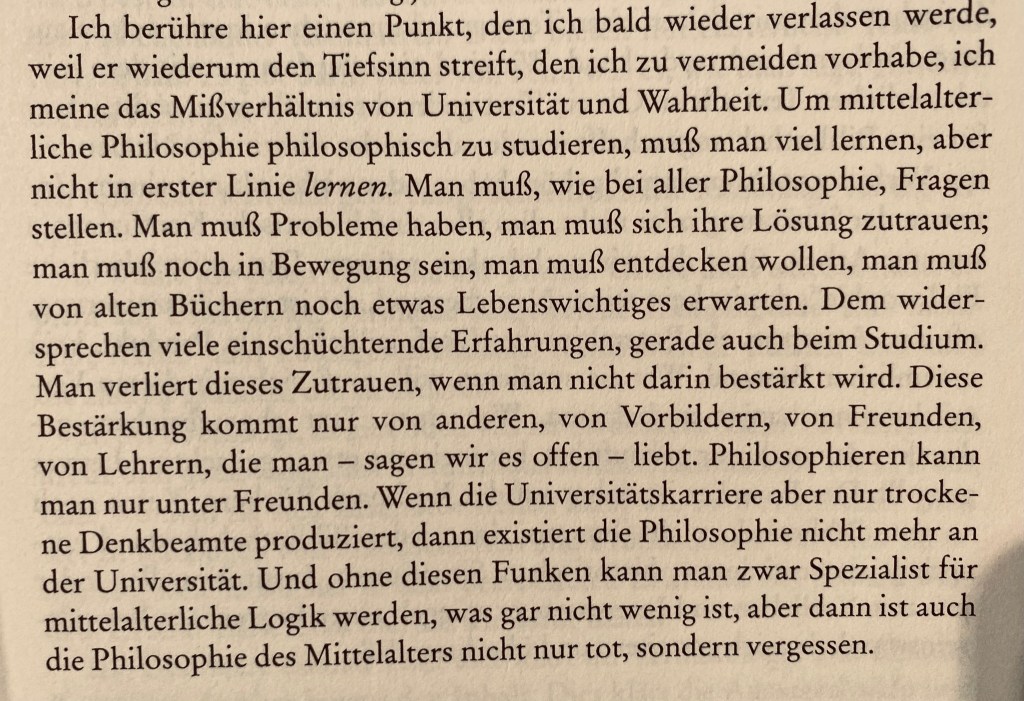
“I am touching on a point that I’ll soon leave behind again, since it relates to the profoundness that I intend to bypass, I mean the disparity between university and truth. To study medieval philosophy in a philosophical way one has to learn a lot, but one should not prioritise learning. As with any kind of philosophy, one has to ask questions. One has to have problems; one has to have confidence in being able to solve them; one still has to be on the move, wishing to make discoveries, wishing to learn something of vital importance from old books. This is countered by many intimidating experiences, especially during one’s studies. One loses this confidence if one is not encouraged. This encouragement comes only from others, from role models, from friends, from teachers whom one – let’s be frank – loves. Only among friends can one do philosophy. But if university career paths merely produce sober thinking clerks (Denkbeamte), then philosophy does no longer exist at universities. And without this spark you might still become a specialist in medieval logic – which is no small endeavour – but then medieval philosophy is not just dead but forgotten, too.”

Kurt Flasch, Historische Philosophie, 2003*

In times of increasing worries about ChatGPT and education systems more generally it’s soothing and inspiring to re-read some of the works of my teacher Kurt Flasch. Neither he nor my PhD supervisors Burkhard Mojsisch and Gert König were very good at preparing me for a career on the international job market, but they surely inspired some resilience against its crushing mechanisms. Re-reading the passage I translated above made me think about love of teachers again. Not in the recently well-rehearsed sense of academic ‘metoo stories’, but in the sense of what I’d like to call love as imitation. I know there are a lot more topics in the offing, but the idea of love in academia is, as far as I can see, perhaps the least understood.

So what does it mean to love a teacher? – Quite simply, to love one’s teacher means wanting to be like them. While it might involve interacting with them on some level, the crucial aspect is wanting to become like them, and that means, for instance, approach problems like them; speak, sound and listen like them; read like them or perhaps even enter into the form of life displayed by them – in one word: imitate them. (As I have argued earlier, love is, amongst other things, the ability and desire to understand another person. A strong way of understanding the other, then, is imitating them.) When I was a student, I had a couple of professors I really loved in that sense. I ended up following their courses, not primarily because I was into the topic all too much, but because I thought that, whatever they would teach, I would be learning something worthwhile. But how do you learn, how does that kind of love play out? While I was (back then) completely unaware what that meant, I just attempted to imitate them. This was quite palpable to me. When I wanted to pursue a certain (stylistic) approach, I would simply hear and try to imitate their voice in or their style when writing. – You might find this strange, but that’s probably what’s going on when we learn to find our voice in any kind of art, be it playing music, trying to paint or draw, or trying to speak and write.

Shouldn’t we aim at independence? – I guess the reason why imitation is so underrated in teaching is that we’re told to value independence. This is a fair point, but there are two issues that should be considered in response: Firstly, there is no independence without belonging. We’re not monads but always relating to a form of life and style that allows us (and others) to recognise that we’re engaging in the kind of practice we wish to engage in. How do I know I’m playing music if there is no one I’m relating to in my musicianship? Secondly, when we imitate we are never perfect imitators or impersonators – we end up appropriating and making things our own. So when I imitate my favourite teacher, you won’t hear Kurt Flasch but – willy nilly – an appropriation of his approach. In fact, the initial enthusiasm for pursuing something is fostered most by imitating a role model, be it a musician, an actor or a philosophy professor. In doing so, we might begin by rehearsing the things – half understood – we value most. After a while, though, we’ll find them pervading what we take to be our own voice.

Where to go from here? – Being a teacher myself, I think I should be aware of the facts surrounding the imitative ways of learning. After all, students don’t do as we say but imitate what we do. So if we act mainly as competitors on “the market”, students will see and imitate us in this respect. If we’re policing them as potentially fraudulent users of ChatGPT, they might follow suit. But what if we were to follow through with the idea that the best kind of philosophy develops in a community of friends?

_____

* Kurt Flasch, Historische Philosophie, 2003, S. 67:

Education versus employability. A reply to Daniel James Țurcaș and others

Common sense: why don’t you practise your violin more? You are really talented.

Also common sense: why would you waste your time practising a musical instrument, if you can’t sustain a living from it?

***

Taken together, these two questions express everything that is wrong with our education system. The reason is that there are two largely disparate sets of values at work: while the first question expresses educational values, the second is driven by concerns of what now often goes under the heading of employability. While many European education systems pride themselves on fostering the first set, they ultimately honour the second set. The two questions jumped at me when trying to figure out what’s wrong with meritocratic hero narratives designed to empower first-generation students. In reply to my previous piece a number of people have pointed out that it’s basically a Good Thing to spread stories by first-generation academics, the reason being that it might ultimately allow for sharing struggles and rasing awareness. I agree that such stories might be empowering etc. but something keeps nagging me. So here it is:

Academic success as a student follows a different logic than success as an academic employee. Performing well as a student can be honoured by, by and large, academic standards. Even if studying is often competitive, students do not need to compete, because, at least in principle, grades, even good ones, are not a limited resource. By contrast, academic employment is strongly limited. Therefore, academics compete in a zero-sum game. Arguably, then, empowerment for first-gen students might work very well for student success, but it probably has nothing to offer when it comes to employment. My worry is that empowerment through first-gen stories might be taken as a recipe or empowerment for the job market, when in fact it mostly speaks to values that hold or should hold in educational contexts.

Here is what I wrote about these different sets of values two years ago: Most education systems hold a simple promise: If you work hard enough, you’ll get a good grade. While this is a problematic belief in itself, it is a feasible idea in principle. The real problem begins with the transition from education to employment relations in academia. If you have a well performing course, you can give all of your thirty students a high grade. But you can’t give thirty applicants for the same position the job you’ve advertised, even if all the applicants are equally brilliant. Now the problem in higher education is that the transition from educational rewards to employment rewards is often rather subtle. Accordingly, someone not getting a job might draw the same conclusion as someone not getting a good grade.

It is here that we are prone to fallacious reasoning and it is here that especially academic employers need to behave more responsibly: Telling people that “the best candidate” will get the job might too easily come across like telling your first-year students that the best people will get a top grade. But the job market is a zero sum game, while studying is not. (It might be that there is more than just one best candidate or it might be impossible for the employer to determine who the best candidate is.) So a competition among students is of a completely different kind than a competition between job candidates. But this fact is often obscured. An obvious indicator of this is that for PhD candidates it is often unclear whether they are employees or students. Yet, it strikes me as a category mistake to speak about (not) “deserving” a job in the same way as about deserving a certain grade or diploma. So while, at least in an ideal world, a bad grade is a reflection of the work you’ve done, not getting a job is not a reflection of the work you’ve done. There is no intrinsic relation between the latter two things. Now that doesn’t mean that (the prospect of doing) good work is not a condition for getting a job, it just means that there is no relation of being deserving or undeserving.

Or to put the same point somewhat differently, while not every performance deserves a good grade, everyone deserves a job.

Between coming out and self-praise? The meritocratic ring of first-generation stories

Recently, I took part in an initiative concerning first-generation academics. As I took it, the idea was that established professors take the lead in talking about their special experiences and career paths in view of their non-academic backgrounds. The idea strikes me as good and empowering. Although people from non-academic backgrounds have significantly fewer chances of upward social mobility, let alone landing a sustainable position in academia, it is not impossible. Given this, it makes sense to raise awareness for the specific obstacles and stigma, yes, stigma, and perhaps to encourage those sitting on the fence about giving it a try. All the power to empowerment, of course. But is that really the effect of this kind of initiative? Here are some doubts.

“Aren’t you mostly engaging in self-praise?” Thus spoke my interlocutor after reading some of the professorial testimonials showing that they “had made it”. I explained at length how I hoped that these stories would help starting a conversation, eventually empowering some people from similar backgrounds and enlightening those unaware of first-gen issues. What’s not to like? “Well,” my interlocutor retorted, “of course, these are good intentions. But who is the intended audience of these testimonials?” Initially, I took my interlocutor’s criticism of self-praise to be totally unfair. In my view, class separations had tightened rather than loosened, so what could be wrong about raising awareness?

Listening to myself, my answers began to ring hollow soon, though: Who would read this? And wasn’t my story really just like patting myself on the back. Would it not just come across like any old meritocratic hero story? ‘Look, I’ve made it, despite …’ The American Dream all over again. Of course, this sounds too harsh. Reading all the stories by others (and not just professors), there were lots of intriguing perspectives. So one effect of this initiative might be that of normalising talk about diverse backgrounds. That would be good indeed. But while normalisation of such talk might be desirable, it doesn’t shed any light on the actual mechanisms obstructing social mobility. Indeed, thinking back, what really made a difference for me was not the opportunity to talk about my background but the political efforts allowing for social mobility within schools and financial support.

Now you might object that I’m misunderstanding such initiatives. While social mobility is hampered by lack of political and financial support, it is also hampered by stigma and more subtle forms of social oppression. These issues are addressed by such initiatives. The situation for first-gen students and academics will not only be improved by throwing money at it, but by normalising such backgrounds. But will it really?

Looking back at the situation I was met with as a student, what helped me most was, among many other things, the then widespread idea that it doesn’t matter where you come from. This idea is ingrained in countless songs, stories, and pop culture at large that accompanied my youth. It carries an enticing promise: the promise that you can just invent yourself – irrespective of who your parents or your ancestry are. Rather than highlighting my background (which I didn’t feel very connected to anyway), then, I felt empowered by the assumption that my background doesn’t matter. When I say in my testimonial that I was lucky to have grown up in a politically empowering environment, I partly refer to this idea. The political birth of this idea is probably linked to 1968, stressing a cut with previous generations especially in Nazi Germany. By the 1970s and 1980s, it probably had taken some hold in educational institutions.

Now you might rightly object that this idea, while perhaps desirable, is not true of the class differences that now rule many educational decisions. To this I’d reply that even back then ‘when I was young’, this idea was not true of most political mechanisms. The ties to the Nazi past were not really cut and we still had strong class differences. The point of the idea that your ancestry doesn’t matter is that it was a normative idea. It shouldn’t matter where you come from, even if it still did.

But if your class or ancestry shouldn’t matter, then what good does it do to focus on the differences in backgrounds? Thinking about this, I realise I’m torn about first-generation initiatives. On the one hand, I really believe that normalisation of such talk might help individuals in navigating through their environments. On the other hand, I worry that I end up normalising meritocratic drivel instead.

Yet again, while class origins (and the meritocratic hero narratives about overcoming them) shouldn’t matter, they do make a difference. While good education should be available to everyone and not hampered by origins, educational paths are often construed as stories of overcoming one’s origins. The Latin roots of “education” in the verbs “educare” (“to train”) and “educere” (“to lead out”) insinuate as much. If this is correct, education means at least partly leaving behind one’s origins.

In this sense, stories about educational paths will probably remain, at least to some degree, stories about leaving one’s origins behind. The very term “first-generation student” or “academic” has this narrative baked into it. So yes, keep talking about origins, but don’t forget to fight for political and financial support.

***

Many thanks to Daniel James Țurcaș and Barbara Vetter for launching the recent FirstGenPhilosophers initiative of the Gesellschaft für Analytische Philosophie (GAP), and to Marija Weste for inspiring conversations on the topic. – As it happens, this blog is now nearly four years old. So special thanks also to all my readers and interlocutors.

#FirstGenPhilosophers

FirstGenPhilosophers is a webpage (in German) curated by Daniel James Țurcaș and Barbara Vetter. It is about and for philosophers with a non-academic background and intended as a forum for sharing stories and ideas. Currently, it hosts stories by Elif Özmen, Andreas Hütteman, Christian Neuhäuser, and yours truly. The curators welcome further contributions.

***

In case you’re interested, here is a quick translation of my contribution:

My parents fled from Pomerania and East Prussia to West Germany as children at the end of the Second World War. My mother worked there as a cleaner and shop assistant, my father as a lorry driver. My ambitions surprised them. Nevertheless, they tried to support me as much as they could. During my studies and afterwards, I was not really aware of any particular difficulties. It was only much later that I realised that I had often tried to hide my origins and that my life was often associated with a certain shame in this way. When my academic teacher once pointed out how selectly I was dressed, I was somewhat startled because I realised how well I had learned to disguise myself – even from myself. Seeing how much it can encourage others to know about this shame and other difficulties has encouraged me to address my experiences occasionally. So I have stayed well in touch with my “inner student” and like to bring him out to understand and address certain problems. On the one hand, perhaps for this very reason, I realise today how much I personally owe to the democratic education orientation in the Germany of the 70s. On the other hand, it is frightening to see how much this orientation is now being fought politically. In this sense, the still claimed meritocratic orientation in academia appears as a toxic fig leaf. For philosophy in particular, it is essential to regain a democratic and pluralistic educational orientation. That is why I try to keep these issues present in my blog and through active work in the union. So if there is one experience that I associate in a special way with my background, it is this: Promoting academic work requires living in solidarity rather than competition.

Philosophy, language, and my long road to tenure (podcast)

After one of my lectures on the history of philosophy for students from other faculties, Daniel Rebbin and Colm O’Fuarthain, two psychology students participating in the lecture, kindly invited me to a conversation on their Mental Minds Podcast.

So we talked about many things: for instance, about my approach to philosophy, the importance of being confused, language, dialogue, my way into academia, pretence, anxiety, and the meaning of life. Enjoy the conversation and check out their other podcasts. Below I added a rough table of contents (the times might not always be correct):

Contents:

00:00 Introduction              

01:40 Why should we study and how did I get into philosophy?                      

03:15 On confusion and expectations

10:10 Do we always focus on what people say rather than on phenomena?

12:36 Language as a mode of direct perception

15:31 Interaction through language

18:37 Limits of language, and how we share experiences

29:19 On going into academia and the relevance of philosophy for our lives

43:05 The role of luck, chance, and shame

52:34 Intrinsic motivation? – Adolescent wishes

56:30 What have professors gone through to become professors?

1:21:30 My anxiety disorder

1:30:40 What advice would I give my younger self?

1:42:00 What gives me meaning in life?

Meditation in philosophy. A conversation with Andrea Sangiacomo (podcast)

Meditation in philosophy. A conversation with Andrea Sangiacomo (podcast)

This is the fourth installment of my still fairly new series Philosophical Chats. In this episode, I have a conversation with Andrea Sangiacomo who is an associate professor of philosophy at Groningen University. In this conversation, we focus on meditation both as part of philosophical traditions as well as an approach that might be a resourceful factor impacting (academic) philosophy, teaching and academic culture. While Cartesian and Buddhist ideas* form a continuous resource in the background of our discussion, here is a list of themes in case you look for something specific:

  • Introduction   0:00
  • Meditation and Descartes’ Meditations   2:20
  • The notion of experience – and objections against experience as a basis in philosophy   9:00
  • Meditation in teaching   21:14
  • Why aren’t we already using these insights in education?   37:00
  • How can we teach and learn effectively?   44:36
  • How can we guide and assess?   52:50
  • Where is this approach leading, also in terms of academic culture?   1:03:00

______

* The opening quotation is from Andrea’s blogpost What can we learn today from Descartes’ Meditations? Here is the passage: “Since last year, I appreciated the text of the Mediations as real meditation, namely, as a way of practicing a meditative kind of philosophy (for lack of better term), a philosophy more concerned with what it means to experience reality in this way or that way, rather than with what a certain set of propositions means.”

He has published four more posts on this topic on the blog of the Centre for Medieval and Early Modern Thought. They are: