Reading as a Social Practice: On Objectivism in Reading Texts

Let me begin, once more, with a question for my colleagues in philosophy: How can we spend a lifetime on a chapter in Aristotle and think we’re done with a student essay in two hours? Both can be equally enigmatic.

I have raised this question several times and received some very interesting answers. What the question, as well as the numerous justifications, clearly reveal, in my opinion, is the state of our reading culture. The difference between the amounts of time spent on such texts is, of course, often justified with regard to the professionalization of reading. Nevertheless, we as scholars and teachers are role models in our respective disciplines. So let’s take a closer look! At least with regard to the type of text (a piece of Aristotle’s work and a student paper), there should be no significant differences: both are, in a broad sense, scholarly texts. The truly significant difference lies instead in a social factor, which, following Miranda Fricker, could be described as an epistemic injustice. It is not any particular characteristics of the text, but rather certain presuppositions held by the community of readers that lead to this injustice. These presuppositions are not simply your or my private opinions about Aristotle, but are structurally embedded or institutionalized in a long history, namely in the form of an existing canon that prioritizes so-called classics over students.

Now you might say: Well, that may well be so. However, such presuppositions are external to the act of reading itself, contextual, incidental, so to speak, but not central to engaging with a text. The text, due to its inherent characteristics, must be decoded, so to speak, and thus stands, as it were, on its own. Objectively.

This almost classic objection is quite typical, not least in philosophy, but also in other disciplines, which is why I intend to focus primarily on refuting it. However, my aim here is not merely to engage in a petty feud. Rather, I consider the question of what reading is to be a fundamental question of philosophy. Surprisingly, with few exceptions, this question is almost never addressed in philosophy. Yet reading, especially the careful reading and reconstruction of written texts, is certainly among the core businesses of philosophy. But if you ask colleagues how they read, you often hear—and this is no joke—”I just read.” It seems to me, however, a major oversight not to specifically consider the conditions of one’s own activity, that is, the reflexivity inherent in reading. In keeping with my long-term project with Irmtraud Hnilica, my thesis that reading is a social practice means precisely what the aforementioned objection denies: that social factors in reading are not merely incidental, but central to reading and the development of quite different reading cultures.

In the following, I would therefore like to first take a look at our reading culture, which promotes the aforementioned objection insofar as it considers texts to be something objectively given. Here, I am interested in the question of how and since when we have considered texts to be something objectively given. Secondly, this question will reveal that the assumed objectivity of texts is an illusion. Thirdly, I would like to outline what I consider reading to be. To help you prepare, I’ll tell you now that we might best understand reading by considering it in analogy to singing songs, namely as a cyclical and ritualized activity. It is the characteristics of this social activity that produce objectivity. Fourthly, I would like to suggest how the persistent illusion leads to a degenerative mechanization of reading. Finally, I would like to ask how this approach could help us in practice to understand our own and other reading cultures.

1 On the Foundation of Objectivism in Philosophy

Let’s begin again with the objection depicting texts themselves as objectively given. If we take this objection seriously, then there should be striking differences between the texts of a student and those of Aristotle, differences that justify the varying effort required. However, even before we can look into the texts themselves, the past, our very own past, will catch up with us. Whether we like it or not, we are standing in a tradition that treats certain texts as sacred. Aristotle, as an author, belongs to this tradition; for almost 1000 years he was considered philosophus, the philosopher par excellence. Even his fiercest opponents attempt to read his texts as the consistent pronouncements of a genius. The sacralization, or, to put it more cautiously, canonization, of Aristotle’s and other works has been followed, at least since the Enlightenment, by a distinctly different reading culture. Against the comprehensive commentary literature of antiquity and the Middle Ages, there is a recurring and increasingly emphatic push for the suppression of close reading by the cultivation of so-called independent thought. For example, Schopenhauer* writes:

“When we read, someone else is thinking for us: we merely repeat his mental process. It is like when the student learns to write with the pen going over the pencil marks of the master. So when one reads, most of the thought-activity has been removed from him. Hence the palpable relief we perceive when we stop to take care of our own thoughts and move on to reading. While we read, our head is truly an arena of unknown thoughts. But if we take away these thoughts, what’s left? So it happens that those who read a lot and for most of the day, in the meantime relaxing with a carefree pastime, little by little lose the ability to think – like one who always rides a horse and eventually forgets how to walk. This is the case of many scholars: they have read to the point of becoming fools.” (Schopenhauer 1851, § 291)

Interestingly, Schopenhauer’s pessimism regarding reading is motivated by concerns similar to today’s warnings against social media, which simultaneously assert the decline of our reading and thinking abilities. If Schopenhauer were right, perhaps we should give up reading altogether, shouldn’t we? But it is precisely the assumption that a text contains the thoughts of others, which we merely follow through reading, that solidifies objectivism in relation to texts. Not surprisingly, certain texts were considered harmful. As early as the late 18th century, there was much criticism of “Lesesucht” (reading mania), particularly in Germany, with young people and women being considered “at-risk groups” in particular. At the same time, the historical-critical method was established in theological and historical disciplines. And in philosophy, alongside a methodologically grounded canonization of classics, notably by authorities like Kuno Fischer, the beginning of the 20th century saw a distinct renaissance of the efforts of the early modern Royal Society to establish an ideal language for the sciences, promising corresponding texts as objective reference systems for describing the world.

One characteristic we still share with the early 20th century is the idea that written texts can be rationally reconstructed by separating arguments from historical and rhetorical embellishments. This allows one to move directly from the surface of the text to its deep structure, to note the logical form, and to reformulate the core statements into premises and conclusions. This idea naturally suggests that the argument is embedded in the text and that one can search for it there—after some introductory instruction. Accordingly, much of current philosophy didactics is concerned not with reading itself, but with the analysis of arguments. Meanwhile, the wave of Critical Thinking, understood in this way, has also spread beyond philosophy to all those who want to teach any kind of competence.

Of course, one should learn how to analyze arguments, but one should also know precisely what one is doing. One is offering a specific translation through omission and substitution. On the one hand, it is claimed that the argument is contained within the text, but on the other hand, that the argument remains invisible without translation. Beginners are often led to believe that there should be one correct reconstruction.

Let’s take a closer look. To illustrate this, let’s consider the famous last sentence from Wittgenstein’s Tractatus Logico-Philosophicus: “Whereof one cannot speak, thereof one must be silent.”

– Firstly, you can interpret the sentence positivistically: as a restriction to what can be meaningfully said by the natural sciences. (In this case, you interpret the “must” as descriptive.)

– Secondly, you can interpret the sentence mystically and ethically: as a prioritization of the unspeakable as what is truly important. (In this case, you interpret the “must” as normative.)

– Thirdly, you can interpret the sentence as self-contradictory and, in this sense, therapeutic: because it speaks precisely of something about which one cannot speak. (The “whereof” names something that is indicated as unspeakable in the reflexive pronoun “thereof”.)

These interpretations contradict each other, but can be validated not only by the quoted sentence, but also by the contexts of the Tractatus and later writings. Once you have seen how many conflicting reconstructions of this and other classics exist, you might be quite puzzled by the idea of textual objectivity. It’s clear that the analysis of relevant arguments relies heavily on communication between logically trained readers, where the original text itself is often seen as an obstacle. Instead of focusing on how the negotiation process between readers shapes the reading experience, however, the approach remains one of optimizing the reconstruction of a classic. What emerges could easily be described as fan fiction.**

If we take this seriously and not merely as polemics, it becomes clear that philosophy, in certain schools of thought, is indeed in close proximity to entirely different literary genres. But even the insistence on philologically rigorous reading generally takes the text as the source of the doctrines and modes of thought derived from it, as is also suggested by the general distinction between primary and secondary texts. Overall, this assumption regarding reading can be described as objectivism. But how should we understand this objectivism in our reading culture?

2 The Text as a Possibility of Readings in Interpretive Communities – Objectivism as an Illusion

By objectivism, I mean the assumption that what we believe we have gleaned from the text is actually found within the text itself. On the one hand, this is a correct assumption, because all readers will confirm that they derive their interpretations from the texts. Of course, it must be added here that a text can indeed be read as a chain of propositions that are decodable and whose presence most readers will be able to agree upon. On the other hand, however, it is a misleading assumption, as can be seen from the fact that there are endless disputes about interpretations. Just think of the Wittgenstein quote. If this is true, then objectivism is, on the one hand, correct, but on the other hand, misleading. On the one hand, correct, on the other hand, misleading? Am I contradicting myself here? – Please bear with me. To resolve this apparent contradiction, we must recognize that a text is not identical to its reading. The text is a possibility for reading, while reading is the realization of the possibilities inherent in the text. Following James Gibson, we can speak of affordances that the text offers. As Sarah Bro Trasmundi and Lukas Kosch have shown, a text offers you various possibilities for action or reading. Which possibilities you ultimately choose in your reading depends on further factors. These factors are—so I argue—primarily social. Specifically, this means that whether you read a text in one way or another, and thus what meaning you derive from it, depends on your interactions with other readers.

Of course, you usually don’t even notice this because—especially in our reading culture—you are often alone with a text. But fundamentally, you were never truly alone with a text: As a child, you were, hopefully, read to. As a student, you were constantly corrected by others. And now, now that you’re an adult, you hear voices. Not in a pathological sense. The interactions with other readers are simply mostly implicit, solidified into habits, even traditions. Following Stanley Fish, I would like to call a group that shares certain interpretive habits an interpretive community. Fish locates the negotiation of meaning for texts within corresponding “interpretive communities.” You’ve learned to read menus, and you know what to do with them. And you wouldn’t mistake a menu for a poem, would you? Even before you skim the essay on your table, you know that it contains an argument because it’s a philosophical text—and if it didn’t contain an argument, it wouldn’t be a philosophical text at all. That’s how the tradition of your interpretive community dictates it.
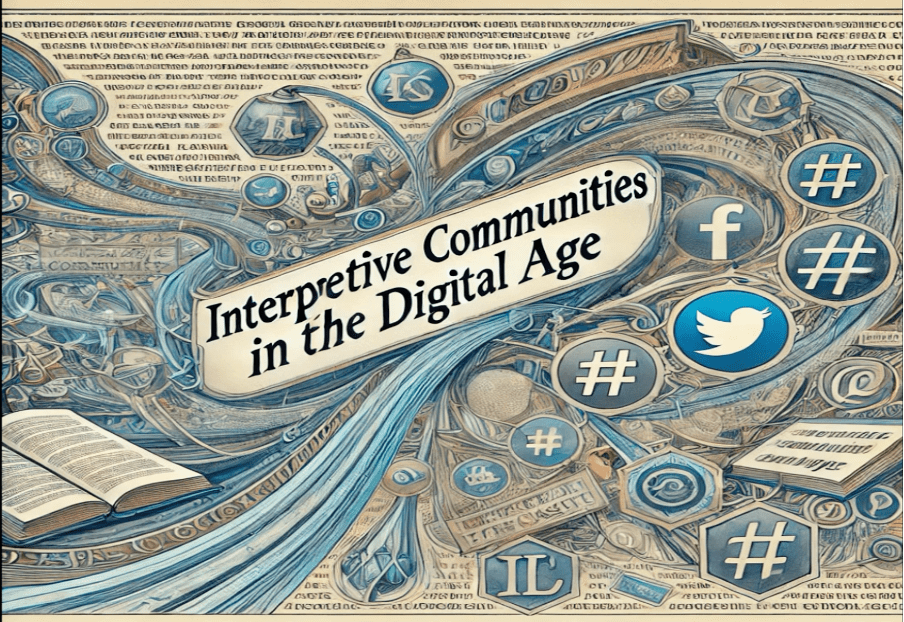
(Taken from this quite insightful podcast.)

It is precisely the fact that a text is not identical with its reading, but rather offers possibilities for reading, that makes us prone to objectivism. The customs of certain interpretive communities are thus presented as properties of the text itself. From this perspective, objectivism with regard to the texts themselves is an illusion.

Now you might say: “Oh, it’s not so bad. Whether I believe I find the customs in the community or in the text itself is irrelevant; the main thing is that I find them!” – That may well be true. However, it becomes a problem when you are looking for something but expect to find it in the wrong place.

3 What Really Generates Objectivity – Reading, just like Singing

So how does reading work? Of course, much can be said about it. But essential points can be understood by considering reading in analogy to singing songs. Let us first return to objectivism.

Written texts have two important properties, it seems, which we also attribute to objective objects: constancy or repeatability and shareability. When I close a book, it seems the text is there constantly, or at least I can read it repeatedly. And when I lend you the book, it seems you can read the same text as me. Thus, these properties of repeatability and shareability seem to be inherent in the text itself.

On closer inspection, however, the matter is different. The aforementioned advantages also arise in a seemingly non-representational activity like singing. Listen to this:  

You just heard Bruder Jakob (Brother John, Frère Jacques)! Most of you will not only know it, but could also sing it effortlessly even if you were jolted awake at 3 a.m. Again, the song is consistently in your memory, and you can repeat it. Moreover, others can sing the same song. And you would even recognize it if someone sang it off-key or changed the rhythm.
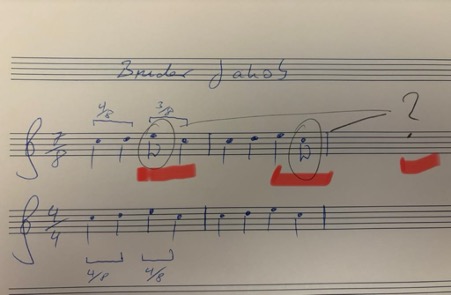
The song thus possesses a certain objectivity; it is independent of our spontaneous performance and our imagination. But it doesn’t possess this objectivity because it is written down somewhere. If you listen closely, you’ll notice that, firstly, the song is played in a 7/8 time signature instead of the usual 4/4 time signature, and secondly, that it is much more richly harmonized.
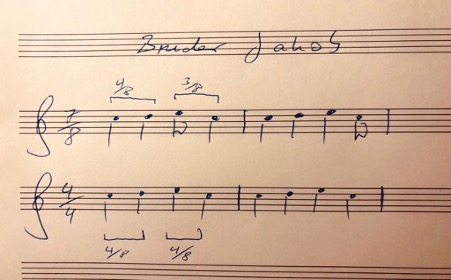
The relational object, however, is not a text; there is no physical object to which you could point. Nevertheless, it seems to be an objectively given point of reference. What establishes objectivity despite all the variance is therefore not the physicality of the object, but rather these two properties: repeatability and sharedness with others.*** Sharedness, or rather, repeatability by others, plays the crucial role here. Why? Because without social sharedness, I could not be corrected in my repetitions. Alone, I could mistake any nonsense for a repetition.
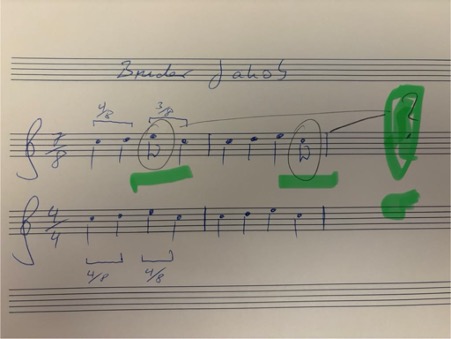
Only in agreement with others can there be anything like a correct or genuine repetition. (This is the consequence I draw from Wittgenstein’s private language argument.) Only when you affirm that the 7/8 version is also “Bruder Jakob” is it considered “Bruder Jakob.”

For precisely this reason, in singing as in reading, it is not the physicality, but the shared repetition, that is, the correct repetition, that establishes objectivity. What singing and reading have in common here is that they are embedded in a long history of social interaction.

Like reading, you may have first experienced singing by being sung to, by it being repeated, embodied, shared, and perhaps even ritualized. Just as you were initially read to repeatedly in typical situations: reading and listening were embodied, perhaps in bed with a book and pictures. Shared, that is, perhaps by your mother, your father, perhaps with other children. And perhaps as a bedtime ritual that has shaped your expectations and structured the evening. Singing, like reading, is inscribed within you as a ritual, so to speak. That’s how we learn it. Reading is embedded in these biographical narratives, not just in an abstract tradition.

In my opinion, it is precisely these factors, and especially repeatability and shared experience, that lend objectivity to what is read, objectivity to which the text, much like a song, ‘in itself,’ offers only a possibility.

So what does this analogy with singing offer us? Firstly, it clarifies how, with regard to the factors of objectivity—repeatability and shareability—we ascribe an objectivity to texts themselves, which we actually derive from their social embeddedness; unlike texts, songs don’t have any discernible objects. Secondly, it points us to crucial social sites and situations: if we want to seriously engage with reading, with the negotiation of meaning among readers, then we must go to the places where this actually happens. Accordingly, a philosophical engagement with an 18th-century text would require us to examine epistolary culture, salons, and, more generally, the establishment of conversation as a site of thought.**** While it is quite natural for many of us to have conversations about texts, this form, conversation itself, arose at some point and—this is one of my conclusions from my central thesis—plays a decisive role in the meaning and use of texts pertaining to certain genres. Alongside peer-review processes, conversation is a crucial space where, not least, philosophical reading culture takes place. Accordingly, you can locate the different interpretations of Wittgenstein in very different discussions or communities: the positivist interpretation in the Vienna Circle, the mystical one around Elisabeth Anscombe, the therapeutic one, for example, around Peter Hacker.

The basic idea is thus: The objectivity attributed to texts is an illusion, suggested by  properties of reading (actualizing affordances in the text) and projected back onto the text. Reading as a social practice is (like singing) repetitive and socially diverse. It is not the text, but social reading that creates objectivity.

As Suresh Canagarajah puts it: “Meaning has to be co-constructed through collaborative strategies, treating grammars and texts as affordances rather than containers of meaning. Interlocutors draw from other affordances, too, such as the setting, objects, gestures, and multisensory resources from the ecology. Thus, meaning does not reside in the grammars they bring to the encounter, but in the negotiated practice of aligning with each other in the context of diverse affordances for communication. In the global contact zone, interlocutors seek to understand the plurality of norms in a communicative situation and expand their repertoires, without assuming that they can rely solely on the knowledge or skills they bring with them to achieve communicative success.” This is precisely the point I am also trying to make: texts do not contain meanings, but rather offer affordances or possibilities.

4 The Consequences of the Illusion: The Degeneration of Objectivism into Mechanical Reading

If what has been said is true, then it is also possible that certain reading cultures will disappear or change. However, this does not necessarily mean that we will unlearn how to read, but perhaps only that the way we read and the places where meanings are negotiated can change. This is noticeable not only with regard to recent technologies, but also in everyday practice, especially in teaching. I believe, however, that the still widespread illusion that texts themselves are objective is leading to a degeneration in our reading culture. And here I come back to my initial observation that we might be living a scholar’s life with a chapter by Aristotle, while we spend only two hours on a student assignment.

This practice, which, incidentally, is also linked to increasing literacy, the so-called mass university, and the simultaneously stagnating number of lecturers, is initially perceived as stemming from external political pressure—and yet, it is increasingly becoming so entrenched that the guidelines for student text production—for instance, in the Netherlands and Great Britain—are themselves so schematic that one actually believes one can judge after 20 minutes of reading whether the requirements have been met. Such a mechanization of writing and reading is, of course, only justifiable if one believes that texts themselves are objective entities that are accordingly either good or bad. This mechanization is, incidentally, not a consequence of ChatGPT. Rather, it is the other way round: a reading culture that is changing in this direction consistently learns to use such technology.

From the Netherlands, I know that the mechanization of reading is already taking hold in elementary schools, where, from the very beginning, students are taught reading comprehension (begrijpend lezen) in order to test their knowledge of text structure in multiple-choice tests, and then people wonder why most young people have no interest in reading.

It seems that such uninspired role models lead to readers who, in turn, produce texts for exams that are hardly ever read. So why should anyone bother writing them themselves? Why bother reading them?

All of these are developments that, at least at universities, cannot be described independently of the introduction of New Public Management in the 1980s. (What good is it to tell a student to look at the text to understand it if there is hardly any interest in doing so outside of class? No, universities are not ivory towers; rather, cultural deserts have formed around them, in which we see primarily stakeholders instead of interpretive communities. But this criticism is nothing new and also a bit one-sided.)

Because, of course, there are places where the meaning of texts is still negotiated. We find them at literature and even philosophy festivals, on social media under #booktok, in often student-led reading groups, and, of course, in our teaching and research events. Here, reading is sometimes so explicitly social that it is actually performed. This, too, is not entirely new, of course. If we are interested in the foundations of reading, we have to go to these places. What is particularly interesting for our reading culture, I think, is that Large Language Models erode not only trust in the authenticity but also in the objectivity of texts. We are experiencing a massive desacralization of the text. Because unlike the divine authority presumed behind biblical texts, we now constantly suspect a deceptive demon. Accordingly, I believe that the academic rebellion against this desacralization is also a rebellion against the death of the illusion that texts themselves possess inherent quality. To name this desacralization does not mean falling for the grand promises of relevant AI product manufacturers. But we can also use this technology to sensitize ourselves to the fact that it is not the texts themselves, but our reading, our singing, our rituals that create meaning and make it something shared.

5 A Few Conclusions Regarding the Practice of Reading

What are the practical implications of these insights? How can we improve reading practices through such findings? Firstly, I would like to remind you that this research project on reading as a social practice is only just beginning. But if the meaning of texts in reading is essentially unlocked through the interactions between readers, then it helps not to stare at the text itself, but to always ask ourselves first: What do I expect from this text? What am I assuming it’s supposed to tell me? Is it supposed to provide me with an argument for something? What do I do if the text doesn’t meet my expectations? Should I humbly assume that I’m too stupid for it? That I don’t belong to the club of readers who say they understand or even love such texts? And why is this tome even on my desk or in my Adobe Reader?

Once you’ve confused yourself enough with these questions, you can actually look at the text and see what’s written there without immediately searching for “the argument”. People always say you shouldn’t just read, but read thoroughly: But what does “thoroughly” mean? Should I choose lots of colors to highlight the incomprehensible passages? Seriously: This instruction is about as helpful as telling you to concentrate. How do I do that? Stare into space and roll my eyes cleverly? – How do you even know when you’ve concentrated well enough? If you can say something that your conversation partner nods to politely in agreement? I can order from a menu, I can sound good with a poem, but what do I do with a philosophical text? When have I truly understood something? We can still only see this through conversation. – Is that enough, though?

Well, a fundamental insight that follows from these theoretical considerations regarding reading is that a philosophical text offers possibilities or affordances, and thus always different ways of reading it. It is a myth of completeness, particularly prevalent in analytic philosophy, that all implicit possibilities can simply be made explicit. Such completeness contradicts the necessary openness or underdetermination in texts. Think again of Wittgenstein’s famous quote. Another very memorable illustration of this is the duck-rabbit, which, in terms of possibility, remains precisely both. My project would therefore not be to reconstruct the one true argument, but rather to reveal different and potentially conflicting possibilities. Accordingly, one must accept that the text allows for various interpretations, which are only gained within different interpretive communities.

At this point, philosophers usually develop a typical fear of relativism. However, as Stanley Fish already noted, emphasizing possibilities is not about a relativistic position, but about plurality. Such plurality, however, by no means leads to arbitrariness. But what, then, are the limits to this space of possibilities? First, there are of course propositional limits: you cannot say that a text asserts non-p if it explicitly asserts p. Unless, of course, you perceive signs of irony. Here, the matter of limits becomes difficult again; and you will ultimately decide one way or the other. Furthermore, there are situation-specific conditions of appropriateness. If someone asks for directions to the train station, it’s not appropriate to respond, paraphrasing Robert Frost, by musing about less-traveled paths. Just as one shouldn’t sing Frère Jaques at an inaugural lecture or at a funeral. Or should one? Of course, we can break with conventions. For example, it’s entirely up to you whether you sing the song in 4/4 or 7/8 time signature, or even reharmonize it psychedelically with suspended chords. Convention gives you something to play with, or sing with.

Accordingly, Alva Noë makes a crucial point when he compares philosophical texts to scores for thinking, which can also be interpreted in very different ways:

“What the philosopher establishes in their labors are not truths or theses, but rather scores, scores for thinking with. … The philosophy lives for us like a musical score that we – students and colleagues, a community – can either play or refuse to play, or wish that we could figure out how to play, or, alternatively, wish that we could find a way to stop playing.”

I would simply add that, analogous to musical notation, philosophical texts can give rise to a multitude of interpretations. Here we don’t just have a single, obvious interpretation of a duck-rabbit, but a whole zoo with possible shifts in perspective.

Now, that may all sound very nice. But one mustn’t forget that interpretations aren’t chosen arbitrarily, but primarily with regard to social affiliation. If you choose an interpretation, you might belong to a club that’s currently out of fashion. The problem with my musings, then, is that they can be received in very different ways. Academics, in particular, fear reputational damage; therefore, they are very reluctant to admit their lack of understanding. “I don’t understand this text” usually is taken to mean something like, “The author is too stupid to explain it to me properly.” If, on the other hand, one can express genuine and sincere incomprehension, one has truly made progress. But such humility is something one has to be able to afford, so to speak. Therefore, it’s not enough to simply seek conversation; one must overcome one’s shame. You can’t learn to sing well if you’re too afraid of singing off-key.

But at some point, you can truly begin to name the difficult parts and ask yourself exactly where and why you’re stuck. Reflected confusion then becomes a genuine conversation starter. Because if a text offers the possibility of understanding it, it also offers the possibility of not understanding it.

____

* Thanks to Arnd Pollmann for pointing out this passage.

** I borrow this classification from Charlie Huenemann, but I forget in which of his posts it was introduced.

*** See on repetition in music and language Elizabeth Hellmuth Margulis’ On Repeat as well as Bente Oost’s vlog on this blog.

**** Thanks to Miriam Aiello for conversations on the topic of conversation.
Why should we encourage the study of canonical authors? Some reflections on the recent Collegium Spinozanum

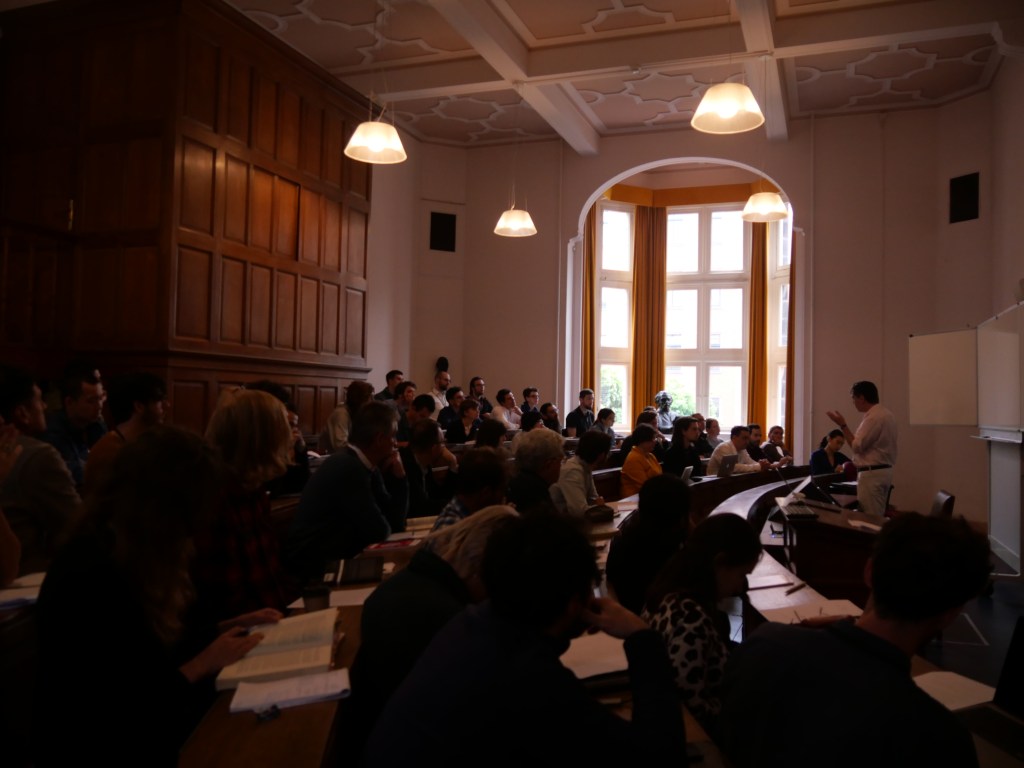
Had you asked me three weeks ago what historians of philosophy should focus on, I would have replied that there is too much focus on individual authors, be they canonical or underrepresented figures, and return instead, at least every now and then, to the question of how certain texts fare in debates or in relation to problems. However, that was three weeks ago. Last week, I co-organised and participated in a summer school on Spinoza, the fourth edition of the so-called Collegium Spinozanum. Having experienced this, I am all in favour of focusing not only on individual authors, but on canonical ones. The reason is not that the current diversification attempts are bad or wrongheaded. Rather, I see studying canonical authors as a means to an important end in its own right: building a (research) community. In what follows, I’d like to explain this in a bit more detail and also say some things about forms of interaction and support in academic contexts.

(Collegium Spinozanum IV – Photo: Irina Ciobanu)

Unacknowledged reasons for being canonical. – The case for or against studying canonical authors is often made for supposed greatness versus political reasons. Great authors, it is assumed, are deemed thus because they were “great thinkers” who still speak to our concerns. Underrepresented authors, by contrast, are taken to be either just “minor figures” or “unduly neglected greats”. There is much that can be said critically about such lines of reasoning, but what I’d like to stress now is that these reasons largely ignore the community of readers, i.e. the recipients. Focussing on reasons in the “object of study”, they obscure the point that a good part of the reasons for choosing such an object might lie in the recipients and their common interests. But arguably it’s these common interests that shape a real community, not the supposed “lacuna in the literature”. So when a number of people thinks that we should read Spinoza, this might not be triggered by Spinoza (alone) but by the fact that there is something that speaks to certain people at a certain slice of time. In any case, this was the feeling I had when listening to all the papers and conversations at our summer school: We form a real community in that we want to talk and understand each other – a feeling that was not just sustained through the week but also by frequent references of participants to earlier editions of the Collegium (see the FB page related to earlier events).

A common corpus and language for diversity. –  Given the diversity of interests (ranging from well-rehearsed arguments in Spinoza to seemingly remote theological questions, from detailed historical reconstructions to actually practised meditations), reciprocal understanding required and found a common corpus and language in Spinoza’s works. We were mostly about 60 people in the room, with quite different leanings, but everyone had at least read Spinoza’s Ethics and understood how parts were referenced. This point is by no means trivial when you’re part of a group composed of people from very different academic stages (ranging from professors near retirement to third-year BA students) and various geographical regions. All too often, the diversity of assumed expectations and backgrounds silences people and lets impostor syndrome run wild. If you’re at a conference on a historical topic rather than a fixed author, you’ll shut up almost everyone when you steer the discussion to some notoriously understudied authors or areas. “Oh, you haven’t heard of this anonymous treatise from 1200? It’s quite important.” A relatively small corpus, by contrast, does not only facilitate the conversation, it ensures that I’m going to learn many new things about texts that I thought I knew inside out. 

“Canonical” doesn’t mean “well-known”. – Let me return to this last point once more. The status of being a canonical author is often equated with the assumption that we know this author fairly well (and thus should enrich our historical picture by studying underrepresented figures). But this is only true insofar as we repeat canonical interpretations of canonical figures. Once we enter into new conversations and accept that what (at least partly) drives our questions is owing to the interests of the recipients rather than to “the object of study”, we can see why every generation must start anew or, in Sellars’ words, why “the probing of historical ideas with current conceptual tools” is “a task which should be undertaken each generation”. This point should not be underestimated. What we did during this recent summer school on Spinoza was having a vast number of philosophical conversations, trying to push the limits as far as we could see. We were talking mereology, necessity, demonology, intuitions, the evil, and at the same time wondering how Ricœur and Wittlich or we ourselves were faithful to Spinoza’s texts or whether Spinoza had lied to his landlady. In this sense, the reference to the canonical author does not reinforce canonicity, but works like crossroads and allows for striking out in all directions. 

Ultimately, the focus is not the author but the community of readers. – The diversity of backgrounds as well as that of approaches should make clear that, ultimately, the focus of conversations is often not the author but the facets afforded by the interaction of the community. So the point of focussing on an author, a canonical one at that, is not to adhere to the canon or trying to restate ‘the intention of the author’. The point is rather what the author affords to us: growing into a community of readers, a corpus accessible across the globe, a common language to converse about many things we might only begin to understand.  

Summary. – At the end of the collegium, I tried and failed to sum up what we achieved together. Instead, I could only quote a poem by Robert Frost that I wish to restate here:

The Secret Sits

We dance round in a ring and suppose,

But the Secret sits in the middle and knows.

(Collegium Spinozanum IV – Photo: Irina Ciobanu)

Local challenges for the summer school. – Since summer school participants do not have angelic properties, they do need all sorts of things, not least a place to sleep. At the time of the summer school, Groningen also hosted two concerts of an infamous German rock band, entailing that most available accommodation was booked out long in advance. Had it not been for our personal efforts and our colleagues from the university’s summer school office, Isidora Jurisic and Tatiana Spijk-Belanova, the summer school could not have provided accommodation for the participants. A lesson for the future is that a university town should probably balance its interests accordingly and take responsibility for leaving some resources for such events.

Thanks. – It doesn’t go without saying that this wonderful event wouldn’t have been possible without the participants, all attentive and present till the very last moment. In particular, I would like to thank my co-organiser, Irina Ciobanu, and the inventor of the whole affair, Andrea Sangiacomo, who ran the first three summer schools on Spinoza since 2015, as well as our keynote speakers who are, besides Andrea, Raphaële Andrault, Yitzhak Melamed, and Gábor Boros. Thanks also to the Groningen Faculty of Philosophy and to the German Spinoza-Gesellschaft for financial support.

Diversity in Philosophy. Martin Lenz in conversation with Catherine Newmark (podcast)

[Catherine Newmark kindly invited me for a conversation with the radio station Deutschlandfunk Kultur. Here is a link to the audio file and a brief summary in German.* Below you’ll find a rough translation of the summary.]

Diversity in Philosophy: Who is read, who belongs?

How diverse is philosophy? The canon is still dominated by European white men. The establishment is remarkably homogeneous in terms of gender, origin and class. There are solid reasons for this, says philosopher Martin Lenz.

Is the history of philosophy really just a collection of “dead white men”? For some years now, criticism has increasingly been voiced against the canon of texts that are authoritative for seminars, curricula and public debates: The perspective is much too narrow. Female thinkers and people of colour, for example, are not represented enough with their points of view. Non-European perspectives are ignored.

Competition for very few jobs

The diversity of those who do philosophy is not balanced either. In the workplace, it is still predominantly white men, mostly of European descent, who set the tone, is one reproach. Moreover, in the competition for the few positions at universities, it is mostly people with an educated middle-class background who come out on top, while applicants from other social classes are left behind.

The philosopher Martin Lenz, professor at the University of Groningen in the Netherlands, has himself had ambivalent experiences with classism in academia. In a short text for the blog “FirstGenPhilosophers – Philosophy in the First Generation” of the Free University of Berlin, he looks back on his educational path: how often he, whose parents did not study, was tempted to hide his origins, he says, he only realised in retrospect.

Reduction of equal opportunities

“When I studied, signs were pointing to permeability (Durchlässigkeit),” says Lenz. In the 1970s and 80s, there were “active attempts to attract people from all backgrounds to the university.” In the meantime, however, this development is being pushed back in the name of “elites”, “excellence” and competition. Today, the standard of “employability” is increasingly being applied internationally, i.e. the demand that studies must optimally prepare students for a specific profession, according to Lenz. The classical educational ideal is thus giving way more and more to a “training ideal”.

As far as the canon of philosophical texts and topics is concerned, Lenz observes that diversity in teaching itself is already quite advanced. For his students in Groningen, it is “now completely natural” to look beyond the horizon of Western philosophy. “They are growing up with the fact that philosophy is a global occurence,” says Lenz.

Too little incentive for discovery

The fact that the inclusion of new voices in the canon is progressing only very slowly, however, also has very practical reasons, Lenz emphasises. For example, established figures of the history of philosophy simply benefit from the fact that their texts are critically edited, translated, annotated and flanked by extensive secondary literature, i.e. they are easily accessible.

In order to edit and publish texts that have received little attention up to now, one needs strong qualifications, experience and a great deal of time. However, this important work is hardly rewarded in academia. No one earns permanent positions or professorships with it. Another factor in the cementing of the canon is the tendency towards conservative appointment procedures at universities.

“We choose our past”

The current debates on diversity at least show that a canon is never set in stone, says Lenz: “Our commemorative culture is not designed to be complete. We don’t try to think of everything, but we try to think of what we take to be important.” And the question of what we consider important is definitely subject to changing insights and interests, so in this sense we “choose our past”.

So if today, for example, we want to remember a thinker like David Hume not only as “a great philosopher”, but strive for a more differentiated view and “just also remember that this is someone who was involved in the slave trade, then that is also a choice of how we want to remember.”

______

* Here the audio file can be accessed directly:

Diversität in der Philosophie Wer wird gelesen, wer gehört dazu? (Deutschlndfunk Kultur)

Meditation in philosophy. A conversation with Andrea Sangiacomo (podcast)

Meditation in philosophy. A conversation with Andrea Sangiacomo (podcast)

This is the fourth installment of my still fairly new series Philosophical Chats. In this episode, I have a conversation with Andrea Sangiacomo who is an associate professor of philosophy at Groningen University. In this conversation, we focus on meditation both as part of philosophical traditions as well as an approach that might be a resourceful factor impacting (academic) philosophy, teaching and academic culture. While Cartesian and Buddhist ideas* form a continuous resource in the background of our discussion, here is a list of themes in case you look for something specific:

  • Introduction   0:00
  • Meditation and Descartes’ Meditations   2:20
  • The notion of experience – and objections against experience as a basis in philosophy   9:00
  • Meditation in teaching   21:14
  • Why aren’t we already using these insights in education?   37:00
  • How can we teach and learn effectively?   44:36
  • How can we guide and assess?   52:50
  • Where is this approach leading, also in terms of academic culture?   1:03:00

______

* The opening quotation is from Andrea’s blogpost What can we learn today from Descartes’ Meditations? Here is the passage: “Since last year, I appreciated the text of the Mediations as real meditation, namely, as a way of practicing a meditative kind of philosophy (for lack of better term), a philosophy more concerned with what it means to experience reality in this way or that way, rather than with what a certain set of propositions means.”

He has published four more posts on this topic on the blog of the Centre for Medieval and Early Modern Thought. They are:

What kind of thing is the canon?

“Our language can be seen as an ancient city: a maze of little streets and squares, of old and new houses, and of houses with additions from various periods; and this surrounded by a multitude of new boroughs with straight regular streets and uniform houses.” Ludwig Wittgenstein

Given the ever-increasing amount of initiatives on diversifying the canon, it is striking that one crucial question does not seem to be tackled much: What kind of thing is the canon?* While I have sketched my view on the function of the canon in an earlier post, I don’t really have found an answer either. I find this question crucial because it will tell us something about the fate and success indicators of the initiatives. What if it turns out that the canon is a kind of thing that cannot be altered? Or at least not in the way envisaged in the current projects? In what follows, I’d like to suggest that it’s crucial to see that, like a standard language, a canon has both a descriptive and prescriptive dimension.

Description and prescription. – Like in music or literature, the canon in the history of philosophy is a historical and normative entity. It has grown over a long time and is related to a larger set of norms and conventions interwoven with our habits and actions. Here, the canon is not just something adhered to; it’s a point of reference equally for those who wish to maintain it and those challenging it. If I write atonal rock music, I know that I do that against a canon of tonal music. My writing atonal music might be a challenge to the canon or might slowly be integrated. Both is possible. What’s crucial is that it’s not under my control whether my pieces alter the canon. The same might be said of the way we speak and write or even the way we build our cities. For me, the upshot is that the canon has at once a descriptive and prescriptive dimension. It tells us how things were and became. But it also tells us how things should be done. And whether your or my contributions figure in that is not for us to say.

The canon as a standard language. – Given the co-presence of descriptive and prescriptive aspects, the canon might be compared to a standard in a language, like Standard English as opposed to certain dialects. It is a historically grown entity as well as a set of rules determining what counts as “proper”. In this sense, we can compare canon diversification projects such as Extending New Narratives to attempts at ameliorating linguistic practices by suggesting different words or grammatical features so as to make underrepresented groups linguistically visible. The emphasis on more diverse and chosen pronouns, for instance, resembles the attempt to make minorities visible in the history of philosophy. Likewise, the political backlashes and difficulties are on a par with those in historiography. But just as language is only partially under our conscious control, the (philosophical) canon cannot be altered simply by adding so called “minor figures” to it. Adding expressions to the standard language does not mean that they will be used in conversation or seen as a (new) standard. But they may be. Who knows?

Can we change the past? – If canons are both descriptive and prescriptive, attempts at altering the canon are not only prescriptive and designed to nudge us into a different future practice of (history of) philosophy. They are also descriptive, and that means they describe the past in an altered way, for instance, by including hitherto underrepresented figures. For this reason, they are often met with the silly objection that they would distort or even erase history. The objection is silly because it identifies the challenged canon with the past or with history. But the canon is not the past. The canon is a way of approaching the past. And such a way is always guided by values and thus selective.

If this is correct, however, it means that attempts at diversifying the canon are not an attempt to give a more complete or accurate picture of the past. It rather means that we (want to) change how we approach the past and who or what we think counts as relevant. The goal of doing history of philosophy is not to present an accurate picture of the past, but to present an accurate picture of what we think matters for our present and future. If diversity matters for us, it also matters in our approach to the past. In this regard, it’s helpful to consider Wittgenstein’s likening of language to an ancient city. Like the philosophical past, the ever changing city has been there and yet is present in our life. But which precise places and streets we go to and build on is something that is up to us. It took a long time until, for instance, mosques in Berlin were not only found in backyards anymore but also in clearly visible places of town.

______

* That said, a number of questions have been tackled, especially in Lonneke Oostland’s recent MA thesis “Canon ‘Enrichment’ and the History of Philosophy”. Besides Lonneke, I’d like to thank Han Thomas Adriaenssen, Daria Drozdova, Martin Krohs, Laura Georgescu and Felipe Romero for intriguing conversations about the status of the canon.

The canon as a status symbol? White men, cancel culture, and the functions of history of philosophy

“I’m an avid reader of Locke.” “I love listening to Bach.” – Utterances like this often expose the canon – be it in philosophy, literature, music or other arts – as a status symbol. The specifics of our cultural capital might differ, but basically we might say that one man’s Mercedes Benz is another’s readership of Goethe. What is often overlooked is that challenging the canon can look equally status-driven: “Oh, that’s another dead white man.” “I’m so excited about Caroline Shaw’s work.” – Spoken in the pertinent in-group, utterances like this are just as much of an indication of status symbolism. Challenging the canon, then, can become as much of a worn trope as defending adherence to the traditional canon. Let me explain.

Functions of history. – For better or worse, the aims of our discipline are often portrayed in epistemic terms. We study history, we say, to understand or explain (the development of) ideas and events. And in doing that, we want to “get it right.” Arguably, the aim of getting it right obscures a whole set of quite different aims of history. I think more often than not, history is done to (politically) justify or even legitimise one’s position. Just as talk about ancestors justifies inheritance, talk about philosophical predecessors is often invoked to legitimise why it’s worth thinking about something along certain lines. Just asking a question on the fly is nothing, but continuing the tradition of inquiring about the criteria of knowledge does not only justify historical research; it also legitimises our current approaches. Seen this way, a historical canon legitimises one’s own interests. Likewise, the attack on a canonical figure can be seen as shaking such legitimacy, be it with regard to representative figures, topics or questions. Conversely, I might aim to adjust the canon to find and highlight the ancestry that legitimises a new field of study. This endeavour is not one of “getting it right” though.  Of course, we cannot change the past, but we can attempt to change the canon or what we admit to the canon so as to admit of ancestors in line with new ways of thinking. As I see it, these are well-founded motivations to study and/or alter the study of canonical figures. – However, while such motivations might well drive our choices in doing history, they can also deteriorate into something like mere status symbolism. Let’s look at a concrete example.

Three kinds of debates. – I recently read a piece about Locke on slavery, making the point that Locke’s involvement in the American context is far more problematic than recent research portrayed it to be.* The piece struck me as an interesting contribution to (1) the debate on Locke’s political ideas, but the title was jazzed up with the recommendation to leave “Locke in the dustbin of history”. Since the word “dustbin” doesn’t return in the text, I’m not sure whether the title reflects the author’s choice. Be that as it may, in contrast to the piece itself (which is part of a series of texts on Locke’s political position), the title firmly places it in (2) a larger public debate about the moral status of canonical philosophers such as Hume, Berkeley or Aristotle. I think both the more scholarly and the more public debates are important and intertwined in various ways. We can be interested in both how Locke thought about slavery and how we want to judge his involvement. Given what I said about the justifying function of history, it’s clear that we look at authors not only as ancestors. We also ask whether they do or do not support a line of thought we want to endorse. And if it turns out that Locke’s thought is compatible with advocating slavery, then we want to think again how we relate to Locke, in addition to studying again the pertinent documents. However, in addition to these two debates, there is (3) yet another debate about the question whether we should be having these debates at all. This is the debate about the so-called “cancel culture”. While some say we shouldn’t cancel philosophers like Locke, others challenge the omnipresence of the notorious old or dead white men. As I see it, this latter debate about cancellation is highly problematic insofar as its proponents often question the legitimacy of the former (scholarly) debates.

As I see it, debates (1) and (2) are scholarly debates about Locke’s position on slavery. (1) makes an internal case regarding Locke’s writings. (2) also zooms in on the contrast to current views on slavery. (3) however is a different debate altogether. Here, the question is mainly whether it is legitimate to invoke Locke as an ancestor or as part of a canon we want to identify with. The main problem I see, though, is that the title “Leave John Locke in the historical dustbin” makes the whole piece ambiguous between (2) and (3). Given the piece, I’d think this works on level (2), but given how people responded to it and can use it, it becomes a hit piece on level (3) whose only aim seems to be to write Locke out of the (legitimate) canon. But this ambiguity or continuity between the the two kinds of debate is disastrous for the discipline. While on levels (1) and (2) the question of how Locke relates to slavery is an open question, dependent on interpretations of empirical evidence, Locke’s moral failure is already taken for granted on level (3). Here, the use of the canonical figure Locke stops being historical. It reduces to political partisanship. Why? Because history is then taken to be something already known, rather than something to be studied.

The irony is that each group, the defenders as well as the challengers of the canonical figure, questions the moral legitimacy of what they suppose the other group does by making a similar move, that is by appealing to a status symbol that enjoys recognition in the pertinent in-group. One group shouts “Locke and Enlightenment”; the other group shouts “Locke and Racism”. Neither approach to history strikes me as historical. It deteriorates into a mere use of historical items as status symbols, providing shortcuts for political fights. All of this is perhaps not very suprprising. The problem is that such status symbolism undermines scholarly debates and threatens to reduce historical approaches to political partisanship. My point, then, is not that all political or moral discussion of history reduces to status symbolism. But there is the danger that historical scholarship can appear to be continuous with mere status symbolism.

______

* I’d like to thank Nick Denyer, Natalia Milopolsky, Naomi Osorio, Tzuchien Tho, Anna Tropia, and Markus Wild for insightful remarks or exchanges on this matter.

Are philosophical classics too difficult for students?

Say you would like to learn something about Kant, should you start by reading one of his books or rather get a good introduction to Kant? Personally, I think it’s good to start with primary texts, get confused, ask questions, and then look at the introductions to see some of your questions discussed. Why? Well, I guess it’s better to have a genuine question before looking for answers. However, even before the latest controversy on Twitter (amongst others between Zena Hitz and Kevin Zollman) took off, I have been confronted with quite different views. Taken as an opposition between extreme views, you could ask whether you want to make philosophy about ideas or people (and their writings). It’s probably inevitable that philosophy ends up being about both, but there is still the question of what we should prioritise.

Arguably, if you expose students to the difficult original texts, you might frighten them off. Thus, Kevin Zollman writes: “If I wanted someone to learn about Kant, I would not send them to read Kant first. Kant is a terrible writer, and is impossible for a novice to understand.” Accordingly, he argues that what should be prioritised is the ideas. In response Zena Hitz raises a different educational worry: “You’re telling young people (and others) that serious reading is not for them, but only for special experts.” Accordingly, she argues for prioritising the original texts. As Jef Delvaux shows in an extensive reflection, both views touch on deeper problems relating to epistemic justice. A crucial point in his discussion is that we never come purely or unprepared to a primary text anyway. So an emphasis on the primary literature might be prone to a sort of givenism about original texts.

I think that all sides have a point, but when it comes to students wanting to learn about historical texts, there is no way around looking at the original. Let me illustrate my point with a little analogy:

Imagine you want to study music and your main instrument is guitar. It is with great excitement that you attend courses on the music of Bach whom you adore. The first part is supposed to be on his organ works, but already the first day is a disappointment. Your instructor tells you that you shouldn’t listen to Bach’s organ pieces themselves, since they might be far too difficult. Instead you’re presented with a transcription for guitar. Well, that’s actually quite nice because this is indeed more accessible even if it sounds a bit odd. (Taken as an analogy to reading philosophy, this could be a translation of an original source.) But then you look at he sheets. What is this? “Well”, the instructor goes on, “I’ve reduced the accompaniment to the three basic chords. That makes it easier to reproduce it in the exam, too. And we’ll only look at the main melodic motif. In fact, let’s focus on the little motif around the tonic chord. So, if you can reproduce the C major arpeggio, that will be good enough. And it will be a good preparation for my master class on tonic chords in the pre-classic period.” Leaving this music school, you’ll never have listened to any Bach pieces, but you have wonderful three-chord transcriptions for guitar, and after your degree you can set out on writing three-chord pieces yourself. If only there were still people interested in Punk!

Of course, this is a bit hyperbolic. But the main point is that too much focus on cutting things to ‘student size’ will create an artificial entity that has no relation to anything outside the lecture hall. But while I thus agree with Zena Hitz that shunning the texts because of their difficulties sends all sorts of odd messages, I also think that this depends on the purpose at hand. If you want to learn about Kant, you should read Kant just like you should listen to Bach himself. But what if you’re not really interested in Kant, but in a sort of Kantianism under discussion in a current debate? In this case, the purpose is not to study Kant, but some concepts deriving from a certain tradition.  In this case, you might be more like a jazz player who is interested in building a vocabulary. Then you might be interested, for instance, in how Bach dealt with phrases over diminished chords and focus on this aspect first. Of course, philosophical education should comprise both a focus on texts and on ideas, but I’d prioritise them in accordance with different purposes.

That said, everything in philosophy is quite difficult. As I see it, a crucial point in teaching is to convey means to find out where exactly the difficulties lie and why they arise. That requires all sorts of texts, primary, secondary, tertiary etc.

Why using quotation marks doesn’t cancel racism or sexism. With a brief response to Agnes Callard

Would you show an ISIS video, depicting a brutal killing of hostages, to the survivor of their murders? Of if you prefer a linguistic medium: would you read Breivik’s Manifesto to a survivor of his massacre? – Asking these questions, I’m assuming that none of you would be inclined to endorse these items. That’s not the point. The question is why you would not present such items to a survivor or perhaps indeed to anyone. My hunch is that you would not want to hurt or harm your audience. Am I right? Well, if this is even remotely correct, why do so many people insist on continuing to present racist, sexist or other dehumanising expressions, such as the n-word, to others? And why do we decry the take-down of past authors as racists and sexists? Under the label of free speech, of all things? I shall suggest that this kind of insistence relies on what I call the quotation illusion and hope to show that this distinction doesn’t really work for this purpose.

Many people assume that there is a clear distinction between use and mention. When saying, “stop” has four letters, I’m not using the expression (to stop or alert you). Rather, I am merely mentioning the word to talk about it. Similarly, embedding a video or passages from a text into a context in which I talk about these items is not a straightforward use of them. I’m not endorsing what these things supposedly intend to express or achieve. Rather, I am embedding them in a context in which I might, for instance, talk about the effects of propaganda. It is often assumed that this kind of “going meta” or mentioning is categorically different from using expressions or endorsing statements. As I noted in an earlier post, if I use an insult or sincerely threaten people by verbal means, I act and cause harm. But if I consider a counterfactual possibility or quote someone’s words, my expressions are clearly detached from action. However, the relation to possible action is what contributes to making language meaningful in the first place. Even if I merely quote an insult, you still understand that quotation in virtue of understanding real insults. In other words, understanding such embeddings or mentions rides piggy-back on understanding straightforward uses.

If this is correct, then the difference between use and mention is not a categorical one but one of degrees. Thus, the idea that quotations are completely detached from what they express strikes me as illusory. Of course, we can and should study all kinds of expressions, also expressions of violence. But their mention or embedding should never be casual or justified by mere convention or tradition. If you considered showing that ISIS video, you would probably preface your act with a warning. – No? You’re against trigger warnings? So would you explain to your audience that you were just quoting or ask them to stop shunning our history? And would you perhaps preface your admonitions with a defense of free speech? – As I see it, embedded mentions of dehumanising expressions do carry some of the demeaning attitudes. So exposing others to them merely to make a point about free speech strikes me as verbal bullying. However, this doesn’t mean that we should stop quoting or mentioning problematic texts (or videos). It just means that prefacing such quotations with pertinent warnings is an act of basic courtesy, not coddling.

The upshot is that we cannot simply rely on a clear distinction between quotation and endorsement, or mention and use. But if this correct, then what about reading racist or sexist classics? As I have noted earlier, the point would not be to simply shun Aristotle or others for their bigotry. Rather, we should note their moral shortcomings as much as we should look into ours. For since we live in some continuity with our canon, we are to some degree complicit in their racism and sexism.

Yet instead of acknowledging our own involvement in our history, the treatment of problematic authors is often justified by claiming that we are able to detach ourselves from their involvement, usually by helping ourselves to the use-mention distinction. A recent and intriguing response to this challenge comes from Agnes Callard, who claims that we can treat someone like Aristotle as if he were an “alien”. We can detach ourselves, she claims, by interpreting his language “literally”, i.e. as a vehicle “purely for the contents of his belief” and as opposed to “messaging”, “situated within some kind of power struggle”. Taken this way, we can grasp his beliefs “without hostility”, and the benefits of reading come “without costs”. This isn’t exactly the use-mention distinction. Rather, it is the idea that we can entertain or consider ideas without involvement, force or attitude. In this sense, it is a variant of the quotation illusion: Even if I believe that your claims are false or unintelligible, I can quote you – without adding my own view. I can say that you said “it’s raining” without believing it. Of course I can also use an indirect quote or a paraphrase, a translation and so on. Based on this convenient feature of language, historians of philosophy (often including myself) fall prey to the illusion that they can present past ideas without imparting judgment. Does this work?

Personally, I doubt that the literal reading Callard suggests really works. Let me be clear: I don’t doubt that Callard is an enormously good scholar. Quite the contrary. But I’m not convinced that she does justice to the study that she and others are involved in when specifying it as a literal reading. Firstly, we don’t really hear Aristotle literally but mediated through various traditions, including quite modern ones, that partly even use his works to justify their bigoted views. Secondly, even if we could switch off Aristotle’s political attitudes and grasp his pure thoughts, without his hostility, I doubt that we could shun our own attitudes. Again, could you read Breivik’s Manifesto, ignoring Breivik’s actions, and merely grasp his thoughts? Of course, Aristotle is not Breivik. But if literal reading is possible for one, then why not for the other?

The upshot is: once I understand that a way of speaking is racist or sexist, I cannot unlearn this. If I know that ways of speaking hurt or harm others, I should refrain from speaking this way. If I have scholarly or other good reasons to quote such speech, I shouldn’t do so without a pertinent comment. But I agree with Callard’s conclusion: We shouldn’t simply “cancel” such speech or indeed their authors. Rather, we should engage with it, try and contextualise it properly. And also try and see the extent of our own involvement and complicity. The world is a messy place. So are language and history.

Two kinds of philosophy? A response to the “ex philosopher”

Arguably, there are at least two different kinds of philosophy: The first kind is what one might call a spiritual practice, building on exercises or forms of artistic expression and aiming at understanding oneself and others. The second kind is what one might call a theoretical endeavour, building on concepts and arguments and aiming at explaining the world. The first kind is often associated with traditions of mysticism, meditation and therapy; the second is related to theory-building, the formation of schools (scholasticism) and disciplines in the sciences (and humanities). If you open any of the so-called classics, you’ll find representations of both forms. Descartes’ Meditations offer you meditative exercises that you can try at home alongside a battery of arguments engaging with rival theories. Wittgenstein’s Tractatus closes with the mystical and the advice to shut up about the things that matter most after opening with an account of how language relates to the world. However, while both kinds are present in many philosophical works, only the second kind gets recognition in professional academic philosophy. In what follows, I’d like to suggest that this lopsided focus might undermine our discipline.

Although I think that these kinds of philosophy are ultimately intertwined, I’d like to begin by trying to make the difference more palpable. Let’s start with a contentious claim: I think that most people are drawn into philosophy by the first kind, that is, by the desire understand themselves, while academic philosophy trains people in the second kind, that is, in handling respectable theories. People enter philosophy with a first-person perspective and leave or become academics through mastering the third-person perspective. By the way, this is why most first-year students embrace subjectivism of all kinds and lecturers regularly profess to be “puzzled” by this. Such situations thrive on misunderstandings: for the most part, students don’t mean to endorse subjectivism as a theory; they simply and rightly think that perspective matters.* Now, this is perhaps all very obvious. But I do think that this transition from the one kind to the other kind could be made more transparent. The problem I see is not the transition itself, but the dismissal of the first kind of philosophy. As I noted earlier, the two kinds of philosophy require one another. We shouldn’t rip the Tractatus apart, to exclude either mysticism or the theory. Whether you are engaging in the first or second kind is more a matter of emphasis. However, interests in gatekeeping and unfounded convictions about what is and what isn’t philosophy often entail practices of exclusion, often with pernicious effects.

Such sentiments were stirred when I read the confessions of an ex philosopher that are currently making the rounds on social media. The piece struck many chords, quite different ones. I thought it was courageous and truthful as well as heart-breaking and enraging. Some have noted that the piece is perhaps more the complacent rant of someone who was never interested in philosophy and fellow philosophers to begin with. Others saw its value in highlighting what might be called a “phenomenology of failure” (as Dirk Koppelberg put it). These takes are not mutually exclusive. It’s not clear to me whether the author had the distinction between the two kinds of philosophy in mind, but it surely does invoke something along these lines:

“Philosophy has always been a very personal affair. Well, not always. When it stopped being a personal affair, it also stopped being enjoyable. It became a performance.

… Somewhat paradoxically, academia made me dumber, by ripening an intellectual passion I loved to engage with into a rotten performance act I had to dread, and that I hurried to wash out of my mind (impossible ambition) when clocking out. Until the clocking out became the norm. Now I honestly do not have insightful opinions about anything — not rarefied philosophical problems nor products nor popular culture nor current events.”

What the author describes is not merely the transition from one approach to another; it is transition plus denial. It’s the result of the professional academic telling off the first-year student for being overly enthusiastically committed to “subjectivism”. While we can sometimes observe this happening in the lecture hall, most of this denial happens within the same person, the supposed adult telling off themselves, that is, the playful child within. No doubt, sometimes such transition is necessary and called for. But the denial can easily kill the initial motivation. – That said, the author also writes that he has “never enjoyed doing philosophy.” It is at this point (and other similar ones) where I am torn between different readings, but according to the reading I am now proposing the “philosophy” he is talking about is a widespread type of academic philosophy.** What he is talking about, then, is that he never had an interest in a kind of philosophy that would deny the initial enthusiasm and turn it into a mere performance.

Now you might say that this is just the course of a (professionalised) life. But I doubt that we should go along with this dismissal too readily. Let me highlight two problems, unfounded gatekeeping and impoverished practices:

  • The gatekeeping has its most recognisable expression in the petulant question “Is this philosophy?” Of course, it depends on who is asking, but the fact that most texts from the mystic tradition or many decidedly literary expressions of philosophy are just ignored bears witness to the ubiquitous exclusion of certain philosophers. It certainly hit Hildegard of Bingen, parts of Nietzsche and bits of Wittgenstein. But if an exaggerated remark is in order, soon anything that doesn’t follow the current style of paper writing will be considered more or less “weird”. In this regard, the recent attempts at “diversifying the canon” often strike me as enraging. Why do we need to make a special case for re-introducing work that is perfectly fine? In any case, the upshot of dismissing the first kind of philosophy is that a lot of philosophy gets excluded, for unconvincing reasons.
  • You might think that such dismissal only concerns certain kinds of content or style. But in addition to excluding certain traditions of philosophy, there is a subtler sort of dismissal at work: As I see it, the denial of philosophy as a (spiritual) practice or a form of life (as Pierre Hadot put it) pushes personal involvement to the fringes. Arguably, this affects all kinds of philosophy. Let me give an example: Scepticism can be seen as a kind of method that allows us to question knowledge claims and eventually advances our knowledge. But it can also be seen as a personal mental state that affects our decisions. As I see it, the methodological approach is strongly continuous with, if not rooted in, the mental state. Of course, sometimes it is important to decouple the two, but a complete dismissal of the personal involvement cuts the method off from its various motivations. Arguably, the dismissal of philosophy as a spiritual (and also political) practice creates a fiction of philosophy. This fiction might be continuous with academic rankings and pseudo-meritocratic beliefs, but it is dissociated from the involvement that motivates all kinds of philosophical exchange.

In view of these problems, I think it is vital keep a balance between what I called two kinds but what is ultimately one encompassing practice. Otherwise we undermine what motivates people to philosophise in the first place.

____

* Liam Bright has a great post discussing the often lame counterarguments to subjectivism, making the point that I want to make in a different way by saying that the view is more substantial than it is commonly given credit for: “The objection [to subjectivism] imagines a kind of God’s-eye-perspective on truth and launches their attack from there, but the kind of person who is attracted to subjectivism (or for that matter relativism) is almost certainly the kind of person who is suspicious of the idea of such a God’s eye perspective. Seen from within, these objections simply lose their force, they don’t take seriously what the subjectivist is trying to do or say as a philosopher of truth.”

Eric Schliesser provides a brief discussion of Liam’s post, hitting the nail on the following head: “Liam’s post (which echoes the loveliest parts of Carnap’s program with a surprisingly Husserlian/Levinasian sensibility) opens the door to a much more humanistic understanding of philosophy. The very point of the enterprise would be to facilitate mutual understanding. From the philosophical analyst’s perspective the point of analysis or conceptual engineering, then, is not getting the concepts right (or to design them for ameliorative and feasible political programs), but to find ways to understand, or enter into, one’s interlocutor life world.”

** Relatedly, Ian James Kidd distinguishes between philosophy and the performative craft of academic philosophy in his post on “Being good at being good at philosophy”.

Love, crime, sincerity and normality. Or: sameness claims in history

How do the things mentioned in the title hang together? – Read on, then! Think about this well known illusion: You see a stick in the water; the stick seems to be bent. What can you do to check whether it is really bent? – Knowing that water influences visual perception, you can change the conditions: You take it out of the water and realise that it is straight. Taking it out also allows for confirmation through a different sense modality: Touching the stick, you can compare the visual impression with the tactile one. Checking sense modalities and/or conditions against one another establishes an agreement in judgment and thus objectivity. If you only had the visual impression of the stick in the water, you could not form an objective judgment. For all you knew, the stick would be bent.

Now, objectivity is nice to have. But it requires a crucial presupposition that we have not considered so far: that the different perceptions are perceptions of the same thing. Identity assumptions about perceptual objects come easily. But, in principle, they could be challenged: How do you know that what you touch really is the same thing as the one you feel? Normally, yes: normally, you don’t ask that question. You presuppose that it’s the same thing. Of course, you might theorise about a wicked friend exchanging the sticks when you aren’t looking, but this is not the issue now. We need that presupposition; otherwise our world would fall apart. Cutting a long story short, to ‘have’ our world we need at least two things, then: (1) agreement in our tacit judgments (about perceptions) and agreement with the judgments of others: So when someone says it’s raining that judgment should agree with our perceptual judgments: “it’s raining” must agree with the noise we hear of the drops hitting the rooftop and the drops we see hitting the window; (2) and we must presuppose that all these judgments concern the same thing: the rain.

Now all hell breaks loose when such judgments are consistently challenged. What is it I hear, if not the rain? What do you mean when you say “it’s raining”, if not that it’s raining? Are you talking figuratively? Are you not sincere? – One might begin to distrust the speaker or even one’s senses (or the speaker’s senses). It might turn out that the sameness was but a presupposition. (Oh, and what guided the comparison between touch and vision in the first place? How do I know what it feels like to touch a thing looking like ‘that’? Best wishes from Mr Molyneux …)

Presuppositions about sameness and challenging them: this provides great plots for stories about love, crime, sincerity and normality. I leave it to your imagination to fill in the gaps now. Assumptions about sameness figure in judgments about sincerity, about objects, persons, about perceptions, just about everything. (Could it turn out that the Morning Star is not the Evening Star, after all?) It’s clear that we need such assumptions if we don’t want to go loopy, and it’s palpable what might happen if they are not confirmed. Disagreement in judgment can hurt and upset us greatly.

No surprise then that we read philosophical texts with similar assumptions. If your colleague writes a text entitled “on consciousness” or “on justice” you make assumptions about these ideas. Are these assumptions confirmed when you pick up a translation: “De conscientia” or “Über Bewusstsein”? Hmmm, does the Latin match? Let’s see! What you look for, at least when your suspicion is raised, is confirmation about the topic: Does it match what you take consciousness to be? But hang on! Perhaps you should check your linguistic assumptions first? Is it a good translation?

What you try to track is sameness, by tracking agreement in judgments about different kinds of facts. Linguistic facts have to match. But also assumptions about the topic. Now a new problem emerges: It might be that the translation is a match, but that you genuinely disagree with your colleage about what consciousness is. Or it might be that you agree about consciousness, but that the translation is incorrect. – How are you going to find out which disagreement actually obtains? – You can ask your colleage: What do you mean by “conscientia”? She then tells you that she means that conscientia is given if p and q obtain. You might now disagree: I think consciousness obtains when p and r obtain. Now you have a disagreement about the criteria for consciousness. – Really? Perhaps you now have disagreement of what “consciousness” means or you have a disagreement of what “conscientia” means. How do you figure that out? Oh, look into a canonical book on consciousness! – Let’s assume it even notes certain disagreements: What are the disagreements about?

I guess the situation is not all that different when we read historical texts. Perhaps a bit worse actually. We just invoke some more ways of establishing sameness: the so-called context. What is context? Let’s say we invoke a bunch of other texts. So we look at “conscientia” in Descartes. Should we look at Augustine? Some contemporaries? At Dennett? At some scholastic authors? Paulus? The Bible? How do we determine which context is the right one for establishing sameness. And is consciousness even a thing? A natural kind about which sameness claims can be well established? – Oh, and was Descartes sincere when he introduced God in the Meditations?

Sometimes disagreements among historians and philosophers remind me of the question which interpretation of a piece of music is the proper one. There is a right answer: it’s whichever interpretation you’ve listened to first. Everything else will sound more or less off, different in any case. That’s where all your initial presuppositions were rooted. Is it the same piece as the later interpretations? Is it better? How? Why do I like it? How do I recognise it as the same or similar? And I need a second coffee now!

I reach to my cup and find the coffee in there lukewarm – is it really my coffee, or indeed coffee?

____

Whilst I’m at it: Many thanks to all the students in my course on methodology in the history of philosophy, conveniently called “Core Issues: Philosophy and Its Past”. The recent discussions were very intriguing again. And over the years, the participants in this course inspired a lot of ideas going into this blog.