Does reading involve texts? Reading as a reciprocal process between readers

It goes without saying that the title question is a bit of a provocation. Nevertheless, the point I want to make is that reading is first and foremost an interaction between readers and the ‘text itself’ comes second. It’s not just one of those weird hear-me-out appeals. Rather, I think that this insight should have repercussions on our practice of teaching and, perhaps, of reading.

Early Beginnings

Come to think of it, before you even learned to read, you probably have been read to! Be it by your parents or by mischievous siblings. At least I remember that, before I ever set eyes on a text myself, my mother used to read fairy tales to me, hoping I’d fall asleep. So my first encounters of reading were actually interactions, not so much with the text, but with the special reading voice of my mother. A reciprocal interaction: My mother would read; I would listen. My mother would stop; I would plead. Tell me, gentle reader, is my listening already a form of reading? I’m not sure. – Anyway. Likewise, learning to read at school involved first and foremost interactions with the teacher and the class. Here, however, the reciprocity would become slightly asymmetrical: I would not just try to make sense of the letters on the blackboard; I would be judged on my performance. I don’t remember much of it, but I still feel the excitement of internally gliding along with my inner voice trying to remember the alphabet correctly: A, B, C, D, E, F, G … H? I don’t actually remember whether we also had to learn to write the letters when learning to read them, but it feels like it must have been a related process. In any case, reading is taught through an interaction between teachers and pupils (and asymmetrically so), when actual texts are still a long way away.

Tacit Agreements in Reading

Let’s slowly move on to my claim then. My thesis is that at least a crucial part of reading consists in partly tacit and partly explicit interactions between readers. Why would this be so, though? Doesn’t reading mainly consist in grabbing a text and reading it? Well, before you actually pick up a text, you’ll be fed with assumptions about the genre. So you’ll know what to expect before you set eyes on the actual page or screen. If you enter a restaurant, for instance, the items on the menu won’t come across as strange poetry. Conversely, if you picked up a book from a poetry section, you wouldn’t take the text to offer a menu, even if there was talk of pizza and pasta on the page. And if you enter a philosophy class, you’ll of course expect to be offered philosophical texts. In any case, the habitually familiar settings already stir tacit expectations about the texts in question. I consider such settings tacit agreements between the reader and the provider of texts.  If you enter a restaurant, you’ll expect a menu. If you enter a literature course, you’ll expect a literary text (or at least one dealing with literature). Questions (mostly on genre) will be raised if these expectations are frustrated. At this point, the crucial stages of interaction are about seeing whether expectations of genre are met or frustrated.

The Topic of Texts

Philosophical and certain literarary texts often thrive on a certain openness or even ambiguities. Unlike manuals or menus their understanding is not exhausted by being able to act on their content; that is, to build the shelves or order the soup successfully. This means that it’s often an open question what’s going on or what the text is actually about. Deciding on the precise topic of a passage or paper or book is thus often a matter of debate. This can even be true of your very own texts. (Agnes Callard once gave a nice example of her book as an Ugly Duckling by reporting on how she started out thinking it was on the weakness of will when it later turned out that she was really talking about aspiration.) So even if we’re clear about the genre of a text, we might remain unsure about its topic. In such situations, we might recommend all sorts of scholarly remedies: such as looking into the text in question, comparing it with other texts or some such straightforward means. However, what I think is really doing a great part of the work is the interaction with other readers. This doesn’t mean that the text plays no part in it. But the attempts at settling the topic will crucially involve an attempt to reach agreement with other readers, be they alive or part of a tradition of reading texts in a certain way.

The Triangulation Thesis

This idea has its roots in Donald Davidson’s so-called triangulation argument: Understanding linguistic utterances or the beliefs of my interlocutor involves not just understanding what object these utterances are about. Rather I need to interact with my interlocutor to fix the object in question in the first place. Jeff Malpas puts this point as follows:

“Identifying the content of attitudes is a matter of identifying the objects of those attitudes, and, in the most basic cases, the objects of attitudes are identical with the causes of those same attitudes (as the cause of my belief that there is a bird outside my window is the bird outside my window). Identifying beliefs involves a process analogous to that of ‘triangulation’ (as employed in topographical surveying and in the fixing of location) whereby the position of an object (or some location or topographical feature) is determined by taking a line from each of two already known locations to the object in question – the intersection of the lines fixes the position of the object … Similarly, the objects of propositional attitudes are fixed by looking to find objects that are the common causes, and so the common objects, of the attitudes of two or more speakers who can observe and respond to one another’s behaviour.” (Italics mine)  

So while the object or Ding an sich is elusive, it’s being fixed in the interaction with the other. Similarly, I think that the topic of a text is elusive. Determining it requires triangulation with other readers. Once we admit that, we’ll see that becoming clear about our interlocutor’s assumptions and authorities as well as their relation to our own take on the text is a crucial element in reading.

***

Part of this idea has been presented at an interdisciplinary workshop on “Reziprozität” at the FernUniversität in Hagen. I’d like to thank Dorett Funcke for inviting me to present my musings at this occasion. Special thanks to Christian Grabau, Irina Gradinari, Irmtraud Hnilica, Tanja Moll, and Marija Weste for further discussions of this idea.
Why should we encourage the study of canonical authors? Some reflections on the recent Collegium Spinozanum

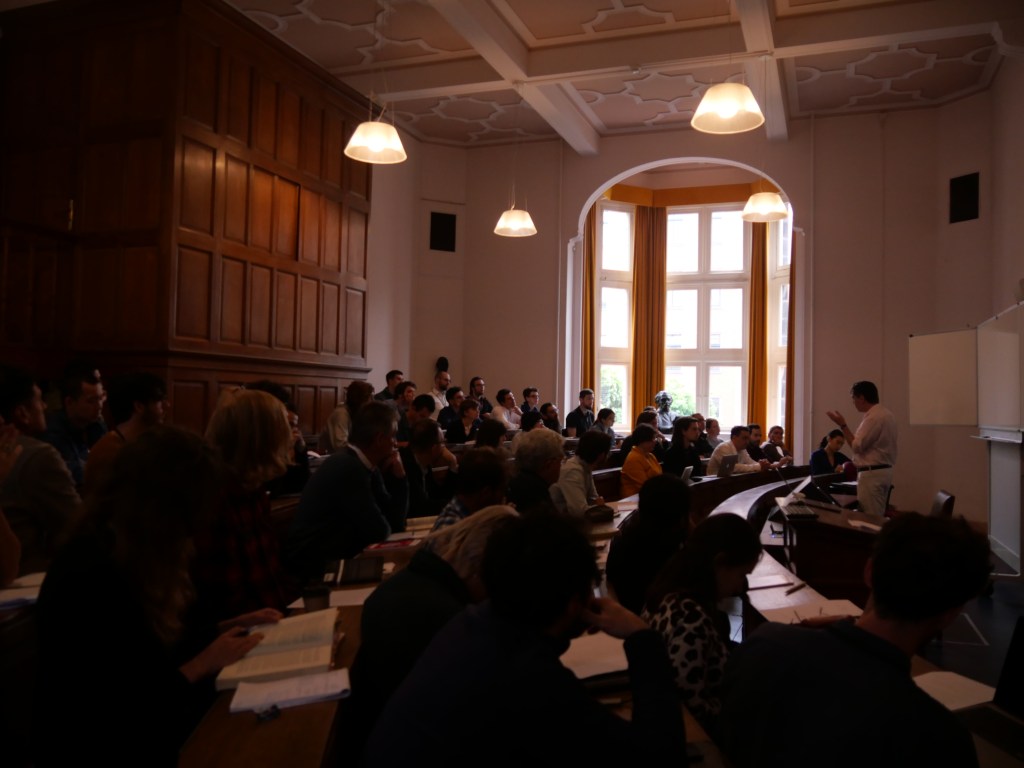
Had you asked me three weeks ago what historians of philosophy should focus on, I would have replied that there is too much focus on individual authors, be they canonical or underrepresented figures, and return instead, at least every now and then, to the question of how certain texts fare in debates or in relation to problems. However, that was three weeks ago. Last week, I co-organised and participated in a summer school on Spinoza, the fourth edition of the so-called Collegium Spinozanum. Having experienced this, I am all in favour of focusing not only on individual authors, but on canonical ones. The reason is not that the current diversification attempts are bad or wrongheaded. Rather, I see studying canonical authors as a means to an important end in its own right: building a (research) community. In what follows, I’d like to explain this in a bit more detail and also say some things about forms of interaction and support in academic contexts.

(Collegium Spinozanum IV – Photo: Irina Ciobanu)

Unacknowledged reasons for being canonical. – The case for or against studying canonical authors is often made for supposed greatness versus political reasons. Great authors, it is assumed, are deemed thus because they were “great thinkers” who still speak to our concerns. Underrepresented authors, by contrast, are taken to be either just “minor figures” or “unduly neglected greats”. There is much that can be said critically about such lines of reasoning, but what I’d like to stress now is that these reasons largely ignore the community of readers, i.e. the recipients. Focussing on reasons in the “object of study”, they obscure the point that a good part of the reasons for choosing such an object might lie in the recipients and their common interests. But arguably it’s these common interests that shape a real community, not the supposed “lacuna in the literature”. So when a number of people thinks that we should read Spinoza, this might not be triggered by Spinoza (alone) but by the fact that there is something that speaks to certain people at a certain slice of time. In any case, this was the feeling I had when listening to all the papers and conversations at our summer school: We form a real community in that we want to talk and understand each other – a feeling that was not just sustained through the week but also by frequent references of participants to earlier editions of the Collegium (see the FB page related to earlier events).

A common corpus and language for diversity. –  Given the diversity of interests (ranging from well-rehearsed arguments in Spinoza to seemingly remote theological questions, from detailed historical reconstructions to actually practised meditations), reciprocal understanding required and found a common corpus and language in Spinoza’s works. We were mostly about 60 people in the room, with quite different leanings, but everyone had at least read Spinoza’s Ethics and understood how parts were referenced. This point is by no means trivial when you’re part of a group composed of people from very different academic stages (ranging from professors near retirement to third-year BA students) and various geographical regions. All too often, the diversity of assumed expectations and backgrounds silences people and lets impostor syndrome run wild. If you’re at a conference on a historical topic rather than a fixed author, you’ll shut up almost everyone when you steer the discussion to some notoriously understudied authors or areas. “Oh, you haven’t heard of this anonymous treatise from 1200? It’s quite important.” A relatively small corpus, by contrast, does not only facilitate the conversation, it ensures that I’m going to learn many new things about texts that I thought I knew inside out. 

“Canonical” doesn’t mean “well-known”. – Let me return to this last point once more. The status of being a canonical author is often equated with the assumption that we know this author fairly well (and thus should enrich our historical picture by studying underrepresented figures). But this is only true insofar as we repeat canonical interpretations of canonical figures. Once we enter into new conversations and accept that what (at least partly) drives our questions is owing to the interests of the recipients rather than to “the object of study”, we can see why every generation must start anew or, in Sellars’ words, why “the probing of historical ideas with current conceptual tools” is “a task which should be undertaken each generation”. This point should not be underestimated. What we did during this recent summer school on Spinoza was having a vast number of philosophical conversations, trying to push the limits as far as we could see. We were talking mereology, necessity, demonology, intuitions, the evil, and at the same time wondering how Ricœur and Wittlich or we ourselves were faithful to Spinoza’s texts or whether Spinoza had lied to his landlady. In this sense, the reference to the canonical author does not reinforce canonicity, but works like crossroads and allows for striking out in all directions. 

Ultimately, the focus is not the author but the community of readers. – The diversity of backgrounds as well as that of approaches should make clear that, ultimately, the focus of conversations is often not the author but the facets afforded by the interaction of the community. So the point of focussing on an author, a canonical one at that, is not to adhere to the canon or trying to restate ‘the intention of the author’. The point is rather what the author affords to us: growing into a community of readers, a corpus accessible across the globe, a common language to converse about many things we might only begin to understand.  

Summary. – At the end of the collegium, I tried and failed to sum up what we achieved together. Instead, I could only quote a poem by Robert Frost that I wish to restate here:

The Secret Sits

We dance round in a ring and suppose,

But the Secret sits in the middle and knows.

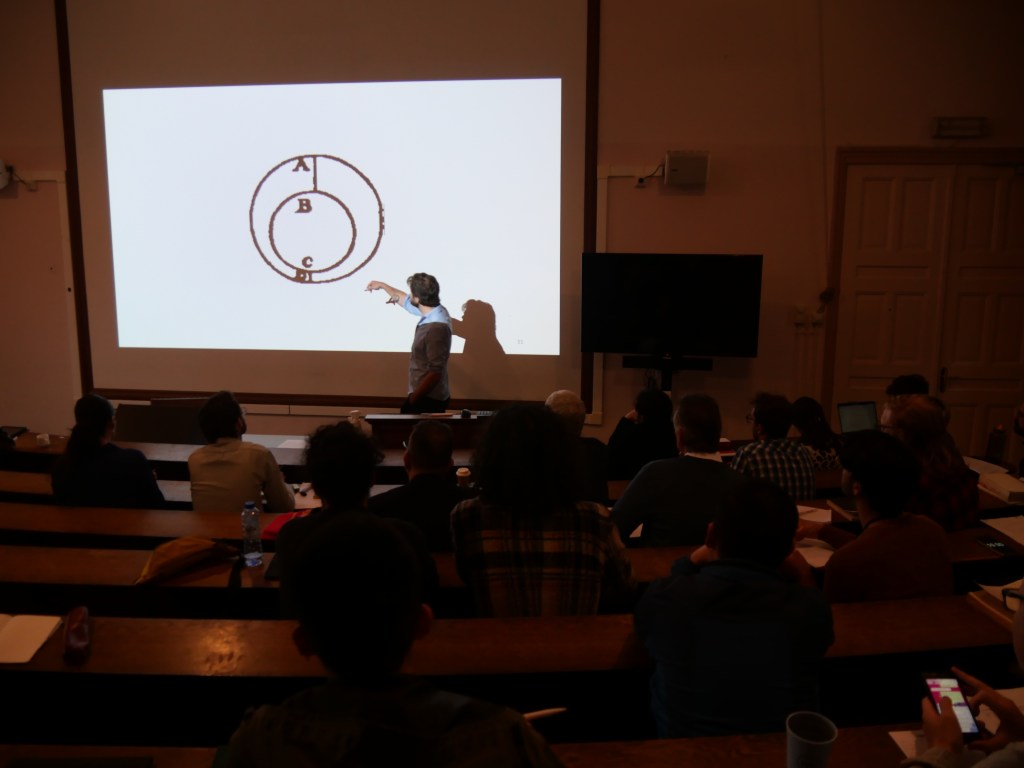
(Collegium Spinozanum IV – Photo: Irina Ciobanu)

Local challenges for the summer school. – Since summer school participants do not have angelic properties, they do need all sorts of things, not least a place to sleep. At the time of the summer school, Groningen also hosted two concerts of an infamous German rock band, entailing that most available accommodation was booked out long in advance. Had it not been for our personal efforts and our colleagues from the university’s summer school office, Isidora Jurisic and Tatiana Spijk-Belanova, the summer school could not have provided accommodation for the participants. A lesson for the future is that a university town should probably balance its interests accordingly and take responsibility for leaving some resources for such events.

Thanks. – It doesn’t go without saying that this wonderful event wouldn’t have been possible without the participants, all attentive and present till the very last moment. In particular, I would like to thank my co-organiser, Irina Ciobanu, and the inventor of the whole affair, Andrea Sangiacomo, who ran the first three summer schools on Spinoza since 2015, as well as our keynote speakers who are, besides Andrea, Raphaële Andrault, Yitzhak Melamed, and Gábor Boros. Thanks also to the Groningen Faculty of Philosophy and to the German Spinoza-Gesellschaft for financial support.

How can you ask and structure questions?

For the last four years or so I’ve tried to integrate exercises for asking questions in my courses. (Here is a blog post on my first attempt.) To my great surprise, students in my faculty now kindly selected my musings and instructions about questions as a “best practice in teaching and learning”, and my faculty nominated me for the pertinent award given by our university.

In what follows, I post a promotional video featuring one of my students* and myself as well as the text that I wrote for the award jury.

Structured Questions

If you ask students whether they have questions about any given text, you’re often met with embarrassed silence. It’s hard to admit that you’re confused. Although asking questions is a crucial activity, how to do this is hardly ever explained. By teaching to structure and analyse questions, I attempt to achieve five things:

  1. Countering embarrassment by suggesting that genuine questions require confusion;
  2. Showing how confusion generates the motivation of a question by having students spell out what (passage) precisely causes confusion;
  3. Showing that confusion is often the result of (frustrated) expectations as a reader;
  4. Detailing how to analyse such expectations as hidden theoretical assumptions;
  5. Having students estimate what possible answers might look like, e.g. by estimating how assumptions in the text differ from one’s own assumptions. 

While stimulating active learning, most steps can be achieved without requiring new information, but rather by developing an understanding of how one’s confusion arises. Accordingly, students are encouraged to enter into a dialogue with their own hidden assumptions and with others, for instance, by articulating how their background assumptions might differ. It is designed to stimulate self-directed learning and exchange as well as benefitting from seeing diversity in assumptions.

The technique of structured questions is an active learning device and was positively evaluated by students at my Faculty. I designed it to foster self-directed learning and interaction with texts and interlocutors. Being geared towards texts and discussions generally, it should be easily transferable to other disciplines. Here is some more information about it:

Questions are an ubiquitous genre in academic exchange. In the analysis of old philosophical texts, questions are a crucial guide in approaching material and in entering a dialogue about it.  As an instructor, I’ve often been surprised by how hard students find it to formulate questions themselves, even if they are good at giving answers. Discussions with students made me realise that the reason is only partly psychological (i.e. owing to embarrassment). Even in philosophy, it is hardly taught how to articulate genuine questions and what (partly tacit) components questions consist of.

I often teach and write (on my blog) about reading and writing texts. So I designed a format for asking structured questions about texts to foster an understanding about one’s own confusions and actually benefit from confusions.

Ideally, the question focuses on a brief passage from the text. It must be no longer than 500 words and contain the following components:

– Topic: say what the question is about (the passage or concepts that cause confusion);
– Question: state the actual question;
– Motivation: give a brief explanation why the question arises (use your assumptions or frustrated expectations);
– Answer: provide a brief anticipation of at least one possible answer (e.g. by guessing at the implicit assumptions in the text and how they might differ from yours).

What did I want to teach in designing this? My initial goal was to offer a way of engaging with all kinds of difficult texts. When doing so I assumed that understanding (a text) can be a general aim of asking questions. I often think of questions as a means of making contact with the text or interlocutor. For a genuine question brings two aspects together: on the one hand, there is your question, on the other hand, there is that particular bit of the text that you don’t understand or would like to hear more about.

In order to enter into dialogue, readers or interlocutors need to learn to consider questions such as: Why exactly am I confused? Could it be that my own expectations about the text send me astray? What am I expecting? What is it that the text doesn’t give me? Arguably, readers need to understand their confusion to make genuine contact with the text. One’s own confusion needs to be understood. The good news is: this often can be achieved without acquiring new information. Instead, bringing together one’s own expectations or assumptions with those of the text (or those of other readers) initiates a meeting of minds.

I began to implement this technique in autumn 2019 with first-year students and have since then introduced it in all my courses. While it was designed with medieval philosophical texts in mind, I realised that it can be used in various contexts and indeed both for approaching texts and discussions. What I didn’t anticipate was that it also seems to help in contexts of blended learning. Last year, I received a number of mails from students thanking me for how this technique had helped them to engage in self-study and prepare for exchanges in online contexts. Since it is geared towards articulating one’s confusion about texts in general, it should be easily adaptable to other disciplines.

________

* I’m very grateful the students of our faculty and in particular to Maddalena Fazzo Cusan who kindly agreed to speak on behalf of the faculty’s programme committee at the very last minute.

How to read (part nine). Being understood. A brief flashback of having my new book discussed

When I was fairly little, say 8 years old, I often walked around with the fantasy that, while I was going about my everyday life, my doing so would be screened and viewed as a film. At the time and for a long time afterwards I always thought that I was an “open book” to others. They could not only see what I did, they would also know what my motives were and what I thought. Overall, it was a pleasant fantasy. Thinking back now to the first author-meets-critics conference on my recent book Socializing Minds, it seems not only like a scholarly event with great critiques and discussions, but also like having my thoughts screened for everyone to see. In that sense, it was the most personal event that I ever attended in academia. At the same time, it also made very clear to me what it means to be understood as the author of a text. This is why I include the following musings in my series on how to read.

In a nutshell, being understood manifested itself in three dimensions:

  1. in terms of actual content: commentators gave an account of how (well) one thought in my book (might have) led to another;
  2. in terms of counterfactual ideas: commentators located what I wrote “in the space of reasons” by contrasting it with what one could (or should) have said instead;
  3. in terms of method or style by showing how the way of writing relates to their or other ways of seeing things and how it could be transferred to other contents.

Having so many good people devote so much time to your own book stirs all kinds of feelings. But going from my experiences with paper reviews, discussions of talks or responses to blog posts I am immensely surprised how wholly, how well and how deeply a book can be understood. All responses gave sophisticated mixtures of the three points mentioned, and it became clear to me that the readers often understood me better than I understand myself, especially by employing step (2) and confronting me with intriguing counterfactual ideas. In what follows, I don’t want to give an overview of the response pieces (that would require more proper work on my part). Rather, I would like to highlight some moments of how being understood manifested itself.

Discussions of intersubjectivity invoke both theoretical and practical perspectives. When Susan James opened with her paper on “Mixing Metaphysics, Language and Medicine with Politics” I immediately realised that I had written my book from a limited perspective: As Sue argued Locke’s rules of propriety of language are not merely semantic rules but presuppose political power relations. Eric Schliesser corroborated this point the next day by calling my approach a “de-politicalization”. Interestingly, for me the writing of the book meant the opposite, i.e. a politicization of theoretical topics like (social) intentionality, while for people also educated in political theory the story has different priorities. (Luckily, I didn’t come totally unprepared, as Eric had written three blog posts on the topic that I link to at the bottom of this post.) In this respect, it’s interesting to note that scholarship in history of political versus theoretical philosophy is still pretty much separated. As both Eric’s and Sue’s contributions show, these perspectives remain impoverished, if they are not brought to bear on one another. At the same time, they leave us with the question what has priority for Locke and others, the political or the theoretical issues.

When responding to earlier reviewers who pointed out that many more authors should be included in my study, I had said that I merely want to start a conversation (in the sense explained by Regina Rini). Picking up on my questions, Katarina Peixoto’s piece engaged straightforwardly with the problem of how minds can actually interact, that is, with what I call the contact problem. But rather than confining herself to the figures I treat in the book, she expanded the scope and discussed the problem in Elisabeth of Bohemia. In a similar vain, Yoen Quan-Laurent extended the discussion by invoking Blaise Pascal. Parallels with other historical figures are not only extending our knowledge of the field. Listening to Spyridon Tegos’ talk, I thought that part of my Hume chapter would fit the medical doctrines of Pierre Jean Georges Cabanis perhaps sometimes better than those of Hume. (Note to self: I must study Cabanis much more closely when writing on imitation as a form of interaction.) Seeing the set of issues I had raised for Spinoza, Locke, and Hume applied to other figures in unexpected ways made me think that something of my approach could be “carried over” and that the conversation could be extended further into the field.

As is perhaps well-known, at least some of my authors rely on God for a great part of what they attempt to explain. Now there is a worrying objection that, once you introduce God as an explanans, why not explain everything in reference to God? Kathryn Tabb spelled out this worry, amongst other objections, in her talk on “Divine Intersubjectivity” carefully recontextualising my claims and highlighting limits I might have overstepped in my book.*

Stephen Daniel pushed this line of objection to the extreme, considering the idea that, if you start out with the idea that we’re made in the image of God etc., the need for explaining intersubjectivity might not even arise. While such an objection might sound devastating, it is not or so I think. It shows what happens when one highlights different commitments of the authors in question. And as I see it, this back and forth also makes clear why interpretive disagreements (mostly) cannot be resolved by relying on textual evidence alone. We always approach texts bearing certain priorities in mind. In such dialogues they can be made explicit.

Especially my Hume chapter I wrote with the continuous worry that I might be wrong all the way down. Does Hume’s talk about medical issues reduce to something metaphorical? Tamás Demeter did not only organise the whole conference. While revealing himself as the kindest of hosts, he also took this worry very seriously, opening up an alternative reading that makes sense of a physiological approach like mine but showing a different line of reconstruction. Like Kathryn, Tamás provided an intriguing alternative reading of my story that acknowledges the interpretive challenges but differs in crucial details. Writing a book over many years doesn’t mean that you get rid of all the scars or ideas that sometimes feel somewhat over the top. Here, I felt clearly seen with respect to what I liked as much as with respect to the scars, some of which I’d sometimes rather hide from myself.

Speaking of productive critique, some people said that I might get off lightly with regard to my Spinoza chapter. But this is not true. It’s just that the papers focussing on Spinoza were of the creative sort rather than critical. Mateusz Janik approached the discussion of intersubjectivity by introducing memory as a way of being in the minds of others (even when one is dead). At the same time, he also made my reading of specific propositions visible as one among others and especially as one diverting from Spinoza’s mode of presentation, showing how Spinoza went one way and my book imagined another way. This way, Mateusz made me actually remember how I consciously chose – back then when writing – to divert from the path Spinoza set and move on in a different way.  Charles Wolfe did not just categorise my Spinoza interpretation in “a space of imagination”, but localised my whole approach in the space of philosophy. In a manner of speaking, Charles makes me (or my approach) feel at home in a space that I didn’t realise I properly belonged to. I would like to believe that he is right. If he is, I am no unrespectable part of the world:**

What does all of this teach me? While this conference certainly had the beauty of a once-in-a-lifetime-event, it does show me that we can be understood if we find diligent, friendly and ingenious readers. It leaves me with an optimism about being understood that I haven’t had for many years.

I would like to close this post by thanking all the participants of the conference and especially my partner Marija Weste, also for joining the event and for keeping me engaged in dialogue.

______

* Slide below taken from Kathryn Tabb’s presentation with permission.

** Picture taken from Charles Wolfe’s presentation with permission. – I couldn’t help alluding to this beautiful line from Ingeborg Bachmann’s Malina: “We, too, form an acceptable part of the world.”

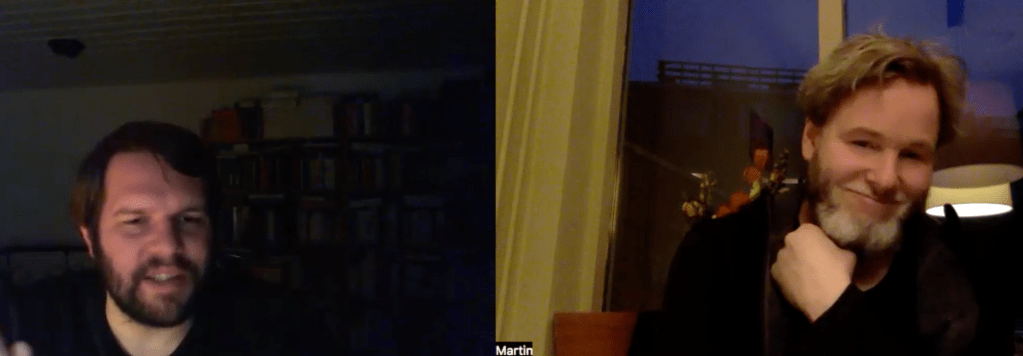
How to read (part seven). A conversation with Daniel-Pascal Zorn about reading philosophy and twitter (podcast)

This is the ninth installment (not the eighth!) of my series Philosophical Chats. In this episode, I have a conversation with Daniel-Pascal Zorn who is a Lecturer of Philosophy at Bergische Universität Wuppertal. In addition to his scholarly work in comparative philosophy, he wrote a number of books and pieces that found much recognition widely beyond the confines of professional philosophy.

In this conversation, we focus on reading practices in philosophy (from 01:33 onwards) and social media, especially twitter and Daniel’s “twitter persona” (from 1:05:54).

Crucial for our discussion is a distinction between to kinds of attention or concepts, namely concepts of content and operation, the latter being the means through which we express content. You can read more about Daniel’s approach and the distinction here. You can follow him on Twitter here.

__________

Notes:

* If you prefer to watch this conversation as a video, see below:

A conversation between Daniel-Pascal Zorn and Martin Lenz about reading philosophy and twitter

* Here is the video in which Adam Neely introduces the idea of musicking (as opposed to seeing music merely as rhythm, harmony and melody). I try to liken the distinction between music and musicking to the one between content and operation.

* Part one of my series “How to read” is here.

* Finally, here is the link to a piece on the understanding of history in analytic philosophy we co-authored.

How to read (part four). Accepting confusion as the rule and understanding as the exception

Now that we have looked at how to get started, at some malpractices that might get in the way, and at some effects of reading for writing, I finally want to begin to get to the heart of the matter, that is, to the text itself. Looking at the eager faces of my students, I think many of them usually want to do everything well and present very smart ideas about the text. I was no different, but the first thing that needs to be done is to establish a rough understanding of the text. How is that done, though? Let’s get down to business.

Accepting confusion as the default state of mind. – Reading philosophical texts, I generally assumed that I would not understand very much. Confusion was the rule; getting something was a rare exception. The most impressive experience of that sort I had when I translated my first text from William of Ockham’s Quodlibeta. The title suggested that it was on the problem of universals, but I didn’t understand a word of what I had translated. By contrast, my students commonly want to grasp how things hang together. So they often ask how this relates to that. I love those questions and the eagerness to spot the system behind the remarks. But I often have to admit that I am not sure what the system is or whether there is one. My point is not to discourage consistent thinking. However, systematic consistency is first of all an expectation, typical for contemporary readers. There is no guarantee that a historical text will meet that expectation or meet it in the way we expect. Lowering expectations of systematicity, then, is what I mean by accepting confusion as the default. When opening a book, we often simply don’t know what to expect. So it helps to accept confusion and looking for islands that (seem to) make sense, rather than to start out wanting to get everything and see dark passages as outliers. Accept that you will understand very little. If you want to rush to conclusions, that’s very understandable, but you’re going to be frustrated much of the time.

What is the text about? The hermeneutic circle. – The first question that you will need to answer is: What is the text about? Assuming that you don’t understand much at this point, you will have to make a guess. That guess is usually prompted by the islands of understanding, i.e. some details that make sense. Perhaps this is the title of the text, although Platonic dialogues will be frustrating in this regard. Or it will be some line in the beginning, with some familiar words and phrases. Or it might be simply that your instructor has set the text as an instance of a text about a particular topic. The point is that, at this point, you’ll be hooked by some detail and draw a conclusion about the general topic. The projection of of such a general topic works like a hypothesis, to be confirmed or frustrated by the next details you’re going to look at. In any case, the move from some detail to a general assumption about a topic and back to further details back to the general topic or a refined understanding of it is what is called the hermeneutic circle.

Approaching details. – Once you decided that a text is about a particular topic, you will begin to see the details as relating to that topic. If the genre allows for it, you should try and see which general conclusion the text argues for. Typically, a conclusion is introduced by words like “thus” or “therefore”. But sometimes it’s more hidden than that. Anyway, once you think that a text is designed to make such a claim, you will begin to see arguments as an (attempted) support of that claim. In other words, your general understanding guides how you see details. If something doesn’t make sense or is not in keeping with your assumed topic or conclusion, you must either figure out whether this is owing to a deviation like special use of terminology or you must refine your hypothesis about the claim or topic. When you hit on something like this, try to analyse exactly where your understanding breaks down: Is it about an unusual term or the unusual use of a term? Try to search for such uses online! Is it a whole sentence? Or the connection between sentences? Try to analyse the sentence or find a paraphrase! Is it a whole section? Try to figure out the function of the section or paragraph! Is the author speaking sincerely? There are a number of questions you can ask. What helps me most of the time is look at related or similar texts. Do they have the same kind of oddities? – Above all, remember that understanding a text as whole is the exception, not the rule.

Placing your own steps in the conversation. – Many people think of reading as receiving what the author says or, perhaps worse, as receiving information. That is never true. When you read and begin to think or stumble along silently, you will have (at least) two voices. You’ll hear the voice of the author and your own voice. Your tacit questions, your despair or impatience, your paraphrases, or your nodding and occasional disagreement are present throughout. Take it seriously! Reading is a dialogical act. And your mumblings are the voice that engages with the text, making it come alive and vice versa. Keep a record of what you find important or strange in the text. But also keep a record of what you think and feel. A passage makes you feel uneasy? Note it and try to figure out what exactly makes you feel this way. You find yourself nodding agreement all the time? Why? Are there reasons in the text? Does it speak to your sentiments? You find yourself lost? Note what it is and start a search. – If you’re supposed to discuss the reading and you find that this is too difficult, begin by offering your own responses to the text. They are just as good as the other voices to enter the conversation.

Here is part five of this series.

How to read. Some basics (part one)

It’s a commonplace among lecturers that students don’t know how to read anymore. The culprit is often found quickly: Social media and mobile phones are responsible for almost everything. I’m not sure about this, but I think that it might be a good thing to devote more attention to reading techniques. When I was a student, I was often told to read or even to read carefully. However, what no one really told me was how careful reading is actually done. The situation reminds me of a conversation with my colleague Andrea Sangiacomo, who remarked that we are often told to “concentrate”, but no one tells you how it’s actually done. Just sitting and staring at what you’re supposed to focus on probably isn’t concentration. It’s something one needs to learn and cultivate. The same goes for reading. Ask a fellow philosopher or philosophy student what they do. “I read much of the time”, they might reply. Ask them then how they do it. At this point I often merely get a “well, I just, well, read.” In what follows, I want to say a bit more about the basics of reading. Philosophers shouldn’t shy away from stating or thinking through the obvious. So I’m sure it’s going to be worth your time.

Getting comfy and preparing yourself. – It might seem obvious, but when you begin to read a text, say a primary text in philosophy or a paper, you should get comfy first. Pick a nice place where nothing disturbs or distracts you (too much) and get your text out. Experience teaches many of us that reading real printed texts rather than virtually on a computer file yields better results. But no matter which way you are going to read, make sure that you have some device to underline or highlight phrases and to take notes. I stress this because I see many students coming to class without their texts, let alone notes. While some people have an admirable memory of what they read, the point of highlighting phrases and taking notes is not just to memorise text chunks. Highlighting words or phrases makes you see connections that arguably remain obscure to you otherwise. In reading, we often focus on “the meaning”, but it is important to also see some material aspects of the text: the words and phrases, the way paragraphs are set etc. It gives you a sense of how terms reappear in the following sentence or section, how phrases are picked up again or rephrased in different words, how one sentence is (or isn’t) connected to the previous one and so on. (Frege, for instance, devised his formal notation system, the Begriffsschrift, to visualise logical relations that are salient but often unnoticed in common forms of writing.) After all, one simple way to grasp the topic or strategy of a text is to see which words come up most. Moreover, highlighting phrases or taking notes will draw you into a dialogue with the text. How’s that? Well, if you underline, for instance, you might underline words and then come back to wonder why you underlined those and not others. You notice and also begin to question what you find important in a text. So get out your pencil or the comment mode in your pdf! It’s of course also a way to make the text your own. Coming back after a couple of years and seeing what you highlighted back in the day will make you see your old copy and sometimes make you chuckle or wonder why you worried about that. Now if you forget to bring your annotated text with you in class, you cannot turn to these material connections when the text is discussed.

What are you reading anyway? – Now that you’re all set, it’s time to look at what you’re going to read. Isn’t that clear? The author and title of the text are on the jacket, no? So no worries there. – Far from it! If you pick up Nietzsche’s famous The Will to Power and think that it’s a book by Nietzsche you’re quite mistaken. The Will to Power was compiled from Nietzsche’s notebooks, put into order and attributed to Nietzsche by his sister Elisabeth Förster Nietzsche. Yes, Nietzsche had thought about this idea at length, but the book is fake. This is why it is crucial to consult not just any old version but the critical edition that has been carefully researched from the actual manuscripts. (Here is a brief account of critical editions of ancient texts, but such issues apply across the board.) If you don’t read German and thus cannot study the original, you should be aware that you are reading a translation. The enormously great work of translators often goes unacknowledged, but it should be seen, and seen for what it often is. A translation is not just “the same text” in a different language. It is a new text, developed on the basis of the original version. To get a feeling for this, you should try and paraphrase a bit of text. You’ll soon run into ambiguities or issues that require opinionated choices. Such choices silently come back to you when you read a translation, and there is often more than one translation. There can be whole different traditions of translations. Ideally, you compare different translations and pick central terms from the original to see how they are rendered in the various versions. In any case, you should pick a translation that is based on a reliable critical edition. – You might think that such issues apply mainly to historical texts, but that would be a mistake: Papers in modern or contemporary philosophy can also come in different versions and translations of course. What is more, the question of what you’re actually reading affords you a critical distance to the tendency of identifying a text with the author who purportedly wrote it. And note at least that even correctly attributed authors don’t always believe what they have published under their name …

Why are you reading? – Again, this question seems obvious. You’re reading because you’ve been assigned a text in one way or another. Perhaps you’re even reading for fun. But that’s not what I mean. Well before you begin to read, you will have expectations about what you’re going to encounter. These expectations can be fairly concrete and detailed if you know the author or have heard about the work in question. In any case, it helps to do two things now. (1) you should make your expectations clear to yourself, so that you notice when the text deviates from what you expect it to say. This tells you at once how the author might differ from what you assumed them to say and how you think about the matter. This is interesting because it is a real meeting of minds, a confrontation of your expectations and what the author says. You might then wonder what is responsible for this difference. (2) In any case, you should also make clear to yourself what you are looking for. Are you just exploring what the author has to say? Fine. But more often than not you’ll read with a (tacit) question in mind, like: What does the author say about X? Where X is (related to) the topic of the course you’re following. The more clear it is what you’re looking for, the easier it is to watch out for pertinent key terms or arguments, but also to differentiate what is currently important for you from digressions or sections that simply speak to other issues. Ideally, then, you watch out for your own expectations as well as for items that are unclear to you. What is important to note is that both (1) your expectations and (2) what you are looking for do not as such yield an interpretation of the text. But they will inform, often tacitly, what you highlight in your interpretation or understanding. So it’s good to get clear about these issues. However, don’t worry about this too much at the beginning. Reading, careful reading in particular, is a very slow process, not linear, but involving going back and forth many times, of trying and failing and trying again.

_______

Click here for part two of this series.

Philosophy, language, and my long road to tenure (podcast)

After one of my lectures on the history of philosophy for students from other faculties, Daniel Rebbin and Colm O’Fuarthain, two psychology students participating in the lecture, kindly invited me to a conversation on their Mental Minds Podcast.

So we talked about many things: for instance, about my approach to philosophy, the importance of being confused, language, dialogue, my way into academia, pretence, anxiety, and the meaning of life. Enjoy the conversation and check out their other podcasts. Below I added a rough table of contents (the times might not always be correct):

Contents:

00:00 Introduction              

01:40 Why should we study and how did I get into philosophy?                      

03:15 On confusion and expectations

10:10 Do we always focus on what people say rather than on phenomena?

12:36 Language as a mode of direct perception

15:31 Interaction through language

18:37 Limits of language, and how we share experiences

29:19 On going into academia and the relevance of philosophy for our lives

43:05 The role of luck, chance, and shame

52:34 Intrinsic motivation? – Adolescent wishes

56:30 What have professors gone through to become professors?

1:21:30 My anxiety disorder

1:30:40 What advice would I give my younger self?

1:42:00 What gives me meaning in life?

Are we really polarised? A conversation with Emma Young (podcast)

This is the sixth installment of my series Philosophical Chats. In this episode, I have a conversation with Emma Young who is a research master student in philosophy at Groningen University. We focus on the issue of (political) polarisation. While it seems common to portray public discourse as being polarised, we rarely find the assumption itself questioned or investigated as such. Here is a rough outline of topics:

  • Introduction 0:00
  • Is polarisation empirically discovered or an assumption structuring our perception? 5:58
  • Does the assumption of polarisation create a self-fulfilling prophecy? 9:30
  • First summary. And does polarisation obscure problems? 12:10
  • Division over corona policies as an example 15:50
  • How polarisation promotes the illusion of a (neutral) centre 23:00
  • How this illusion figures in history (of philosophy) 33:03
  • Interests in or beneficiaries of polarisation 45:02
  • Is polarisation irrational? 48:26
  • Does philosophy fail in overcoming polarisation? 52:28
  • How do we build solidarity? 1:07:04

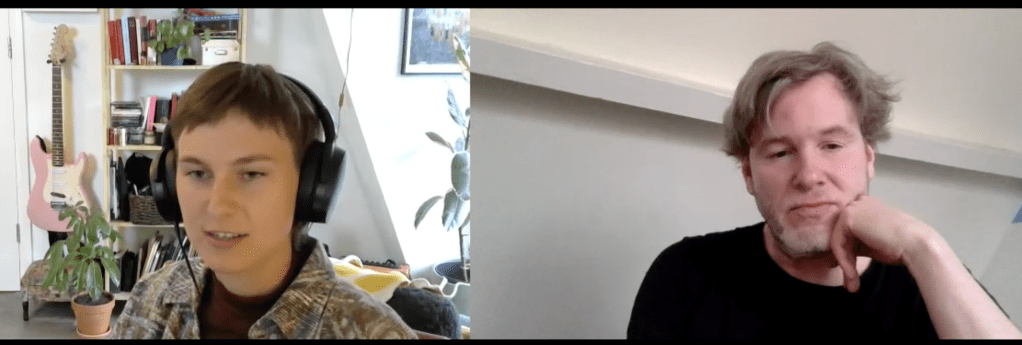
Writing philosophy and avoiding the delete button. A brief conversation about blogging with Anna Tropia (video)

Writing philosophy and avoiding the delete button. A brief conversation about blogging with Anna Tropia

This is the fifth installment of my series Philosophical Chats. In this episode, I have a conversation with Anna Tropia who is an assistant professor of philosophy at the University of Prague. Following up on some earlier musings, we focus on issues of writing (philosophy) as they figure in my blogging. Here is a rough table of contents:

  • Introduction and the focus of “Handling Ideas” 0:00
  • How can and why should we avoid the delete button? 2:17
  • Dare to say something wrong! A general tip on writing 6:53