How to read (part eleven): With texts against interpretations

A telling fact about human intelligence is that we can hold a lot of false beliefs and still survive or even live a jolly good life. For all I know, there are flat-earthers around whose beliefs don’t seem to interfere much with other beliefs. It’s telling because it raises the question of how much really depends on our knowing the truth (imagine the word capitalised). Much less spectacular but vital for philosophers and historians of philosophy, the same might be true for our understanding of texts.* Many of us might live with grand misinterpretations without ever noticing. (I, for one, lived with a mistaken understanding of what the term “proposition” means roughly until I wrote a paper about it. ) This fact triggers at least two responses: (1) A fair amount of people think that this sad state of affairs can be amended by proper reading which will eventually lead to a proper understanding. “I just read carefully and see what it says”, or something like that. (2) To this a more sceptically inclined colleague might respond: “Well yeah, but it’s all down to your interpretation.” These fairly common yet opposed responses give rise to two opposed myths about reading: The first is that the text simply contains what we can say about it. This kind of hermeneutical givenism is often met with what one might call interpretationism, that is, the idea that there is no text an sich but only interpretations. This opposition is frustrating because it polarises approaches that actually depend on one another. As I see it, the relation between them is not one of contrariety but of a dialectical swinging back and forth. Even if there is not one single correct understanding of a text, there are many false ones. If this is correct, we should exploit this fact for (becoming aware of) our practice of reading by looking for frictions between what we think we know and what the text presents us with. In what follows, I would like to share some ideas how to exploit such frictions. The crucial point is that a claim on what a given text is about should be refined in the course of confronting the actual text. You may start with the assumption that a text is about X. If you’ve done some proper work, you should find that the text is about Y. Here is how:

What are philosophical texts about? – Contrary to a widespread assumption, the answer to that question is normally not given in the text itself. Philosophical texts typically consist of arguments for a certain claim. That’s at least what should be true of our currently most common genre, the philosophical paper or essay. Thus, a good way to read those is to begin by identifying the conclusion that is argued for and then to look for the premisses supporting to the conclusion. How do you find the conclusion, though? What’s often overlooked is that this question is twofold. It has a textual or grammatical sense and a topical or disciplinary sense. In the textual sense, papers or passages often contain a line saying “the aim is to show”, an explicit statement with the defended view or a “therefore” (or “thus” or a similar word or phrase) introducing a conclusion. You should by all means look for such items when reading, but I suppose that the assumption of what a given text or passage is about is settled well in advance by what I call topical sense. Usually, you don’t just bump into a text wondering what it’s about. That question is normally settled by a a course instructor, secondary literature or a bibliography listing this text under a course title or keyword. In this sense, the conclusion is generally embedded in a topical network of a topic (the nature of the mind) as related to a discipline (like philosophy of mind), a common problem (how do mind and body interact), and a set of positions (say, dualism vs monism) on that problem. So even if you look for the conclusion in the text, it will be the topic suggested by the instructor or some other context that guides your search for the conclusion. I bet that if you were to list Cinderella in a syllabus for a consciousness course, people would start looking for the pertinent points in the text. What this comes down to is, again, twofold: On the one hand, a philosophical text is about (arguing for) a conclusion; and identifying the conclusion settles what you take the premisses to be. However, on the other hand, the conclusion is commonly assumed in advance, since the text is given to you in a topical context that suggests and constrains potential conclusions. If this is correct, it seems that prior interpretations (taken on authority) often settle what a text is about. Try reading Descartes’ Meditations as a text that is not in some sense about dualism and you’ll see what I mean. It’s not impossible, but many people will think you’re avoiding the elephant in the room.

Points of contact. – Guiding topical assumptions might seem problematic, but they are not. They belong to the way we receive the text. Rival interpretations often argue about the right topical context. They can be quite controversial and seem mutually exclusive. Just think of the Bible as a religious text as opposed to a historical document. Sometimes they seem more complementary. You can see the Bible as both a historical document and a religious foundation. The point is, then, not to avoid such contexts (and go for givenism), but to see what actually connects text and interpretations. In other words, you should look for points of contact. What are the interpretations arguing about and how do they relate to the text. Interpretations worth your time do not only argue about the proper topical context but do so by also pointing out a concrete term or passage in the text. This is the proper point of contact. Interpretations and related disagreement must have a clear textual basis.

Where are you now and what is next? – If you have found one or several points of contact, you can begin to see what the text is about – in keeping with various interpretations. Don’t downplay this! Figuring out a point of contact is an achievement going well beyond engaging with doxography or an individual interpretation. You could now write something about the state of the art. But note that, so far, you have not begun to work with the text as such. But how do you begin that and why should you bother? Many people won’t even delve into different interpretations but stick to a doxography telling them authoritatively what certain texts are about. Although doxographies initially derive from engagements with the text, they don’t make these engagments explicit. No one today will actually argue that Locke was an empiricist. Such interpretations are taken for granted, not in the sense that they are taken to be true, but in that they are taken to belong to an interpretive tradition. (In the same way, we wouldn’t call a map of Paris from 1250 or from 1950 false; although it still tells us something, we know that it’s outdated.) If you want to move on, you should know what you want. Do you actually want to read the text or do you want to pass an exam? Are you interested in a certain kind of philosophy or do you want to see how it was or is done, that is, written? As I like to put it, if you’re merely doing philosophy, it’s enough to get the hang of some interpretations. If you want to do history of philosophy, you have to engage with the text. But how?

Build up friction between the text and the interpretations. – Topical contextualisations or doxographies are often taken as a starting point, but they do obscure (earlier) failures of understanding. Students often don’t notice that they have mainly learned to project an interpretation into a text, rather than reading a text. So how do you move ahead? Start from your point of contact, but rather than taking an interpretation for granted, ask yourself what the term or passage in question is about. Begin by trying to explain the passage in virtue of the other parts of the same text. How? Explanations like “Locke is an empiricist” or “This passage contains Locke’s account of linguistic meaning”, for example, will commonly block actual reading. You’ll notice this when you ask for details in the text. Once people parse Locke’s famous claim that “Words in their primary and immediate Signification, stand for nothing, but the Ideas in the Mind of him that uses them …” with the assumption that Locke discusses meaning, they are likely to think that “signification” means “meaning”. Arguably, Locke’s text doesn’t offer any such account. So what do you do instead?

  • Provide an analysis of the content and style of the passage as such: explain (technical) terms, see how they hang together and get taken up. Look at logical operators and connections between sentences. See whether it contains arguments or explications of terms. See whether it contains examples. References to other authors or texts. See whether it contains metaphorical expressions. Ask yourself what work the metaphors do.
  • Make a strict distinction between the content and the function of a passage in the overall text. Does it function as an introduction or is it a refinement of something earlier? Is it a key passage in the text itself or part of a larger argument?
  • See whether the technical terms used are part of a common terminology. Study the terminology through dictionaries, handbooks or related texts.
  • Check the translation (if it is one) for consistency with regard to technical terms. Is it a use of terms that’s still common or now part of a different discipline?

Going through some of these considerations will quickly challenge the interpretive ideas. You will likely notice that a text, once you look at the whole, can be part of quite different topics or disciplines and also that the priorities provided in the text rarely match what is deemed relevant in current interpretations. As Jenny Ahworth has shown with regard to Locke’s notion of signification, sometimes a different understanding of one technical term can turn over whole traditions of reading a text. But even if you don’t intend to contribute original research, you’ll have made a first step to developing a solid and independent understanding.

____

* Here is part one of my series on how to read.
Reviving the commentary as a philosophical genre

When I was in my final school years and reading lots of Goethe, my German teacher recommended I read some commentaries by Erich Trunz. This was an amazing discovery: Trunz explained the texts on various levels and, above all, he left out none of the difficult passages that seemed impossible to grasp. When I began reading philosophy at Bochum university I found like-mined approaches, especially in medieval studies. But especially the so-called secondary literature on modern philosophy was often disappointing: True, the interpretations were often quite elegant, but they mostly bypassed the dark passages that clearly required a professional interpretation to make any sense whatsoever. The often fleeting remarks on Wittgenstein’s Tractatus and its numbering system, for instance, left me in despair. Was I not seeing the obvious or were the interpretations I consulted just not geared towards explaining the text? Only much later it dawned on me that the commentary was a philosophical genre in its own right and, outside more philologically inclined circles, a rather rare treat. These days, this is especially perplexing, given that the “diversification of the canon” requires reading unfamiliar material and thus a lot of detailed commentary. But apart from a couple of good examples (especially in classics and medieval studies), one can’t say that the commentary is exactly fashionable again. (See Barry Smith on the neglect of this genre.) Students are often entirely unfamiliar with the genre and sometimes seem to conflate it with what is known as an “opinion piece” in newspapers. After some sketchy remarks here and there, it is high time, then, to say more clearly why a revival of this genre is overdue.

So what is a commentary? – My rule of thump is that commentaries focus on explaining given texts, the linguistic forms of utterances themselves, rather than merely on ideas and arguments. Commentators do not solely attempt to say what a text is saying and what it means or has meant, but also why it is expressed in the way it is expessed. This means that the structure of the commentary follows the text and not the interpretive ideas or goals of the commentator. The beginning of a commentary is thus marked by a quotation of a word or passage from the text itself. Commentaries are often provided along with critical editions or translations of primary texts. They range from occasional annotations to “dark” passages or unfamiliar terminology to full-blown interpretations, giving background information on related texts or tracing unacknowledged sources. That said, a commentary can of course also be a part of a larger interpretation and typically occurs when a specific text passage or term forms the point of contact between different interpretations of a text. In fact, many introductions or guidebooks are commentaries in disguise. But besides critical editions of ancient and medieval texts, it’s mainly Wittgenstein’s work that seems to have invited the genre of commentary.

Why bother? – Do you know Beethoven’s 5th Symphony? Of course you do! Most people only know the opening theme, though. Secondary literature focussing on “central themes” is a bit like that. Arguably, you need a line-by-line commentary of Wittgenstein’s Tractatus to get beyond the famous Proposition 7 (see e.g. Duncan Richter’s commentary). The point is, then, that understanding a thought, argument or concept is different from understanding a text. But if philosophers care mainly about the former, why bother with the latter? Aren’t the essential ideas enough? Getting the “essentials” of the Tractatus, for instance, is like getting a Readers Digest or worse perhaps a cartoon version of it. Nothing wong with cartoons, you say. Of course not, but why bother with philosophical texts in the first place? But here is a more important point: It is often said that the text as such only really matters, if we consider it or the author an authority we want to defer to. Arguably, then, if we value independent thinking we can bypass the textual details. However, this gets things the wrong way round. For who tells you what “the main point” of a text is, if not an authority that you implicitly defer to? As I see it, then, the supposed “main points” are taken on mere authority and are in fact the outcome of earlier textual work of past generations. It is the detailed commentary that equips you with the material necessary for independent study and thought.

How to write a commentary? – Getting a glimpse of the scholarly work going into a commentary often makes the idea of writing such a thing overwhelming. But fear not, it’s doable. Especially these days with so many searchable resources at hand, you often don’t even need to travel. Here are a couple of preparatory moves, though, that might help you getting into the right frame of mind for beginning to write a commentary:

  • Pick and prepare a bit of text: Pick a text you like and find a bit tricky. Not too much: just a couple of lines. The text is your guide. So actually write it down. No, don’t copy it. Only if you actually write it, you will begin to see tricky bits. Write it down, number the sentences, underline words that you want to focus on, and highlight sections that you find tricky.
  • Think about the origin of the text: Make clear to yourself how the text made it onto your screen: Is it from an early print, a student or critical edition, a translation? Who edited it and when and why? Is the spelling in keeping with the original, is there something standardized? All these things tell you something about the material basis and politics involved in the text and might matter to what you actually find on the page.
  • Translation: If the text is in a foreign language, then try to translate it or write out a given translation beneath or beside it. If you don’t know the language, try to get at least keyterms. Check every keyterm and ask yourself whether you can think of a better alternative. Making a translation is the best way to see what you really don’t get. In my experience, many sentences begin to become unclear if you try translating or paraphrasing them.
  • Paraphrase: If the text is in your native or working language, try to make a paraphrase or transfer bits into formal language.
  • Variants: If you waver between different paraphrases, write down both or more. These are possible interpretations. If applicable: Have someone else make a paraphrase, too.

Now that you have a version of the text, you can begin with the actual commentary:

  • Start with a term you find central: Explain briefly why the term is central. Try saying how its centrality affects the rest of the passage you’ve picked. Say how the term relates to (modern or contemporary) cognates (similarities, differences). Say in what sense the term is part of a terminology.
  • Move on to a phrase you find difficult: Say what makes the phrase difficult for an imagined reader (even if it’s no longer dark for you): a certain grammatical feature, an unknown lexical meaning, unfamiliar terminology, strange wording etc. Now spell out some resources that help(ed you) figuring out what the phrase means: a grammar, dictionary, related texts that come with similar phrases.
  • Where does the idea expressed by the phrase come from? Hardly anything you find in a text is (entirely) original. This means that there is often something to be gained from asking genealogical questions: Where does this idea come from? Is it almost a quotation? Does the terminology perhaps just signal a slight shift of interest?

When writing your commentary, there are some obvious techniques to be used:

  • What if you can’t figure something out? Take the phrase and google it! Likely someone else has commented on it. Or something similar is in a different text that helps you figure it out.
  • Make connections within the text: Try to see whether the terms you commented on shed light on the dark phrases. Check logical connectives and see whether they are well used. Check for omissions, enthymemes, implicit assumptions etc. and write them down. Relate these notes to other parts of the same or a different text.
  • Think of audiences: Who will understand thee text better with your comments. Will it help students, people new to the material or fellow specialists? Try too gear your comments to one of those audiences. Ideally begin with students who had no exposure to the material.
  • Contextualise your priorities: Even if you try focussing on “the text as such”, your interests and what you find worth commenting on will be in keeping with certain interpretive traditions. Make them clear to yourself and use them for deciding how to move forward.

It goes without saying that there are many other factors that you could take into account, but if you follow at least some of these stepts, you’ll end up with a bit of commentary on a bit of text that might present you with a way forward or a spark for doing something else with it. Perhaps you’ll extend it, move on to another text or integrate it in an interpretation. I for one will begin to make the commentary a decisive part of writing exercises for students. My hope is that we might write more commentaries in the future. In the meantime, I’d love to hear your thoughts, suggestions or about your favourite commentaries.*

_______

* Thanks to Susanne Bobzien, Nicholas Denyer, Michael Kremer, and Michael Walschots for some first suggestions.

Love as imitation. A note on the role of love in academic teaching and learning

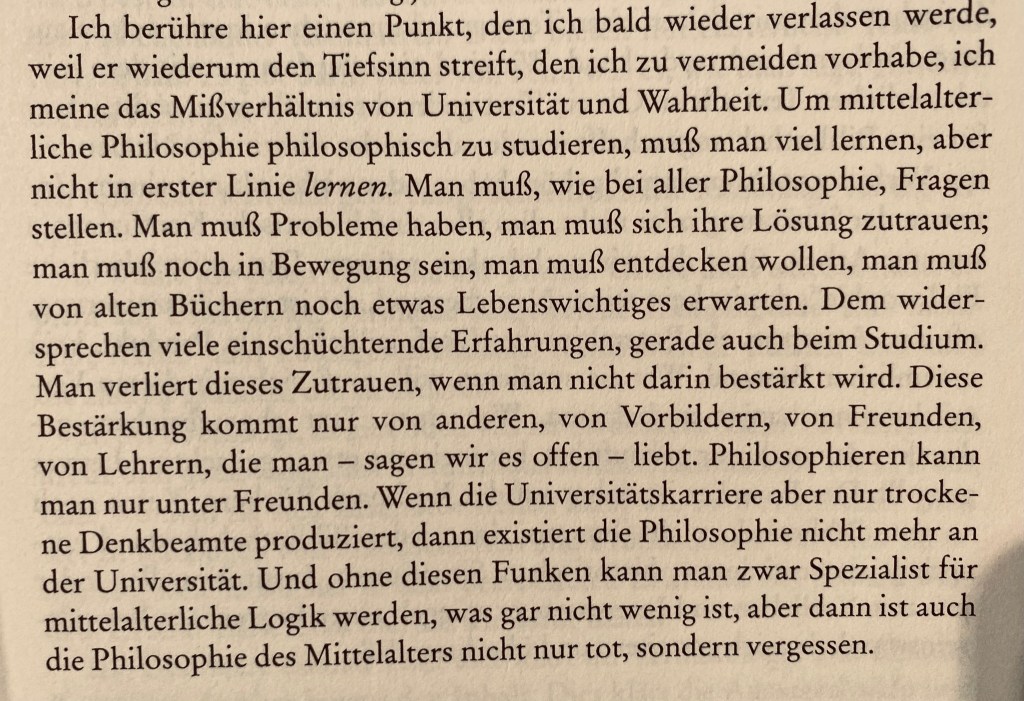
“I am touching on a point that I’ll soon leave behind again, since it relates to the profoundness that I intend to bypass, I mean the disparity between university and truth. To study medieval philosophy in a philosophical way one has to learn a lot, but one should not prioritise learning. As with any kind of philosophy, one has to ask questions. One has to have problems; one has to have confidence in being able to solve them; one still has to be on the move, wishing to make discoveries, wishing to learn something of vital importance from old books. This is countered by many intimidating experiences, especially during one’s studies. One loses this confidence if one is not encouraged. This encouragement comes only from others, from role models, from friends, from teachers whom one – let’s be frank – loves. Only among friends can one do philosophy. But if university career paths merely produce sober thinking clerks (Denkbeamte), then philosophy does no longer exist at universities. And without this spark you might still become a specialist in medieval logic – which is no small endeavour – but then medieval philosophy is not just dead but forgotten, too.”

Kurt Flasch, Historische Philosophie, 2003*

In times of increasing worries about ChatGPT and education systems more generally it’s soothing and inspiring to re-read some of the works of my teacher Kurt Flasch. Neither he nor my PhD supervisors Burkhard Mojsisch and Gert König were very good at preparing me for a career on the international job market, but they surely inspired some resilience against its crushing mechanisms. Re-reading the passage I translated above made me think about love of teachers again. Not in the recently well-rehearsed sense of academic ‘metoo stories’, but in the sense of what I’d like to call love as imitation. I know there are a lot more topics in the offing, but the idea of love in academia is, as far as I can see, perhaps the least understood.

So what does it mean to love a teacher? – Quite simply, to love one’s teacher means wanting to be like them. While it might involve interacting with them on some level, the crucial aspect is wanting to become like them, and that means, for instance, approach problems like them; speak, sound and listen like them; read like them or perhaps even enter into the form of life displayed by them – in one word: imitate them. (As I have argued earlier, love is, amongst other things, the ability and desire to understand another person. A strong way of understanding the other, then, is imitating them.) When I was a student, I had a couple of professors I really loved in that sense. I ended up following their courses, not primarily because I was into the topic all too much, but because I thought that, whatever they would teach, I would be learning something worthwhile. But how do you learn, how does that kind of love play out? While I was (back then) completely unaware what that meant, I just attempted to imitate them. This was quite palpable to me. When I wanted to pursue a certain (stylistic) approach, I would simply hear and try to imitate their voice in or their style when writing. – You might find this strange, but that’s probably what’s going on when we learn to find our voice in any kind of art, be it playing music, trying to paint or draw, or trying to speak and write.

Shouldn’t we aim at independence? – I guess the reason why imitation is so underrated in teaching is that we’re told to value independence. This is a fair point, but there are two issues that should be considered in response: Firstly, there is no independence without belonging. We’re not monads but always relating to a form of life and style that allows us (and others) to recognise that we’re engaging in the kind of practice we wish to engage in. How do I know I’m playing music if there is no one I’m relating to in my musicianship? Secondly, when we imitate we are never perfect imitators or impersonators – we end up appropriating and making things our own. So when I imitate my favourite teacher, you won’t hear Kurt Flasch but – willy nilly – an appropriation of his approach. In fact, the initial enthusiasm for pursuing something is fostered most by imitating a role model, be it a musician, an actor or a philosophy professor. In doing so, we might begin by rehearsing the things – half understood – we value most. After a while, though, we’ll find them pervading what we take to be our own voice.

Where to go from here? – Being a teacher myself, I think I should be aware of the facts surrounding the imitative ways of learning. After all, students don’t do as we say but imitate what we do. So if we act mainly as competitors on “the market”, students will see and imitate us in this respect. If we’re policing them as potentially fraudulent users of ChatGPT, they might follow suit. But what if we were to follow through with the idea that the best kind of philosophy develops in a community of friends?

_____

* Kurt Flasch, Historische Philosophie, 2003, S. 67:

Why should we encourage the study of canonical authors? Some reflections on the recent Collegium Spinozanum

Had you asked me three weeks ago what historians of philosophy should focus on, I would have replied that there is too much focus on individual authors, be they canonical or underrepresented figures, and return instead, at least every now and then, to the question of how certain texts fare in debates or in relation to problems. However, that was three weeks ago. Last week, I co-organised and participated in a summer school on Spinoza, the fourth edition of the so-called Collegium Spinozanum. Having experienced this, I am all in favour of focusing not only on individual authors, but on canonical ones. The reason is not that the current diversification attempts are bad or wrongheaded. Rather, I see studying canonical authors as a means to an important end in its own right: building a (research) community. In what follows, I’d like to explain this in a bit more detail and also say some things about forms of interaction and support in academic contexts.

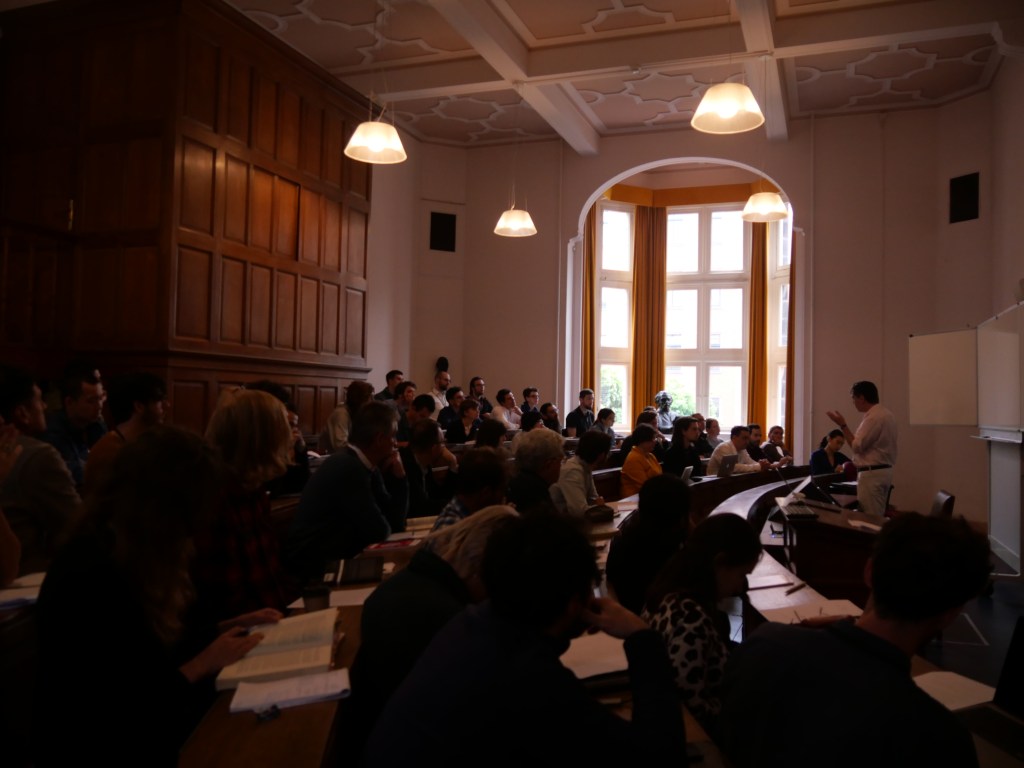
(Collegium Spinozanum IV – Photo: Irina Ciobanu)

Unacknowledged reasons for being canonical. – The case for or against studying canonical authors is often made for supposed greatness versus political reasons. Great authors, it is assumed, are deemed thus because they were “great thinkers” who still speak to our concerns. Underrepresented authors, by contrast, are taken to be either just “minor figures” or “unduly neglected greats”. There is much that can be said critically about such lines of reasoning, but what I’d like to stress now is that these reasons largely ignore the community of readers, i.e. the recipients. Focussing on reasons in the “object of study”, they obscure the point that a good part of the reasons for choosing such an object might lie in the recipients and their common interests. But arguably it’s these common interests that shape a real community, not the supposed “lacuna in the literature”. So when a number of people thinks that we should read Spinoza, this might not be triggered by Spinoza (alone) but by the fact that there is something that speaks to certain people at a certain slice of time. In any case, this was the feeling I had when listening to all the papers and conversations at our summer school: We form a real community in that we want to talk and understand each other – a feeling that was not just sustained through the week but also by frequent references of participants to earlier editions of the Collegium (see the FB page related to earlier events).

A common corpus and language for diversity. –  Given the diversity of interests (ranging from well-rehearsed arguments in Spinoza to seemingly remote theological questions, from detailed historical reconstructions to actually practised meditations), reciprocal understanding required and found a common corpus and language in Spinoza’s works. We were mostly about 60 people in the room, with quite different leanings, but everyone had at least read Spinoza’s Ethics and understood how parts were referenced. This point is by no means trivial when you’re part of a group composed of people from very different academic stages (ranging from professors near retirement to third-year BA students) and various geographical regions. All too often, the diversity of assumed expectations and backgrounds silences people and lets impostor syndrome run wild. If you’re at a conference on a historical topic rather than a fixed author, you’ll shut up almost everyone when you steer the discussion to some notoriously understudied authors or areas. “Oh, you haven’t heard of this anonymous treatise from 1200? It’s quite important.” A relatively small corpus, by contrast, does not only facilitate the conversation, it ensures that I’m going to learn many new things about texts that I thought I knew inside out. 

“Canonical” doesn’t mean “well-known”. – Let me return to this last point once more. The status of being a canonical author is often equated with the assumption that we know this author fairly well (and thus should enrich our historical picture by studying underrepresented figures). But this is only true insofar as we repeat canonical interpretations of canonical figures. Once we enter into new conversations and accept that what (at least partly) drives our questions is owing to the interests of the recipients rather than to “the object of study”, we can see why every generation must start anew or, in Sellars’ words, why “the probing of historical ideas with current conceptual tools” is “a task which should be undertaken each generation”. This point should not be underestimated. What we did during this recent summer school on Spinoza was having a vast number of philosophical conversations, trying to push the limits as far as we could see. We were talking mereology, necessity, demonology, intuitions, the evil, and at the same time wondering how Ricœur and Wittlich or we ourselves were faithful to Spinoza’s texts or whether Spinoza had lied to his landlady. In this sense, the reference to the canonical author does not reinforce canonicity, but works like crossroads and allows for striking out in all directions. 

Ultimately, the focus is not the author but the community of readers. – The diversity of backgrounds as well as that of approaches should make clear that, ultimately, the focus of conversations is often not the author but the facets afforded by the interaction of the community. So the point of focussing on an author, a canonical one at that, is not to adhere to the canon or trying to restate ‘the intention of the author’. The point is rather what the author affords to us: growing into a community of readers, a corpus accessible across the globe, a common language to converse about many things we might only begin to understand.  

Summary. – At the end of the collegium, I tried and failed to sum up what we achieved together. Instead, I could only quote a poem by Robert Frost that I wish to restate here:

The Secret Sits

We dance round in a ring and suppose,

But the Secret sits in the middle and knows.

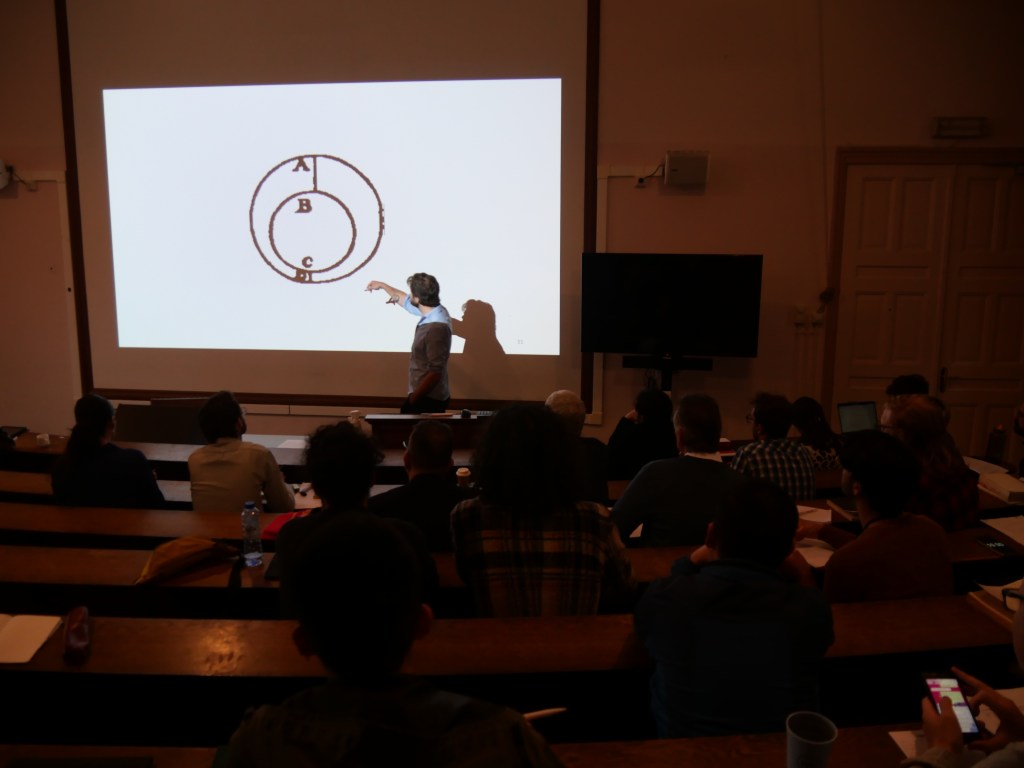
(Collegium Spinozanum IV – Photo: Irina Ciobanu)

Local challenges for the summer school. – Since summer school participants do not have angelic properties, they do need all sorts of things, not least a place to sleep. At the time of the summer school, Groningen also hosted two concerts of an infamous German rock band, entailing that most available accommodation was booked out long in advance. Had it not been for our personal efforts and our colleagues from the university’s summer school office, Isidora Jurisic and Tatiana Spijk-Belanova, the summer school could not have provided accommodation for the participants. A lesson for the future is that a university town should probably balance its interests accordingly and take responsibility for leaving some resources for such events.

Thanks. – It doesn’t go without saying that this wonderful event wouldn’t have been possible without the participants, all attentive and present till the very last moment. In particular, I would like to thank my co-organiser, Irina Ciobanu, and the inventor of the whole affair, Andrea Sangiacomo, who ran the first three summer schools on Spinoza since 2015, as well as our keynote speakers who are, besides Andrea, Raphaële Andrault, Yitzhak Melamed, and Gábor Boros. Thanks also to the Groningen Faculty of Philosophy and to the German Spinoza-Gesellschaft for financial support.

How to read (part ten): What if authors are not consistent?

At a recent conference, a colleague kindly pointed out that my interpretation of Spinoza had changed over the last two weeks, since I gave two rather different answers to the same question. Of course, it’s possible that I change or even improve my interpretation in the course of two weeks, but the suggestion was not really that I had improved my position. Rather, the assumption seemed to be that my utterances were inconsistent. Although we could settle the matter most amicably, such a situation can be quite a nightmare. Am I talking nonsense? Am I inconsistent without noticing it? Am I just opportunistically changing my views to align with certain people in the audience? Of course, I could also blame the listener: Was he being uncharitable? This matter is difficult to figure out. But rather than trying to figure out who is to blame, it might be better to ask what it is that affords (criteria for) consistency in the first place.

Let’s first look how important this is. It’s a common and rational expectation that authors be consistent. (This is why I include the following musings in my series on how to read.) If you read someone asserting that p and then asserting not-p, you can easily recognise their inconsistency by the very form of words. Of course, most types of inconsistency are a bit harder to detect, but once you notice them, you seem be faced with a choice: Either you find a factor that explains the inconsistency (away) or you have to doubt the rationality of the person whose text you read. Factors to deal with apparent inconsistencies are abundant features in interpretations. Faced for instance with Wittgenstein’s earlier and later philosophy, many readers think that he changed his mind or that he shifted his focus. A sensible and charitable reading of such changes will harmonise inconsistencies and look for evidence that confirms the assumption of a change of mind or focus. Even if it’s tricky to settle on a clear story of the changes in Wittgenstein, his case is fairly straightforward because he explicitly declares that he found his earlier work problematic. It’s harder, though, if no such evidence can be found. Of course, one might still assume that there is an explanation that resolves the inconsistency, but if no evidence can be found, we must also allow for the assumption that an author is in fact inconsistent.

But what does such a verdict amount to? I think we’re faced with a choice again: Either we assume a failure of what we call rationality, or we consider the option that consistency is too high a bar. What if authors are, by and large, more inconsistent than we like to admit? I think there is an explanation that leaves the rationality of the author untouched and focuses on what affords consistency. In philosophy, such factors might be found most straightforwardly in the debates that the author’s text is related to. What looks like a failure of rationality might in fact boil down to a change of debate. For me, some of the most obvious examples are to be found in medieval commentaries. Reading Ockham, I often thought he was inconsistent because he addressed problems for his position in one text, while he seemed completely oblivious to these problems in the next text. After a while, however, it dawned on me that the contexts and stakes were different. One text was a commentary on Aristotle’s logic; the other text was a mainly theological commentary on the Sentences of Peter the Lombard. Having noticed this changed my expectations as a reader across the board. While we might expect an author today to be consistent or “systematic” across their works, this might not have been a common expectation in other times or contexts.

Noting changes in genre or shifts in contexts is certainly good advice for texts of the past. But what about our own practices? Is consistency really a feature of what we call rationality? Or might the phenomenon by much more “local”, pertaining more to certain stable contexts such as debates rather than to minds? For the time being, I’d like to settle for the assumption that consistency is a feature of debates rather than authors.

Worlds, norms, and empathy. A conversation with Tom Poljanšek (podcast)

This is the tenth installment of my series Philosophical Chats. In this episode, I have a conversation with Tom Poljanšek who is currently working as a postdoc at the University of Göttingen.

Our conversation is inspired by his recent book Realität und Wirklichkeit: Zur Ontologie geteilter Welten and zooms in on topics such as the relation between reality and appearance, relativism, bureaucracy, norms, Musil’s Man without Qualities, and empathy as well as Tom’s approach to writing this book. Here is a rough overview:

Introduction 00:00

Tom’s book  01:20

Rules – from semantics to politics   22:00

Implicit rules and trust        28:26

Empathy – and how it figures in sharing experience       40:40

How to read work by students and others openly            51:50

On mapping philosophy and being part of the map        55:40

Philosophy as orientation    01:11:00

***

If you prefer to watch this conversation as a video, see below:

Worlds, norms, and empathy. A conversation with Tom Poljanšek

How can you ask and structure questions?

For the last four years or so I’ve tried to integrate exercises for asking questions in my courses. (Here is a blog post on my first attempt.) To my great surprise, students in my faculty now kindly selected my musings and instructions about questions as a “best practice in teaching and learning”, and my faculty nominated me for the pertinent award given by our university.

In what follows, I post a promotional video featuring one of my students* and myself as well as the text that I wrote for the award jury.

Structured Questions

If you ask students whether they have questions about any given text, you’re often met with embarrassed silence. It’s hard to admit that you’re confused. Although asking questions is a crucial activity, how to do this is hardly ever explained. By teaching to structure and analyse questions, I attempt to achieve five things:

  1. Countering embarrassment by suggesting that genuine questions require confusion;
  2. Showing how confusion generates the motivation of a question by having students spell out what (passage) precisely causes confusion;
  3. Showing that confusion is often the result of (frustrated) expectations as a reader;
  4. Detailing how to analyse such expectations as hidden theoretical assumptions;
  5. Having students estimate what possible answers might look like, e.g. by estimating how assumptions in the text differ from one’s own assumptions. 

While stimulating active learning, most steps can be achieved without requiring new information, but rather by developing an understanding of how one’s confusion arises. Accordingly, students are encouraged to enter into a dialogue with their own hidden assumptions and with others, for instance, by articulating how their background assumptions might differ. It is designed to stimulate self-directed learning and exchange as well as benefitting from seeing diversity in assumptions.

The technique of structured questions is an active learning device and was positively evaluated by students at my Faculty. I designed it to foster self-directed learning and interaction with texts and interlocutors. Being geared towards texts and discussions generally, it should be easily transferable to other disciplines. Here is some more information about it:

Questions are an ubiquitous genre in academic exchange. In the analysis of old philosophical texts, questions are a crucial guide in approaching material and in entering a dialogue about it.  As an instructor, I’ve often been surprised by how hard students find it to formulate questions themselves, even if they are good at giving answers. Discussions with students made me realise that the reason is only partly psychological (i.e. owing to embarrassment). Even in philosophy, it is hardly taught how to articulate genuine questions and what (partly tacit) components questions consist of.

I often teach and write (on my blog) about reading and writing texts. So I designed a format for asking structured questions about texts to foster an understanding about one’s own confusions and actually benefit from confusions.

Ideally, the question focuses on a brief passage from the text. It must be no longer than 500 words and contain the following components:

– Topic: say what the question is about (the passage or concepts that cause confusion);
– Question: state the actual question;
– Motivation: give a brief explanation why the question arises (use your assumptions or frustrated expectations);
– Answer: provide a brief anticipation of at least one possible answer (e.g. by guessing at the implicit assumptions in the text and how they might differ from yours).

What did I want to teach in designing this? My initial goal was to offer a way of engaging with all kinds of difficult texts. When doing so I assumed that understanding (a text) can be a general aim of asking questions. I often think of questions as a means of making contact with the text or interlocutor. For a genuine question brings two aspects together: on the one hand, there is your question, on the other hand, there is that particular bit of the text that you don’t understand or would like to hear more about.

In order to enter into dialogue, readers or interlocutors need to learn to consider questions such as: Why exactly am I confused? Could it be that my own expectations about the text send me astray? What am I expecting? What is it that the text doesn’t give me? Arguably, readers need to understand their confusion to make genuine contact with the text. One’s own confusion needs to be understood. The good news is: this often can be achieved without acquiring new information. Instead, bringing together one’s own expectations or assumptions with those of the text (or those of other readers) initiates a meeting of minds.

I began to implement this technique in autumn 2019 with first-year students and have since then introduced it in all my courses. While it was designed with medieval philosophical texts in mind, I realised that it can be used in various contexts and indeed both for approaching texts and discussions. What I didn’t anticipate was that it also seems to help in contexts of blended learning. Last year, I received a number of mails from students thanking me for how this technique had helped them to engage in self-study and prepare for exchanges in online contexts. Since it is geared towards articulating one’s confusion about texts in general, it should be easily adaptable to other disciplines.

________

* I’m very grateful the students of our faculty and in particular to Maddalena Fazzo Cusan who kindly agreed to speak on behalf of the faculty’s programme committee at the very last minute.

How to read (part nine). Being understood. A brief flashback of having my new book discussed

When I was fairly little, say 8 years old, I often walked around with the fantasy that, while I was going about my everyday life, my doing so would be screened and viewed as a film. At the time and for a long time afterwards I always thought that I was an “open book” to others. They could not only see what I did, they would also know what my motives were and what I thought. Overall, it was a pleasant fantasy. Thinking back now to the first author-meets-critics conference on my recent book Socializing Minds, it seems not only like a scholarly event with great critiques and discussions, but also like having my thoughts screened for everyone to see. In that sense, it was the most personal event that I ever attended in academia. At the same time, it also made very clear to me what it means to be understood as the author of a text. This is why I include the following musings in my series on how to read.

In a nutshell, being understood manifested itself in three dimensions:

  1. in terms of actual content: commentators gave an account of how (well) one thought in my book (might have) led to another;
  2. in terms of counterfactual ideas: commentators located what I wrote “in the space of reasons” by contrasting it with what one could (or should) have said instead;
  3. in terms of method or style by showing how the way of writing relates to their or other ways of seeing things and how it could be transferred to other contents.

Having so many good people devote so much time to your own book stirs all kinds of feelings. But going from my experiences with paper reviews, discussions of talks or responses to blog posts I am immensely surprised how wholly, how well and how deeply a book can be understood. All responses gave sophisticated mixtures of the three points mentioned, and it became clear to me that the readers often understood me better than I understand myself, especially by employing step (2) and confronting me with intriguing counterfactual ideas. In what follows, I don’t want to give an overview of the response pieces (that would require more proper work on my part). Rather, I would like to highlight some moments of how being understood manifested itself.

Discussions of intersubjectivity invoke both theoretical and practical perspectives. When Susan James opened with her paper on “Mixing Metaphysics, Language and Medicine with Politics” I immediately realised that I had written my book from a limited perspective: As Sue argued Locke’s rules of propriety of language are not merely semantic rules but presuppose political power relations. Eric Schliesser corroborated this point the next day by calling my approach a “de-politicalization”. Interestingly, for me the writing of the book meant the opposite, i.e. a politicization of theoretical topics like (social) intentionality, while for people also educated in political theory the story has different priorities. (Luckily, I didn’t come totally unprepared, as Eric had written three blog posts on the topic that I link to at the bottom of this post.) In this respect, it’s interesting to note that scholarship in history of political versus theoretical philosophy is still pretty much separated. As both Eric’s and Sue’s contributions show, these perspectives remain impoverished, if they are not brought to bear on one another. At the same time, they leave us with the question what has priority for Locke and others, the political or the theoretical issues.

When responding to earlier reviewers who pointed out that many more authors should be included in my study, I had said that I merely want to start a conversation (in the sense explained by Regina Rini). Picking up on my questions, Katarina Peixoto’s piece engaged straightforwardly with the problem of how minds can actually interact, that is, with what I call the contact problem. But rather than confining herself to the figures I treat in the book, she expanded the scope and discussed the problem in Elisabeth of Bohemia. In a similar vain, Yoen Quan-Laurent extended the discussion by invoking Blaise Pascal. Parallels with other historical figures are not only extending our knowledge of the field. Listening to Spyridon Tegos’ talk, I thought that part of my Hume chapter would fit the medical doctrines of Pierre Jean Georges Cabanis perhaps sometimes better than those of Hume. (Note to self: I must study Cabanis much more closely when writing on imitation as a form of interaction.) Seeing the set of issues I had raised for Spinoza, Locke, and Hume applied to other figures in unexpected ways made me think that something of my approach could be “carried over” and that the conversation could be extended further into the field.

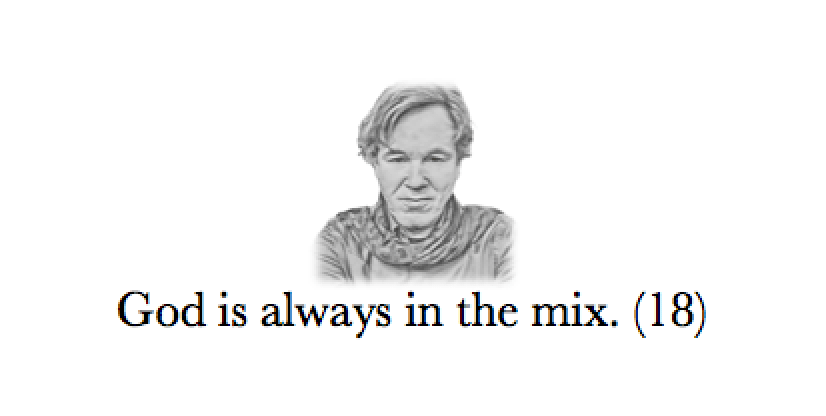
As is perhaps well-known, at least some of my authors rely on God for a great part of what they attempt to explain. Now there is a worrying objection that, once you introduce God as an explanans, why not explain everything in reference to God? Kathryn Tabb spelled out this worry, amongst other objections, in her talk on “Divine Intersubjectivity” carefully recontextualising my claims and highlighting limits I might have overstepped in my book.*

Stephen Daniel pushed this line of objection to the extreme, considering the idea that, if you start out with the idea that we’re made in the image of God etc., the need for explaining intersubjectivity might not even arise. While such an objection might sound devastating, it is not or so I think. It shows what happens when one highlights different commitments of the authors in question. And as I see it, this back and forth also makes clear why interpretive disagreements (mostly) cannot be resolved by relying on textual evidence alone. We always approach texts bearing certain priorities in mind. In such dialogues they can be made explicit.

Especially my Hume chapter I wrote with the continuous worry that I might be wrong all the way down. Does Hume’s talk about medical issues reduce to something metaphorical? Tamás Demeter did not only organise the whole conference. While revealing himself as the kindest of hosts, he also took this worry very seriously, opening up an alternative reading that makes sense of a physiological approach like mine but showing a different line of reconstruction. Like Kathryn, Tamás provided an intriguing alternative reading of my story that acknowledges the interpretive challenges but differs in crucial details. Writing a book over many years doesn’t mean that you get rid of all the scars or ideas that sometimes feel somewhat over the top. Here, I felt clearly seen with respect to what I liked as much as with respect to the scars, some of which I’d sometimes rather hide from myself.

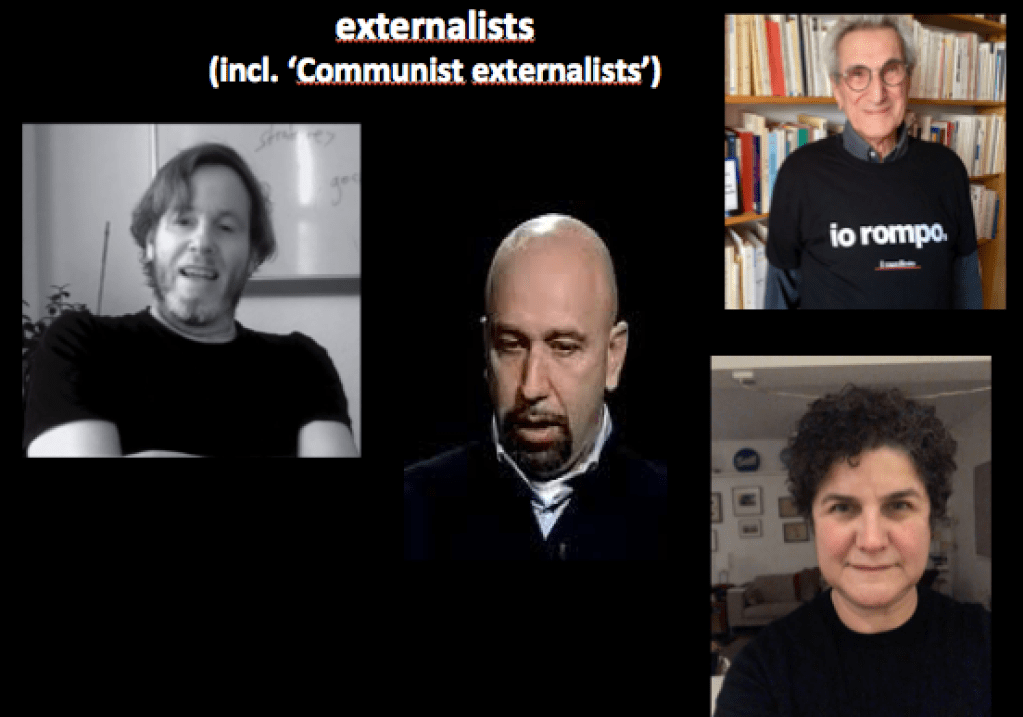
Speaking of productive critique, some people said that I might get off lightly with regard to my Spinoza chapter. But this is not true. It’s just that the papers focussing on Spinoza were of the creative sort rather than critical. Mateusz Janik approached the discussion of intersubjectivity by introducing memory as a way of being in the minds of others (even when one is dead). At the same time, he also made my reading of specific propositions visible as one among others and especially as one diverting from Spinoza’s mode of presentation, showing how Spinoza went one way and my book imagined another way. This way, Mateusz made me actually remember how I consciously chose – back then when writing – to divert from the path Spinoza set and move on in a different way.  Charles Wolfe did not just categorise my Spinoza interpretation in “a space of imagination”, but localised my whole approach in the space of philosophy. In a manner of speaking, Charles makes me (or my approach) feel at home in a space that I didn’t realise I properly belonged to. I would like to believe that he is right. If he is, I am no unrespectable part of the world:**

What does all of this teach me? While this conference certainly had the beauty of a once-in-a-lifetime-event, it does show me that we can be understood if we find diligent, friendly and ingenious readers. It leaves me with an optimism about being understood that I haven’t had for many years.

I would like to close this post by thanking all the participants of the conference and especially my partner Marija Weste, also for joining the event and for keeping me engaged in dialogue.

______

* Slide below taken from Kathryn Tabb’s presentation with permission.

** Picture taken from Charles Wolfe’s presentation with permission. – I couldn’t help alluding to this beautiful line from Ingeborg Bachmann’s Malina: “We, too, form an acceptable part of the world.”

How to read (part eight). Reading some Davidson (podcast)

This is a first stab at an experiment in the “phenomenology of reading”, as it were: After my first post in this series, I’ve been toying with the idea of “demonstrating” some of the ‘things rushing through my head’ when reading, without prior meditation on what to say. So the idea is not to say something particularly philosophical or scholarly about the text (although this might sound like it here or there), but focus on what strikes me as a reader. In the future, I hope to continue these kind of live-comments in dialogical fashion with guests.

To get started, I’ve just picked a famous paper by Donald Davidson, his “Rational Animals”, scanned it (please find it below), read through the first two paragraphs and started commenting. Afterwards, I added one or two minutes of introduction to the sound file. That’s all. What I try to achieve is to capture very basic steps in organising or grasping what I see on the page. It’s not (yet) about the topic, position or argument that is introduced, and there is no attempt at understanding the text as a whole.* Rather, it is mainly about what Davidson says in the first paragraphs and what sort of expectations and associations I develop in confrontation with the text.

Recording the sound file (without the intro) in one go and leaving it untouched, I didn’t do any corrections or additions. Listening back to this now, this troubles me greatly. Why didn’t I say this or focus on that or put this differently?! I really had and have to stop wanting to talk about the whole text or thoughts (as in, talking about what I know about the text), rather than just go with the flow of the actual reading experience. This reveals (to me at any rate) how much what I say is normally guided by second thoughts or by wanting to sound smart.

The goal, if there is one, of this exercise is to develop questions for reading on, from the text. In a further step, these questions could then upheld and asked when reading on. In yet another step, an understanding of the whole text would have to be established and checked against these first steps, to either correct the understanding of the whole or to refine my initial questions. What is recorded, then, is the attempt to present a first grasp, while ignoring the rest of the text or an understanding of the whole.

As I said, this is just a rough start to get going and to see what happens when I try (to comment on) reading. If you can bear with this, I’m happy about suggestions for “further reading”.

________

* Roughly, Davidson’s argument for rationality requiring linguistic communication (and thus being a social trait of humans) is the following:

  • Rationality requires at least having beliefs.
  • Having beliefs requires having beliefs about beliefs (so that one can distinguish between true and false beliefs)
  • Having beliefs about beliefs requires speaking a language.
  • Therefore, being rational requires speaking a language, i.e. it requires linguistic communication (which makes rationality a social trait).

Here is the paper:

______

* Here is part nine.

How to read (part seven). A conversation with Daniel-Pascal Zorn about reading philosophy and twitter (podcast)

This is the ninth installment (not the eighth!) of my series Philosophical Chats. In this episode, I have a conversation with Daniel-Pascal Zorn who is a Lecturer of Philosophy at Bergische Universität Wuppertal. In addition to his scholarly work in comparative philosophy, he wrote a number of books and pieces that found much recognition widely beyond the confines of professional philosophy.

In this conversation, we focus on reading practices in philosophy (from 01:33 onwards) and social media, especially twitter and Daniel’s “twitter persona” (from 1:05:54).

Crucial for our discussion is a distinction between to kinds of attention or concepts, namely concepts of content and operation, the latter being the means through which we express content. You can read more about Daniel’s approach and the distinction here. You can follow him on Twitter here.

__________

Notes:

* If you prefer to watch this conversation as a video, see below:

A conversation between Daniel-Pascal Zorn and Martin Lenz about reading philosophy and twitter

* Here is the video in which Adam Neely introduces the idea of musicking (as opposed to seeing music merely as rhythm, harmony and melody). I try to liken the distinction between music and musicking to the one between content and operation.

* Part one of my series “How to read” is here.

* Finally, here is the link to a piece on the understanding of history in analytic philosophy we co-authored.