“The aims are discussed far too rarely” – An interview about the latest conference of the European Society for Early Modern Philosophy

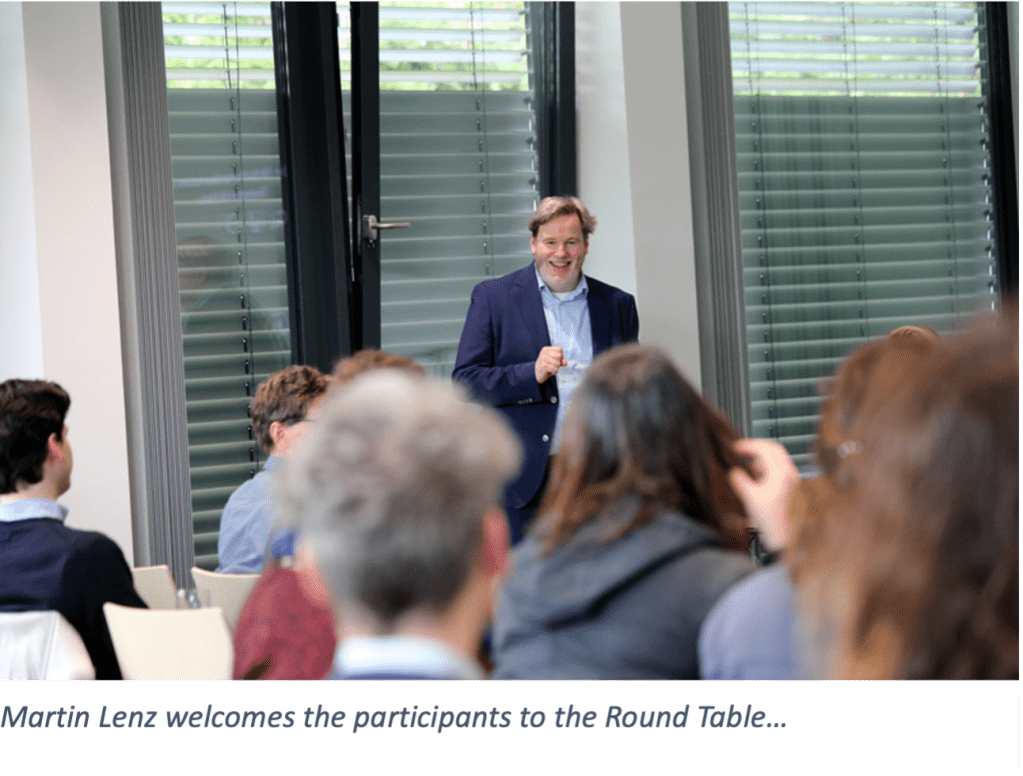
A major conference on early modern philosophy brought together guests from all over the world on the Hagen campus. Organizer Prof. Martin Lenz explains what it was all about.

The society has come full circle: In 2004, the European Society for Early Modern Philosophy (ESEMP) was founded with a conference at the FernUniversität in Hagen – on the initiative of Hubertus Busche, who headed the Philosophy I department at the time. Now, around 20 years later, the professional society is inviting participants back to Hagen: to the 7th International ESEMP Congress: “Why and How Do We Study Early Modern Philosophy Today?”

Martin Lenz has headed ESEMP for the past three years, and since 2024, he has also lead the Philosophy I department. He was the lead organizer of the international meeting in Hagen. The German Research Foundation (DFG) supported the conference with its diverse program – from the Early Career Session to the round table. Keynote speakers were Mogens Lærke (Oxford) and Anik Waldow (Sydney).

Clearly identify aims

“We talk far too rarely about the aims, why we pursue our studies in the first place,” Lenz says, highlighting a basic assumption of the conference. What does this mean? “In philosophy, we have what’s known as canon expansion, for example. This means we’re trying to expand the canon with people who have hardly been read before.” These usually include members of underrepresented groups – such as female philosophers. But why expand the canon at all? Why not stick with the older works? “In this case, the answer seems to be a political one,” explains Lenz. “There is the goal of equality, which is followed by a research agenda.” As a researcher, he identifies with this concern. Nevertheless, it is important to reflect explicitly on such objectives, the “why?” – if only to choose the right method for one’s own work.

Utilizing a variety of methods

“And our methods in philosophy have become very diverse these days,” Lenz says, addressing the second major conference question: “How?” Sitting in a quiet room with dusty books? Academic work increasingly rarely corresponds to this image. “Digitalization has brought us many possibilities.” As an example, Lenz cites the so-called Digital Humanities – a still fairly young movement within philosophy that utilizes digital tools. “It’s often about making texts accessible, producing editions, or recognizing frequencies,” says Lenz. “For example, I could instruct an artificial intelligence system to search for all dissertations on a certain topic in a specific region.” Such a computer analysis can, among other things, help to counteract prejudices and subjective misconceptions: “You can then see, for example, that ‘Philosopher X’ wasn’t actually as dominant in their era as assumed.”

“How did we get here?”

For Lenz, the questions of “how?” and “why?” lead to fundamental considerations about the relevance of his discipline. “If we want to understand ourselves, we find ourselves in different histories – depending on our individual backgrounds. For example, can one understand the FernUni as a project if one is unfamiliar with the educational policy situation in North Rhine-Westphalia in the 1970s?” For him, history is not a linear process that inevitably ends in progress; it is asynchronous and dependent on subjective preconditions. “How did we get here? And why haven’t we all arrived at the same point?” Properly applied, philosophy helps answer such questions and organize narrative threads in the history of ideas.

Suggesting alternatives

Although philosophy often remains self-referential, it can provide new food for thought: “Philosophy does not thrive on progress, but on repeatedly returning to themes. It could be viewed as a great conversation spanning all time – within this, however, one often discovers alternatives to the prevailing thinking.” Lenz also locates the lively debates of the international conference in this interplay of old and new, established and alternative.

A vibrant campus

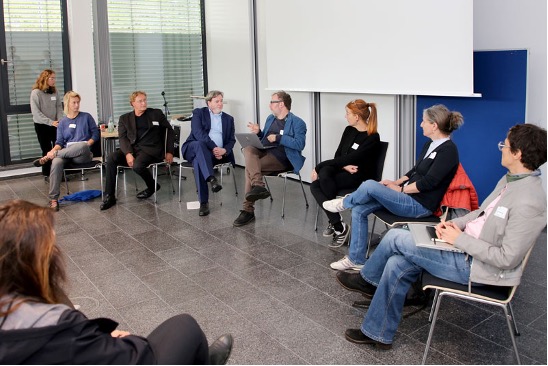
Breaking down established structures wasn’t just about the content: “With the conference, we also offered mentoring for researchers in early career phases.” They were assigned mentors in keeping with specific keywords, thus creating professional tandems. “Established people then attended lectures given by younger people and were able to provide feedback – and, conversely, gather new ideas themselves.” The plan worked, with all generations mingling at the conference. “My impression was that it was very well received.” The coordination both beforehand and on-site paid off. A large team was needed to effectively support the many people on campus and during the supporting program in Hagen. “There was a lot to do!” emphasizes Martin Lenz. “I would like to express my sincere thanks to everyone who helped.”

**

Interview and photos by Bendedikt Reuse

Translated from the German by Martin Lenz

CfP: Reading as a Social Practice. An Interdisciplinary Workshop

CfP: Reading as a Social Practice. An Interdisciplinary Workshop

Berlin, 27-28 March 2026

Organised by Irmtraud Hnilica (Mannheim/Hagen) and Martin Lenz (Hagen)

According to a widespread consensus, we are currently living through a reading crisis. This workshop seeks to take a step back from the rhetoric of decline and instead raise the question of how reading itself can be conceptualised and approached from different disciplinary perspectives, particularly in philosophy and literary studies. To a first approximation, we propose that reading is determined not only by texts themselves or by individual readers, but mainly by the interactions between readers. We especially invite submissions engaging with this claim—whether through historical investigations of reading cultures, theoretical reflections on the social dynamics of interpretation, or analyses of contemporary practices in both analogue and digital spheres. We explicitly welcome submissions from scholars at all career stages. The aim of this international workshop is to spark new collaborations that will eventually result in a joint interdisciplinary network devoted to the study of reading as a social practice.

To submit, please email an abstract around 500 words to Martin Lenz (martin.lenz@fernuni-hagen.de) no later than 31 October 2025. Please use ‘Reading 2026’ as the header of your email. The email should contain a short bio of the author‘s details (including position and affiliation). We hope to notify you about the outcome by the end of November 2025.

The languages of the workshop are English and German. For each talk, there will be time for a 30-minute presentation, with about another 15 minutes for discussion. Upon acceptance, we grant reimbursement of accommodation and travel expenses.

***

CfP: Lesen als soziale Praxis. Interdisziplinärer Workshop

Berlin, 27./28. März 2026

Organisiert von Irmtraud Hnilica (Mannheim/Hagen) und Martin Lenz (Hagen)

Einem weitverbreiteten Konsens zufolge erleben wir derzeit eine Lesekrise. Dieser Workshop möchte einen Schritt zurücktreten von der Rhetorik des Niedergangs und stattdessen die Frage stellen, wie Lesen selbst konzeptualisiert und aus verschiedenen disziplinären Perspektiven – insbesondere in der Philosophie und Literaturwissenschaft – betrachtet werden kann. In einer ersten Annäherung schlagen wir vor, dass Lesen nicht nur durch die Texte selbst oder durch individuelle Leser*innen bestimmt wird, sondern maßgeblich durch die Interaktionen zwischen Leser*innen. Wir freuen uns auf Beiträge, die sich mit dieser These auseinandersetzen – sei es durch historische Explorationen von Lesekulturen, theoretische Reflexionen über die sozialen Dynamiken der Interpretation oder durch Analysen zeitgenössischer Praktiken in analogen wie digitalen Räumen. Explizit erwünscht sind Einreichungen von Wissenschaftler*innen aller Karrierestufen. Ziel dieses internationalen Workshops ist es, neue Kooperationen anzustoßen, die in ein gemeinsames interdisziplinäres Netzwerk zum Lesen als sozialer Praxis münden sollen.

Bitte senden Sie ein Abstract von ca. 500 Wörtern bis spätestens 31. Oktober 2025 per E-Mail an Martin Lenz (martin.lenz@fernuni-hagen.de). Verwenden Sie als Betreff Ihrer E-Mail bitte: Reading 2026. Bitte ergänzen Sie Ihr Abstract durch eine akademische Kurzbio mit Angaben zu Position und Institution. Wir hoffen, bis spätestens Ende November 2025 Rückmeldung geben zu können.

Workshopsprachen sind deutsch und englisch. Vorgesehen sind 30 Minuten Vortrag und je 15 Minuten Diskussion. Fahrt- und Übernachtungskosten werden übernommen.

ESEMP Conference: Why and How Do We Study Early Modern Philosophy Today?

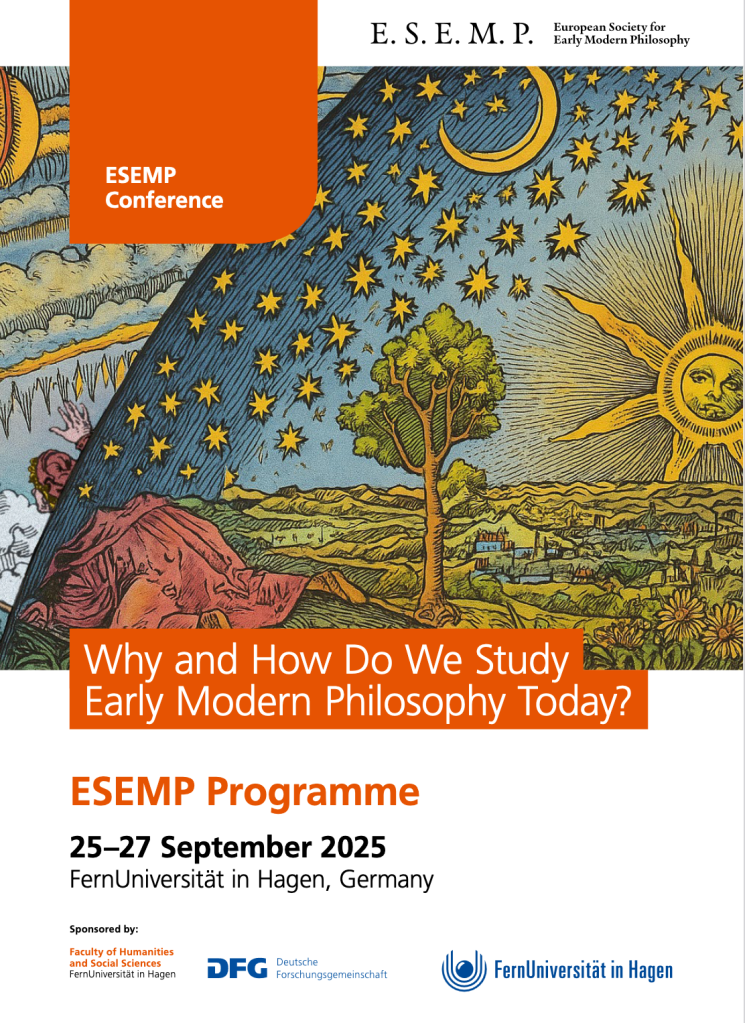
Following our Call for Abstracts last November, I am now happy to report that the Society for Early Modern Philosophy (ESEMP) runs its seventh conference at Hagen University, the place where the society was actually founded in 2004. In the meantime, we’ve finalised the downloadable conference programme (more details will be added on the conference website in the coming days). In case you want to register as a guest, there is an extra page for this.

At this point, I take the liberty to thank my wonderful team at Hagen for working ceaselessly to make (not only) this conference happen as well as the Hagen Faculty of Humanities and Social Sciences and the Deutsche Forschungsgemeinschaft for generous financial support.

The aim of this conference is to bring together leading experts and young talented scholars from all over the world to explore ways of approaching early modern philosophy and reflect anew on the aims of doing so. Following recent discussions in the field, we will wonder, for instance, whether we should favour historical over so-called rational reconstructions of texts or what precise aims are served by extending the canon. Likewise, we will ask how advances in the digital humanities shape our field. Even if one works in more traditional ways, one has to inquire whether common assumptions about how to place and study texts, figures or debates still stand. A second focus of our conference concerns (practical) issues concerning especially early career researchers. In this spirit, the conference includes a mentoring programme intended to connect mentees with experienced researchers who will provide advice on papers.

The incorrigibility of ChatGPT and the end of teaching

Suppose you witness an accident and have to report it to the police. “Well, the red car drove with high speed towards me and then took a sharp left turn”, you exclaim. You try hard to find the right words to capture the precise sequence of events and people you’ve noticed. Being a bit fussy by nature, you keep correcting yourself. “To begin with, it seemed as if the driver wanted to run me over.”, is the formulation you eventually settle on. – Now imagine you try to refine your impressions using ChatGPT. Obviously, there is always room for improving on style and grammar. But can you expect ChatGPT (or any LLMs or AI) to improve on the accuracy of your factual statements? No. But what does it mean if it is used to that end anyway?

Given the way ChatGPT works, it has no experience of the world in any sense. Rather, it generates sentences by predicting the most likely sequence of words based on the input it receives and the vast amount of text it was trained on. Thus, it cannot improve on the content of any statements relying on experience. While this is no surprise, the repercussions it has for teaching contexts deserve careful attention because such contexts thrive on the correction of statements. Especially now that people not only use this device to hide their plagiarisms, but also to “decide” all sorts of questions. I’ve been wondering repeatedly what precisely it is that goes wrong in teaching contexts with the use of AI and now I begin to think that it comes down to a loss of corrigibility, a loss of understanding what corrigibility even means. Put in a nutshell, seeing that this device improves the form of (written) texts in amazing dimensions, it makes us blind to the fact that it impoverishes our relation to empirical content. In what follows, I’d like to explore this loss with regard to teaching philosophy.  

What is corrigibility? Corrigibilty means that a statement or text can be corrected. If I state that it’s raining you can correct me by pointing out that it’s in fact not raining. We offer and receive corrections all the time. We improve the way of phrasing something we’ve seen by finding more adequate phrases. We can differentiate between grammatical and stylistical corrections as corrections of form as opposed to content, but often the two are difficult to keep apart. The phrase “it’s raining” is formally correct when used among English language speakers, but what makes it correct for these users is how it’s applied to a shared experience of the world (in which it happens to rain). If I ask you to refine your phrasing, suggesting for instance that it’s really pouring and not just raining, I can mean at once to pay attention to your experience and the conventional way of expressing such an experience in the English language. When you think about your experience and modes of expression, you’ll likely involve linguistic sources (your language conventions, literature, the sociolect your audience is supposedly expecting etc.) as well as non-linguistic sources (whatever you can gather from other sense-modalities). Most importantly, you’ll involve relations of applying linguistic resources to non-linguistic experiences. In other words, we relate linguistic conventions to (non-linguistic) facts. ChatGPT, by contrast, doesn’t do that. Having no relation to the world, it is confined to linguistic resources; it has no other sense modalities and it has no way of relating linguistic to non-linguistic facts. In other words, while it can improve on formulations, it cannot be corrected. Put in Wittgensteinian terms, whatever seems correct to ChatGPT is correct – and that means that there is no sense of distinguishing between correct and incorrect. (There is an intriguing piece about learning this the hard way.) Thus, we shouldn’t even say that it’s “hallucinating” when it’s “making things up”. There is no meaningful distinction for this device between hallucinating and getting things right in the first place.

Now I doubt that I’m spreading any news here. So why is this worth saying? Because both the language of ChatGPT and of the merchants of this technology constantly suggests that this device is learning, being corrected and improved. Yes, it’s being improved at what it does already, but it’s not improved in any other sense. This lingo tricks many of us into thinking that the improvement is of the kind that we are familiar with. Just like AI is now increasingly taken to be a meaningful, sexy or caring interlocutor, it tricks many of us into assuming that it could “learn” by being “corrected”. But learning, for humans, always involves a relation to the world. The great confusion about ChatGPT, then, is that it would be improved in any way that we would try to improve our own way of expressing ourselves.

How does this affect teaching (philosophy)? There are many pieces about the decline of the humanities in the face of ChatGPT and related devices. Given how this technology diffuses our sense of authorship and our reading culture, I’m inclined to think that our whole way of cherishing text production and reading will go out of fashion and become a nerdy niche. Just like long electric guitar solos or keyboard solos, which seemingly were ubiquitous in the 70s and 80s, are now a thing for a few nerds on youtube. So as I see it, the problem is not that students are faking texts; the problem is that most texts are considered irrelevant. Along with the skills and features that go into their production. Being able to write good texts is already irrelevant in world where so-called leaders get by without even glancing at their briefings. But let’s stick to the current story. My hunch is that the loss of corrigibility ingrained in ChatGPT is the outcome of a larger trend that was clearly recognised in Harry Frankfurt’s On Bullshit as early as 1986: Once you realise that you can convince without sticking to techniques of truth-evaluation, you can disregard truth altogether. After all, the question is not in what way ChatGPT is incorrigible. We can figure that out quickly. The question is why are we letting ourselves be corrected by a device that is incorrigible.

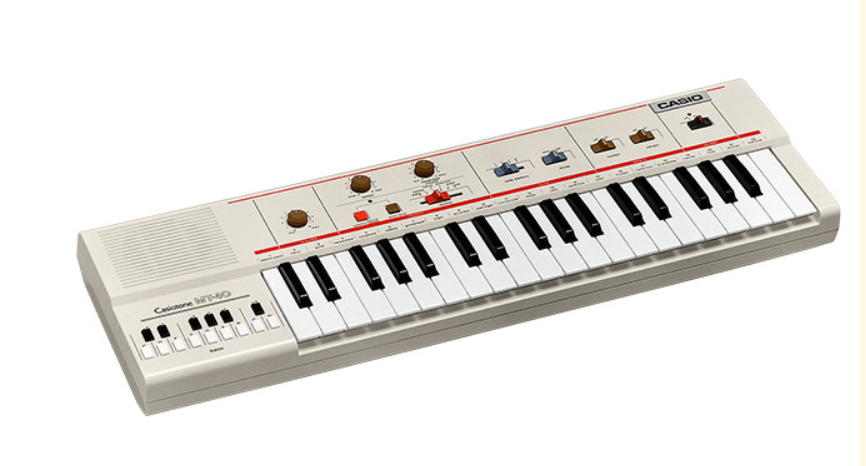
But that’s a question for nerds. Mastering long written texts, let alone writing them, then, doesn’t seem to hold much of a promise for anything now. This is not just because students have incentives to fake their work; it’s because there are hardly any incentives to produce such work in the first place. Why do you need to learn to play the piano if you have keyboards with automatic accompaniment? Of course, you might get sick of their sounds quickly. But who cares if that’s all that’s on offer?

So again: the problem is not cheating; it’s irrelevance. Writing this, I feel like a fossil decrying the loss of its natural habitat. And that’s probably what it is: An old man whining that no one recognises the beauties hidden in the art he cherishes. So what? So what indeed?

So what’s left for teachers? If you don’t worry too much about plagiarized texts, you might adjust your energy towards getting people to think, not by by analysing texts, but by coming up with good prompts for ChatGPT or by enhancing your techniques of video editing. In other words, while certain products (such as well-written essays) will simply be done by ChatGPT in the future, you can support students in improving “their” work by focussing on helping them to use this and the AI devices to come as a good tool. The remaining question is, though, what this tool is good for, once we admit that writing texts is irrelevant?

What does it say? The supposed objectivity of written texts

“… interpretation is the source of texts, facts, authors, and intentions.”

Stanley Fish, Is There a Text in This Class?

Do you remember when you first committed some of your own thoughts to paper? Perhaps you kept a diary, perhaps you wrote poems or lyrics or crafted a letter to a friend. Perhaps you had worked on the aesthetics of your handwriting. Anyway, there it was. Something that you had written could now be read and, of course, misread in a distant place during your absence. This striking distance became even more evident to me when I had seen my words, not in my clumsy handwriting, but in the typeface of a word-processor. Imagining that someone would read my words not as my personal scribblings but as a text in an authoritative typeface, made me at once proud but also seemed to diminish my personal impact on the text. In any case, the absence or possible absence of the author from something written, I suppose, is what turns texts into something objective. As I see it, texts become objective when they can be read independently of the writer, of what the writer says and thinks. If this is correct, it seems that written texts are fundamentally different from spoken texts or thoughts. In turn, this makes me wonder whether it’s written texts alone that afford the interpretive openness allowing for different readings or interpretations as we know them in the humanities of our time. In what follows, I would like pursue some perhaps naïve musings on this issue.

Thinking versus speaking versus thought?

If you observe what you say in contrast to how you write, you’ll probably notice a stark difference between spoken versus written language. While academics sometimes seem to try and imitate the grammatical standards of their written language in their speech, we quickly notice that the grammatical rules, word choices and other aspects are vastly different. Pondering on this issue quickly brought me back to the ancient and medieval doctrine of “three kinds of language”, according to which thought is expressed through spoken language and spoken language is signified by written language. But once you notice how different already speaking and writing really are, it’s difficult to give much credit to said doctrine. The very idea that writing is a set of signs of what is spoken strikes me as a very impoverished understanding of the difference. This makes me wonder when written language was first considered as a set of signs independently from spoken language. Following Stephan Meier-Oeser’s work, my hunch is that William of Ockham and Pierre D’Ailly in their logical treatises are among the first to deem written signs as independent from spoken language. (Sadly, it’s not entirely clear why they hold this in contrast to many of their fellow thinkers.) Now, once you think of written language as independent from speech it seems that you acknowledge something that could be the objectivity of the written text. Of course, long before the written text is acknowledged as an independent signifier, there have been sacred texts like the Bible that were considered objective in some sense. But experiencing our very own writings as independent from our speaking must do something to the way we think about texts and their interpretability more generally, or so I think.

The written text as an objective ‘thing’

The way we encounter written texts or books (be it on paper or screens) seems to present them as distal objects, independent from how we interact about or with them. Like the table in front of you, the book on your desk or in your pdf isn’t altered when you look away. This experience is certainly at least in part responsible for the common assumption that texts and their meanings are stable items independently of us. Likewise, our experience of reading is commonly thought of as grasping something external to us or our interactions. But why? While I myself have begun to think that reading is in many ways a matter primarily dependent on interactions between readers, I equally wonder how written texts, non-sacred texts in particular, have earned the status of independent carriers of meaning that can be hit or missed. Our current reading practices inside and outside of academia seem to corroborate this assumption. – (What does it say? This is a question that silences classes but equally fosters the pretence that texts are stable unchanging sources of meaning that provide all the necessary constraints for possible interpretations. Yet, not knowing whether we’re reading a recipe or a a poem, we are probably unable to tell the genres apart without context. “Context” – this harmless little term obscuring all the greatly important factors allowing for recognition, and constantly underestimated as a “side issue” when it comes to competing readings!) But what does it take for a written text to be actually seen as independent in such ways?

The advent of ChatGPT

Investigating the question of the objectivity of texts will take some time. But currently it seems that this objectivity becomes undone in quite unexpected manners: the advent of chatGPT does not only call into question the production of texts through proper authorship. Rather, it also calls into question the independence of written language as a system of signs, thriving on a supposed text-world relation having been taken for granted for a very long time. Reading a piece of text, we can no longer presume that it was produced by a person having a relation to the world, to themselves and to other people making it a rational item, interpretable by rational beings, or simply readers.

How did we get here?

Stop grading student essays and start reading them instead. The ethics of reading (2)

A question for scholars. – How can we spend a lifetime on a chapter in Aristotle and think we’re done with a student essay in two hours? Both can be equally enigmatic.

Writing this little joke back in 2018, ChatGPT was still unheard of in my part of the world. My point was that our teaching practice results in our unlearning to read and encourages mindless writing and reading. Back then, people responded by emphasising that, contrary to texts of “proper” philosophers, student work is being produced and read to be judged with regard to specific skills, so it doesn’t merit further attention. With the advent of ChatGPT, the judging part of this kind of exercise went down the drain. But even back then, the thought that sparked the worry behind my joke was that we have students produce texts that no one wants to read and, basically, that we train forms of writing that no one wants to read. After all, we now know that it’s not only student papers that often get no more than a quick glace, but equally work of peers. As I see it, then, ChatGPT did not alter this situation but just made our practice of mindless reading and writing more visible. At least, we talk about it now.

If this contains at least a grain of truth, then we knew very well before the advent of ChatGPT that our exercises weren’t very promising. Why? Of course, writing is a great thing and should be practised, but grading writing is another matter altogether. Either our responses would have to be very formulaic or they would have to be so time consuming that no one could serve larger classes. So the problem is not that students now have better ways of cheating. The problem is that we don’t and didn’t act well as readers of our student work. No matter whether we act like cops to catch cheaters or just keep rushing through masses of work: we’re acting as a bad role model for good reading and writing. If we rush through student papers, we demonstrate that we only care about grading. Students learn that they should mainly care about grades, too. It’s no surprise, then, that what gets perfected is not the writing but the techniques of cheating.

But this doesn’t mean that students don’t want to write or learn writing. Rather, they probably don’t want to write for readers who spend two to five seconds on a paragraph that took two days to compose. Perhaps what we (should) really feel, now that ChatGPT makes it almost impossible to distinguish real from hallucinated work, is relief – relief that student essays can’t be graded as they used to be. It should encourage us, not to abolish this kind of exercise, but take it more seriously and stop grading it in the way we used to. While we can focus our common grading practices on other kinds of exercises, we could encourage student essays designed as longer projects for those who really want to go through the effort.

Wie schreibt man ein Exposé für eine philosophische Arbeit?

Schreiben ist schwer. Schreiben über das, was man zu schreiben beabsichtigt, ist meist noch schwerer, weil man nicht weiß, was man herausfinden wird. Dennoch ist gerade bei der Absprache einer Arbeit das Exposé eines der wichtigesten Bestandteile. Denn hierüber kann man am besten absehen, wo Schwierigkeiten entstehen, ob die Planung realistisch ist und eine interessante Arbeit verspricht. Idealerweise werden Lehrende gerade hier eingreifen, wenn sich Probleme abzeichnen, und Korrekturen am Gesamtprojekt vorschlagen. Deshalb sollte man für das Exposé und dessen Überarbeitungen (Plural!) einen Großteil der verfügbaren Zeit und Mühe einplanen. Ja, natürlich wird sich vieles erst beim Schreiben der Arbeit ergeben, aber ob die Arbeit überhaupt Hand und Fuß haben wird, zeigt sich bereits beim Exposé. Woraus also sollte es bestehen?

Ein gutes Exposé ist nichts anderes als eine vorläufige Einleitung, die im Groben aus der Formulierung eines Problems und eines Lösungsvorschlags besteht. Bevor wir uns die einzelnen Teile bzw. Unterteile ansehen, noch ein paar strategische Bemerkungen.

Grundsätzliches. – Die Arbeit an einer Arbeit und auch am Exposé zu einer Arbeit besteht aus zwei sehr unterschiedlichen Phasen: der Exploration, in der Sie ein Thema erkunden, und der Darstellung, in der Sie Ihre Gedanken zum Thema einer Leserschaft präsentieren. Die oft zufällig-assoziative Ordnung der Exploration ist von der didaktisch geleiteten Darstellung grundverschieden. Im Exposé und in der Arbeit geht es um die Darstellung, nicht um die Erschließung des Themas. Als Leserschaft stellen Sie sich am besten interessierte Erstsemester vor. Gehen Sie nicht davon aus, dass sich Ihre Leser:innen auskennen. Bedenken Sie bitte auch, dass Sie nicht all das, was Sie in der Exploration interessiert oder hilft, für die Darstellung benötigen. Deshalb ist es für die Fragestellung oder These, die Ihre Darstellung leitet, wichtig, dass Sie möglichst klar und eng eingegrenzt ist. Überhaupt ist die Fragestellung oder These, die Sie in Ihrer Arbeit entwickeln, das allerwichtigste. Laut einer trefflichen Beobachtung meiner Kollegin Charlotte Baumann legen viele Studierende Ihre Arbeiten wie Übersichtsartikel bei Wikipedia an. Das ist keine gute Idee. Fokussieren Sie sich stattdessen auf eine (und nicht mehr als eine!) These, für die Sie in Ihrer Arbeit argumentieren. Wie finden Sie aber eine These? Das ist nicht so leicht. Am besten entscheiden Sie sich im Laufe Ihrer Exploration einfach für eine bestimmte These, die Ihnen plausibel erscheint, und versuchen, diese mit eigenen Argumenten und Belegen zu untermauern. Was soll so eine These dabei eigentlich leisten? Nun, sie ist der L.ösungsvorschlag für ein Problem. Zunächst also müssen Sie ein Problem aufdecken? Wie machen Sie das? Nun, Sie nehmen sich eine konkrete Passage aus einem Primärtext oder aus einem Sekundärtext vor und schauen nach einer Reibung oder Schwierigkeit, die der Erklärung bedarf. Solche Reibungen können Sie selbst erzeugen, indem Sie sich über die Konsequenzen des Gesagten Gedanken machen. Mit der Reibung und der These haben Sie das besagte Problem und einen Lösungsvorschlag. Und damit kann es losgehen.

Ihr Exposé besteht neben dem Titel oder Arbeitstitel idealerweise aus folgenden Teilen. Das sind:

(a) das allgemeine Thema bzw. die problematische Textpassage;

(b) ein Problem, das in den wissenschaftlichen Debatten des Themas oder der Passage auftritt (oft im Einklang mit der Diskussion in der Literatur);

(c) die Motivation des Problems bzw. eine Erklärung, warum das Problem relevant ist oder welche ungelösten Schwierigkeiten es offenlässt;

(d) eine These zur Herangehensweise an das Problem;

(e) die Forschungsfrage, d. h. die Frage nach einem entscheidenden Aspekt, der untersucht werden muss, damit sich die These als wahr oder als plausibel erweist;

(f) der methodische Ansatz, der die Art der zur Beantwortung dieser Frage erforderlichen Belege oder Argumente rechtfertigt;

(g) die Gliederungsschritte (und Einschränkungen), die zur Begründung der Argumentation berücksichtigt werden müssen.

Wie Sie sehen, kann man eine Menge unterschiedliche Dinge bereits im Exposé ansprechen. Dabei geht es nicht darum, schon alle Punkte genau untersucht zu haben. Vielmehr müssen Sie sich einfach trauen, diese Punkte mal ins Blaue zu formulieren und dann ­– im Austausch mit anderen (z.B. der Lehrenden) – nachzujustieren, bis sich ein gangbarer Weg abzeichnet. In jedem Fall werden Sie so endlich aus der bloßen Explorationsphase rauskommen und zur Darstellung übergehen können. Wenn das Exposé abgestimmt ist, kann es dann mit der eigentlichen Arbeit weitergehen, für die ich den Hagener Leitfaden empfehlen möchte.

Reading as a Social Practice. Sketching a long-term project (from March 2025 onwards)

Currently, Irmtraud Hnilica and I are sketching guiding ideas for a project that has been in the making for some time. Below is a small blurb. Please feel free to get in touch, if you’re interested in collaborating:

According to an ever-growing consensus, there is a reading crisis today. It ranges from illiteracy and a lack of text comprehension to a reduced willingness of pupils and students to engage with complex texts. This development has been recognised as an area of ​​action. The German Federal Ministry of Education and Research (BMBF), for instance, has initiated measures to promote reading with significant funding for empirical educational research. By contrast, our project Reading as a Social Practice is meant as a reflexive evaluation of the reading crisis.

For starters, it is questionable what exactly this crisis consists of. Many academic disciplines are working on this question and related issues, but the expertise remains largely fragmented. Setting out from the disciplinary perspectives of philosophy and literary studies, our project aims at bringing together the fragmented expertise across disciplines and examining what reading actually is. The reading crisis, as well as the observation that a countervailing reading hype can be observed at the same time (associated, for example, with the social media phenomenon #booktok), is placed in a historical and systematic context. Considering, for instance, forms of reading aloud and quietly, various biblical interpretations, the novella tradition (where reading is presented as a social phenomenon), the salon culture and book clubs, reading is mostly a social practice. A communal bond weaves readers and books into larger contexts. Our project explores this by looking at three main areas:

1. Reading Theories and Text Types. – The project builds on theories of hermeneutics and tries to advance these further. Reading, we submit, is essentially determined by interactions between readers, which can decentre different text types, on which it nevertheless remains dependent.

2. Reading Cultures and Canon Formation. – The history of reading is examined as a history of social practices. In doing so, mechanisms of inclusion and exclusion come into focus. The social practice of reading, through its associated potential for distinction, usually swings in both directions.

3. Reading Scenes and Interventions. – Using specific reading scenes, we will examine, for instance, autosociobiographical texts from authors with a background of social climbing to explore the conditions for success and failure of reading practices as well as possible interventions. What role, for instance, does the opportunity for identifying reading play in reading socialization?

***

You’ll find a number of texts under the category Reading as a Social Practice on this blog.

Witnessing reactions to ideas. A response to Michael Hampe’s autobiographical philosophy

Her eyes are wide open, her left hand covering her mouth to suppress a scream. – Imagining this kind of scene, ideally in black and white, you know you’re probably watching a classic horror film. This kind of scene is called a reaction shot. It’s designed to show the reaction to an event rather than the event itself. This kind of shot is certainly intriguing in many ways. The reactions to events guide our empathy, letting on what it’s like to undergo a certain event, even if we’re not seeing the event as such. We know that something scary or funny or beautiful is being seen. Seeing the event, we can then make up our minds as to whether we agree with the sentiments displayed. Once you get to know someone, you might be quite interested in how they in particular react to something. Unsurprisingly, there is by now a whole genre of “reaction videos”, designed to show initial reactions to music or films or whatever. In a manner of speaking, philosophical works can be seen as reaction shots to ideas. In this case, too, you might be quite interested in how a certain philosopher reacts to certain ideas. Knowing someone fairly well, you might be able to anticipate their reactions. Still, you might be surprised or curious as to how that person will phrase their response to a particular idea. Reading Michael Hampe’s book What for? A philosophy of purposelessness (Wozu? Eine Philosophie der Zwecklosigkeit)*, which comes with a decidedly autobiographical approach, it dawned on me that this approach is perhaps the ideal form of what a philosophical reaction shot could be.

Why bother? ­– Although I have a strong interest in philosophers’ attempts to overcome teleology, my wish to read this book was mainly driven by what I already know about the author. There are some authors whose reactions to thoughts are just interesting to witness. And Hampe is a great writer: the way he challenges and recombines patterns of ideas is just a treat, to say nothing of his style. This book is no exception. It consists of three parts: (1) an autobiographical exploration of purposes and their conditions and boundaries; (2) a reflection on the actual approach as a sceptical stance with its ethical and political repercussions; (3) the discussion of a set of inspirational sources ranging from Aristotle and Spinoza to Weil and Wittgenstein.

Picturing the invisible. – The book is beautifully composed: Starting out by probing into thoughts about how we might experience our first conscious beginnings of getting drawn into speech, attention, and purposes, Hampe skillfully navigates through the dialectics of purposes and what its boundaries might be. One of the crucial (Wittgensteinian) ideas Hampe develops is that we live our lives by adhering to a certain picture. That is, you might have a certain picture of individual events you wish to happen, like a picture of yourself reading a book in the library tomorrow; thus, you might behave in such a way that you make the pictured event happen. At the same time, you might follow a more abstract or super-picture governing your actions as pertaining to your life or a life project. Taken in this light, the question whether you can dip into purposelessness (which is still close to impossible to imagine) amounts to the question whether you can devise a different picture to govern your life. Sometimes we seem to manage this. But how can you express what this amounts to? Trying to express this resembles the practice of negative theology. That is, eventually it seems inexpressible. However, witnessing Hampe reacting to this thought goes beyond this somewhat helpless gesture. He writes: “The relief that occurs when all purposes disappear is quite different from that which occurs when a certain purpose is achieved.” (“Die Erleichterung, die eintritt, wenn alle Zwecke verschwinden, ist eine ganz andere als die, die eintritt, wenn ein Zweck erreicht wird.”). Comparing kinds of relief is one of Hampe’s many ways to explore what purposelessness might mean.

Scepticism as a way into purposelessness. – Hampe’s kaleidoscopic autobiographical approach is embedded and recflected in a nuanced sceptical approach (with a touch of Buddhism, Montaigne, Rorty and other pragmatists). Again, the crucial merit is not to develop a theory or to “defend a position” but to react to the historically grown array of philosophical and scientific stances to the world and ourselves, as they oscillate between ascribing and denying purposes. Here, it is especially the dismissal of hierarchical thinking (ingrained in most attempts at how we see and evaluate what we see) that takes the lead in dipping into purposelessness. Taking this dismissal of hierarchy as a trait of dismissing a universe with final causes, Hampe suggests, inter alia, that Spinoza’s anti-teleological thought can be redescribed as a way of dismissing hierarchical orders in nature and second nature. Along similar lines, we can see Hampe reacting to his readings of a vast array of other philosophers, not attempting to present their thoughts in a historical reconstruction, but in a way that Jay Rosenberg has called creative reading.

Situatedness. – In keeping with the picturing approach to capture desires, life goals and projects, Hampe thinks that what makes me me and you you is not an essence but the fact that we find ourselves in certain situations. It’s not our supposed character traits but arrays of situations gone through that seem to determine our responses to the world. It’s no surprise then that Hampe, like Rorty, seems commited, not to an ethics of principles, but to an ethics of sensitivity, educated through diligent attention and literature. In like manner, Hampe suggests it’s our historical situatedness, rather than philosophical originality, that makes renewed interest in old topics worthwhile. Thus, we might say of Hampe’s treating (anti-)teleology what Hampe himself says of of others treating the topic of love: “It would be strange to claim that Shakespeare’s works represented a sort of ‘progress’ over those of Homer… One can no longer write about love today like Homer or Shakespeare … People love at different times and in different situations. It is because of these changes, and not because of any genuinely new philosophical insights, that love must be written about again and again.” (“Es wäre merkwürdig zu behaupten, dass die Arbeiten von Shakespeare einen ‘Fortschritt’ gegenüber denen von Homer … darstellten. Man kann heute nicht mehr wie Homer oder Shakespeare über die Liebe schreiben … Menschen lieben zu unterschiedlichen Zeiten in unterschiedlichen Situationen. Aufgrund dieser Wandlungen und nicht wegen irgendeiner genuin neuen philosophischen Erkenntnis muss immer wieder über die Liebe geschrieben werden.”)

Accordingly, we might say that our renewed interest in people writing on old philosophical issues is not a belief in progress but an interest in contemporary reactions, i.e. reactions situated like we are situated, to these issues. Autobiographical reactions might be most revealing about their situatedness and thus most pertinent to this purpose.

______

* Incidentally, there will be a seminar on Michael Hampe’s “Wozu?” as well as a talk by him in Hagen. – Here is a post with some more reflections on the autobiographical approach.

Thou shalt not read sloppily on your phone! The ethics of reading (1)

“What the philosopher establishes in their labors are not truths or theses, but rather scores, scores for thinking with.”

Alva Noë, The Entanglement, 115

If it’s true that so many people and especially ‘students these days’ fail at reading, there must be an ethics of reading. And of course, there is more than one. While many ideas in this field are revolving around the relation between reader and text (just think of the principle of charity), I’m currently more interested in the relation between readers. After all, it’s not so much between reader and text but between readers within a certain group that we try to enforce certain values.* Spinoza or his œvre will not show much offence, if you read sloppily. But your instructor, your fellow student or your colleague are already waiting for their gotcha moment. Indeed, many philosophy classes are thinly veiled occasions for blaming others of sloppy reading or, if they’re aiming higher, of missing the argument. What many philosophers or indeed other academic readers tend to overlook is that such (ethical) standards are relative to the profession or shared philosophical endeavour. If you’re reading for pleasure or reciting some passage to a friend, quite different standards might apply.** But even within philosophy, there are different sets of standards. In what follows, I want to look at these standards more closely, hoping to suggest that many common complaints about students these days etc. might be off the mark.

The ‘fake it till you make it’ reader. – I guess we all know this particular student who comes to class, is rather quiet when we ask for a summary of the text, but greatly enlivens the discussion when we turn to a particular argument. As instructors, we can sense that this student “didn’t do the reading”, but we let them get away with it – just this once – because it’s the discussion we care about most for the moment. If you haven’t been this student yourself, here is how it works: You just wait till the discussion reaches a very particular point (and it will), then you make up your mind about the point, deriving most insights from the summaries before and the heat of the moment. If you actually did bring the text, you might quickly search for the pertinent passage and even shine with terminological digressions. It’s a great skill, but it doesn’t require the kind of devoted reading that is encouraged by old dons. The skill is not based on “wrestling with the text” but on distilling crucial information and turns from what is being said. By and large, this kind of skill is greatly honoured in philosophy classes and in essay writing. We use words like “smart” to describe such behaviour, even if we might chide the student for not going all the way and reading the damn book properly. (By the way, I don’t think Jerry Fodor lied when he said that he thought he could write a book about Hume “without actually knowing anything about Hume.”)*** Hence, we might say that the ethical core value in place is not so much being a serious reader but rather being a serious discussant of pertinent ideas.

Now change just some parameters. – Instead of listening to your fellow students, you ask ChatGPT for a summary and for what’s in certain paragraphs. The same honoured skill is applied, but instead of honouring the skill we now focus on the decline of mankind as we knew it. But has anything relevant changed in what the student does? Remember, the student didn’t read the originally set text but gathers information from a likely somewhat flawed summary. Granted, the student might be better off listening to fellow students rather than feeding off tech products, but for the particular ethics applying to what happens in class or on the page, the student may still be doing what matters most, i.e. engaging in a serious discussion of a thesis or argument. In fact, many philosophers I know trust their rational reconstructions much more than poring over the ancient texts. We even have debates about whether we should really have students read an actual text by Kant, let alone the original German, rather than, say, the smart secondary texts in our ubiquitous “just the arguments” summaries. So if we don’t care all that much about teaching “the text”, let alone “the original”, why do we worry so much about students when they take this endeavour to the next level?

I’m not saying textual scholarship doesn’t matter; and you wouldn’t have much fun in my history of philosophy classes when ignoring the texts. What I’m saying is that different ethics of reading apply to different sub-disciplines in philosophy. I often tell students that, while philosophers care most about problems, historians of philosophy also care about texts. So the stakes are different. And it’s this difference that we signal to our students when we focus on, say, the structure of the argument as opposed to the frilly bits and bobs in the text.

______

* I’m greatly inspired by Adam Neely’s The Ethics of Fake Guitar, who makes a similar point about adherents of different genres of music favouring different core values.

** Already in relation to an earlier post, Marija Weste convinced me that there is less of a difference between different types of texts (say, philosophical texts versus novels), but much more of a difference between professional academic reading as opposed to non-professional kinds of reading.

*** Here is the passage I have in mind from Fodor’s Hume Variations:

However, ChatGPT tells me: “Jerry Fodor’s claim that he could write a book on Hume without knowing him is not meant to be taken literally. It highlights his approach to philosophy, which is to focus on the enduring theoretical insights of philosophers like Hume, rather than necessarily adhering to historical interpretations. Fodor uses Hume’s ideas as a source of inspiration for his own work in cognitive science, particularly his theories about the mind and language.”